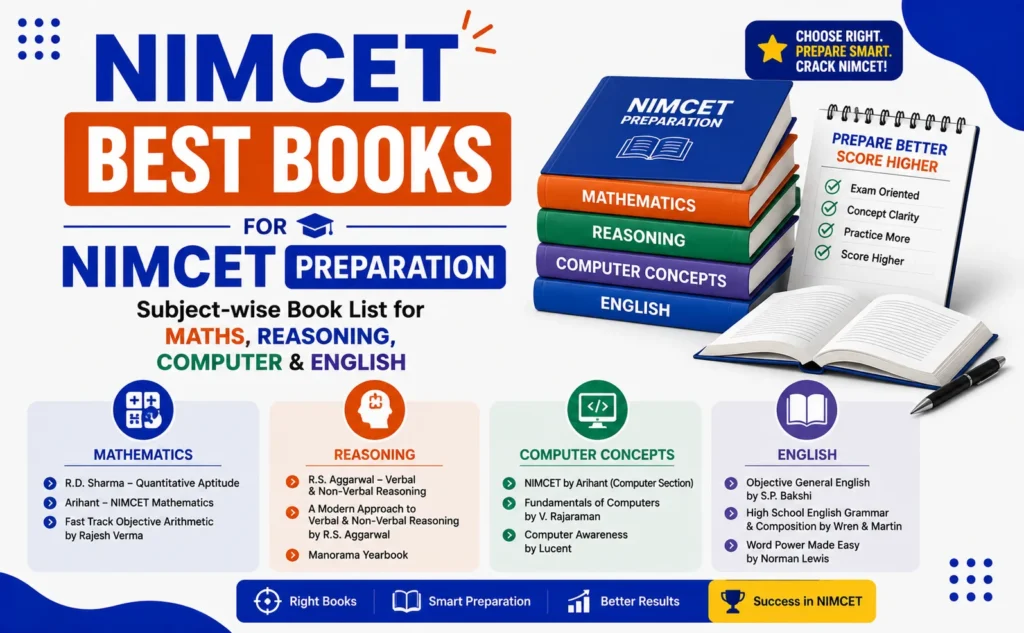
Choosing the best books for NIMCET 2027 preparation does not mean collecting multiple books for every subject. A focused combination of one primary book, supplementary practice material, previous-year questions and mock tests is usually more practical.
NIMCET 2027 Preparation Books: Quick Facts
| Particular | Details |
| Exam Name | NIMCET 2027 |
| Main Subjects | Mathematics, Logical Reasoning, Computer Awareness & General English |
| Mathematics | R.D. Sharma, A.B. Rao, NCERT |
| Logical Reasoning | R.S. Aggarwal, M.K. Pandey, B.S. Sijwali |
| Computer Awareness | P.K. Sinha, Arihant Computer Awareness |
| English | S.P. Bakshi, Wren & Martin, S.C. Gupta |
| Best Approach | 1 primary book + supplementary practice |
| Essential Practice | Previous-Year Questions (PYQs) + Mock Tests |
| Revision Tools | Short Notes, Formula Sheets & Error Notebook |
| Latest Syllabus Reference | Revised NIMCET syllabus applicable from 2026 onwards |
| NIMCET 2027 Notification | To be released officially |
Why Choosing the Right Books Matters for NIMCET 2027
NIMCET preparation is not only about completing the syllabus. Candidates also need to develop speed, accuracy, problem-solving ability and familiarity with objective questions.
The right book can help you:
- Understand concepts from the basics
- Practise different types of questions
- Identify frequently tested concepts
- Improve calculation speed
- Develop logical thinking
- Build vocabulary and grammar
- Revise important formulas and concepts
- Practise questions in a structured manner
The official NIMCET portal should remain the primary reference for the syllabus. The current revised syllabus is applicable from NIMCET 2026 onwards, so candidates preparing for 2027 can use it as the latest available reference until the 2027 notification is released.
Best Books for NIMCET Mathematics
Mathematics deserves significant attention during NIMCET preparation. Candidates should choose reliable preparation books that match the latest syllabus and provide conceptual clarity along with objective practice.
1. Objective Mathematics – R.D. Sharma
Best for: Concept building and objective practice
R.D. Sharma’s Mathematics resources are widely used by competitive-exam aspirants. The objective versions can be particularly useful for practising MCQs and improving problem-solving speed.
Why use it?
- Strong coverage of mathematical concepts
- Large question bank
- Objective-style questions
- Useful solved examples
- Suitable for regular practice
Do not attempt to complete every question blindly. Select questions that correspond to the NIMCET syllabus and gradually increase the difficulty level.
2. Numerical Ability and Mathematical Aptitude – A.B. Rao
Best for: Competitive Mathematics practice
A.B. Rao’s book can be useful for candidates looking for additional numerical practice.
It can help improve:
- Calculation speed
- Numerical ability
- Problem-solving techniques
- Objective-question accuracy
Use it after establishing your basic concepts.
3. Objective Mathematics for Engineering Entrances – Amit M. Agarwal
Best for: Higher-level objective practice
Candidates who already have strong mathematical fundamentals can use an objective Mathematics book designed for engineering entrance-level preparation.
This type of resource is particularly useful when you want to move beyond basic questions and practise more challenging problems.
4. NCERT Mathematics – Classes 11 and 12
Best for: Building fundamentals
NCERT Mathematics books are particularly useful for candidates whose fundamentals are weak.
Use them to strengthen:
- Algebra
- Calculus
- Coordinate Geometry
- Probability
- Statistics
- Trigonometry
- Basic mathematical concepts
However, NCERT alone should not be considered sufficient for NIMCET preparation. Candidates also need competitive-level objective practice.
5. Handbook of Mathematics – Amit Rastogi
Best for: Formula revision
A Mathematics handbook is more useful during revision than during initial concept building.
It can help candidates quickly revise:
- Important formulas
- Mathematical identities
- Shortcuts
- Key concepts
- Frequently used results
You do not need to complete all of these books. Choose one primary Mathematics book based on your preparation level and use the others only for supplementary practice or revision.
Recommended Mathematics Combination
If you want to keep your resources limited:
NCERT → R.D. Sharma → Previous-Year Questions → Mock Tests
If your fundamentals are already strong:
R.D. Sharma/Objectives → A.B. Rao or Amit M. Agarwal → PYQs → Mock Tests
Current NIMCET preparation resources similarly recommend combining foundational material with objective and exam-oriented practice rather than relying on a single source.
Best Books for NIMCET Logical Reasoning
Logical Reasoning improves mainly through consistent question practice. Reading theory alone will not be enough.
Important areas can include:
- Coding-Decoding
- Blood Relations
- Direction Sense
- Seating Arrangement
- Puzzles
- Syllogism
- Statement and Conclusion
- Series
- Analogy
- Data Interpretation
- Logical deductions
1. A Modern Approach to Verbal & Non-Verbal Reasoning – R.S. Aggarwal
Best for: Beginners and comprehensive practice
R.S. Aggarwal is one of the most commonly used reasoning resources among competitive-exam aspirants.
It provides:
- Topic-wise explanations
- Solved examples
- Practice questions
- Different types of reasoning problems
- Progressive difficulty
It is a good starting point if you are weak in Reasoning.
2. Analytical Reasoning – M.K. Pandey
Best for: Advanced analytical reasoning
M.K. Pandey can be useful for candidates who have already developed basic reasoning skills and want to improve their ability to solve complex analytical problems.
Focus particularly on problems involving:
- Logical deductions
- Analytical arrangements
- Complex reasoning
- Multi-step problems
3. Verbal & Non-Verbal Reasoning – B.S. Sijwali & S. Sijwali
Best for: Additional practice
B.S. Sijwali’s reasoning resources are also frequently mentioned by NIMCET aspirants. Recent student discussions specifically mention B.S. Sijwali as a preferred Logical Reasoning resource.
Recommended Reasoning Strategy
Rather than studying multiple reasoning books simultaneously:
Learn the concept → Solve examples → Practise questions → Analyse mistakes → Repeat
Spend around 30–60 minutes regularly on Reasoning rather than leaving it for occasional long study sessions.
Best Books for NIMCET Computer Awareness
Computer Awareness can become a scoring area when concepts are clear and candidates revise regularly.
Important areas should be selected according to the latest official syllabus.
Candidates should prepare topics such as:
- Computer fundamentals
- Hardware and software
- Operating systems
- Number systems
- Data representation
- Programming basics
- Database concepts
- Computer networks
- Internet concepts
- Cyber security
- Basic computer terminology
The official revised NIMCET syllabus should be used to decide the exact topics to cover.
1. Computer Fundamentals – P.K. Sinha
Best for: Concept building
P.K. Sinha’s Computer Fundamentals is a useful resource for candidates who want detailed explanations of basic Computer concepts.
It can help you understand:
- Computer organisation
- Hardware
- Software
- Operating systems
- Networking
- Internet
- Programming fundamentals
It is particularly useful for students who do not have a strong Computer Science background.
2. Objective Computer Awareness – Arihant
Best for: MCQ practice and revision
An objective Computer Awareness book can help candidates practise competitive-exam-style questions.
Use it after studying the underlying concepts.
3. Computer Awareness for Competitive Examinations
Best for: Quick practice and revision
Competitive-exam-oriented Computer Awareness resources can be useful for revising terminology and practising MCQs.
The focus should be on understanding the concept behind the answer rather than memorising large lists of facts.
Recommended Computer Strategy
A practical combination is:
P.K. Sinha → Objective Computer Awareness → PYQs → Mock Tests
You do not need several Computer books covering the same fundamentals.
Best Books for NIMCET General English
English preparation should focus on grammar, vocabulary, comprehension and accuracy.
Important areas include:
- Grammar
- Vocabulary
- Synonyms
- Antonyms
- Sentence correction
- Error detection
- Fill in the blanks
- Idioms and phrases
- Reading comprehension
- Sentence arrangement
1. Objective General English – S.P. Bakshi
Best for: Competitive-exam English
S.P. Bakshi’s Objective General English is a popular choice for competitive examinations.
It is useful for:
- Grammar
- Vocabulary
- Error detection
- Sentence correction
- Objective questions
Recent NIMCET student discussions also mention S.P. Bakshi among preferred English resources.
2. High School English Grammar and Composition – Wren & Martin
Best for: Grammar fundamentals
Wren & Martin is useful if your grammar foundation needs improvement.
You can use it for:
- Tenses
- Articles
- Prepositions
- Subject-verb agreement
- Active and passive voice
- Direct and indirect speech
- Sentence structure
There is no need to study the entire book if you already have strong grammar fundamentals.
3. General English for Competitive Examinations – S.C. Gupta
Best for: Practice and vocabulary
S.C. Gupta can be used as an additional practice resource for grammar and vocabulary.
Recommended English Combination
For most candidates:
Wren & Martin → S.P. Bakshi → Daily Reading → PYQs
Regular reading is also important because it improves vocabulary and comprehension without requiring you to memorise every word from a book.
Subject-wise NIMCET 2027 Book List
| Subject | Recommended Book | Primary Use |
| Mathematics | R.D. Sharma | Concept + practice |
| Mathematics | A.B. Rao | Numerical practice |
| Mathematics | NCERT XI & XII | Fundamentals |
| Reasoning | R.S. Aggarwal | Basics + practice |
| Reasoning | M.K. Pandey | Analytical reasoning |
| Computer | P.K. Sinha | Concept building |
| Computer | Arihant Computer Awareness | MCQs + revision |
| English | S.P. Bakshi | Grammar + objective practice |
| English | Wren & Martin | Grammar fundamentals |
How Should You Select Books According to Your Preparation Level?
If You Are a Beginner
Focus on building fundamentals before jumping into difficult questions.
Mathematics: NCERT + R.D. Sharma
Reasoning: R.S. Aggarwal
Computer: P.K. Sinha
English: Wren & Martin + S.P. Bakshi
If Your Basics Are Strong
Move quickly towards objective practice.
Mathematics: R.D. Sharma + A.B. Rao/Amit M. Agarwal
Reasoning: R.S. Aggarwal + M.K. Pandey
Computer: P.K. Sinha + Objective Computer Awareness
English: S.P. Bakshi
If You Have Limited Time
Do not start four or five books per subject.
Instead:
- Choose one primary book.
- Follow the latest syllabus.
- Complete important topics.
- Solve previous-year questions.
- Take mock tests.
- Revise your mistakes.
This is more effective than constantly switching between resources.
Are NCERT Books Enough for NIMCET 2027?
No, NCERT books alone are generally not enough for complete NIMCET preparation.
NCERT Mathematics books are useful for strengthening fundamentals, especially if your concepts are weak. However, NIMCET preparation also requires objective-question practice, speed-building exercises, previous-year questions and mock tests.
A better approach is:
NCERT → Competitive-level book → Previous-year questions → Mock tests → Revision
For Mathematics, NCERT can help build the foundation, while books such as R.D. Sharma, A.B. Rao and other objective Mathematics resources can provide additional competitive-level practice. These books also appear consistently across current NIMCET preparation guides.
Do not spend months completing every NCERT exercise if your fundamentals are already strong. Move to objective practice once you are comfortable with the concepts.
How to Choose the Right NIMCET Preparation Books?
With so many NIMCET study materials and preparation books available, choosing the right ones can be confusing.
Use the following checklist before selecting a book.
1. Check the Latest Syllabus
The book should cover topics relevant to the latest NIMCET syllabus.
The official NIMCET website currently provides the revised syllabus applicable from 2026 onwards. Until the NIMCET 2027 notification is released, this is the latest official syllabus available for aspirants.
2. Look for Objective Questions
NIMCET preparation requires extensive MCQ practice. Choose resources that provide sufficient objective questions rather than only theoretical explanations.
3. Check the Solutions
A good book should provide clear solutions so that you can understand why an answer is correct and identify mistakes in your approach.
4. Match the Difficulty Level
Do not automatically choose the most difficult book available.
Start according to your current level and gradually move towards more challenging questions.
5. Consider Your Preparation Time
A huge book is not necessarily a better book.
A resource that you can complete, revise and practise thoroughly is more useful than several books that remain unfinished.
Which Books Are Recommended by NIMCET Toppers?
There is no single official booklist recommended by NIMCET toppers or the conducting authority.
However, several books repeatedly appear in preparation guides and student discussions.
Commonly mentioned resources include:
- R.D. Sharma for Mathematics
- R.S. Aggarwal for Logical Reasoning
- M.K. Pandey for Analytical Reasoning
- B.S. Sijwali for Reasoning
- P.K. Sinha for Computer Fundamentals
- S.P. Bakshi for English
Recent NIMCET 2027 aspirant discussions also mention combinations such as R.D. Sharma for Mathematics, B.S. Sijwali for Logical Reasoning, P.K. Sinha for Computer Awareness and S.P. Bakshi for English. These are student experiences rather than official recommendations, so candidates should choose resources according to their own preparation level.
The important takeaway is that toppers generally do not depend on the number of books they complete. Depth of practice and revision matter more than the size of the book collection.
Are Online Resources Better Than Books?
Neither books nor online resources are automatically better.
The most effective strategy is to use both for different purposes.
Books Are Better for:
- Structured preparation
- Detailed concepts
- Topic-wise practice
- Large question banks
- Formula revision
- Offline study
Online Resources Are Better for:
- Difficult concepts
- Video explanations
- Doubt solving
- Mock tests
- Performance analysis
- Quick revision
For example, if you cannot understand a particular Mathematics concept from your book, use an online explanation to understand it and then return to your book to solve practice questions.
The Ideal Combination
Book → Concept → Online explanation if required → Practice → Mock Test → Revision
This prevents you from becoming dependent on either books or online videos.
How to Use NIMCET Books Effectively?
Simply purchasing the best books for NIMCET 2027 preparation will not improve your score. You need a systematic approach.
Step 1: Start With the Syllabus
Keep the official syllabus beside you and divide it into individual topics.
Mark each topic as:
- Not Started
- Learning
- Practising
- Completed
- Needs Revision
Step 2: Learn the Concept
Read the relevant chapter from your primary book.
Focus on understanding the method instead of memorising solutions.
Step 3: Solve Examples
Attempt to solve examples yourself before checking the solution.
Step 4: Practise Independently
After understanding the concept, solve a set of questions without looking at the explanation.
Step 5: Track Your Mistakes
Maintain an error notebook containing:
- Questions you answered incorrectly
- Formulas you forgot
- Concepts you misunderstood
- Questions that took too much time
- Repeated mistakes
Step 6: Revise
Revisit your mistakes every week.
This is especially important for Mathematics formulas, Computer Awareness facts and English grammar rules.
Step 7: Test Yourself
Once a topic is completed, attempt a timed test.
This tells you whether you actually understand the topic or only recognise the concepts while reading.
How Many Books Should Students Refer To?
One primary book per subject is generally enough.
You can add a supplementary book when you need additional practice, but avoid studying three or four books simultaneously.
A practical resource structure is:
Mathematics
1 primary book + 1 supplementary practice book
Logical Reasoning
1 primary book + previous-year questions
Computer Awareness
1 concept book + 1 objective question bank
English
1 grammar/objective book + reading practice
Common Resources
- Previous-year question papers
- Mock tests
- Short notes
- Formula sheets
- Error notebook
Remember: The goal is not to finish more books. The goal is to solve more relevant questions accurately.
NIMCET Book Strategy According to Your Preparation Level
For Beginners
If you are starting preparation from scratch, concentrate on fundamentals first.
Mathematics: NCERT + R.D. Sharma
Reasoning: R.S. Aggarwal
Computer: P.K. Sinha
English: Wren & Martin + S.P. Bakshi
Do not immediately start with the most difficult questions.
For Intermediate Students
If you already understand the basics:
Mathematics: R.D. Sharma + A.B. Rao
Reasoning: R.S. Aggarwal + B.S. Sijwali/M.K. Pandey
Computer: P.K. Sinha + Objective Computer Awareness
English: S.P. Bakshi + practice papers
Spend more time solving questions than reading theory.
For Advanced Students
If your concepts are already strong:
- Focus on difficult objective questions
- Solve previous-year papers
- Attempt full-length mocks
- Analyse mistakes
- Work on speed
- Revise formulas regularly
At this stage, starting another basic textbook may not add much value.
NIMCET Books vs Previous-Year Papers
Books help you learn the concepts.
Previous-year papers help you understand how those concepts are tested.
Therefore, candidates should not postpone previous-year questions until the final month.
Once you complete a topic, solve relevant previous-year questions.
For example:
Calculus → Learn from book → Practice questions → Solve relevant PYQs → Analyse mistakes
This approach helps you identify whether your preparation is actually aligned with the examination.
Several current preparation resources also emphasise previous-year papers as an important part of preparation because they provide a more realistic understanding of the examination than books alone.
Common Mistakes While Choosing NIMCET Preparation Books
1. Buying Too Many Books
Having ten books does not mean having ten times better preparation.
2. Ignoring the Syllabus
Do not spend weeks studying topics that are outside the relevant syllabus.
3. Choosing Books Only Because They Are Popular
A book should suit your preparation level.
4. Reading Without Practising
Competitive examinations require active problem-solving.
5. Ignoring Previous-Year Questions
PYQs should be an important part of your preparation.
6. Switching Resources Frequently
Constantly changing books can create gaps in preparation.
7. Avoiding Revision
Completing a chapter once does not mean you have mastered it.
8. Focusing Only on Mathematics
Mathematics is important, but candidates should maintain preparation across all four sections.
6-Month NIMCET 2027 Book Strategy
Candidates following a six-month preparation plan can use their books differently at each stage.
| Month | Main Focus | Book Strategy |
| Month 1 | Fundamentals | NCERT/basic books |
| Month 2 | Concept completion | Primary books |
| Month 3 | Topic-wise practice | Objective books |
| Month 4 | Advanced practice | Selected supplementary resources |
| Month 5 | PYQs + mocks | Reduce new material |
| Month 6 | Revision | Notes + PYQs + mocks |
Months 1–2: Build Your Foundation
Focus on understanding concepts.
Do not worry about solving extremely difficult questions immediately.
Month 3: Increase Practice
Complete important chapters and begin solving more objective questions.
Month 4: Improve Accuracy and Speed
Start timed practice and sectional tests.
Month 5: Focus on PYQs and Mock Tests
At this point, avoid constantly adding new books.
Your priority should shift towards examination-style practice.
Month 6: Revision
Use:
- Short notes
- Formula sheets
- Error notebook
- Previous-year papers
- Mock tests
The final month should not become a race to complete another huge book.
Recommended NIMCET 2027 Resource Combination
If you want a simple and manageable booklist, the following combination is sufficient for most students:
Mathematics
R.D. Sharma + A.B. Rao
Logical Reasoning
R.S. Aggarwal + B.S. Sijwali
Computer Awareness
P.K. Sinha + Objective Computer Awareness
English
S.P. Bakshi + Wren & Martin
Additional Resources
Official syllabus + Previous-year papers + Mock tests + Error notebook
This focused approach is also consistent with current preparation guides, which repeatedly recommend these types of resources across the four NIMCET sections.
Conclusion
The best books for NIMCET 2027 preparation are not necessarily the ones with the largest number of pages or questions. The right resources are those that match the latest syllabus, explain concepts clearly and provide enough relevant practice.
Candidates should also remember that the official NIMCET syllabus takes priority over any booklist. The current official website lists the revised syllabus applicable from 2026 onwards; the final NIMCET 2027 notification should be checked once released.
Ultimately, your result will depend less on how many books you own and more on how consistently you study, practise, revise and analyse your mistakes
FAQs
1. Which are the best books for NIMCET Mathematics?
R.D. Sharma, A.B. Rao’s Numerical Ability and Mathematical Aptitude, Amit A. Aggarwal’s Objective Mathematics for Engineering Entrances, NCERT Mathematics and Amit Rastogi’s Handbook of Mathematics are useful options. Students should select books according to their preparation level instead of attempting to complete all of them.
2. Which books are useful for Logical Reasoning?
A Modern Approach to Logical Reasoning by R.S. Aggarwal and Analytical Reasoning by M.K. Pandey are popular choices. B.S. Sijwali’s reasoning book can also be used for additional practice.
3. What are the best Computer Awareness books?
Computer Fundamentals by P.K. Sinha, Computer Awareness for General Competitive Exams by Soumya Ranjan Behera, Objective Computer Awareness by Arihant Experts and Lucent’s Computer are useful resources.
4. Which English books help in NIMCET preparation?
Objective General English by S.P. Bakshi, High School English Grammar and Composition by Wren & Martin, and General English for All Competitive Examinations by S.C. Gupta are commonly used for competitive-exam English preparation.
5. Are NCERT books enough for NIMCET?
No. NCERT books are useful for strengthening Mathematics fundamentals but should be supplemented with objective questions, previous-year papers and mock tests.
6. How should I choose the right preparation books?
Choose books that match the latest syllabus, explain concepts clearly, contain objective questions and provide adequate practice. Also consider your current preparation level and the time available before the examination.
7. Which books are recommended by toppers?
There is no officially prescribed topper booklist. However, R.D. Sharma, R.S. Aggarwal, B.S. Sijwali, P.K. Sinha and S.P. Bakshi are frequently mentioned in student discussions and NIMCET preparation resources.
8. Are online resources better than books?
Online resources and books serve different purposes. Books are useful for structured learning and question practice, while online resources are helpful for video explanations, doubts, mock tests and performance analysis. Combining both can make preparation more effective.
9. How should I use books effectively?
Start with the syllabus, learn concepts, solve examples, practise questions independently, record mistakes and revise them regularly. Once a topic is completed, test yourself through timed questions or previous-year problems.
10. How many books should students refer to?
One primary book per subject is generally sufficient. You can use one additional practice resource where necessary, particularly for Mathematics or Reasoning. Avoid collecting too many books at the expense of solving PYQs and mock tests.