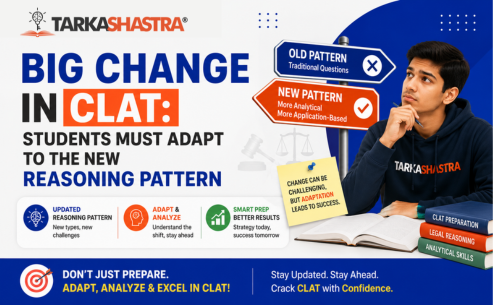
The biggest change in the CLAT 2027 Reasoning Pattern is not the syllabus — it is the way the exam now tests students. CLAT 2027 is becoming increasingly comprehension-driven, analytical, and passage-based. Instead of rewarding rote learning, the new pattern focuses on reading speed, logical interpretation, and application of ideas under time pressure.
- The CLAT 2027 New Pattern continues with 120 questions in 2 hours, but most sections now demand deeper reasoning and contextual understanding. Logical Reasoning, Legal Reasoning, and even Current Affairs are shifting toward inference-based questioning rather than direct factual recall.
Students preparing with old static methods may struggle in this evolving format. Success in Big Change in CLAT 2027 will depend on adaptability, accuracy, and strong reasoning skills.
What Exactly Has Changed in CLAT 2027?
The biggest CLAT 2027 Exam Pattern Update is the shift from memory-based preparation to reasoning-based evaluation. Earlier, students could score through direct factual preparation and isolated logical reasoning practice. The CLAT 2027 New Reasoning Pattern now focuses on comprehension, interpretation, and analytical thinking.
- Most sections have become heavily passage-based.
- English Language now tests inference and tone rather than vocabulary alone.
- Legal Reasoning focuses on applying principles to factual situations rather than on prior legal knowledge.
- Logical Reasoning includes sets that are heavily deductive and argument-driven.
- Even Current Affairs increasingly emphasises contextual understanding rather than static recall.
Another major Big Change in CLAT 2027 is the increased emphasis on accuracy. Since the paper uses negative marking of –0.25, random attempts can significantly reduce scores. Students must improve their decision-making and option-elimination skills.
| Old CLAT Style | CLAT 2027 New Pattern |
| Static GK preparation | Contextual GK understanding |
| Direct logical questions | Passage-based reasoning |
| Memory-focused preparation | Analytical preparation |
| Standalone MCQs | Comprehension-driven MCQs |
| High attempts strategy | Accuracy-focused strategy |
The CLAT 2027 Passage-Based Questions trend clearly shows that reading under pressure and extracting logic quickly are becoming the most important skills for aspirants.
Section-Wise Impact of the New Reasoning Pattern
The CLAT 2027 Logical Reasoning Changes are affecting every section of the exam. Students can no longer prepare sections in isolation because comprehension and analytical reasoning now dominate the overall paper structure.
Section-Wise Impact Table
| Section | What CLAT 2027 Demands |
| English Language | Faster reading, tone detection, inference |
| Logical Reasoning | Deduction, argument analysis, assumptions |
| Legal Reasoning | Application of legal principles to facts |
| GK & Current Affairs | Contextual understanding over memorisation |
| Quantitative Techniques | Data interpretation and quick calculations |
- English Language
The CLAT 2027 Reading Comprehension trend shows a stronger focus on author intent, vocabulary in context, and inference-based questions. Students must improve reading speed and accuracy simultaneously.
- Logical Reasoning
The biggest CLAT 2027 Reasoning Pattern shift is visible here. Questions are becoming more analytical and passage-driven. Students must quickly identify assumptions, conclusions, hidden logic, and deductions.
- Legal Reasoning
Legal Reasoning is now application-oriented. Instead of memorising laws, aspirants must understand legal principles and apply them to factual scenarios under time pressure.
- GK & Current Affairs
Current Affairs preparation is no longer limited to static facts. The CLAT 2027 Exam Pattern Update favours contextual awareness, issue analysis, and comprehension-based GK questions.
- Quantitative Techniques
Quant remains DI-heavy. Students must focus on tables, ratios, percentages, and interpretation speed rather than advanced mathematics.
Why Students Must Change Their Preparation Strategy
The CLAT 2027 Preparation Strategy must change because the exam now rewards interpretation, reasoning, and reading efficiency rather than rote learning. Students preparing with old static methods may struggle with the new comprehension-heavy format.
- Reading Must Become Daily
To adapt to the CLAT 2027 New Reasoning Pattern, students should read editorials, opinion articles, and analytical pieces daily. This improves reading speed, vocabulary in context, inference skills, and comprehension accuracy.
- Mock Tests Must Become Analytical
Mocks are no longer only for score calculation. A strong CLAT 2027 Mock Test Strategy includes:
- analysing mistakes,
- tracking accuracy,
- improving section timing,
- understanding decision-making errors.
Students who analyse mocks properly improve faster than students who only attempt more tests.
- Reasoning Practice Must Change
The CLAT 2027 Logical Reasoning Changes require aspirants to practice:
- passage-based reasoning,
- argument analysis,
- assumption-conclusion questions,
- Inference-based sets.
Traditional topic-wise puzzle-solving alone is no longer enough.
The new How to Prepare for CLAT 2027 approach should focus on:
- reading under pressure,
- fast interpretation,
- eliminating wrong options,
- maintaining accuracy despite negative marking.
CLAT now rewards smart analytical thinking far more than memorisation.
Common Mistakes CLAT 2027 Aspirants Must Avoid
Many students are still preparing for CLAT using outdated methods. Under the CLAT 2027 New Reasoning Pattern, these mistakes can seriously reduce scores.
Common CLAT 2027 Preparation Errors
- Treating CLAT like a static GK exam instead of a reasoning-based paper
- Ignoring passage reading practice and focusing only on factual learning
- Solving only standalone Logical Reasoning questions instead of passage-based sets
- Attempting too many questions despite the CLAT Negative Marking Strategy
- Not analysing mock tests properly after completion
- Memorising legal facts instead of practising application-based Legal Reasoning
- Spending excessive time on difficult Quant questions
Another major CLAT 2027 Mistake is avoiding long reading passages during preparation. Since most sections are now comprehension-heavy, students who lack reading stamina often struggle with timing and accuracy during the actual exam.
Aspirants should understand that the Big Change in CLAT 2027 is about analytical thinking and interpretation. Students who continue to rely solely on rote preparation methods may find the exam unpredictable and difficult to manage.
Previous Related Blogs You Should Read
To understand the CLAT 2027 New Reasoning Pattern more deeply, students should also explore these related blogs:
- CLAT 2026 Exam Analysis: Section-Wise Review, Difficulty Level & Good Attempts
- CLAT 2027 Registration Process: Step-by-Step Application Guide
- CLAT 2027 Complete Guide: Exam Pattern, Syllabus, Dates & Preparation Tips
- Is CLAT 2027 Tough? Difficulty Level, Competition & Expert Analysis
- CLAT 2027 Registration Last Date: Important Deadlines & Updates
- CLAT 2027 Full Form: Meaning, Exam Purpose & Career Scope Explained
- Top Law Colleges in Hyderabad Through CLAT 2027: Fees, Placements & Ranking
- Top Law Colleges in Maharashtra Through CLAT 2027: Colleges, Fees & Cutoffs
These blogs explain the latest CLAT 2027 Exam Pattern Update, section-wise weightage, mock analysis strategy, and preparation methods needed for the evolving reasoning-heavy CLAT format.
How Tarkashastra Helps Students Adapt to the New CLAT Pattern
The Big Change in CLAT 2027 requires students to improve reasoning, comprehension, and analytical thinking. Tarkashastra aligns its CLAT 2027 Coaching with these latest exam trends through:
- passage-based mock tests,
- analytical reasoning practice,
- reading comprehension training,
- detailed mock analysis,
- accuracy and time-management tracking.
Students also get mixed-pattern practice designed around the evolving CLAT 2027 New Reasoning Pattern and comprehension-heavy exam structure.
For students preparing seriously, the focus must shift from rote learning to reasoning speed, interpretation, and smart decision-making.
Conclusion — The Students Who Adapt Early Will Lead
The CLAT 2027 New Reasoning Pattern clearly shows that the exam is moving toward comprehension, analytical thinking, and passage-based reasoning. Students who adapt early by improving reading speed, reasoning accuracy, and mock analysis will gain a major advantage.
The Big Change in CLAT 2027 is not about a new syllabus — it is about a new way of testing thinking ability under pressure.
FAQs — Big Change in CLAT 2027: Students Must Adapt to the New Reasoning Pattern
1. What is the biggest change in CLAT 2027?
The biggest change in CLAT 2027 is the shift toward a reasoning-heavy and passage-based format. The exam now focuses more on comprehension, inference, and analytical thinking instead of rote learning.
2. Is the CLAT 2027 syllabus changing?
As of now, there are no major syllabus changes expected for CLAT 2027. The primary change is in the framing of questions and the reasoning style, rather than in syllabus topics.
3. Why is Logical Reasoning becoming more important in CLAT 2027?
The CLAT 2027 Logical Reasoning section is becoming more analytical and deduction-based. Students must identify assumptions, conclusions, and hidden logic within passages.
4. Is CLAT 2027 fully passage-based?
Almost all major sections in CLAT 2027 are passage-driven, including English, Legal Reasoning, GK, and Logical Reasoning. Quantitative Techniques remains data-interpretation focused.
5. How should students prepare for the new CLAT 2027 pattern?
Students should focus on:
- daily reading practice,
- passage-based reasoning,
- mock-test analysis,
- accuracy improvement,
- comprehension speed.
6. Does CLAT 2027 still have negative marking?
Yes. CLAT 2027 follows a negative marking system, with 0.25 marks deducted for each incorrect answer.
7. What type of reading should students do for CLAT 2027?
Students should regularly read editorials, opinion articles, legal news, and analytical essays to improve comprehension and reasoning skills.
8. Is memorising GK enough for CLAT 2027?
No. Current Affairs questions are becoming more contextual and comprehension-based. Students must understand issues rather than only memorising facts.
9. Why are mock tests important for CLAT 2027?
Mock tests help students improve timing, accuracy, decision-making, and passage-handling ability under pressure, which are critical in the new CLAT reasoning pattern.
10. How can Tarkashastra help students prepare for CLAT 2027?
Tarkashastra helps students through passage-based mocks, reasoning practice, comprehension training, and detailed performance analysis aligned with the latest CLAT 2027 exam trends.