Introduction
The Biggest Myth About IPMAT
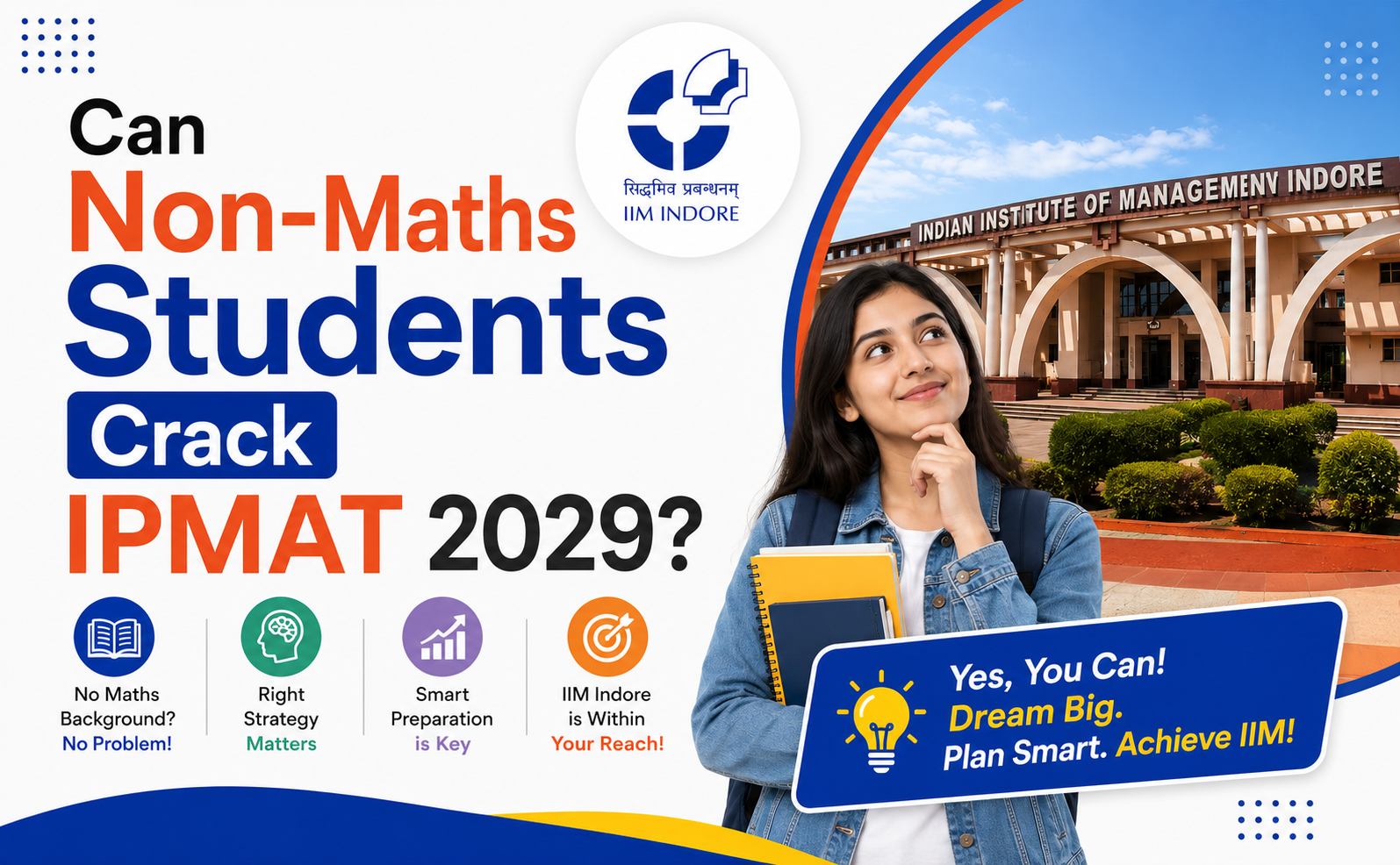
One of the most common questions among aspirants is: Can non maths students crack IPMAT 2029 exam and get into an IIM? The answer is yes. Every year, students from Commerce, Science, Humanities, and even non-maths backgrounds successfully clear IPMAT and secure admission to top Integrated Programme in Management (IPM) colleges.
A major misconception is that Mathematics in Class 11 and 12 is mandatory for the exam. However, IPMAT eligibility criteria do not require Mathematics as a compulsory subject. With the right IPMAT strategy, strong fundamentals, and a structured IPMAT preparation plan, non-maths students can compete effectively and achieve excellent results.
Can Non-Maths Students Apply for IPMAT 2029?
The answer is a clear yes. One of the biggest advantages of the IPM admission process is that students from all academic streams—Commerce, Arts, and Science—are eligible to apply. Contrary to popular belief, Mathematics is not a compulsory subject for most IPM programs. The IPMAT eligibility criteria primarily focus on a candidate’s Class 10 and Class 12 academic performance rather than their subject combination.
IPMAT Eligibility at a Glance
| Criteria | Requirement |
| Stream | Arts, Commerce, Science |
| Maths in Class 11–12 | Not Mandatory |
| Class 10 & 12 Marks | As per institute criteria |
| Age Limit | Varies by institute |
This means IPMAT for non maths students is completely achievable, provided candidates prepare strategically and understand the IPMAT syllabus 2029 thoroughly.
Understanding the IPMAT Exam Structure 2029
Before starting your preparation, it is important to understand the IPMAT exam structure. Many students believe that the exam is heavily focused on advanced mathematics, but the reality is quite different. The exam is designed to evaluate a candidate’s aptitude, analytical thinking, and communication skills.
Sections in the IPMAT Exam
| Section | Skills Tested |
| Quantitative Ability (MCQ) | Mathematical Aptitude & Problem Solving |
| Quantitative Ability (Short Answer) | Conceptual Clarity & Calculations |
| Verbal Ability | Reading Comprehension, Vocabulary, Grammar |
For non maths students IPMAT 2029, the Quantitative Ability section may initially seem challenging. However, candidates can balance their scores by excelling in Verbal Ability while gradually strengthening their IPMAT quant basics. Understanding the IPMAT syllabus 2029 and section-wise weightage is the first step toward building an effective preparation strategy.
How Difficult Is IPMAT Mathematics for Non-Maths Students?
The biggest concern among aspirants targeting non maths students IPMAT 2029 is the level of mathematics asked in the exam. The good news is that IPMAT does not test highly advanced mathematics. Instead, it focuses on aptitude-based concepts that can be mastered with consistent practice and a strong foundation.
The key to overcoming IPMAT maths difficulty is to focus on fundamental topics rather than trying to learn everything at once. The reference guide also highlights that basic understanding of Arithmetic, Algebra, Geometry, and Data Interpretation is sufficient to build a strong base.
Important IPMAT Quant Basics for Non-Maths Students
| Topic | Important Areas |
| Arithmetic | Percentages, Ratio & Proportion, Profit & Loss, Averages |
| Algebra | Linear Equations, Quadratic Equations |
| Geometry | Areas, Perimeter, Mensuration |
| Data Interpretation | Graphs, Charts, Tables |
Instead of fearing mathematics, focus on mastering these IPMAT quant basics. A structured approach can significantly reduce IPMAT maths difficulty and improve overall performance.
Why Non-Maths Students Can Still Crack IPMAT
Many students assume that a maths background automatically guarantees success in IPMAT. In reality, several IPMAT for non maths students success stories prove otherwise. Non-maths students often possess strengths that can significantly improve their overall score.
Hidden Advantages of Non-Maths Students
| Strength | How It Helps in IPMAT |
| Strong Reading Skills | Better Reading Comprehension performance |
| Good Language Ability | Higher Verbal Ability scores |
| Analytical Thinking | Helps in Logical Reasoning and Data Interpretation |
| Strategic Preparation | Focused effort on weak areas |
Moreover, non-maths students tend to approach preparation with greater discipline and consistency. By leveraging their strengths in Verbal Ability while steadily improving their IPMAT quant basics, they can build a balanced score and successfully crack non maths students IPMAT 2029.
Step-by-Step IPMAT Preparation Plan for Beginners
A structured IPMAT preparation for beginners approach can help non-maths students overcome their fear of quantitative aptitude and gradually build confidence. Instead of rushing into advanced concepts, focus on learning fundamentals first and then move towards test-based preparation.
Phase 1: Build Strong Quant Basics (Months 1–6)
Start with the most important IPMAT quant basics:
- Percentages
- Ratio & Proportion
- Profit & Loss
- Average
- Time & Work
- Simple & Compound Interest
These topics appear frequently in IPMAT and are considered easier for beginners.
Phase 2: Strengthen Core Concepts (Months 7–15)
Once the basics are clear, move to:
| Topic Category | Important Areas |
| Algebra | Linear & Quadratic Equations |
| Geometry | Area, Perimeter, Volume |
| Data Interpretation | Tables, Charts, Graphs |
| Number System | Divisibility, Factors, Remainders |
Phase 3: Exam-Focused Preparation (Months 16–24)
Focus on:
- Weekly mock tests
- Sectional tests
- Time-bound practice
- Error analysis
- Revision of formulas and concepts
A well-planned IPMAT preparation plan allows non maths students IPMAT 2029 aspirants to improve steadily without feeling overwhelmed. Consistency, rather than mathematical background, is the key to success.
Smart IPMAT Strategy for Non-Maths Students
A smart IPMAT strategy can help non-maths students maximize their strengths while minimizing weaknesses. The goal is not to become a mathematics expert overnight but to score efficiently across all sections of the exam.
Focus on High-Scoring Areas
The Verbal Ability section can become a major advantage for IPMAT for non maths students. Focus on:
- Reading Comprehension
- Vocabulary Building
- Grammar
- Para Jumbles
The reference document specifically recommends maximizing Verbal Ability scores to gain a competitive edge.
Time Management Techniques
| Strategy | Benefit |
| Attempt Strength Areas First | Builds confidence and saves time |
| Skip Difficult Questions | Prevents time wastage |
| Set Sectional Targets | Improves overall accuracy |
Mock Test Strategy
Regular mock tests help students improve speed, accuracy, and decision-making under pressure. Analyze every mock, identify recurring mistakes, and refine your IPMAT strategy accordingly. Consistent practice and effective time management are among the most important IPMAT success tips for non-maths aspirants.
Common Mistakes Non-Maths Students Should Avoid
Many aspirants targeting non maths students IPMAT 2029 make avoidable mistakes that impact their performance. The most common error is completely ignoring Quantitative Ability due to fear of mathematics. Another mistake is relying only on Verbal Ability preparation.
Mistakes to Avoid
- Delaying Quantitative Aptitude preparation
- Ignoring sectional cut-offs
- Avoiding mock tests
- Spending too much time on difficult questions
- Following an inconsistent IPMAT preparation plan
Remember, successful IPMAT for non maths students preparation requires balanced effort across all sections, regular practice, and continuous improvement.
How Tarkashastra Helps Non-Maths Students Crack IPMAT
At Tarkashastra, we understand that many aspirants worry about mathematics while preparing for IPMAT for non maths students. That is why our preparation programs are designed to build confidence from the ground up.
We help students through:
| Tarkashastra Support | Benefit |
| Foundation Quant Classes | Strengthen IPMAT quant basics |
| Concept-Based Learning | Simplify difficult topics |
| Regular Mock Tests | Improve speed and accuracy |
| Personal Mentorship | Customized preparation guidance |
| Performance Analysis | Identify strengths and weaknesses |
Whether you are from Commerce or Humanities, our structured IPMAT preparation plan, expert mentorship, and exam-focused approach can help you successfully crack non maths students IPMAT 2029 and secure admission to a top IPM program.
Conclusion
The belief that only maths students can crack IPMAT is one of the biggest myths among aspirants. In reality, non maths students IPMAT 2029 can perform exceptionally well by focusing on strong fundamentals, consistent practice, and a smart preparation strategy. Since Mathematics is not a mandatory subject under IPMAT eligibility, students from Commerce, Arts, and Science backgrounds have an equal opportunity to succeed. By strengthening IPMAT quant basics, maximizing Verbal Ability scores, taking regular mock tests, and following a structured IPMAT preparation plan, non-maths students can confidently crack IPMAT 2029 and secure admission to their dream IPM college.
FAQs
1. Can non-maths students crack IPMAT 2029?
Yes, non-maths students can crack IPMAT 2029 with consistent preparation and the right strategy. Many Commerce and Humanities students successfully secure admission to top IPM programs every year.
2. Is Mathematics compulsory for IPMAT preparation?
No, Mathematics is not compulsory in Class 11 or 12 for IPMAT eligibility. However, candidates must prepare for the Quantitative Ability section as part of the exam.
3. How can non-maths students handle Quantitative Aptitude?
Non-maths students should start with basic Arithmetic topics and gradually move to Algebra and Geometry. Regular practice and mock tests help build confidence and accuracy.
4. Is IPMAT harder for non-maths background students?
Initially, the Quantitative Ability section may seem challenging, but it becomes manageable with proper preparation. Strong Verbal Ability can also help non-maths students balance their overall score.
5. How much time does a non-maths student need for Quant?
A non-maths student should ideally spend 1–2 hours daily on Quantitative Aptitude. Consistent practice over several months is more effective than last-minute preparation.
6. Can weak maths students clear IPMAT in one year?
Yes, weak maths students can clear IPMAT within a year if they follow a structured study plan. Focusing on fundamentals and regular mock tests can lead to significant improvement.
7. Which topics should non-maths students start with?
Students should begin with Arithmetic topics such as Percentages, Ratio & Proportion, Profit & Loss, and Averages. These concepts are easier to learn and frequently appear in IPMAT.
8. What is the biggest challenge for non-maths students?
The biggest challenge is often the fear of mathematics rather than the actual syllabus. Building confidence through gradual learning and practice helps overcome this obstacle.
9. Can coaching help non-maths students in IPMAT?
Yes, coaching provides structured guidance, expert mentorship, and regular mock tests. It helps non-maths students strengthen their fundamentals and prepare more effectively.
10. What is the success rate of non-maths students in IPMAT?
There is no official success-rate data based on academic stream. However, many successful IPMAT candidates come from non-maths backgrounds, proving that consistent preparation matters more than the stream chosen in school.