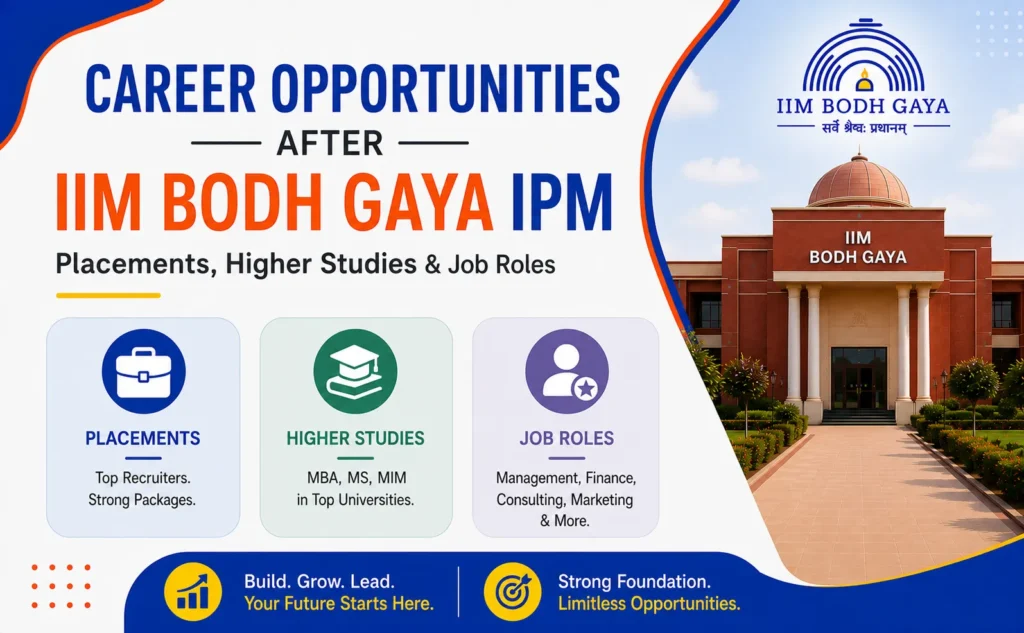
For students choosing a programme after Class 12, understanding career opportunities after IIM Bodh Gaya IPM is as important as evaluating the course itself. The five-year integrated programme combines undergraduate education with an MBA pathway, preparing students for careers in:
- Consulting
- Finance
- Marketing and Sales
- Business Development
- Analytics and Operations
- Strategy
- Banking
- Human Resources
- General Management
- Entrepreneurship
However, the degree does not guarantee a specific job or salary. Career outcomes depend on how students build their skills through academics, internships, leadership activities, and networking.
This article explores the IPM career scope, placements, job roles, salary expectations, higher studies, and long-term career prospects after IIM Bodh Gaya.
What Is the Career Path After IIM Bodh Gaya IPM?
The IPM provides students with a structured five-year management education.
The first three years focus on undergraduate-level multidisciplinary education, while the final two years follow the MBA-oriented management curriculum.
This creates a relatively direct pathway:
Class 12 → JIPMAT → IIM Bodh Gaya IPM → BBA + MBA → Management Career
Students who successfully complete the programme can enter the corporate sector through campus placements or explore other opportunities.
The programme can also provide a foundation for entrepreneurship, higher studies and professional certifications.
Is an MBA included in IIM Bodh Gaya IPM?
Yes.
The Integrated Programme in Management combines undergraduate and postgraduate management education.
The first stage leads to the undergraduate qualification, while students who continue through the complete five-year programme proceed into the MBA phase.
This is one of the biggest attractions of IPM.
A student does not need to separately complete:
BBA → CAT → MBA
to follow the integrated route.
Instead, the student enters the programme after Class 12 and follows the institute’s integrated academic pathway.
What Degree Do Students Receive?
Students completing the full programme receive the degrees specified under the institute’s applicable IPM structure.
The programme is designed around an integrated undergraduate and MBA pathway.
This provides students with both an academic foundation and postgraduate management education within one institution.
The exact degree structure, exit provisions and academic requirements should always be checked against the admission policy applicable to the student’s batch.
Career Opportunities After IIM Bodh Gaya IPM
There is no single career path after IPM.
One of the biggest advantages of management education is career flexibility.
Students can potentially enter different functions depending on their:
- Skills
- Academic strengths
- Internships
- Career interests
- Specialisation
- Placement performance
- Interview performance
The major career areas include consulting, finance, marketing, analytics, operations, sales, strategy and general management.
1. Consulting Careers
Consulting is one of the most attractive career paths for management graduates.
Consultants help organisations solve business problems related to:
- Strategy
- Operations
- Marketing
- Technology
- Finance
- Growth
- Organisational performance
Possible entry-level roles include:
- Business Analyst
- Associate Consultant
- Consulting Analyst
- Strategy Analyst
- Management Trainee
Students interested in consulting should develop:
- Problem-solving
- Data interpretation
- Business understanding
- Presentation skills
- Communication
- Case-solving ability
Case competitions and internships can be particularly useful for building a consulting profile.
2. Finance Careers
Students interested in finance can explore several areas.
Potential career paths include:
- Financial Analyst
- Corporate Finance
- Investment Research
- Banking
- Credit Analysis
- Risk Management
- Financial Services
- Wealth Management
Finance-oriented students can strengthen their profiles by learning:
- Excel
- Financial modelling
- Accounting
- Valuation
- Statistics
- Data analysis
Professional certifications can also complement an MBA-oriented education.
Students interested in investment-related careers may consider certifications such as CFA, subject to their individual career goals.
3. Marketing Careers
Marketing provides another broad career path.
Students can potentially work in:
- Brand management
- Digital marketing
- Product marketing
- Sales
- Growth marketing
- Market research
- Consumer insights
- Advertising
Possible entry-level roles include:
- Marketing Executive
- Brand Analyst
- Growth Analyst
- Business Development Executive
- Marketing Analyst
- Sales Management Trainee
Marketing careers are particularly suitable for students who enjoy communication, creativity, consumer psychology and business strategy.
4. Business Development and Sales
Sales and business development are major recruitment areas across industries.
Students may work on:
- Customer acquisition
- Revenue generation
- Account management
- Partnerships
- Market expansion
- Enterprise sales
Potential job titles include:
- Business Development Executive
- Business Development Analyst
- Sales Manager
- Account Executive
- Relationship Manager
- Growth Associate
These roles can provide strong exposure to customers and business operations.
They can also lead to management responsibilities relatively quickly for high-performing employees.
5. Business Analytics
Analytics has become increasingly important across management careers.
Students with strong quantitative skills can explore:
- Business Analytics
- Data Analytics
- Marketing Analytics
- Product Analytics
- Financial Analytics
- Strategy Analytics
Potential roles include:
- Business Analyst
- Data Analyst
- Business Intelligence Analyst
- Product Analyst
- Analytics Consultant
Students interested in this career path should develop skills in:
- Excel
- SQL
- Power BI
- Statistics
- Data visualisation
- Basic programming
An IPM student who combines management knowledge with analytics skills can create a strong professional profile.
6. Operations Management
Operations involves managing how organisations produce and deliver products or services.
Career opportunities can include:
- Operations Analyst
- Operations Manager
- Supply Chain Analyst
- Process Analyst
- Logistics Manager
- Project Coordinator
Industries hiring for operations roles include:
- Manufacturing
- E-commerce
- Logistics
- Retail
- Technology
- Healthcare
- Financial services
Students who enjoy process improvement and problem-solving may find operations particularly suitable.
7. Strategy Careers
Strategy roles focus on long-term business decisions.
Students can potentially work on:
- Market expansion
- Competitive analysis
- New product launches
- Business planning
- Growth strategy
- Corporate strategy
Possible roles include:
- Strategy Analyst
- Business Strategy Associate
- Corporate Strategy Analyst
- Growth Strategy Associate
Strategy roles often require strong analytical and communication abilities.
8. Banking and Financial Services
The banking sector provides opportunities in:
- Retail banking
- Corporate banking
- Credit
- Risk
- Financial analysis
- Relationship management
- Wealth management
Students interested in banking can use their finance and economics knowledge to build relevant profiles.
Internships with banks and financial institutions can be valuable for entering this sector.
9. Human Resources
Although many students associate management primarily with finance and consulting, HR is another possible career path.
Students can work in:
- Recruitment
- Talent management
- Learning and development
- Compensation
- Employee engagement
- HR analytics
Potential roles include:
- HR Analyst
- HR Executive
- Talent Acquisition Associate
- People Operations Associate
- Management Trainee
Students interested in psychology, organisational behaviour and people management may enjoy this field.
10. Product Management
Product management is an increasingly attractive career for management graduates.
Product managers work between:
- Customers
- Technology
- Business
- Design
- Data
They help determine:
- What products should be built
- Which features should be prioritised?
- How products should be positioned
- How customer problems should be solved
Students interested in product management should build knowledge of:
- Technology
- User behaviour
- Analytics
- Product strategy
- Business models
An IPM background can provide a useful foundation, particularly when combined with technical and analytical skills.
| Industry | Career Areas / Roles |
| Consulting | Strategy, management, advisory |
| Banking & Finance | Banking, NBFCs, financial institutions, fintech |
| Technology | Software, SaaS, technology services, digital businesses |
| E-commerce | Online retail, marketplaces, consumer technology |
| FMCG | Sales, marketing, brand management |
| Healthcare | Healthcare services, pharmaceuticals, health technology |
| Manufacturing | Operations, supply chain, corporate management |
| Education | EdTech, education services, institutional management |
| Startups | Growth, operations, product, marketing, business development |
IIM Bodh Gaya IPM Placement Opportunities
Placements are a major component of the career discussion.
IIM Bodh Gaya has developed a growing placement ecosystem with recruiters across multiple industries.
The institute’s current placement information reports a broad recruiter base and strong overall placement performance.
However, students should understand the difference between:
Institute-level placement statistics
and
IPM-specific placement statistics.
The IPM is a relatively young programme. Therefore, the institute’s broader MBA placement data should not automatically be interpreted as the salary or placement outcome that every IPM student will receive.
This is an important distinction when evaluating the programme.
What Determines Placement Outcomes?
Not every student receives the same package.
Placement outcomes can depend on:
- Academic performance
- Internship experience
- Communication skills
- Technical skills
- Interview performance
- Leadership experience
- Certifications
- Extracurricular activities
- Job preferences
- Market conditions
Therefore, students should focus on building a strong profile rather than relying only on the institute’s brand.
Salary Packages After IIM Bodh Gaya IPM
Students often ask:
“What salary can I expect after IPM?”
There is no guaranteed salary.
The final package depends on the recruiting company, role, student profile and market conditions.
The institute’s latest broader placement reporting has included an average package of around ₹14.80 LPA and a highest reported CTC of around ₹45.63 lakh.
However, these are institute-level figures and should not be presented as the expected salary specifically for IPM graduates.
Students should therefore use placement statistics as an indicator rather than a promise.
Average Package vs Highest Package
The highest package is often the number that attracts the most attention.
But it is not the most useful figure for most students.
For career planning, students should pay greater attention to:
- Average package
- Median package
- Distribution of packages
- Number of recruiters
- Job roles
- Industry diversity
A ₹40 lakh highest package does not mean that most students will earn ₹40 lakh.
A more realistic approach is to understand the overall placement distribution.
Salary Growth After Graduation
The first salary is only the beginning.
A graduate may start in a role such as:
Business Analyst → Senior Analyst → Consultant → Manager
or:
Marketing Analyst → Brand Executive → Brand Manager → Senior Brand Manager
or:
Data Analyst → Business Analyst → Analytics Manager
Career progression can substantially increase earnings over time.
Therefore, students should evaluate IPM based on long-term career growth rather than only the first-year package.
Higher Studies After IIM Bodh Gaya IPM
Completing IPM does not mean that students must immediately enter employment.
Several higher-study options remain available.
Students can consider:
- Specialised master’s programmes
- PhD
- Professional certifications
- International postgraduate programmes
- Executive education later in their careers
- Specialised analytics or finance programmes
However, students should carefully evaluate whether another general MBA is necessary after completing an MBA through IPM.
Can IPM Graduates Pursue Another MBA?
Technically, students may pursue further management education, but doing another general MBA immediately after completing an MBA through IPM may not be the most logical choice.
Instead, students may consider specialised education in areas such as:
- Finance
- Business Analytics
- Data Science
- Economics
- Public Policy
- International Business
- Technology Management
An additional degree should have a clear purpose.
International Higher Studies
Students interested in studying abroad can explore postgraduate programmes depending on their academic profile and eligibility.
Potential fields include:
- Business Analytics
- Finance
- Economics
- Management
- International Business
- Public Policy
- Entrepreneurship
A strong academic record, internships, extracurricular activities and standardised test scores can strengthen an international application.
Professional Certifications
Certifications can complement the IPM degree.
Depending on career goals, students can explore:
Finance
CFA and relevant financial certifications.
Analytics
SQL, Power BI, Python and analytics certifications.
Project Management
Relevant project-management certifications.
Digital Marketing
Google, Meta and other recognised industry certifications.
Data
Data analytics and business intelligence credentials.
Students should prioritise useful skills rather than collecting certificates without practical application.
Entrepreneurship After IPM
Entrepreneurship is another potential career path.
The management curriculum can provide knowledge of:
- Business models
- Marketing
- Finance
- Strategy
- Operations
- Consumer behaviour
Students can use their college years to:
- Build startups
- Participate in competitions
- Test business ideas
- Work with student entrepreneurs
- Join incubators
- Develop prototypes
Not every startup succeeds, but the experience can significantly improve business understanding.
Alumni Opportunities
An alumni network can become one of the most valuable assets of an IIM education.
Alumni can potentially help students with:
- Internship referrals
- Career guidance
- Mentorship
- Job referrals
- Industry knowledge
- Entrepreneurship
- Networking
Because IIM Bodh Gaya is a relatively young institution, its alumni network is still developing.
However, every new graduating batch expands the network.
For students entering in 2027, the alumni network can become increasingly valuable during their five-year journey.
Skills Developed During IPM
The degree itself is only one part of the career value.
Students should use the programme to develop practical skills.
Analytical Skills
Students learn to interpret data and solve business problems.
Communication
Presentations, group discussions and projects improve communication.
Leadership
Clubs, committees and team projects create leadership opportunities.
Financial Understanding
Students gain exposure to accounting, economics and finance.
Strategic Thinking
Business cases and management subjects develop strategic thinking.
Teamwork
Group assignments and projects teach collaboration.
Problem-Solving
Case studies and practical projects require structured problem-solving.
Technical Skills Students Should Learn
Management students should not ignore technical skills.
A modern IPM graduate can benefit from learning:
- Advanced Excel
- PowerPoint
- SQL
- Power BI
- Basic Python
- Data visualisation
- Financial modelling
- Digital marketing
- AI tools
These skills can differentiate a student during internships and placements.
Importance of Internships
Internships are one of the strongest ways to improve career prospects.
Students should not wait until the final year.
Ideally, they should gradually build experience through:
First year: Explore fields and short projects.
Second year: Pursue structured internships.
Third year: Seek a career-relevant internship.
Fourth year: Target strong corporate exposure.
Final year: Convert experience into placement opportunities.
The objective should be quality rather than simply collecting certificates.
Building a Strong Profile
A strong IPM profile can include:
- High CGPA
- Relevant internships
- Case competition participation
- Leadership roles
- Professional certifications
- Research projects
- Strong communication
- Technical skills
- Industry networking
Students should build their profile progressively.
Trying to do everything in the final year is unlikely to produce the same results.
Career Growth: First Five Years After Graduation
The first five years after graduation are particularly important.
A possible progression could look like:
Year 1: Entry-level role
Year 2: Greater responsibility
Year 3: Specialisation
Year 4: Team/project ownership
Year 5: Management or specialist progression
Actual progression varies significantly across industries.
Consulting, technology, finance and startups can have very different promotion structures.
Is IIM Bodh Gaya IPM Good for Long-Term Career Growth?
It can provide a strong foundation for long-term career development.
The main advantages are:
- Integrated management education
- IIM environment
- Peer network
- Professional exposure
- Internship opportunities
- Alumni network
- Leadership activities
But long-term career growth ultimately depends on the student.
The degree may open the first door.
Performance determines what happens afterwards.
Career Options by Interest
Students can use the following framework to identify suitable paths:
| Interest | Potential Career |
| Numbers | Finance / Analytics |
| Business strategy | Consulting / Strategy |
| Creativity | Marketing / Branding |
| Technology | Product / Analytics |
| People | HR / Sales |
| Entrepreneurship | Startup / Business Development |
| Operations | Supply Chain / Operations |
| Communication | Sales / Consulting / Marketing |
This can help students make more informed career decisions during IPM.
Is IPM Better Than BBA for Career Growth?
There is no universal answer.
A traditional BBA gives students greater flexibility and a shorter undergraduate commitment.
IPM provides an integrated management pathway and access to an IIM environment.
The IPM can be particularly valuable for students who are already confident about pursuing management.
Students who are uncertain about their career direction may prefer a more flexible undergraduate degree.
IPM vs Traditional BBA + MBA
| Factor | IIM Bodh Gaya IPM | BBA + MBA |
| Entry | After Class 12 | BBA first |
| MBA pathway | Integrated | Separate admission |
| Duration | 5 years | Usually 5+ years |
| Entrance risk | Lower after IPM admission | Separate MBA entrance |
| Flexibility | Lower | Higher |
| Brand | IIM | Depends on institutions |
| Career exposure | Early management focus | Depends on colleges |
The choice depends on whether the student values certainty and integration or flexibility.
Career Opportunities for Students Interested in Consulting
Consulting aspirants should focus on:
- Case competitions
- Quantitative aptitude
- Structured problem-solving
- Communication
- PowerPoint
- Excel
- Internships
Students should also follow business news and understand industries.
Career Opportunities for Finance Aspirants
Finance-focused students should build:
- Accounting knowledge
- Corporate finance
- Excel
- Financial modelling
- Valuation
- Economics
- Statistics
Relevant internships can substantially strengthen the profile.
Career Opportunities for Marketing Aspirants
Marketing students should develop:
- Consumer understanding
- Communication
- Digital marketing
- Analytics
- Branding
- Presentation
- Sales experience
Real-world projects can be particularly useful.
Career Opportunities for Analytics Aspirants
Analytics-focused students should prioritise:
- Statistics
- SQL
- Excel
- Power BI
- Python
- Data visualisation
Combining analytics with business understanding can create strong career opportunities.
Career Opportunities for Entrepreneurs
Entrepreneurship requires more than management knowledge.
Students should develop:
- Customer discovery
- Product development
- Sales
- Financial management
- Marketing
- Leadership
- Resilience
The IPM environment can provide a useful platform for experimenting with business ideas.
How IIM Bodh Gaya IPM Helps Career Growth
The programme can support career growth through several mechanisms.
Academic Foundation
Students understand business fundamentals.
Peer Network
They interact with ambitious students from different backgrounds.
Faculty
Faculty can provide academic and career guidance.
Internships
Students gain practical exposure.
Clubs
Students develop leadership and teamwork.
Competitions
Students apply classroom concepts.
Placements
The institute provides access to corporate recruitment opportunities.
Together, these elements create a professional ecosystem.
What Students Should Not Expect
Students should not expect:
- Guaranteed six-figure salaries
- Automatic consulting jobs
- Every graduate receiving the highest package
- A job solely because of the IIM name
- Guaranteed international placements
The IIM brand provides an advantage, but students still need to perform.
Factors That Determine Career Success
The following factors can make a major difference:
Academic performance: A strong CGPA keeps more opportunities open.
Internships: Relevant experience demonstrates practical ability.
Skills: Technical and analytical skills improve employability.
Communication: Interviews and management roles require strong communication.
Networking: Relationships can create opportunities.
Leadership: Employers value ownership and initiative.
Adaptability: Careers change rapidly, so students must keep learning.
Final Thoughts
The career opportunities after IIM Bodh Gaya IPM are broad, ranging from consulting and finance to marketing, analytics, operations, entrepreneurship and general management.
The integrated structure gives students early exposure to business education and creates a clear path towards the MBA phase.
However, the degree alone does not determine career success.
Students who combine academics with internships, technical skills, communication, leadership and networking are better positioned to maximise the opportunities available through the programme.
For a student committed to management, IIM Bodh Gaya IPM can provide a strong foundation for a long-term career.
Frequently Asked Questions
1. What are career opportunities after IIM Bodh Gaya IPM?
Graduates can explore consulting, finance, marketing, analytics, operations, sales, strategy, banking, entrepreneurship and general management.
2. What job roles are available after completing IPM?
Potential roles include business analyst, management trainee, financial analyst, marketing analyst, consultant, business development associate and operations analyst.
3. What are placement opportunities after graduation?
Students can participate in the institute’s placement process and access recruiters across multiple sectors, although individual opportunities depend on profile and market conditions.
4. Can students pursue higher studies after IPM?
Yes. Graduates can pursue specialised master’s programmes, professional certifications, PhD programmes and international higher education depending on their career goals.
5. Is an MBA included after IPM?
Yes. The five-year IPM is designed as an integrated undergraduate and MBA-level management pathway for students who continue through the complete programme.
6. What industries hire IPM graduates?
Potential industries include consulting, banking, finance, technology, FMCG, e-commerce, manufacturing, healthcare, education and startups.
7. What salary can students expect?
There is no guaranteed salary. Compensation depends on the role, company, student profile and recruitment cycle; institute-level placement figures should not be treated as IPM-specific guarantees.
8. How does IPM help in career growth?
IPM combines management education, internships, projects, leadership opportunities, peer learning and corporate exposure, helping students develop a broad professional foundation.
9. What skills are developed during the programme?
Students develop analytical thinking, communication, leadership, teamwork, financial understanding, strategic thinking and problem-solving skills.
10. Is IIM Bodh Gaya IPM good for long-term career growth?
It can be a strong foundation for long-term management careers, particularly for students who actively build skills, internships, networks and leadership experience during the programme.