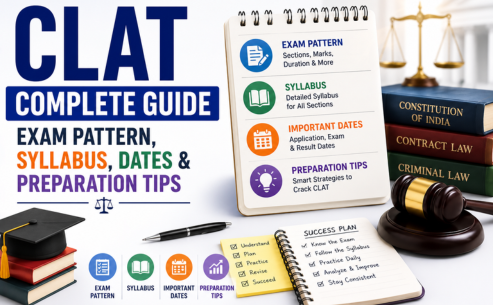
The CLAT 2028 Complete Guide is designed for students aiming to gain admission into India’s leading National Law Universities. The Common Law Admission Test (CLAT 2028) is a national-level law entrance exam conducted for undergraduate programs such as BA LLB, BBA LLB, BCom LLB, and similar integrated law courses.
Every year more than 90,000 aspirants compete for around 3,800+ seats, making CLAT one of the toughest law entrance exams in India. The CLAT 2028 exam date is expected in December 2027, giving aspirants enough time to strategically prepare.
This CLAT 2028 Complete Guide covers the exam pattern, syllabus, important dates, and preparation tips, helping you build a smart, structured, and results-oriented strategy.
What is CLAT 2028?
The Common Law Admission Test (CLAT 2028) is a national-level entrance exam for admission to 5-year integrated law programs such as BA LLB, BBA LLB, BCom LLB, and BSc LLB offered by 26 National Law Universities (NLUs) across India.
As highlighted in this CLAT 2028 Complete Guide, the exam evaluates candidates on reading comprehension, logical reasoning, legal aptitude, and current affairs awareness.
The CLAT 2028 exam is the most important gateway for students aiming to build a successful career in law through top NLUs.
CLAT 2028 Exam Overview (Quick Table)
Understanding the structure is essential in any CLAT 2028 Complete Guide. The CLAT 2028 exam pattern follows a standardized format designed to test comprehension, reasoning, and accuracy.
| Feature | Details |
| Mode | Offline (Pen & Paper) |
| Duration | 120 Minutes |
| Total Questions | 120 |
| Marking Scheme | +1 (Correct), -0.25 (Incorrect) |
| Sections | English, GK, Legal, Logical, Quant |
The CLAT 2028 Exam Pattern remains highly comprehension-oriented, making accuracy and time management essential.
CLAT 2028 Important Dates
Tracking timelines is crucial in any CLAT 2028 Complete Guide, as missing deadlines can cost you a full academic year. The CLAT 2028 exam date is tentatively set for December 2027, with the process beginning months in advance.
Tentative CLAT 2028 Important Dates:
| Event | Expected Timeline |
| Notification Release | July 2027 |
| Application Start | July 2027 |
| Last Date to Apply | November 2027 |
| Admit Card Release | November 2027 |
| CLAT 2028 Exam Date | December 2027 |
| Result Declaration | December 2027 |
Staying updated ensures smooth participation in the CLAT 2028 exam process.
CLAT 2028 Eligibility Criteria
Understanding the eligibility requirements is important before applying for the CLAT 2028 exam, as outlined in this Complete Guide. The CLAT 2028 eligibility criteria are simple and easy for students to understand.
- Candidates must have passed Class 12 (10+2) or be appearing in 2028
- Minimum marks required:
- General/OBC/PwD: 45%
- SC/ST: 40%
- There is no upper age limit for CLAT 2028
Fulfilling the CLAT 2028 eligibility criteria ensures your application remains valid and eligible for the admission process.
CLAT 2028 Exam Pattern
A proper understanding of the CLAT 2028 exam pattern is important for creating an effective preparation strategy, as discussed in this CLAT 2028 Complete Guide. The exam is structured to assess comprehension, reasoning ability, and decision-making rather than memorisation.
The CLAT 2028 exam includes 120 passage-based questions to be solved within 120 minutes. Every correct response awards +1 mark, while 0.25 marks are deducted for each incorrect answer.
The paper is divided into five sections:
- English Language
- Current Affairs & General Knowledge
- Legal Reasoning
- Logical Reasoning
- Quantitative Techniques
One key feature of the CLAT 2028 exam pattern is its comprehension-focused approach, making reading speed and accuracy essential for performing well.
CLAT 2028 Syllabus (Section-wise Breakdown)
Understanding the CLAT 2028 syllabus is important for focused preparation, as discussed in this CLAT 2028 Complete Guide. The exam follows a comprehension-based approach across five sections, with passages given greater weight than direct factual questions.
CLAT 2028 Syllabus – Section-wise Weightage
| Section | Weightage | Key Topics |
| English Language | ~20% | Reading comprehension, vocabulary, grammar |
| Current Affairs & GK | ~25% | National & international events, legal GK |
| Legal Reasoning | ~25% | Legal principles, contracts, constitutional law |
| Logical Reasoning | ~20% | Arguments, conclusions, analytical reasoning |
| Quantitative Techniques | ~10% | Data interpretation, percentages, ratios |
The CLAT 2028 syllabus emphasizes reading comprehension, inference, and analytical thinking. For example, the English and Legal sections include passages of around 400–450 words, testing your ability to interpret and apply concepts.
Importantly, no prior legal knowledge is required—all principles are provided within passages. The CLAT 2028 syllabus is designed to evaluate how well you understand, analyse, and apply information under time pressure, making practice and consistency essential.
CLAT 2028 Preparation Tips
A smart approach to preparation is the backbone of this CLAT 2028 Complete Guide. The CLAT 2028 preparation tips focus on building consistency, accuracy, and strong reading ability rather than rote learning.
Key CLAT 2028 Preparation Tips
1. Understand the Exam Pattern & Syllabus
Start by analysing the CLAT 2028 exam pattern and syllabus to prioritise high-weightage sections like Legal Reasoning and Current Affairs.
2. Build a Daily Reading Habit
Read newspapers like The Hindu or The Indian Express daily. This improves performance in English, GK, and Legal sections simultaneously.
3. Focus on Legal Reasoning
Practice principle-based questions regularly. This section carries high weightage and can significantly boost your score.
4. Master Current Affairs
Prepare monthly notes covering national and international events, legal updates, and important judgments.
5. Practice Logical Reasoning Daily
Solve arguments, assumptions, and inference-based questions to improve accuracy and speed.
6. Revise Basic Mathematics
Focus on Class 10 concepts like percentages, ratios, and data interpretation.
7. Mock Tests & Analysis (Game Changer)
Regular mock tests are essential. As emphasized in this CLAT 2028 Complete Guide, mock analysis—not just attempts—separates toppers from average aspirants.
Ideal CLAT 2028 Study Plan
A structured plan is essential in this CLAT 2028 Complete Guide to ensure consistent progress. The CLAT 2028 study plan should be divided into three phases for maximum efficiency.
Phase 1 (12–8 months): Foundation
Focus on reading habits, basic concepts, and current affairs notes.
Phase 2 (8–4 months): Practice
Start sectional tests, improve weak areas, and begin mock tests.
Phase 3 (4 months): Revision & Mocks
Increase mock frequency and focus on accuracy and time management.
Daily Routine Snapshot:
- Newspaper reading (1 hour)
- Reasoning practice (2 hours)
- GK revision (1 hour)
- Mock analysis (1 hour)
Consistency is key to cracking CLAT 2028.
Common Mistakes to Avoid
Avoiding mistakes is just as important as preparation in this CLAT 2028 Complete Guide. Many aspirants lose marks because of a poor strategy rather than insufficient knowledge.
Common CLAT 2028 mistakes:
- Ignoring daily newspaper reading
- Over-focusing on Mathematics (low weightage)
- Relying on rote learning instead of understanding
- Skipping mock test analysis
Avoiding these mistakes can significantly improve your CLAT 2028 performance.
Additional Blog References
For deeper insights, explore these related resources alongside this CLAT 2028 Complete Guide:
- CLAT 2028 Registration Process: Step-by-Step Application Guide
- CLAT 2028 Syllabus: Topics, Weightage & Preparation Strategy
These guides will strengthen your CLAT 2028 preparation strategy and decision-making.
How Tarkashastra Helps You Crack CLAT 2028?
At Tarkashastra, we go beyond conventional coaching to provide a result-driven approach aligned with this CLAT 2028 Complete Guide. Our programs focus on concept clarity, structured preparation, and continuous performance monitoring.
Students benefit from:
- Expert-led CLAT 2028 classroom training
- High-quality mock tests with detailed analysis
- Daily current affairs and GK modules
- Personal mentorship and doubt-solving sessions
With a proven strategy and disciplined learning environment, Tarkashastra helps you stay fully prepared to crack CLAT 2028 with confidence.
Conclusion
This CLAT 2028 Complete Guide covers everything you need—exam pattern, syllabus, important dates, and preparation tips—to begin your preparation with clarity and confidence. Success in CLAT 2028 depends on early planning, consistent practice, and a smart preparation strategy.
Focus on reading habits, mock tests, and improving accuracy to stay ahead of the competition. With the right approach and disciplined preparation, securing admission to a top NLU is absolutely achievable.
FAQs – CLAT 2028 Complete Guide
1. What is CLAT 2028?
CLAT 2028 is a national-level law entrance exam conducted by the Consortium of NLUs for admission into 5-year integrated law programs like BA LLB, BBA LLB, and BCom LLB.
2. When will CLAT 2028 be conducted?
The CLAT 2028 exam date is tentatively scheduled for December 2027.
3. What is the exam pattern of CLAT 2028?
CLAT 2028 will have 120 questions in 120 minutes, with +1 marking and -0.25 negative marking, covering five sections, including Legal Reasoning and GK.
4. What subjects are included in the CLAT 2028 syllabus?
The CLAT 2028 syllabus includes English, Current Affairs, Legal Reasoning, Logical Reasoning, and Quantitative Techniques.
5. Is CLAT 2028 difficult?
Yes, CLAT is competitive, with 90,000+ aspirants competing for limited NLU seats, but with the right strategy, it is achievable.
6. Is Maths important for CLAT 2028?
Maths has low weightage (~10%), so basic Class 10 concepts like percentages and DI are sufficient.
7. How should I start preparing for CLAT 2028?
Start with understanding the CLAT 2028 exam pattern and syllabus, build a reading habit, and gradually move to mock tests.
8. Are mock tests necessary for CLAT 2028?
Yes, mock tests are crucial. Regular practice and analysis help improve speed, accuracy, and exam strategy.
9. What is the eligibility for CLAT 2028?
Candidates must have passed Class 12 with 45% (General/OBC) or 40% (SC/ST), and there is no age limit.
10. How can Tarkashastra help in CLAT 2028 preparation?
Tarkashastra provides structured coaching, mock tests, mentorship, and current affairs modules to help students crack CLAT 2028 effectively.