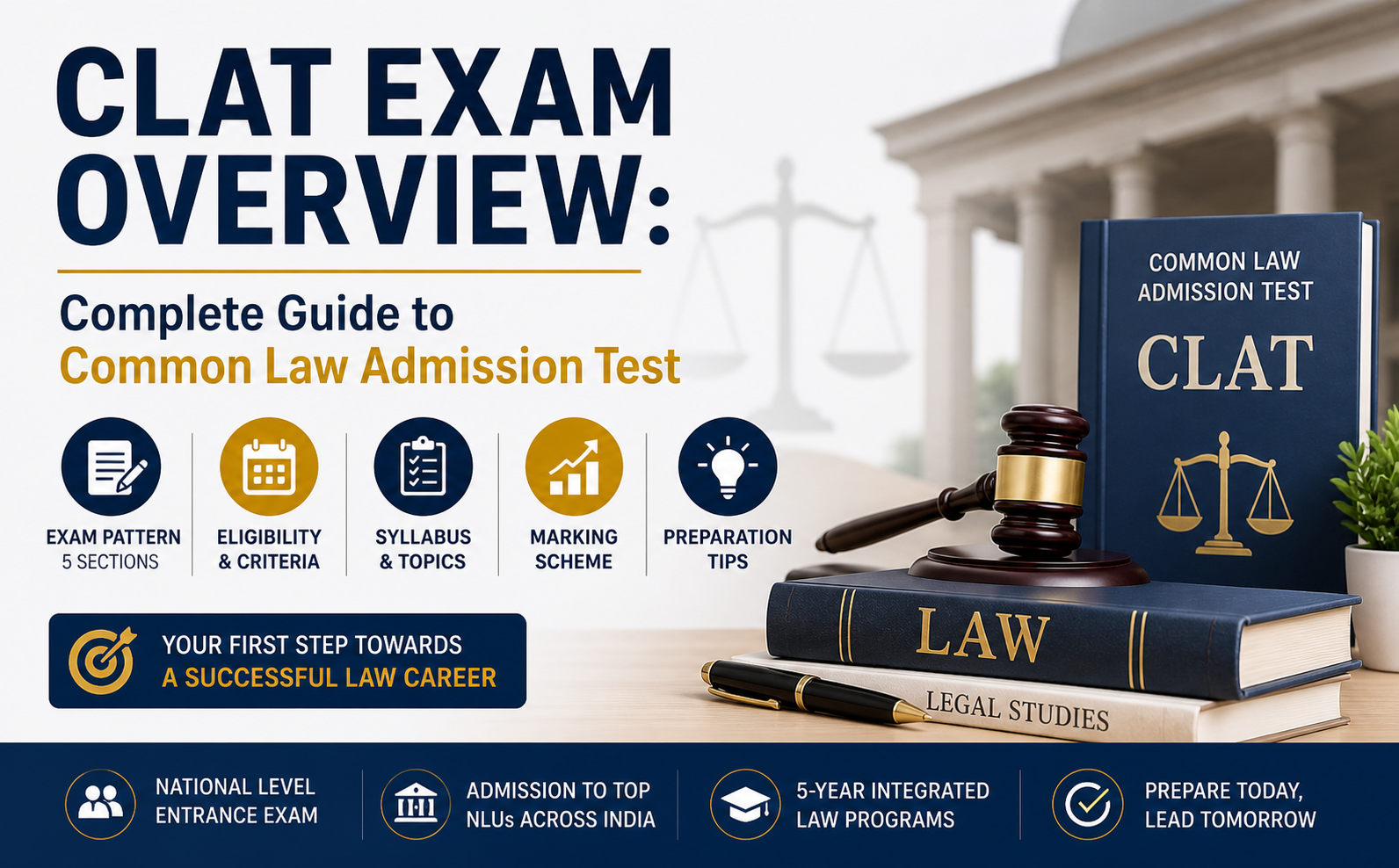
The CLAT 2027 Exam Overview is the first step every serious aspirant must understand before starting preparation. The Common Law Admission Test (CLAT) is a national-level entrance exam conducted for admission to top National Law Universities (NLUs) in India.
Unlike traditional exams, CLAT 2027 is a skill-based test rather than a memory-driven one. It evaluates your ability to read complex passages, apply logic, and make accurate decisions under time pressure—not how much you can memorise.
Many students misunderstand the CLAT 2027 exam pattern and start preparation without clarity, leading to wasted effort. Understanding the CLAT 2027 exam overview, syllabus, and pattern ensures you prepare in the right direction from day one.
CLAT 2027 Exam Overview
Understanding the CLAT 2027 Exam Overview becomes easier when you look at the exam in a structured format. The table below summarises the most important details every aspirant must know before starting CLAT 2027 preparation.
CLAT 2027 Exam Overview Table
| Parameter | Details |
| Exam Name | Common Law Admission Test (CLAT 2027) |
| Conducting Body | Consortium of National Law Universities |
| Exam Level | National-Level (UG – 5-year LLB) |
| Mode of Exam | Offline (Pen-and-Paper) |
| Duration | 120 Minutes |
| Total Questions | 120 |
| Sections | English, GK & Current Affairs, Legal Reasoning, Logical Reasoning, Quantitative Techniques |
| Marking Scheme | +1 (Correct), –0.25 (Incorrect) |
| Medium | English |
This CLAT 2027 exam overview table highlights that the exam is structured, time-bound, and accuracy-driven. As per the latest CLAT 2027 exam pattern, understanding these basics helps you plan your preparation efficiently and avoid confusion later.
CLAT 2027 Exam Pattern (Section-wise Breakdown)
The CLAT 2027 Exam Pattern is fully passage-based and designed to test comprehension, reasoning, and application. Understanding the CLAT 2027 exam pattern is critical because it directly affects your preparation strategy and approach to the exam.
CLAT 2027 Section-wise Weightage
| Section | Weightage | Expected Questions |
| English Language | 20% | 22–26 |
| Current Affairs & GK | 25% | 28–32 |
| Legal Reasoning | 25% | 28–32 |
| Logical Reasoning | 20% | 22–26 |
| Quantitative Techniques | 10% | 10–14 |
The CLAT 2027 exam pattern focuses on reading-intensive passages followed by multiple questions. There are no direct or memory-based questions—every section requires interpretation and logical thinking.
A key insight from this CLAT 2027 exam overview is that Legal Reasoning and GK together form 50% of the paper, making them the most critical scoring areas.
To perform well, aspirants must align their CLAT 2027 preparation strategy with this pattern—prioritising reading speed, accuracy, and decision-making over rote learning.
What CLAT 2027 Actually Tests?
The CLAT 2027 Exam Overview makes it clear that this is not a syllabus-heavy exam but a skill-based evaluation. Understanding what the CLAT 2027 syllabus actually tests is crucial for effective preparation.
Core Skills Tested in CLAT 2027
| Skill Area | What It Involves |
| Reading Comprehension | Understanding passages, tone, inference |
| Logical Reasoning | Arguments, assumptions, conclusions |
| Legal Reasoning | Applying principles to factual situations |
| Quantitative Skills | Data interpretation, basic arithmetic |
The CLAT 2027 exam pattern is designed to assess how well you can interpret information and apply logic under time pressure—not how much you memorise.
What CLAT 2027 Does NOT Test?
- Rote learning or static GK memorisation
- Direct grammar-based questions
- Advanced mathematics or formulas
This CLAT 2027 exam overview highlights one key point: your preparation should focus on building skills, not covering chapters.
CLAT 2027 Syllabus: Section-Wise Topics
A clear understanding of the CLAT 2027 syllabus, section-wise, is essential to build a focused and effective preparation strategy. The exam is designed to test comprehension and reasoning skills across five sections.
- English Language
The CLAT 2027 syllabus for English focuses entirely on reading comprehension.
Key Topics:
- Passage-based questions (fiction & non-fiction)
- Vocabulary in context
- Tone, inference, and central idea
- Argument analysis
Focus: Improve reading speed through daily editorials.
- Current Affairs & GK
This section tests awareness of recent events and their context.
Key Topics:
- National & international news
- Legal developments and judgments
- Government policies
- Economy, awards, and science
Focus: Daily newspaper + monthly revision notes.
- Legal Reasoning
The most important part of the CLAT 2027 syllabus.
Key Topics:
- Principle-fact questions
- Contract law, torts, constitutional basics
- Legal scenarios and reasoning
Focus: Application of principles, not prior legal knowledge.
- Logical Reasoning
This section evaluates analytical thinking.
Key Topics:
- Arguments and assumptions
- Conclusions and inference
- Cause-effect relationships
Focus: Practice passage-based reasoning regularly.
- Quantitative Techniques
The most scoring yet often ignored section.
Key Topics:
- Data interpretation (charts, tables)
- Percentages, ratios, averages
- Basic arithmetic (Class 10 level)
Focus: Accuracy and calculation speed.
Key Insight:
The entire CLAT 2027 syllabus is largely passage-based, making reading comprehension and reasoning the most critical skills.
CLAT 2027 Eligibility Criteria
Before applying, every aspirant must check the CLAT 2027 Eligibility Criteria. As per the CLAT 2027 exam overview, the eligibility requirements for UG programmes are simple and inclusive.
CLAT 2027 Eligibility Criteria (UG)
| Criteria | Requirement |
| Educational Qualification | Class 12 (10+2) or equivalent |
| Minimum Marks | 45% (General/OBC), 40% (SC/ST) |
| Age Limit | No upper age limit |
| Appearing Candidates | Eligible |
The CLAT 2027 eligibility criteria ensure that most Class 12 students can apply. Understanding this early helps you plan your CLAT 2027 preparation strategy without confusion or last-minute issues.
CLAT 2027 Important Dates
Tracking the timeline is essential in the CLAT 2027 Exam Overview. Knowing the CLAT 2027 important dates helps you plan preparation, form filling, and revision without last-minute pressure.
CLAT 2027 Important Dates (Expected)
| Event | Expected Date |
| Notification Release | July 2026 |
| Application Start Date | August 2026 |
| Last Date to Apply | October 2026 |
| Admit Card Release | November 2026 |
| CLAT 2027 Exam Date | 6 December 2026 |
| Result Declaration | December 2026 |
As per the latest CLAT 2027 exam overview, the exam is expected in early December, making early preparation crucial.
Aspirants should align their CLAT 2027 preparation strategy with this timeline to ensure consistent progress and timely revision.
CLAT 2027 Marking Scheme & Strategy Insight
The CLAT 2027 Exam Overview highlights that the marking scheme plays a decisive role in your final rank. Understanding the CLAT 2027 marking scheme is essential to developing an effective strategy for your attempt.
CLAT 2027 Marking Scheme
| Response Type | Marks |
| Correct Answer | +1 |
| Incorrect Answer | –0.25 |
| Unattempted | 0 |
As per the CLAT 2027 exam pattern, negative marking makes accuracy more important than the number of attempts.
Strategy Insight:
- Avoid blind guessing
- Focus on high-confidence questions
- Maintain 80–85% accuracy for a strong score
This CLAT 2027 exam overview clearly shows that controlled attempts outperform aggressive attempts.
Why is CLAT 2027 Different from School Exams?
A key insight from the CLAT 2027 Exam Overview is that this exam is fundamentally different from school or board exams. Misunderstanding this difference leads to ineffective CLAT 2027 preparation.
CLAT vs School Exams (Key Differences)
| Factor | School Exams | CLAT 2027 Exam |
| Question Type | Direct, theory-based | Passage-based, analytical |
| Focus | Memory & recall | Interpretation & reasoning |
| Approach | Subject knowledge | Decision-making under pressure |
| Time Pressure | Moderate | High |
The CLAT 2027 exam pattern requires you to read, analyse, and choose the best answer—not recall facts.
This CLAT 2027 exam overview reinforces one point: success depends on thinking clearly under time constraints, not memorising content.
Difficulty Level & Trends
As per the CLAT 2027 Exam Overview, the expected difficulty level remains moderate to difficult, with a clear shift towards analytical thinking.
CLAT 2027 Expected Difficulty & Trends
- Increased focus on logical and analytical reasoning
- Passage-based questions are becoming more complex
- Return of conceptual GK instead of direct facts
- Accuracy is becoming more important than attempts
Recent trends show that the CLAT 2027 exam pattern is evolving toward deeper comprehension and tighter answer choices.
This CLAT 2027 exam overview suggests that disciplined preparation and strong reading skills will be the key differentiators.
Common Mistakes Aspirants Make
The CLAT 2027 Exam Overview shows that most mistakes stem from misunderstanding the exam, not from a lack of effort.
Common CLAT 2027 Preparation Mistakes
- Treating CLAT as a GK or memory-based exam
- Ignoring daily reading and comprehension practice
- Attempting too many questions with low accuracy
- Skipping mock test analysis
- Studying without understanding the CLAT 2027 exam pattern
These errors reduce performance despite hard work.
This CLAT 2027 exam overview makes it clear: right strategy + clarity > random preparation.
Related Blogs You Should Read
To strengthen your CLAT 2027 preparation strategy, explore these related guides alongside this CLAT 2027 Exam Overview:
- CLAT 2026 Exam Analysis: Section-Wise Review, Difficulty Level & Good Attempts
- CLAT 2027 Registration Process: Step-by-Step Application Guide
- CLAT 2027 Complete Guide: Exam Pattern, Syllabus, Dates & Preparation Tips
- Is CLAT 2027 Tough? Difficulty Level, Competition & Expert Analysis
- CLAT 2027 Registration Last Date: Important Deadlines & Updates
- CLAT 2027 Full Form: Meaning, Exam Purpose & Career Scope Explained
- Top Law Colleges in Hyderabad Through CLAT 2027: Fees, Placements & Ranking
- Top Law Colleges in Maharashtra Through CLAT 2027: Colleges, Fees & Cutoffs
These resources complement the CLAT 2027 exam pattern and help you build a structured preparation approach with clarity and consistency.
How Tarkashastra Helps You Crack CLAT 2027?
The CLAT 2027 Exam Overview clearly shows that success depends on skills like reading, reasoning, and accuracy—not just completing the syllabus. This is where Tarkashastra’s approach is different.
At Tarkashastra, CLAT 2027 preparation is structured around:
- Skill-based learning aligned with the CLAT 2027 exam pattern
- Regular mock tests with detailed performance analysis
- Focused training on reading comprehension and logical reasoning
- Mentorship-driven guidance to improve accuracy and decision-making
Instead of random study, Tarkashastra helps you build a clear preparation system.
This ensures that your CLAT 2027 preparation strategy is aligned with how the actual exam works—maximising performance and consistency.
Conclusion
The CLAT 2027 Exam Overview makes one thing clear—this is a skill-based, decision-driven exam, not a memory test. Understanding the CLAT 2027 exam pattern, marking scheme, and core skills is the first step toward effective preparation.
Aspirants who focus on reading, logical thinking, and accuracy will have a clear advantage. Instead of rushing into preparation, use this CLAT 2027 exam overview to build a structured plan—because clarity at the start leads to better results in the final exam.
FAQs on CLAT 2027 Exam Overview
1. What is the CLAT 2027 Exam Overview?
The CLAT 2027 Exam Overview explains the exam structure, pattern, marking scheme, and skills required to crack the Common Law Admission Test for NLUs.
2. How many questions are there in CLAT 2027?
CLAT 2027 is expected to have 120 passage-based MCQs, covering English, GK, Legal Reasoning, Logical Reasoning, and Quant.
3. What is the CLAT 2027 exam pattern?
The CLAT 2027 exam pattern is fully passage-based, testing comprehension, reasoning, and application instead of direct or memory-based questions.
4. What is the marking scheme of CLAT 2027?
- +1 for correct answer
- –0.25 for incorrect answer
- No negative marking for unattempted questions
5. Is CLAT 2027 a difficult exam?
CLAT 2027 is moderate to difficult, mainly due to reading complexity, close options, and time pressure—not because of syllabus difficulty.
6. What skills are required for CLAT 2027?
The CLAT 2027 exam overview shows key skills:
- Reading comprehension
- Logical reasoning
- Legal application
- Accuracy under pressure
7. Who is eligible for CLAT 2027?
Students who have completed or are appearing for Class 12 with 45% (40% for SC/ST) are eligible. No age limit applies.
8. When will CLAT 2027 be conducted?
CLAT 2027 is expected to be held on 6 December 2026, as per the latest timeline.
9. Can I crack CLAT 2027 without coaching?
Yes, but only if you follow a structured preparation strategy, practice mocks regularly, and focus on skill-building.
10. What is the biggest mistake in CLAT preparation?
The biggest mistake is treating CLAT as a memory-based or GK-heavy exam rather than focusing on reading and reasoning skills.