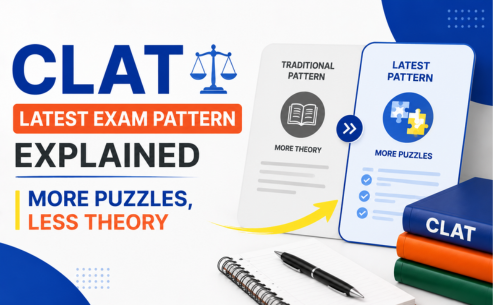
The CLAT 2027 Exam Pattern is becoming more analytical and less theory-driven. Recent trends show a clear shift towards puzzle-solving, logical interpretation, and passage-based application questions. Instead of testing memorisation, the CLAT 2027 Latest Exam Pattern now focuses on comprehension, reasoning, and decision-making under time pressure.
- Legal Reasoning is becoming more application-based, Logical Reasoning now includes tougher analytical sets, and Current Affairs questions increasingly test interpretation rather than direct factual recall. Quantitative Techniques also place greater emphasis on data interpretation than on lengthy calculations.
Students preparing for CLAT 2027 must now prioritise reading speed, analytical reasoning, and mock-test practice over rote learning.
CLAT 2027 Exam Pattern at a Glance
Understanding the CLAT 2027 Exam Pattern is essential before starting preparation. The exam is now heavily passage-based and tests comprehension, reasoning, and analytical ability more than theoretical knowledge.
The latest CLAT 2027 Section-wise Weightage shows that Legal Reasoning and Current Affairs continue to dominate the paper.
CLAT 2027 Expected Exam Pattern
| Section | Expected Questions | Focus Area |
| English Language | 22–24 | Reading comprehension, vocabulary, inference |
| Current Affairs & GK | 28–32 | Current events, legal GK, interpretation |
| Legal Reasoning | 28–32 | Principle-fact application, legal analysis |
| Logical Reasoning | 22–24 | Analytical reasoning, arguments, puzzles |
| Quantitative Techniques | 10–14 | DI, ratios, percentages |
| Exam Feature | Details |
| Total Questions | 120 |
| Duration | 120 Minutes |
| Mode | Offline (OMR-Based) |
| Marking Scheme | +1 Correct, -0.25 Incorrect |
The CLAT 2027 Exam Pattern now rewards smart reading, accuracy, and logical decision-making rather than memorisation alone.
Biggest Shift in CLAT 2027: More Puzzles, Less Theory
The biggest change in the CLAT 2027 Latest Exam Pattern is the clear shift from theory-based preparation to analytical problem-solving. Recent CLAT papers show that students are now expected to interpret passages, solve logical conditions, and apply concepts under time pressure rather than simply memorise facts.
The CLAT 2027 Logical Reasoning Questions are becoming more analytical, with multi-condition puzzles, assumption-based sets, and deduction-heavy questions increasing steadily. Similarly, the CLAT 2027 Legal Reasoning Changes show a shift towards principle-application passages rather than direct legal knowledge.
Current Affairs is also evolving. Instead of asking purely factual questions, CLAT increasingly tests contextual understanding and interpretation. Quantitative Techniques now focus more on data interpretation and logical calculations than advanced mathematics.
Old CLAT vs New CLAT Trend
| Old CLAT Style | New CLAT Trend |
| Theory-heavy | Application-heavy |
| Static GK focus | Passage interpretation |
| Direct reasoning | Analytical puzzles |
| Memory-based learning | Decision-based solving |
Students who continue relying only on rote learning may struggle with time management, accuracy, and analytical reasoning in the new CLAT 2027 Exam Pattern.
Section-Wise Breakdown: What Students Should Prepare Now
1. Legal Reasoning
The CLAT 2027 Legal Reasoning Changes indicate a stronger focus on the application of principles to facts and the interpretation of passages. Students must practise applying legal principles logically rather than memorising legal theory. Questions based on BNS, BNSS, and BSA trends may also appear. Elimination techniques and analytical reading will become crucial in the new CLAT 2027 Exam Pattern.
2. Logical Reasoning
The CLAT 2027 Logical Reasoning Questions are expected to include more analytical puzzles, as well as sets based on assumptions, conclusions, and deduction. Students should focus on solving multi-condition reasoning problems under time pressure. Daily logical reasoning practice and mock-based analysis are now essential.
3. English Language
English preparation for CLAT 2027 should focus mainly on Reading Comprehension, tone-based questions, vocabulary-in-context, and inference-based passages. Editorial reading and long-form comprehension practice will improve speed and accuracy.
4. GK & Current Affairs
The CLAT 2027 Important Topics in GK will include current affairs linked with static concepts, legal developments, constitutional amendments, and major judgments. Students should focus on understanding events instead of memorising isolated facts.
5. Quantitative Techniques
Quantitative Techniques in the CLAT 2027 Exam Pattern now place greater emphasis on data interpretation, ratios, percentages, averages, and logical calculations. Students should prioritise speed and accuracy of interpretation over advanced mathematics.
Smart Preparation Strategy for the New CLAT Pattern
The new CLAT 2027 Preparation Strategy should focus more on analytical thinking, reading speed, and mock-test learning rather than only theory revision. Since the CLAT 2027 Exam Pattern is becoming more reasoning-driven, students must build strong comprehension and decision-making skills.
Daily editorial reading improves English, Legal Reasoning, and Current Affairs simultaneously. Analytical puzzle-solving and logical reasoning practice should also become part of the daily routine. Most importantly, mock tests must be analysed in depth to identify weak areas, time management issues, and accuracy problems.
Students preparing for CLAT 2027 should focus on controlled attempts rather than blind guessing, as negative marking can significantly affect rank stability.
Daily CLAT 2027 Study Plan
| Activity | Recommended Time |
| Newspaper & Editorial Reading | 1 Hour |
| Logical Reasoning Practice | 1.5 Hours |
| Legal Reasoning Passages | 1 Hour |
| GK & Current Affairs Revision | 45 Minutes |
| Mock Analysis | 1 Hour |
A smart CLAT 2027 Study Plan should prioritise consistency, mock analysis, and analytical improvement over random hard work.
Common Mistakes CLAT 2027 Aspirants Must Avoid
- Over-memorising static GK instead of improving analytical reasoning
- Ignoring the changing CLAT 2027 Logical Reasoning Questions trend
- Taking mock tests without proper analysis
- Blind guessing despite negative marking
- Neglecting reading stamina and passage-solving practice
- Spending equal time on all sections instead of prioritising high-weightage areas
- Focusing only on theory instead of application-based learning
- Avoiding timed practice and section-wise accuracy tracking
- Ignoring Legal Reasoning passage interpretation practice
- Following random preparation strategies without a structured CLAT 2027 Study Plan
How Tarkashastra Helps Students Adapt to the New CLAT Pattern?
The new CLAT 2027 Exam Pattern requires more than theoretical preparation. Students now need strong analytical reasoning, faster reading, and an intelligent mock-test strategy. Tarkashastra helps aspirants adapt to these changing CLAT trends through structured, exam-focused preparation.
At Tarkashastra, students receive:
- Analytical reasoning and puzzle-solving practice
- Passage-based Legal Reasoning training
- CLAT 2027 pattern-based mock tests
- Detailed mock analysis and performance tracking
- Reading comprehension improvement sessions
- Time-management and accuracy-building strategies
- Mentorship for section-wise preparation planning
The focus is not just on completing the syllabus but on improving decision-making, accuracy, and exam temperament, as required by the latest CLAT 2027 Preparation Strategy.
Related Blogs You Should Read
- CLAT 2026 Exam Analysis: Section-Wise Review, Difficulty Level & Good Attempts
- CLAT 2027 Registration Process: Step-by-Step Application Guide
- CLAT 2027 Complete Guide: Exam Pattern, Syllabus, Dates & Preparation Tips
- Is CLAT 2027 Tough? Difficulty Level, Competition & Expert Analysis
- CLAT 2027 Registration Last Date: Important Deadlines & Updates
- CLAT 2027 Full Form: Meaning, Exam Purpose & Career Scope Explained
- Top Law Colleges in Hyderabad Through CLAT 2027: Fees, Placements & Ranking
- Top Law Colleges in Maharashtra Through CLAT 2027: Colleges, Fees & Cutoffs
Conclusion
The CLAT 2027 Exam Pattern is clearly shifting towards analytical reasoning, passage interpretation, and decision-making under pressure. Students who continue to rely solely on memorisation and static preparation may struggle with the new exam trend.
Success in CLAT 2027 will depend more on reading ability, logical analysis, mock-test learning, and intelligent question selection. The earlier students adapt to the latest CLAT 2027 Preparation Strategy, the stronger their advantage becomes.
In the new CLAT format, smart preparation will always outperform random hard work.
FAQs on CLAT 2027 Latest Exam Pattern
1. What is the biggest change in the CLAT 2027 Exam Pattern?
The biggest change in the CLAT 2027 Exam Pattern is the increased focus on analytical reasoning, passage interpretation, and application-based problem-solving rather than theory-based learning.
2. Is CLAT 2027 becoming more difficult?
Yes. The latest trend shows that Logical Reasoning and Legal Reasoning are becoming more analytical and time-consuming, making the exam more challenging for students who rely only on memorisation.
3. How many questions will CLAT 2027 have?
CLAT 2027 is expected to have 120 questions across five sections with a total duration of 120 minutes.
4. Does CLAT 2027 have negative marking?
Yes. The CLAT 2027 marking scheme awards +1 for each correct answer and -0.25 for each incorrect answer.
5. Which section carries the highest weightage in CLAT 2027?
Legal Reasoning and Current Affairs are expected to carry the highest weightage in the CLAT 2027 Section-wise Weightage structure.
6. Are puzzles important for CLAT 2027 preparation?
Yes. The CLAT 2027 Logical Reasoning Questions are increasingly analytical and puzzle-based, making logical puzzle practice extremely important.
7. How should students prepare for the new CLAT pattern?
Students should focus on reading comprehension, analytical reasoning, mock-test analysis, and passage-based practice as part of their CLAT 2027 Preparation Strategy.
8. Is rote learning enough for CLAT 2027?
No. The new CLAT 2027 Latest Exam Pattern focuses more on interpretation, decision-making, and application-based learning rather than memorisation.
9. What type of GK questions are expected in CLAT 2027?
CLAT 2027 GK questions are expected to focus more on current affairs linked with legal developments, constitutional updates, and contextual understanding.
10. Why are mock tests important for CLAT 2027?
Mock tests help students improve time management, analytical thinking, accuracy, and decision-making under pressure, which are essential for the latest CLAT 2027 Exam Pattern.