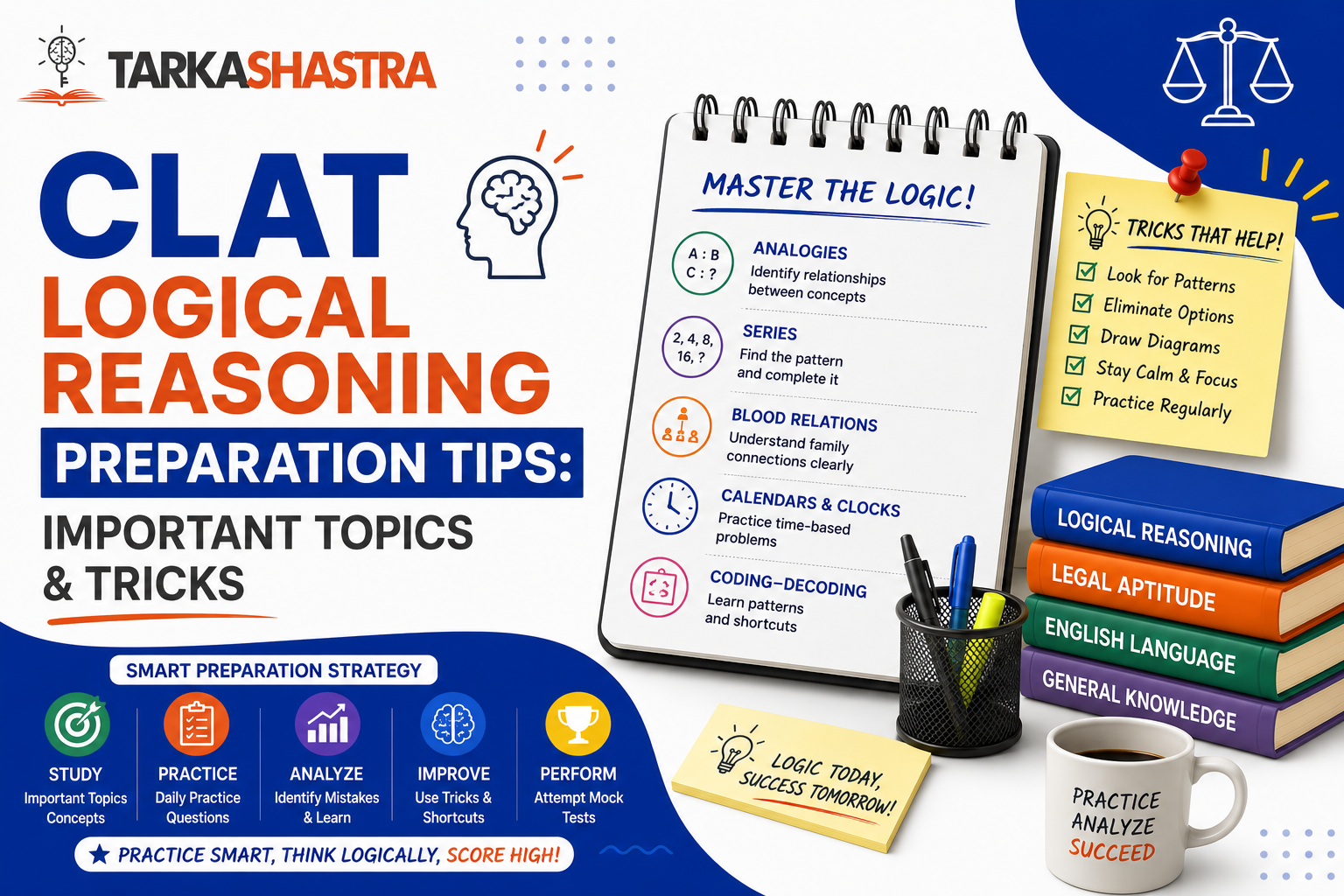
The CLAT 2027 Logical Reasoning Preparation Tips are crucial for aspirants aiming to maximise their score in one of the most accuracy-driven sections of the exam. Logical Reasoning in CLAT is not about shortcuts or puzzle-solving—it is a passage-based reasoning section that tests how effectively you analyse arguments, identify assumptions, and draw logical conclusions.
With 22–26 questions and nearly 20% weightage, this section can significantly impact your rank. Recent trends show a shift towards analytical and deduction-based reasoning, making structured preparation essential.
In this blog, you will learn the most important topics, proven strategies, and practical tricks to master CLAT Logical Reasoning 2027.
CLAT 2027 Logical Reasoning Section Overview
Understanding the structure is the first step in applying effective CLAT 2027 Logical Reasoning Preparation Tips. The section is entirely passage-based and evaluates how well you interpret arguments and apply logic—not how much you memorise.
Key Details of CLAT Logical Reasoning 2027
| Aspect | Details |
| Number of Questions | 22–26 |
| Weightage | ~20% of paper |
| Passage Length | ~450 words |
| Question Type | Passage-based MCQs |
| Skills Tested | Arguments, inference, assumptions |
This section focuses on critical thinking and logical application, with each passage containing multiple questions.
Unlike traditional reasoning exams, CLAT Logical Reasoning requires deep reading, structured thinking, and precision, making it one of the most scoring yet demanding sections.
Most Important Logical Reasoning Topics for CLAT 2027
To apply effective CLAT 2027 Logical Reasoning Preparation Tips, you must prioritise the right topics instead of covering everything randomly. The CLAT Logical Reasoning section is built around core critical reasoning concepts, with a growing focus on analytical reasoning, as reflected in recent exam trends.
High-Priority Logical Reasoning Topics
| Topic | Importance in CLAT 2027 |
| Inference | Core concept in almost every passage |
| Assumptions | Tests hidden logic; highly confusing |
| Strengthen/Weaken Arguments | Most frequently asked |
| Cause–Effect | Common trap-based questions |
| Flaw in Reasoning | Improves elimination accuracy |
| Paradox | Tests deep logical clarity |
These topics dominate the section and directly impact accuracy .
Additionally, analytical reasoning topics like arrangements, puzzles, and deduction-based sets are gaining importance, making it essential to balance both critical reasoning and analytical logic for CLAT 2027 preparation.
Concept Clarity: Core Logical Reasoning Skills
Strong CLAT 2027 Logical Reasoning Preparation Tips begin with mastering core concepts. This section rewards clarity of thought, not memorisation or tricks.
Key Logical Reasoning Skills
- Arguments & Conclusion
- Identify what the passage is trying to prove. Most questions depend on spotting the correct conclusion.
- Assumptions
- Understand hidden links between statements. Missing assumptions lead to wrong answers.
- Inference
- Focus only on what logically follows from the passage—not external knowledge.
- Strengthen/Weaken
- Evaluate how new information impacts the argument.
- Logical Flaws
- Identify weak reasoning or incorrect logic.
- Cause–Effect
- Avoid confusing correlation with causation.
CLAT Logical Reasoning tests the application of logic, not theory, making concept clarity the foundation of accuracy.
Step-by-Step Approach to Solve CLAT LR Passages
A structured method is essential for applying the CLAT 2027 Logical Reasoning Preparation Tips effectively. Since the section is passage-driven, your approach determines accuracy more than difficulty level.
Step-by-Step Framework
| Step | Action |
| 1 | Read for the central idea |
| 2 | Identify the argument (not just topic) |
| 3 | Separate premises and conclusion |
| 4 | Spot assumptions and hidden links |
| 5 | Track keywords (only, most, however) |
| 6 | Evaluate options strictly from passage |
| 7 | Recheck before final answer |
Start by understanding what the author is trying to prove, then break the passage into logical components. Avoid rushing—CLAT Logical Reasoning rewards precision over speed.
Always validate answers using the passage only. Most errors occur when students rely on assumptions or outside knowledge.
This systematic approach ensures higher accuracy and consistency in CLAT 2027 Logical Reasoning.
CLAT 2027 Logical Reasoning Preparation Strategy
A strong plan is essential to implement effective CLAT 2027 Logical Reasoning Preparation Tips. This section improves only through a balance of concept clarity, structured practice, and continuous analysis.
Practical Preparation Strategy
1. Build Concept Clarity First
Start with fundamentals like arguments, assumptions, and inference. Without this, practice becomes ineffective.
2. Study Topic-Wise Initially
Master one question type at a time—assumption, inference, strengthen/weaken—before moving to mixed sets.
3. Focus on Passage-Based Practice
CLAT Logical Reasoning is passage-driven, so avoid solving isolated questions. Practice full sets regularly.
4. Follow the Mock → Analysis Cycle
After every mock:
- Identify mistakes (wrong inference, missed assumption)
- Revisit concepts immediately
5. Maintain Weekly Revision
Condense notes into short points for quick recall and revise consistently.
6. Prioritise Analytical Reasoning (Latest Trend)
Recent patterns show increased weightage of arrangements, puzzles, and deduction-based sets, making them critical.
- Ideal formula: Learn → Practice → Analyse → Revise
This approach ensures steady improvement in accuracy and decision-making.
CLAT Logical Reasoning Tricks & Shortcuts
Applying smart CLAT 2027 Logical Reasoning Preparation Tips can significantly improve accuracy. Still, this section is not shortcut-driven—it is logic-driven.
Practical Tricks That Work
- Use Option Elimination
- Eliminate choices that are not directly supported by the passage.
- Track Keywords Carefully
- Words like only, most, some, and however change the entire meaning.
- Stick to the Passage
- If information is not stated or logically implied, it is incorrect.
- Use Diagrams for Analytical Sets
- Helps manage conditions and avoid confusion.
- Avoid Overthinking
- Most questions are straightforward if the argument is clear.
The best “trick” is structured thinking—not guesswork.
Common Mistakes to Avoid
Avoiding errors is as important as applying CLAT 2027 Logical Reasoning Preparation Tips. Most mistakes occur due to poor interpretation, not difficult questions.
Common Mistakes
- Reading passages superficially
- Confusing topic with conclusion
- Ignoring keywords like only, some, and most
- Choosing options that sound logical but lack support
- Not identifying the question type
- Bringing personal opinion into answers
CLAT Logical Reasoning demands strict passage-based thinking. Most errors happen when students assume rather than analyse.
Time Management Strategy for CLAT Logical Reasoning
Effective CLAT 2027 Logical Reasoning Preparation Tips require strong time management, as this section is accuracy-driven and time-sensitive.
Smart Time Strategy
- Start with easier passages first
- Skip lengthy analytical sets initially
- Avoid spending too long on one passage
- Follow a fixed time limit per set
- Return to difficult questions only if time allows
Focus on accuracy over attempts—a few correct answers matter more than guessing.
Logical Reasoning rewards smart selection and disciplined solving, not speed alone.
Previous Blog References
For a complete CLAT preparation strategy, also explore:
- CLAT 2026 Exam Analysis: Section-Wise Review, Difficulty Level & Good Attempts
- CLAT 2027 Registration Process: Step-by-Step Application Guide
- CLAT 2027 Complete Guide: Exam Pattern, Syllabus, Dates & Preparation Tips
- Is CLAT 2027 Tough? Difficulty Level, Competition & Expert Analysis
- CLAT 2027 Registration Last Date: Important Deadlines & Updates
- CLAT 2027 Full Form: Meaning, Exam Purpose & Career Scope Explained
- Top Law Colleges in Hyderabad Through CLAT 2027: Fees, Placements & Ranking
- Top Law Colleges in Maharashtra Through CLAT 2027: Colleges, Fees & Cutoffs
These resources complement your CLAT 2027 Logical Reasoning Preparation Tips and help build a well-rounded preparation approach across all sections.
How Tarkashastra Helps You Master Logical Reasoning?
At Tarkashastra, our approach to CLAT 2027 Logical Reasoning Preparation Tips is built around accuracy, structured thinking, and exam-level practice.
We focus on:
- Concept clarity sessions covering arguments, assumptions, and inference
- Passage-based practice modules aligned with the latest CLAT pattern
- Analytical reasoning drills to match post-2026 trends
- Full-length mocks with detailed analysis to improve decision-making
Our mentorship model ensures that every student tracks mistakes and improves systematically.
Instead of shortcuts, Tarkashastra trains you to think like the exam demands, helping you build consistency and maximise your Logical Reasoning score in CLAT 2027.
Conclusion
Mastering CLAT 2027 Logical Reasoning Preparation Tips requires clarity, consistency, and smart practice. This section is highly scoring if you focus on core concepts, structured passage analysis, and regular mock evaluations.
- With the shift towards analytical reasoning, accuracy matters more than the number of attempts.
Focus on thinking clearly, not solving quickly—that’s the key to maximising your CLAT Logical Reasoning score.
FAQs: CLAT 2027 Logical Reasoning Preparation Tips
1. What is the weightage of Logical Reasoning in CLAT 2027?
Logical Reasoning carries a weightage of 20% with 22–26 questions, making it one of the most scoring sections in CLAT.
2. Is Logical Reasoning in the CLAT passage-based?
Yes, CLAT Logical Reasoning is completely passage-based, requiring you to analyse arguments, assumptions, and conclusions.
3. What are the most important topics for CLAT 2027 Logical Reasoning?
Key topics include inference, assumptions, strengthen/weaken arguments, cause–and–effect, and flaws in reasoning, along with analytical reasoning.
4. How should I start preparing for CLAT Logical Reasoning?
Start with concept clarity (arguments, assumptions, inference) and then move to passage-based practice and mock analysis.
5. Is analytical reasoning important for CLAT 2027?
Yes, recent trends show an increased emphasis on analytical reasoning, including arrangements and deduction-based questions.
6. How can I improve accuracy in Logical Reasoning?
Focus on structured passage analysis, keyword tracking, and option elimination, and avoid using outside knowledge.
7. What is the best strategy to solve CLAT LR passages?
Follow a structured approach:
Understand argument → Identify assumptions → Evaluate options strictly from the passage.
8. How many Logical Reasoning questions should I attempt?
There is no fixed number—focus on accuracy over attempts, as fewer correct answers are better than guesswork.
9. What are common mistakes in CLAT Logical Reasoning?
Common mistakes include surface-level reading, ignoring keywords, drawing conclusions too quickly, and using personal opinions.
10. Can Logical Reasoning improve my overall CLAT score?
Yes, Logical Reasoning is a rank-deciding section and can significantly boost your score if prepared strategically.