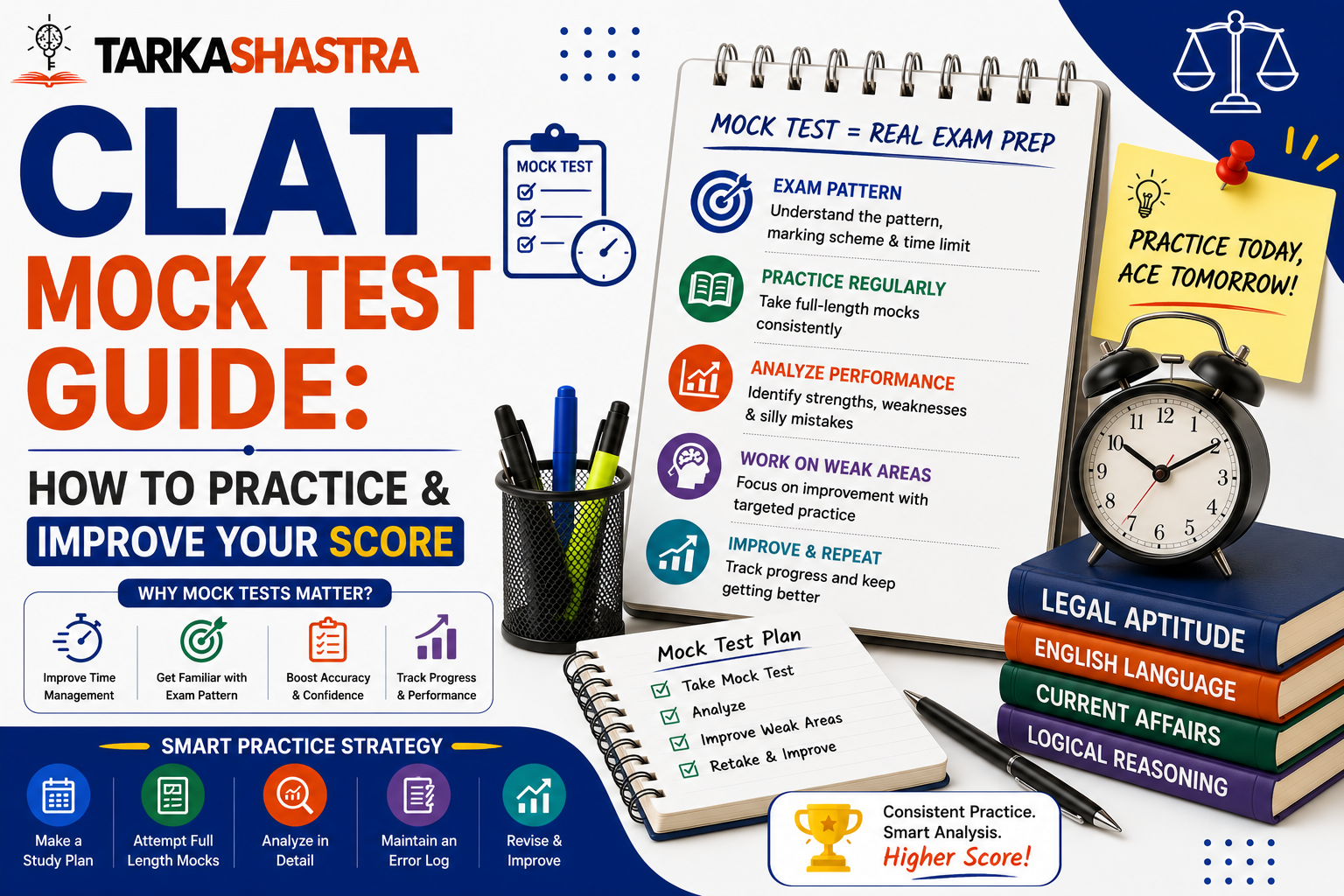
Most students preparing for CLAT focus heavily on notes and theory but ignore practice. However, CLAT is a performance-based exam where speed, accuracy, and decision-making matter the most.
This is why the CLAT 2027 Mock Test Guide is crucial for aspirants aiming for top ranks. Regular CLAT 2027 Mock Tests help students improve time management, reduce negative marking mistakes, and build exam temperament.
More importantly, proper CLAT Mock Test Analysis helps identify weak areas, improve accuracy, and develop a smarter strategy for attempts. In CLAT preparation, consistent mock practice matters more than passive studying.
What Is a CLAT 2027 Mock Test?
A CLAT 2027 Mock Test is a simulated version of the actual CLAT exam designed to replicate the real paper pattern, difficulty level, and time pressure. These tests help students practice under exam-like conditions and gradually improve their performance.
A standard CLAT Free Practice Test 2027 includes:
- 120 questions
- 120-minute duration
- Passage-based questions
- Negative marking of –0.25
There are different types of CLAT 2027 Mock Tests used during preparation:
| Mock Type | Purpose |
| Full-Length Mock | Real exam simulation |
| Sectional Test | Improve weak sections |
| Topic-Based Test | Strengthen specific concepts |
Using all three formats helps students build accuracy, speed, and section-wise control before the actual exam.
Why CLAT Mock Tests Are Critical for Rank Improvement
A strong CLAT 2027 Mock Test Guide focuses on one key idea — mock tests improve performance faster than theory revision alone. Regular CLAT 2027 Mock Tests help students develop speed, improve comprehension, and manage pressure during the actual exam.
Mocks also help aspirants reduce negative marking by improving question selection and decision-making. Students learn when to attempt, skip, or eliminate options logically.
The biggest advantage of proper CLAT Mock Test Analysis is understanding the balance between attempts and accuracy. In CLAT, more serious attempts do not always mean higher scores.
| Attempts | Accuracy | Score Outcome |
| 100 | 60% | Lower |
| 85 | 80% | Higher |
This shows why balanced attempts with strong accuracy lead to better ranks. Consistent mock practice also improves passage-reading stamina and section prioritisation over time.
When Should You Start CLAT 2027 Mock Tests?
Students should begin CLAT 2027 Mock Tests early rather than wait until the syllabus is complete. Early mock exposure helps aspirants understand the paper pattern, improve reading speed, and quickly identify weak sections.
The frequency of mocks should increase gradually as the exam approaches. A structured CLAT 2027 Study Plan ensures balanced preparation without burnout.
| Preparation Phase | Mock Frequency |
| 12–9 Months Before Exam | 1 mock per month |
| 9–6 Months Before Exam | 2 mocks per month |
| Last 6 Months | 1 mock per week |
| Final 3 Months | 2–3 mocks per week |
In the early phase, focus more on understanding the exam. During the final months, emphasis should shift toward full-length mocks, revision, and detailed CLAT Mock Test Analysis to improve consistency and accuracy.
The Correct CLAT Mock Test Strategy
Simply attempting multiple CLAT 2027 Mock Tests is not enough. The real improvement comes from following a structured mock strategy and detailed CLAT Mock Test Analysis after every test.
Before the Mock
Students should simulate actual exam conditions:
- Sit in a distraction-free environment
- Use a strict 120-minute timer
- Avoid pauses during the paper
During the Mock
The focus should remain on:
- Maintaining accuracy
- Avoiding blind guessing
- Following section-wise time limits
- Prioritising easier passages first
After the Mock
This is the most important stage of the CLAT 2027 Mock Test Guide. Students must:
- Analyse incorrect answers
- Identify recurring mistakes
- Track weak sections
- Maintain a mock analysis diary
| Stage | Main Focus |
| Before Mock | Exam simulation |
| During Mock | Time + accuracy |
| After Mock | Analysis + correction |
A useful rule followed by toppers is the “24-hour review rule,” in which every mock is analysed within 24 hours of attempting it.
CLAT Mock Analysis Framework
A proper CLAT Mock Test Analysis helps students convert every mock into a learning opportunity. Instead of focusing only on scores, aspirants should analyse why mistakes happened and how they can improve before the next test.
A structured analysis framework includes five steps:
- Review score and attempts
- Analyse section-wise performance
- Classify mistakes
- Audit time spent per section
- Adjust strategy for the next mock
Most mistakes in CLAT 2027 Mock Tests fall into specific categories.
| Error Type | Improvement Strategy |
| Conceptual Error | Revise weak topics |
| Misreading | Slow down passage reading |
| Careless Mistake | Improve concentration |
| Blind Guessing | Use elimination properly |
| Time Pressure | Practice sectional timing |
Maintaining an error log helps students identify recurring patterns. Over time, this structured How to Practice for CLAT 2027 approach improves accuracy, stability, and overall mock performance.
Section-Wise Mock Improvement Strategy
Every section in CLAT 2027 Mock Tests requires a different improvement strategy. Students should analyse section-wise mistakes rather than just checking overall scores.
| Section | Key Improvement Area |
| English | Reading speed + tone identification |
| Legal Reasoning | Principle-fact application |
| Logical Reasoning | Argument clarity |
| Quantitative Techniques | Calculation efficiency |
| GK & Current Affairs | Revision consistency |
For English, focus on improving reading speed and inference accuracy. In Legal Reasoning, students should practice applying legal principles logically rather than relying on personal opinions.
Logical Reasoning improves through argument-based drills and elimination techniques. Quantitative Techniques require faster calculations and better DI selection. For GK, regular revision cycles are more effective than random reading.
This section-wise CLAT Mock Test Analysis approach helps students improve weak areas systematically and increase overall accuracy.
Common Mock Test Mistakes CLAT Aspirants Make
Many students take regular CLAT 2027 Mock Tests but fail to improve because they repeat the same mistakes. The biggest mistake is attempting mocks without proper CLAT Mock Test Analysis.
Other common errors include:
- Over-attempting questions despite negative marking
- Ignoring weak sections
- Not tracking recurring mistakes
- Practising inconsistently
- Focusing only on scores instead of accuracy
Students should remember that mock tests are tools for improvement, not just performance measurement. Consistent analysis and correction are what improve ranks over time.
Previous Related Blogs You Should Read
To strengthen your overall CLAT 2027 Preparation Strategy, you should also read these related guides:
- CLAT 2026 Exam Analysis: Section-Wise Review, Difficulty Level & Good Attempts
- CLAT 2027 Registration Process: Step-by-Step Application Guide
- CLAT 2027 Complete Guide: Exam Pattern, Syllabus, Dates & Preparation Tips
- Is CLAT 2027 Tough? Difficulty Level, Competition & Expert Analysis
- CLAT 2027 Registration Last Date: Important Deadlines & Updates
- CLAT 2027 Full Form: Meaning, Exam Purpose & Career Scope Explained
- Top Law Colleges in Hyderabad Through CLAT 2027: Fees, Placements & Ranking
- Top Law Colleges in Maharashtra Through CLAT 2027: Colleges, Fees & Cutoffs
These blogs will help you improve revision planning, mock scheduling, and section-wise preparation alongside regular CLAT 2027 Mock Tests.
How Tarkashastra Helps CLAT 2027 Aspirants Improve Mock Scores?
Tarkashastra helps students improve their CLAT 2027 Mock Tests performance through a structured, analytics-driven preparation system. Instead of focusing only on theory, the program emphasises mock-based learning and detailed CLAT Mock Test Analysis.
Students receive:
- Full-length CLAT mocks
- Sectional practice tests
- All India ranking analysis
- Mentor-guided performance reviews
- Error-tracking and accuracy improvement support
The focus remains on improving speed, accuracy, and decision-making through consistent practice. This helps aspirants build a smarter exam strategy and achieve stable score improvement over time.
Conclusion
A strong CLAT 2027 Mock Test Guide is built on one principle — consistent practice with proper analysis. Regular CLAT 2027 Mock Tests improve speed, accuracy, and decision-making under pressure.
However, real rank improvement comes from analysing mistakes, correcting weak areas, and refining strategy after every mock.
Smart mock analysis — not random test attempts — is what separates CLAT toppers from average aspirants.
FAQs — CLAT 2027 Mock Test Guide
1. When should I start CLAT 2027 Mock Tests?
Students should ideally begin CLAT 2027 Mock Tests 10–12 months before the exam to build familiarity with the paper pattern and gradually improve speed.
2. How many CLAT mocks should I take every week?
In the final preparation phase, students should attempt 2–3 full-length mocks weekly along with proper mock analysis.
3. Is mock analysis more important than attempting mocks?
Yes. CLAT Mock Test Analysis helps identify mistakes, weak sections, and accuracy issues, making it more important than simply increasing mock count.
4. What is a good accuracy level in CLAT mocks?
Most top-performing students maintain 75–85% accuracy while carefully balancing attempts.
5. Which type of mock test is most important?
Full-length CLAT 2027 Mock Tests are most important because they simulate actual exam pressure and time management.
6. How much time should mock analysis take?
A detailed analysis usually takes 2–3 hours, depending on the number of mistakes and the number of sections reviewed.
7. Can CLAT mock tests improve reading speed?
Yes. Regular mock practice improves reading stamina, comprehension speed, and efficiency in solving passages.
8. What are the biggest mistakes students make in mocks?
Common mistakes include over-attempting, ignoring weak sections, blind guessing, and skipping mock analysis.
9. Should I attempt mocks before completing the syllabus?
Yes. Early mock exposure helps students understand the exam pattern and identify weak areas quickly.
10. How does Tarkashastra help improve mock scores?
Tarkashastra provides full-length mocks, sectional tests, All India rankings, and mentor-led CLAT Mock Test Analysis for structured score improvement.