Introduction
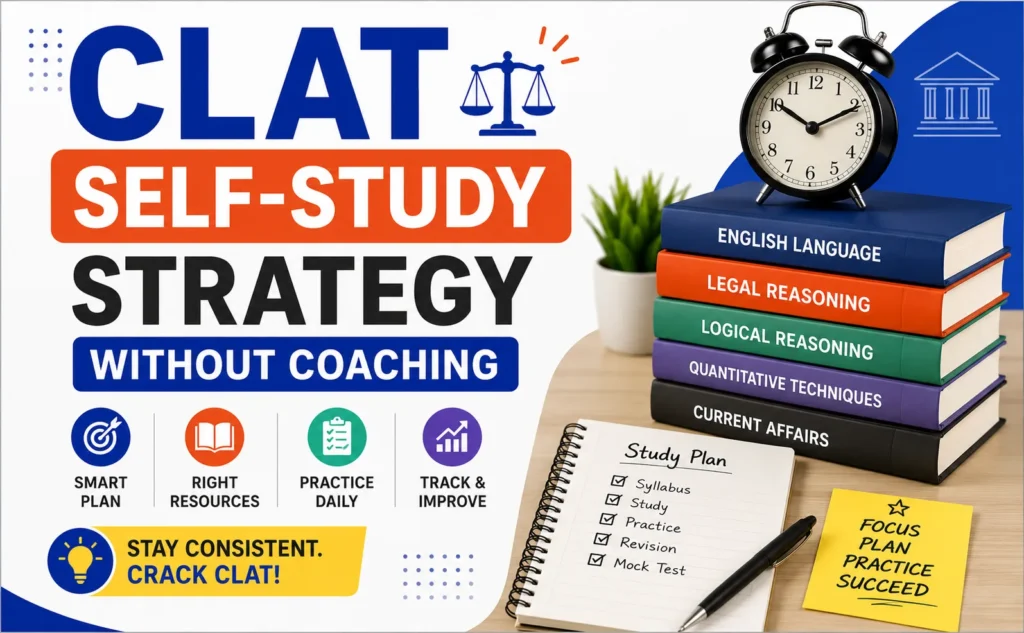
The CLAT 2028 Self-Study Strategy Without Coaching is becoming increasingly popular among law aspirants who want to secure admission to top NLUs without depending on traditional classroom programs.
If you are wondering how to prepare for CLAT 2028 without coaching, the answer is simple: build a structured plan, stay consistent, and focus on the skills that CLAT actually tests.
The exam is largely comprehension-driven and evaluates reading ability, logical thinking, legal reasoning, and current affairs awareness rather than rote memorisation.
A well-planned CLAT 2028 self-study plan can help you compete effectively and achieve a top CLAT score.
Why Self-Study Can Work for CLAT 2028?
Many students believe coaching is mandatory to crack CLAT, but the reality is different. The CLAT 2028 Self-Study Strategy Without Coaching can be highly effective because the exam primarily tests reading comprehension, reasoning skills, and analytical thinking. Since CLAT is not based on extensive memorisation, disciplined self-learning often delivers excellent results.
The biggest advantage of CLAT 2028 preparation at home is flexibility. You can create a personalised CLAT 2028 study schedule, spend more time on weak areas, and revise at your own pace. Self-study is also cost-effective and encourages independent learning.
With regular newspaper reading, focused practice, and consistent mock test analysis, students can build a strong CLAT 2028 preparation strategy without relying entirely on coaching institutes.
Understand CLAT 2028 Before You Start
Before following any CLAT 2028 Self-Study Strategy Without Coaching, you must understand the exam structure. A clear understanding of the pattern helps you create an efficient CLAT 2028 study schedule and prioritise high-scoring areas.
CLAT 2028 Exam Pattern
| Feature | Details |
| Mode | Offline (Pen & Paper) |
| Duration | 120 Minutes |
| Total Questions | 120 |
| Marking Scheme | +1, -0.25 |
| Sections | English, GK, Legal, Logical, Quant |
Section-Wise Weightage
| Section | Approx. Weightage |
| Current Affairs & GK | 25% |
| Legal Reasoning | 25% |
| English Language | 20% |
| Logical Reasoning | 20% |
| Quantitative Techniques | 10% |
Since Legal Reasoning and Current Affairs carry the highest weightage, every CLAT 2028 self-study plan should allocate maximum preparation time to these sections.
Step-by-Step CLAT 2028 Self-Study Strategy
A successful CLAT 2028 Self-Study Strategy Without Coaching requires consistency, planning, and continuous improvement. Instead of studying randomly, follow a structured approach that covers all sections of the exam.
Step 1: Build a Daily Reading Habit
Reading is the foundation of CLAT 2028 preparation at home. Spend at least one hour daily reading newspapers such as The Hindu or The Indian Express. This improves English comprehension, Current Affairs awareness, and Legal Reasoning simultaneously.
Step 2: Follow a Structured Daily Schedule
A disciplined CLAT 2028 daily study plan helps maintain consistency.
| Activity | Daily Time |
| Newspaper Reading | 1 Hour |
| English & Legal Reading | 1 Hour |
| Logical Reasoning Practice | 1 Hour |
| Current Affairs Notes | 30 Minutes |
| Quantitative Techniques | 30 Minutes |
| Revision & Analysis | 1 Hour |
Step 3: Focus on High-Weightage Areas
Since Legal Reasoning and Current Affairs together contribute nearly half of the paper, prioritise these sections in your CLAT 2028 preparation strategy. Develop strong reading and analytical skills rather than relying on memorisation.
Step 4: Create Personal Notes
Maintain concise notes for current affairs, important legal developments, vocabulary, and frequently made mistakes. Self-prepared notes make revision faster and more effective.
Step 5: Start Sectional Tests Early
After building basic concepts, begin sectional tests for English, Legal Reasoning, Logical Reasoning, and Quantitative Techniques. This helps identify weak areas before full-length mock tests.
Step 6: Take Mock Tests and Analyse Them
Mock tests are the most important part of any CLAT 2028 self-study plan. Simply attempting mocks is not enough. Analyse every test carefully, identify recurring mistakes, improve time management, and maintain an error log. Consistent mock analysis often becomes the difference between an average score and a top NLU rank.
Best Resources & Books for CLAT 2028 Self Preparation
Choosing the right resources is crucial for an effective CLAT 2028 Self-Study Strategy Without Coaching. One of the biggest mistakes aspirants make is collecting too many books instead of mastering a few quality resources.
Recommended Resources
| Section | Recommended Resource |
| English | The Hindu, Indian Express, RC Practice Sets |
| Current Affairs | Monthly Current Affairs Compilations |
| Legal Reasoning | CLAT Legal Reasoning Practice Material |
| Logical Reasoning | Analytical Reasoning Question Banks |
| Quantitative Techniques | Class 10 Arithmetic & DI Practice |
For students following a CLAT 2028 self-study plan, newspaper reading should remain non-negotiable. Focus on regular practice, revision, and mock tests rather than constantly switching resources. Consistency with limited, high-quality study material delivers far better results than studying from multiple sources.
Common Mistakes to Avoid During Self-Study
Even the best CLAT 2028 Self-Study Strategy Without Coaching can fail if common mistakes are ignored. Many aspirants lose valuable marks due to poor planning rather than a lack of ability.
Avoid these mistakes:
- Studying without a fixed CLAT 2028 study schedule
- Ignoring daily newspaper reading
- Using too many books and resources
- Delaying mock tests until the final months
- Skipping mock test analysis
- Focusing excessively on Quant despite its lower weightage
- Relying on memorisation instead of comprehension
Avoiding these errors can significantly improve your CLAT 2028 performance.
Previous Related Blogs You Should Read
To strengthen your CLAT 2028 Self-Study Strategy Without Coaching, explore these related guides that cover important aspects of preparation in greater detail:
- CLAT 2028 Registration Process: Step-by-Step Application Guide
- CLAT 2028 Syllabus: Topics, Weightage & Preparation Strategy
- CLAT 2028 Complete Guide: Exam Pattern, Syllabus, Dates & Preparation Tips
- Is CLAT 2028 Tough? Difficulty Level, Competition & Expert Analysis
- CLAT 2028 Registration Last Date: Important Deadlines & Updates
- CLAT 2028 Time Management Techniques
- CLAT 2028 Revision Strategy for Last 30 Days
- CLAT 2028 Preparation for Class 12 Students
- CLAT 2028 Preparation for Class 11 Students
How Tarkashastra Supports Self-Study Aspirants
- A strong CLAT 2028 Self-Study Strategy Without Coaching does not mean preparing without support.
- At Tarkashastra, self-study aspirants receive access to high-quality CLAT mock tests, detailed performance analysis, current affairs modules, mentorship sessions, and doubt-solving support.
- Our structured guidance helps students stay accountable, track progress, and improve weak areas.
- This combination of independent preparation and expert direction significantly enhances the effectiveness of any CLAT 2028 self-study plan.
Conclusion
The CLAT 2028 Self-Study Strategy Without Coaching can deliver excellent results when supported by consistency, reading habits, smart revision, and mock analysis. Follow a disciplined plan, and success becomes achievable.
FAQs – CLAT 2028 Self-Study Strategy Without Coaching
1. Can I crack CLAT 2028 without coaching?
Yes, you can crack CLAT 2028 without coaching if you follow a structured study plan, maintain consistency, develop strong reading habits, and regularly analyse mock tests. Since CLAT focuses on comprehension and reasoning, self-study can be highly effective.
2. How many hours should I study daily for CLAT 2028 self-preparation?
Most aspirants should aim for 4–6 productive hours daily. The focus should be on quality study, newspaper reading, current affairs preparation, reasoning practice, and revision rather than simply increasing study hours.
3. What is the best CLAT 2028 self-study plan?
A good CLAT 2028 self-study plan includes daily newspaper reading, Legal Reasoning practice, Logical Reasoning questions, current affairs revision, Quantitative Techniques practice, and regular mock test analysis.
4. Which newspaper is best for CLAT 2028 preparation?
The Hindu and The Indian Express are widely recommended because they improve reading comprehension, vocabulary, legal awareness, and current affairs knowledge simultaneously.
5. How important are mock tests in CLAT 2028 preparation?
Mock tests are essential. They help improve speed, accuracy, time management, and exam temperament. More importantly, analysing mock tests helps identify weaknesses and improve overall performance.
6. Which section should I prioritise during CLAT 2028 self-study?
Legal Reasoning and Current Affairs should receive the highest priority because they carry significant weightage in the exam. English and Logical Reasoning should also be practiced regularly.
7. Is coaching necessary to get admission into a top NLU?
No. Many students secure admission to top NLUs through disciplined self-study. Success depends more on consistency, strategy, and mock test performance than on coaching alone.
8. What are the biggest mistakes CLAT aspirants make during self-study?
Common mistakes include skipping newspaper reading, using too many books, delaying mock tests, ignoring mock analysis, and studying without a proper timetable.
9. When should I start preparing for CLAT 2028?
The earlier you start, the better. Students in Class 11 or the beginning of Class 12 have sufficient time to build reading skills, strengthen concepts, and develop a strong exam strategy.
10. How can Tarkashastra help self-study aspirants?
Tarkashastra supports self-study aspirants through expert mentorship, CLAT mock tests, performance analysis, current affairs modules, doubt-solving sessions, and structured preparation guidance that complements independent learning.