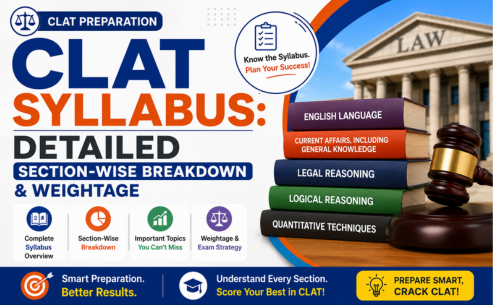
Understanding the CLAT 2027 Syllabus is the first step toward serious CLAT preparation. Many students begin preparing with random mock tests and study materials without understanding the actual exam structure. However, the modern CLAT 2027 exam pattern is no longer memory-based. The exam is now heavily focused on reading comprehension, analytical thinking, and passage-based reasoning.
The CLAT syllabus 2027, section-wise, includes five major sections: English Language, Current Affairs & GK, Legal Reasoning, Logical Reasoning, and Quantitative Techniques. Each section evaluates interpretation, application, and decision-making under time pressure.
A clear understanding of the CLAT 2027 subject-wise weightage helps students prioritise their preparation strategically, rather than studying everything randomly.
CLAT 2027 Exam Pattern Overview
Before starting preparation, students must clearly understand the CLAT 2027 Exam Pattern. The exam follows a passage-based format, in which almost every section tests comprehension and reasoning rather than direct factual recall. Recent CLAT papers have consistently focused on analytical reading and interpretation.
The CLAT 2027 syllabus follows a fixed structure with 120 MCQs to be solved within 2 hours. The paper includes negative marking, making accuracy extremely important.
CLAT 2027 Exam Pattern
| Feature | Details |
| Exam Mode | Offline (Pen & Paper) |
| Total Questions | 120 |
| Duration | 2 Hours |
| Question Type | MCQs |
| Sections | 5 |
| Negative Marking | -0.25 |
| Correct Answer | +1 Mark |
The CLAT 2027 exam pattern includes five sections:
- English Language
- Current Affairs & GK
- Legal Reasoning
- Logical Reasoning
- Quantitative Techniques
Understanding this structure helps students build a focused CLAT 2027 preparation strategy aligned with the actual exam demands.
CLAT 2027 Section-Wise Weightage
Understanding the CLAT 2027 subject-wise weightage is essential for smart preparation. Not all sections contribute equally to the final score. Recent exam trends show that Legal Reasoning and Current Affairs & GK together account for nearly half of the paper, making them the highest-priority sections in the CLAT 2027 syllabus.
At the same time, students should not ignore low-weightage sections like Quantitative Techniques, as they can become highly scoring with proper practice.
CLAT 2027 Section-Wise Weightage
| Section | Expected Questions | Weightage |
| English Language | 22–26 | 20% |
| Current Affairs & GK | 28–32 | 25% |
| Legal Reasoning | 28–32 | 25% |
| Logical Reasoning | 22–26 | 20% |
| Quantitative Techniques | 10–14 | 10% |
Key Insights
- Legal Reasoning + GK = nearly 50% of the paper
- Quantitative Techniques has a lower weightage but high scoring potential
- Reading comprehension impacts almost every section in the CLAT syllabus 2027, section-wise structure
- Accuracy matters because of negative marking
A strong understanding of the CLAT 2027 important topics and weightage helps students allocate preparation time more effectively.
English Language Syllabus
The English section in the CLAT 2027 Syllabus is completely passage-based. The Consortium no longer focuses on direct grammar questions, fill-in-the-blanks, or vocabulary memorisation. Instead, the section tests reading comprehension, interpretation, and analytical understanding through passages of around 450 words.
Students preparing for the CLAT English syllabus 2027 must focus on reading stamina and inference-based thinking rather than traditional grammar exercises.
CLAT English Language Section Overview
| Skills Tested | Focus Area |
| Reading Comprehension | Main idea & theme |
| Inference-Based Questions | Logical conclusions |
| Vocabulary in Context | Meaning within passage |
| Tone Analysis | Author’s viewpoint |
| Passage Structure | Flow of arguments |
Recent CLAT papers have shown increasing emphasis on:
- Editorial-style passages
- Social and legal themes
- Author tone analysis
- Contextual vocabulary
Preparation Strategy for CLAT English
- Read editorials daily
- Practice long RC passages
- Focus on inference-based questions
- Improve reading speed and concentration
For effective CLAT reading comprehension preparation, newspapers like The Hindu and The Indian Express remain highly useful.
GK & Current Affairs Syllabus
The GK section in the CLAT 2027 Syllabus has changed significantly in recent years. Earlier, the section focused heavily on static factual recall. Now, the CLAT GK syllabus 2027 is largely passage-based and tests contextual understanding of current events.
Most questions are linked to national and international developments, legal updates, government policies, and issue-based analysis.
Important Topics in CLAT GK & Current Affairs
| Topic Area | Focus |
| National Affairs | Government policies & bills |
| International Affairs | Global events & treaties |
| Legal Developments | Supreme Court judgments |
| Economy | Budget, RBI, inflation |
| Environment | Climate agreements & COP summits |
| Science & Technology | ISRO, AI, innovations |
The CLAT current affairs preparation strategy should focus on consistency rather than last-minute revision.
Preparation Strategy
- Read newspapers daily
- Maintain monthly current affairs notes
- Revise legal and constitutional developments regularly
- Focus on issue-based understanding instead of memorisation
Since GK carries nearly 25% weightage, consistent preparation can significantly improve overall CLAT scores.
Legal Reasoning Syllabus
Legal Reasoning is one of the most important sections in the CLAT 2027 Syllabus because it carries the highest weightage along with GK & Current Affairs. The section does not test prior legal knowledge directly. Instead, it evaluates a student’s ability to understand legal principles and apply them logically to factual situations.
The modern CLAT Legal Reasoning syllabus is heavily passage-based, focusing on interpretation, application, and analytical reasoning.
Important Topics in CLAT Legal Reasoning
| Topic | Focus Area |
| Constitutional Law | Rights, governance, judiciary |
| Law of Torts | Liability & negligence |
| Contract Law | Offer, acceptance, breach |
| Criminal Law | Basic legal principles |
| Contemporary Legal Issues | Policy & constitutional debates |
Recent CLAT papers have included topics such as:
- Privacy rights
- Free speech
- UCC debates
- Technology regulation
- Governance accountability
Preparation Strategy for Legal Reasoning
- Practice principle-based questions daily
- Focus on passage interpretation
- Read legal news and Supreme Court updates
- Avoid memorising advanced legal theory
Students preparing for the CLAT 2027 should prioritise legal passage analysis, as this section often serves as the biggest rank differentiator.
Logical Reasoning Syllabus
The Logical Reasoning section in the CLAT 2027 Syllabus now resembles critical reasoning more than traditional verbal reasoning. The section focuses on argument analysis, inference, assumptions, and logical interpretation through short passages.
Students preparing for the CLAT Logical Reasoning syllabus must develop structured analytical thinking rather than rely on shortcuts or guesswork.
Important Topics in Logical Reasoning
- Arguments & conclusions
- Assumptions
- Strengthen & weaken questions
- Logical inference
- Cause-and-effect reasoning
- Critical reasoning passages
Recent CLAT papers have included:
- Opinion-based arguments
- Social issue passages
- Ethical reasoning
- Analytical inference questions
Preparation Strategy
- Practice passage-based critical reasoning daily
- Identify conclusions and assumptions carefully
- Solve timed reasoning sets
- Focus on accuracy because of negative marking
Strong performance in Logical Reasoning improves overall analytical ability across the entire CLAT 2027 exam pattern.
Quantitative Techniques Syllabus
The Quantitative Techniques section in the CLAT 2027 Syllabus carries the lowest weightage. Still, it remains one of the most scoring sections for well-prepared students. The questions are based on Class 10-level mathematics and mainly focus on data interpretation rather than advanced calculations.
The modern CLAT Quant syllabus tests interpretation of numerical information through graphs, tables, and charts.
Important Topics in Quantitative Techniques
| Topic | Focus Area |
| Percentages | Percentage change |
| Ratios & Proportions | Comparative analysis |
| Profit & Loss | Commercial maths |
| Averages | Numerical interpretation |
| Data Interpretation | Tables & graphs |
Recent CLAT papers have focused heavily on:
- Graph interpretation
- Table-based DI
- Calculation speed under time pressure
Preparation Strategy
- Revise basic arithmetic concepts
- Practice DI sets regularly
- Improve calculation speed
- Focus on accuracy instead of difficult maths
Since Quant carries around 10% weightage, even a few correct answers can create a strong score advantage.
Smart Preparation Strategy for CLAT 2027
A successful CLAT 2027 preparation strategy depends more on consistency and analytical practice than on collecting excessive study material. Since the modern CLAT 2027 syllabus is passage-based, students must regularly focus on reading, reasoning, and mock analysis.
Smart Preparation Tips for CLAT 2027
- Read editorials daily to improve comprehension speed
- Practice passage-based questions from all sections
- Analyse Previous Year Questions (PYQs) carefully
- Revise Current Affairs monthly instead of last-minute cramming
- Attempt mock tests regularly under timed conditions
- Track weak areas through mock analysis
- Prioritise accuracy because of negative marking
Section-Wise Focus Strategy
| Section | Primary Focus |
| English | Reading comprehension |
| GK & CA | Consistent revision |
| Legal Reasoning | Principle application |
| Logical Reasoning | Critical reasoning |
| Quant | Data Interpretation |
Students preparing for CLAT 2027 should understand that long-term reading habits and structured mock practice are far more effective than rote memorisation.
Related Blogs You Should Read
To strengthen your CLAT 2027 preparation strategy, you should also explore these related guides that cover mock planning, preparation timelines, and exam comparison strategies:
- CLAT 2026 Exam Analysis: Section-Wise Review, Difficulty Level & Good Attempts
- CLAT 2027 Registration Process: Step-by-Step Application Guide
- CLAT 2027 Complete Guide: Exam Pattern, Syllabus, Dates & Preparation Tips
- Is CLAT 2027 Tough? Difficulty Level, Competition & Expert Analysis
- CLAT 2027 Registration Last Date: Important Deadlines & Updates
- CLAT 2027 Full Form: Meaning, Exam Purpose & Career Scope Explained
- Top Law Colleges in Hyderabad Through CLAT 2027: Fees, Placements & Ranking
- Top Law Colleges in Maharashtra Through CLAT 2027: Colleges, Fees & Cutoffs
These blogs help students develop a more structured, practical approach to the CLAT 2027 syllabus and overall exam preparation.
Why Choose Tarkashastra for CLAT 2027 Preparation?
Preparing for the CLAT 2027 syllabus requires more than just completing topics. Students need structured guidance, regular mock analysis, passage-based practice, and a preparation strategy aligned with the modern CLAT pattern.
Tarkashastra helps students prepare through:
- Section-wise preparation planning
- CLAT-focused mock tests and analysis
- Reading comprehension and reasoning practice
- Current Affairs revision support
- Personalised mentorship and performance tracking
Since the modern CLAT 2027 exam pattern is heavily analytical, Tarkashastra focuses on improving comprehension, logical thinking, and application-based problem-solving rather than rote memorisation.
Whether you are starting early or refining your preparation through mocks and PYQs, a structured approach can significantly improve consistency and exam performance.
Conclusion
The CLAT 2027 Syllabus is designed to test comprehension, reasoning, interpretation, and analytical thinking rather than memorisation. Every section of the exam now revolves around passage-based problem-solving, making reading ability and logical reasoning the most important skills for aspirants.
Students preparing for the CLAT 2027 exam pattern should focus on:
- Consistent reading habits
- Section-wise preparation
- Mock test analysis
- Current affairs revision
- Accuracy under time pressure
A clear understanding of the CLAT syllabus 2027, section-wise, helps students prepare strategically rather than study randomly. Smart preparation, regular practice, and strong analytical skills remain the key factors for achieving a high CLAT score.
FAQs on CLAT 2027 Syllabus
1. What is the syllabus for CLAT 2027?
The CLAT 2027 syllabus includes English Language, Current Affairs & GK, Legal Reasoning, Logical Reasoning, and Quantitative Techniques.
2. Has the CLAT 2027 syllabus changed?
No major official changes have been announced. The exam continues to follow a passage-based analytical format.
3. Which section has the highest weightage in CLAT 2027?
Legal Reasoning and Current Affairs & GK carry the highest weightage, contributing nearly 50% of the paper together.
4. Is CLAT 2027 passage-based?
Yes. Modern CLAT papers are heavily passage-based across almost all sections.
5. Is Maths difficult in CLAT?
No. Quantitative Techniques is based on Class 10-level maths and mainly focuses on Data Interpretation.
6. Does CLAT require prior legal knowledge?
No. The Legal Reasoning section tests the application of the legal principles presented in the passage.
7. How many questions are there in CLAT 2027?
The exam is expected to contain 120 multiple-choice questions.
8. What is the marking scheme for CLAT 2027?
Students receive +1 for every correct answer and -0.25 for every incorrect answer.
9. How should I prepare for CLAT 2027 Current Affairs?
Students should read newspapers daily, maintain monthly notes, and revise current affairs consistently.
10. What is the best preparation strategy for CLAT 2027?
The best CLAT 2027 preparation strategy includes daily reading, sectional practice, mock tests, PYQ analysis, and regular revision.