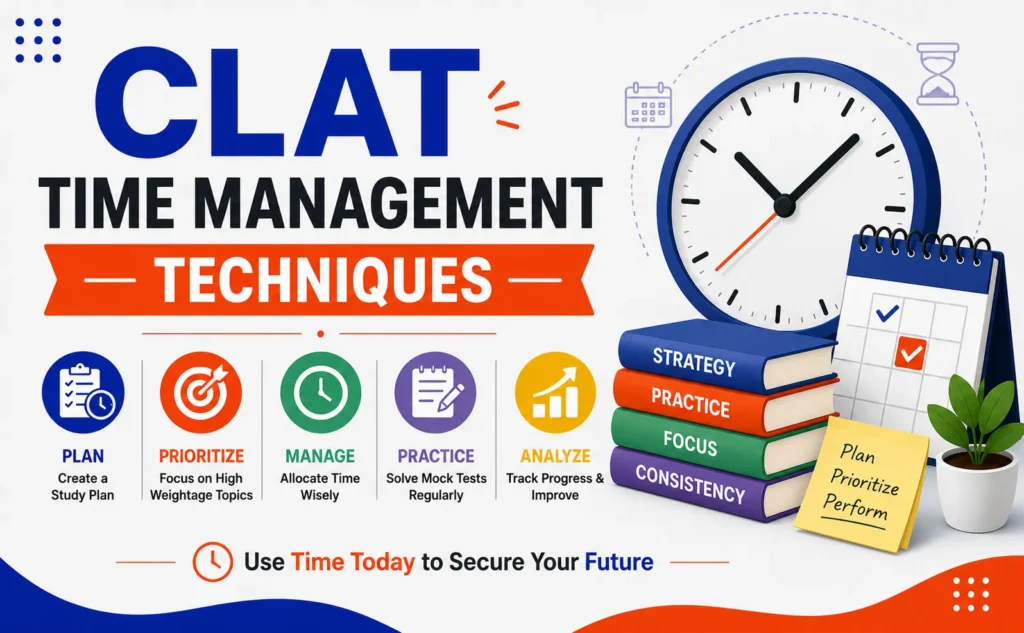
The most overlooked factor in CLAT preparation is time management. Since the exam requires candidates to solve 120 questions in 120 minutes, success depends not only on knowledge but also on speed, accuracy, and decision-making. Effective CLAT 2028 Time Management Techniques help students maximise attempts, reduce negative marking, and handle passage-based sections efficiently.
In this blog, we will discuss a practical CLAT 2028 time management strategy, section-wise time allocation, mock test execution, and exam-day techniques that can significantly improve your overall score.
Section-Wise Time Management Strategy for CLAT 2028
Understanding CLAT 2028 Time Management Techniques requires allocating time according to section weightage and difficulty. Since Legal Reasoning and Current Affairs carry the highest weightage, students should prioritise them while ensuring enough time remains for Logical Reasoning, English, and Quant.
Recommended Time Allocation
| Section | Suggested Time |
| Current Affairs & GK | 8–10 mins |
| English Language | 20–22 mins |
| Legal Reasoning | 32–35 mins |
| Logical Reasoning | 22–25 mins |
| Quantitative Techniques | 12–15 mins |
| Review Buffer | 10 mins |
- English Language
Focus on understanding the passage before reading questions. Avoid re-reading entire passages repeatedly.
- Current Affairs & GK
This should be the quickest section. Attempt known questions immediately and skip doubtful ones.
- Legal Reasoning
As the highest-weightage section, it requires the most time. Read the principle carefully before evaluating options.
- Logical Reasoning
Set a fixed time limit for each passage. Use elimination to reduce decision-making time.
- Quantitative Techniques
Prioritise DI sets that appear straightforward. Avoid lengthy calculations during the first round.
A practical CLAT 2028 section-wise time allocation strategy prevents panic and ensures balanced attempts across all sections. Students should test and refine this timing through regular mocks before exam day.
How CLAT Toppers Manage Time During the Exam?
Successful candidates rely on proven CLAT 2028 Time Management Techniques rather than attempting questions randomly. Their primary goal is to maximize accurate attempts while avoiding time-consuming questions.
Most toppers follow a two-round approach. In the first round, they solve easy and moderate questions quickly. In the second round, they revisit marked questions and difficult passages.
Topper Time Management Framework
| Stage | Objective |
| First 90 Minutes | Attempt all easy and moderate questions |
| Next 20 Minutes | Revisit flagged questions |
| Last 10 Minutes | Review marked answers and errors |
The most effective CLAT 2028 exam time management strategy is avoiding difficult passages during the initial attempt. This prevents loss of momentum and ensures better coverage of the paper. Consistent mock-test practice helps students identify the approach that works best for them.
CLAT 2028 Mock Test Time Management Strategy
Developing strong CLAT 2028 Time Management Techniques requires regular mock-test practice. Mocks help students identify slow sections, improve decision-making, and refine their CLAT 2028 section-wise time allocation.
Mock Test Frequency Plan
| Phase | Mock Frequency |
| Foundation Phase | 1 Mock/Week |
| Practice Phase | 2 Mocks/Week |
| Final 3 Months | 3 Mocks/Week |
After every mock, track:
- Time spent per section
- Accuracy percentage
- Questions left unattempted
- Reading speed and comprehension
The biggest mistake students make is taking multiple mocks without analysis. An effective CLAT 2028 mock test strategy focuses on identifying why questions were missed and where time was wasted. Maintaining a simple error log helps improve speed and accuracy over time.
Mock tests should be used to test different attempt orders and timing plans so that exam-day execution becomes predictable and efficient.
Common Time Management Mistakes That Cost Marks
Even students with strong preparation lose marks because of poor CLAT 2028 exam time management. Most mistakes occur due to panic, poor question selection, or lack of mock-test analysis.
Common Mistakes & Solutions
| Mistake | Solution |
| Spending too much time on one passage | Move ahead and revisit later |
| Starting with the weakest section | Begin with a comfortable section |
| Ignoring Quantitative Techniques | Attempt scoring DI sets |
| Blind guessing | Prioritise accuracy over attempts |
| Not following a fixed timing plan | Use sectional time limits |
A strong CLAT 2028 time management strategy focuses on maximising easy marks first and avoiding unnecessary time drains. Eliminating these mistakes can significantly improve both attempts and accuracy.
30-Day Time Management Improvement Plan for CLAT 2028
Improving CLAT 2028 Time Management Techniques requires structured practice rather than simply taking more mocks. A focused 30-day plan can significantly improve speed, accuracy, and question selection.
Week-by-Week Plan
Week 1: Improve reading speed through daily editorials and passage practice.
Week 2: Take timed sectional tests to build speed in Legal, Logical, and English.
Week 3: Attempt full-length mocks and track section-wise time usage.
Week 4: Simulate actual exam conditions and fine-tune your attempt strategy.
By the end of 30 days, students should be able to manage passages more efficiently, reduce wasted time, and execute a reliable CLAT 2028 exam time management plan on test day.
Related Blogs You Must Read
To strengthen your CLAT 2028 Time Management Techniques, explore these related guides that complement your preparation:
- CLAT 2028 Registration Process: Step-by-Step Application Guide
- CLAT 2028 Syllabus: Topics, Weightage & Preparation Strategy
- CLAT 2028 Complete Guide: Exam Pattern, Syllabus, Dates & Preparation Tips
- Is CLAT 2028 Tough? Difficulty Level, Competition & Expert Analysis
- CLAT 2028 Registration Last Date: Important Deadlines & Updates
These resources will help you build a stronger CLAT 2028 preparation strategy, improve section-wise planning, and maximise your performance in mock tests and the actual exam.
How Tarkashastra Helps Students Master CLAT Time Management
At Tarkashastra, CLAT 2028 Time Management Techniques are integrated into preparation from the beginning. Since CLAT is a passage-based exam, students are trained to improve reading speed, accuracy, and section-wise execution through structured practice.
Tarkashastra provides:
- Section-wise time management drills
- Full-length CLAT mock tests with analysis
- Reading comprehension improvement sessions
- Personalised performance tracking
- Exam-specific strategy mentorship
Regular feedback helps students identify time-consuming mistakes, optimise their CLAT 2028 section-wise time allocation, and develop a practical exam-day approach. This ensures better accuracy, smarter attempts, and improved overall scores.
Conclusion
Mastering CLAT 2028 Time Management Techniques can significantly improve your final score and rank. Since the exam is heavily passage-based, success depends on balancing speed, accuracy, and intelligent question selection.
A well-planned CLAT 2028 time management strategy, combined with regular mock-test analysis and section-wise practice, helps students maximise attempts while minimising negative marking. Start building these habits early, test them consistently through mocks, and refine your approach before exam day.
Effective time management often becomes the difference between an average score and a top CLAT rank.
FAQs on CLAT 2028 Time Management Techniques
1. Why is time management important for CLAT 2028?
Time management is important because CLAT requires candidates to solve 120 questions in 120 minutes. Proper planning helps maximise attempts while maintaining accuracy.
2. What is the ideal section-wise time allocation for CLAT 2028?
A common strategy is 8–10 minutes for GK, 20–22 minutes for English, 32–35 minutes for Legal Reasoning, 22–25 minutes for Logical Reasoning, and 12–15 minutes for Quantitative Techniques.
3. Which section should I attempt first in CLAT 2028?
Most students begin with their strongest section. Many aspirants prefer Current Affairs & GK first because it can be completed quickly.
4. How can I improve my reading speed for CLAT?
Daily editorial reading, passage practice, and timed comprehension exercises help improve reading speed and understanding.
5. How many mock tests should I take before CLAT 2028?
Students should aim for at least 30–40 quality mock tests along with detailed analysis to improve timing and accuracy.
6. What is the biggest time-management mistake in CLAT?
Spending too much time on a single passage is one of the most common mistakes and often reduces overall attempts.
7. Should I attempt every question in CLAT 2028?
No. Since CLAT has negative marking, students should avoid blind guessing and focus on questions they can solve with reasonable confidence.
8. How do CLAT toppers manage their time during the exam?
Most toppers use a two-round approach—attempting easy and moderate questions first, then revisiting difficult questions later.
9. How can mock tests improve time management?
Mock tests help students identify slow sections, track accuracy, refine section-wise timing, and develop an effective exam strategy.
10. Can strong time management improve my CLAT rank?
Yes. Strong CLAT 2028 Time Management Techniques can increase attempts, reduce errors, and significantly improve overall scores and rank.