Introduction
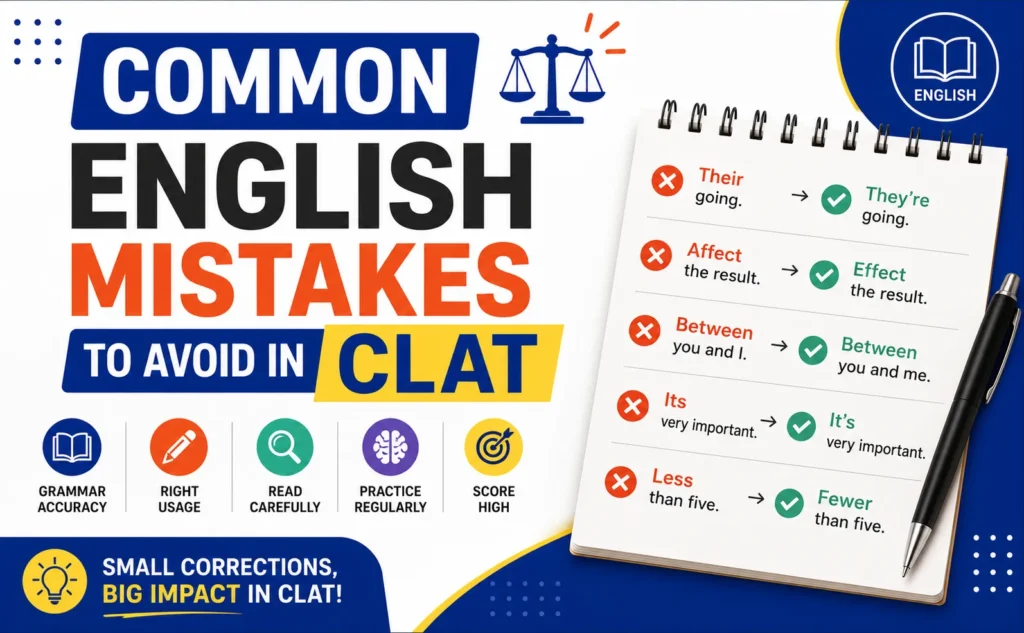
The Common English Mistakes to avoid in CLAT can significantly impact your overall score, even if you have strong reasoning abilities. Since the CLAT English section is comprehension-driven, students often lose marks because of avoidable errors rather than a lack of knowledge.
The exam tests reading comprehension, vocabulary, inference skills, and language understanding through passage-based questions. With negative marking in place, every incorrect answer reduces your final score.
Understanding the Common English Mistakes to avoid in CLAT early helps improve accuracy, confidence, and performance. This guide covers the most frequent errors and practical ways to avoid them during preparation.
Why English Accuracy Matters in CLAT?
English accuracy plays a crucial role in CLAT because the section contributes nearly 20% of the overall paper and directly affects your final rank. The modern CLAT pattern emphasizes comprehension, inference, vocabulary, and critical reading rather than direct grammar-based questions.
Students who make frequent reading and interpretation mistakes often lose easy marks due to negative marking. Since passages require careful analysis of the author’s tone, arguments, and conclusions, accuracy becomes more important than speed.
Avoiding the Common English Mistakes to avoid in CLAT helps improve question selection, reduce errors, and maximize scores in one of the highest-scoring sections of the exam.
Mistake #1 – Reading Passages Too Fast Without Understanding
One of the most common English mistakes in CLAT is rushing through passages to save time. Many students focus on completing the passage quickly but fail to understand the author’s main argument, tone, or purpose. As a result, they struggle with inference-based and comprehension questions.
What Students Usually Do?
- Skim passages without active reading.
- Ignore transition words and supporting arguments.
- Jump directly to questions without understanding the passage structure.
Why Does It Hurt Your Score?
Fast reading often leads to misinterpretation, incorrect assumptions, and avoidable negative marking. Students may confuse facts with opinions or miss subtle clues hidden within the passage.
Correct Approach
Read actively, identify the central idea, note the author’s viewpoint, and understand the flow of arguments. Strong comprehension improves both accuracy and confidence.
Mistake #2 – Ignoring Vocabulary Building
A weak vocabulary can become a major obstacle in CLAT English. Many aspirants rely on guesswork when they encounter unfamiliar words, which often leads to incorrect answers. Since CLAT tests vocabulary through context rather than direct word meanings, students must develop the habit of learning words naturally through reading.
Common Vocabulary Errors
- Memorising word lists without understanding usage.
- Ignoring editorial and opinion articles.
- Guessing meanings without analysing context.
How to Improve Vocabulary for CLAT?
Read quality newspapers daily, maintain a vocabulary notebook, and learn words through sentences rather than definitions. Consistent reading gradually improves comprehension and accuracy.
Mistake #3 – Depending Only on Grammar Rules
Many students spend excessive time studying grammar rules, believing that grammar alone can help them score well in CLAT English. While grammar knowledge is useful, the exam primarily evaluates comprehension, interpretation, and reasoning skills through passages. Focusing only on grammar often leaves students unprepared for the actual question types asked in the exam.
Traditional Grammar vs CLAT English
- Grammar focuses on sentence correctness.
- CLAT focuses on understanding meaning and context.
What CLAT Actually Tests
Students must interpret ideas, identify assumptions, draw conclusions, and understand the author’s perspective. Reading ability and comprehension skills carry far more weight than memorising grammar rules.
Mistake #4 – Not Practicing Inference-Based Questions
Inference-based questions are among the most challenging parts of CLAT English. Many students focus only on direct information available in the passage and struggle when asked to identify implied meanings, assumptions, or conclusions.
This approach leads to frequent errors despite understanding the passage at a basic level.
Direct Questions vs Inference Questions
| Direct Questions | Inference Questions |
| Answer is explicitly stated | Answer is implied |
| Easier to locate | Requires analysis |
| Fact-based | Logic-based |
How CLAT Tests Critical Reading?
CLAT often asks students to determine the author’s viewpoint, predict conclusions, identify assumptions, or interpret hidden meanings. Regular practice with inference-based questions improves analytical thinking. It helps avoid one of the most common English mistakes in CLAT.
Mistake #5 – Ignoring Newspaper Reading
Many CLAT aspirants underestimate the importance of daily newspaper reading. However, newspapers are one of the most effective resources for improving English comprehension, vocabulary, reading speed, and critical thinking. Students who skip this habit often struggle with passage-based questions and contextual vocabulary.
Why Newspapers Improve CLAT English?
- Enhance reading comprehension skills.
- Improve understanding of complex sentence structures.
- Build contextual vocabulary naturally.
- Develop the ability to identify arguments and opinions.
Recommended Reading Sources
| Newspaper | Benefit for CLAT |
| The Hindu | Editorial analysis and vocabulary |
| The Indian Express | Balanced opinion pieces and comprehension |
| Live Law | Legal awareness and legal language exposure |
A daily reading habit significantly reduces common English mistakes in CLAT and improves overall accuracy.
Mistake #6 – Not Analysing Mock Tests
Many students regularly attempt mock tests but fail to analyse them properly. Simply taking mocks does not guarantee improvement. The real learning happens when you review mistakes, identify patterns, and understand why questions were answered incorrectly. This is one of the most overlooked yet critical English mistakes in CLAT preparation.
The Biggest Improvement Opportunity
- Identifies recurring comprehension errors.
- Highlights weak vocabulary areas.
- Improves question selection strategy.
- Helps reduce negative marking.
How to Analyse English Errors?
| What to Track | Why It Matters |
| Wrong Answers | Understand recurring mistakes |
| Accuracy Rate | Measure improvement |
| Time Per Passage | Improve speed management |
| Vocabulary Errors | Build stronger word knowledge |
Top performers treat mock analysis as seriously as mock attempts. Consistent review leads to steady score improvement.
Mistake #7 – Poor Time Management During the English Section
Poor time management can significantly reduce your CLAT English score. Many students spend too much time on difficult passages or repeatedly revisit the same questions, leaving easier questions unanswered. Since CLAT is a time-bound examination, balancing speed and accuracy is essential.
Common Timing Errors
- Spending excessive time on a single passage.
- Attempting questions in random order.
- Overthinking answer choices.
Ideal Attempt Strategy
Start with passages you find comfortable, maintain a steady pace, and avoid getting stuck on difficult questions. Timed sectional practice helps improve decision-making and ensures maximum attempts without compromising accuracy.
Quick Checklist to Avoid English Mistakes in CLAT
Before every mock test or practice session, use this checklist to ensure you are avoiding the most common English mistakes in CLAT.
| Mistake | Solution |
| Reading too fast | Practice active reading and identify the main idea |
| Weak vocabulary | Read newspapers and maintain a vocabulary notebook |
| Over-reliance on grammar | Focus on comprehension and inference skills |
| Skipping mock analysis | Maintain an error log and review mistakes |
| Poor time management | Attempt timed sectional tests regularly |
Following this checklist consistently can improve accuracy, confidence, and overall CLAT English performance.
Related CLAT Blogs You Should Read
To strengthen your preparation beyond English, explore these related CLAT resources:
- CLAT 2028 Registration Process: Step-by-Step Application Guide
- CLAT 2028 Syllabus: Topics, Weightage & Preparation Strategy
- CLAT 2028 Complete Guide: Exam Pattern, Syllabus, Dates & Preparation Tips
- Is CLAT 2028 Tough? Difficulty Level, Competition & Expert Analysis
- CLAT 2028 Registration Last Date: Important Deadlines & Updates
- CLAT 2028 Time Management Techniques
- CLAT 2028 Revision Strategy for Last 30 Days
- CLAT 2028 Preparation for Class 12 Students
- CLAT 2028 Preparation for Class 11 Students
- CLAT 2028 Self-Study Strategy Without Coaching
- 6-Month CLAT 2028 Study Plan
- 1-Year CLAT 2028 Preparation Plan
- 3-Month CLAT 2028 Crash Course Strategy
- CLAT 2028 Important Information at a Glance
- CLAT 2028 Quick Guide for First-Time Aspirants
- CLAT 2028 Complete Beginner’s Guide
These guides provide deeper insights into exam strategy, preparation planning, syllabus coverage, and mock test preparation.
How Tarkashastra Helps Improve Your CLAT English Score
At Tarkashastra, we help students overcome the most common English mistakes in CLAT through a structured and result-oriented approach. Our CLAT programs focus on reading comprehension, vocabulary development, inference-based practice, and regular sectional tests.
Students receive detailed mock test analysis, personalized mentorship, and performance tracking to identify weaknesses early.
With expert guidance, daily practice resources, and continuous feedback, aspirants can improve accuracy, build confidence, and develop the skills required to excel in the CLAT English section.
Conclusion
Avoiding the Common English Mistakes to avoid in CLAT can significantly improve your performance in one of the highest-scoring sections of the exam. Focus on active reading, vocabulary building, inference practice, mock test analysis, and effective time management.
Small improvements in accuracy can lead to substantial score gains. Start correcting these mistakes early and build strong English skills to maximize your CLAT 2028 success.
FAQs – Common English Mistakes to Avoid in CLAT
1. What are the most common English mistakes students make in CLAT?
The most common mistakes include reading passages too quickly, weak vocabulary, over-reliance on grammar rules, poor time management, ignoring newspaper reading, and skipping mock test analysis.
2. Is vocabulary important for CLAT English?
Yes. A strong vocabulary helps you understand passages better, interpret contextual meanings, and answer comprehension questions more accurately.
3. Does CLAT ask direct grammar questions?
CLAT primarily focuses on comprehension, inference, and language understanding. Grammar knowledge is helpful, but it is not the main focus of the English section.
4. How can I improve my reading comprehension for CLAT?
Develop a daily reading habit, read editorials regularly, practice passage-based questions, and analyze your mistakes after every mock test.
5. Which newspapers should I read for CLAT English preparation?
The Hindu, The Indian Express, and Live Law are among the most recommended sources for improving reading skills, vocabulary, and critical thinking.
6. Why are inference-based questions difficult in CLAT?
Inference questions require you to identify implied meanings, assumptions, and conclusions rather than directly stated facts, making analytical thinking essential.
7. How many mock tests should I take for CLAT English improvement?
There is no fixed number, but regular mock tests combined with detailed analysis are crucial for identifying weaknesses and improving accuracy.
8. How can I manage time effectively during the CLAT English section?
Practice timed sectional tests, avoid spending too much time on difficult passages, and attempt questions strategically based on your strengths.
9. Is reading speed more important than accuracy in CLAT English?
No. Accuracy is more important because incorrect answers attract negative marking. A balance between speed and comprehension is essential.
10. Can I improve my CLAT English score without coaching?
Yes. With consistent reading, vocabulary building, regular practice, and mock analysis, students can significantly improve their English performance through self-study.