Introduction
Every year, thousands of students appear for IPMAT and other IPM entrance examinations with the dream of securing admission into a prestigious Integrated Programme in Management (IPM). However, many students focus solely on the entrance exam and overlook a critical aspect of the admission process—the IPM final merit list.
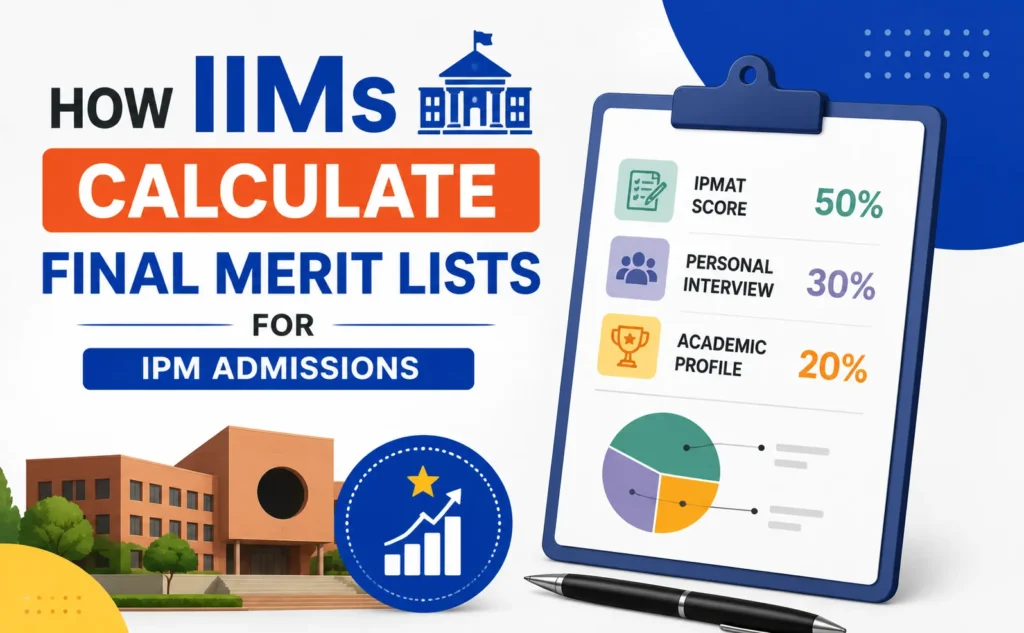
A high IPMAT score is important, but it does not guarantee admission. Most IIMs prepare a final merit list using a composite score that combines entrance exam performance, personal interview scores, and in some cases, academic records.
This guide explains everything about IPM merit list calculation, including how the IPMAT final score is used, how interviews influence rankings, and how different IIMs prepare their final admission lists.
What Is an IPM Final Merit List?
The IPM final merit list is the final ranking of candidates prepared by an institute after completing all stages of the admission process.
The merit list determines:
- Which candidates receive admission offers
- Candidate rankings within categories
- Waitlist positions
- Seat allocation priorities
Unlike entrance exam results, the merit list is based on multiple factors and not just the IPMAT score.
Why Is the Merit List Important?
Many students assume that clearing the cutoff means admission is secured.
In reality:
- Cutoffs only help candidates qualify for the next stage.
- Final admission depends on the composite score.
- Interview performance can significantly impact rankings.
- Academic records may influence selection in certain institutes.
Therefore, understanding the IPM admission criteria is essential for every aspirant.
Understanding the Final Composite Score
The foundation of every IPM merit list calculation is the composite score.
A composite score combines multiple admission parameters into a single numerical value.
A simplified formula looks like:
Final Composite Score = Entrance Exam Score + Interview Score + Academic Score + Additional Factors
Each institute assigns different weightages to these components.
Candidates are ranked according to their final composite score, and admission offers are issued based on these rankings.
Major Components Used in IPM Merit List Calculation
1. IPMAT Score
The entrance examination score remains the most important factor in most IPM admissions.
The IPMAT score is often normalised and converted into a standardised score before being used in merit list calculations.
Strong entrance performance helps candidates:
- Receive interview calls
- Achieve higher composite scores
- Improve final ranking
This is why entrance preparation remains the most critical part of the admission journey.
2. Personal Interview Score
The interview evaluates qualities that cannot be measured through an aptitude test.
Interview panels assess:
- Communication skills
- Confidence
- Academic understanding
- Leadership potential
- Career clarity
- Problem-solving ability
A strong interview can significantly improve a candidate’s final composite score.
3. Academic Performance
Some institutions consider the following:
- Class 10 marks
- Class 12 marks
- Consistency in academics
The weightage varies considerably across institutions.
4. Category-Based Ranking
Most IIMs prepare separate merit lists for:
- General
- EWS
- NC-OBC
- SC
- ST
- PwD
Candidates compete within their respective categories for final admission offers.
IIM Indore Merit List Calculation
The IIM Indore merit list is among the most straightforward among IPM institutions.
The final composite score is generally calculated using:
| Component | Weightage |
| Aptitude Test Score (ATS) | 65% |
| Personal Interview (PI) | 35% |
There is typically no direct weightage assigned to Class 10 or Class 12 board scores in the final composite score calculation. Candidates are selected based on their performance in the aptitude test and interview.
Example
Suppose:
- Aptitude Test Score = 80/100
- Interview Score = 70/100
Composite Score:
= (80 × 0.65) + (70 × 0.35)
= 52 + 24.5
= 76.5
Candidates are ranked according to this final composite score.
Why Interviews Matter So Much at IIM Indore
Many students underestimate the role of interviews.
At IIM Indore:
- Interview weightage is 35%.
- More than one-third of the final ranking depends on interview performance.
This means a candidate with a slightly lower IPMAT score can outperform a higher-scoring candidate through an excellent interview.
IIM Rohtak Merit List Calculation
The IIM Rohtak merit list follows a broader evaluation framework.
The final merit list generally includes:
| Component | Weightage |
| IPMAT Score | 55% |
| Personal Interview | 15% |
| Class 10 Marks | 10% |
| Class 12 Marks | 20% |
This approach rewards both entrance performance and academic consistency.
Example
Assume a candidate has:
- IPMAT Score: 85
- Interview Score: 80
- Class 10 Score: 90
- Class 12 Score: 88
Composite Score:
= (85 × 0.55)
- (80 × 0.15)
- (90 × 0.10)
- (88 × 0.20)
= 46.75 + 12 + 9 + 17.6
= 85.35
Candidates are then ranked according to these final scores.
Key Difference Between IIM Indore and IIM Rohtak
The biggest distinction lies in academic weightage.
IIM Indore
Focuses primarily on:
- IPMAT performance
- Personal Interview
IIM Rohtak
Focuses on:
- IPMAT score
- Interview performance
- Class 10 marks
- Class 12 marks
Students with strong board scores often gain an advantage at IIM Rohtak.
Do All IIMs Follow the Same Merit List Formula?
No.
Every institute designs its own admission framework.
Examples include:
| Institute | Entrance Test Weightage | Interview Weightage |
| IIM Indore | 65% | 35% |
| IIM Rohtak | 55% | 15% |
| IIM Ranchi | 65% | 15% |
| IIM Shillong | 30% | 50% |
| IIM Amritsar | 70% | 25% |
The exact formula changes periodically and may vary from year to year.
How the IPMAT Final Score Is Used
The IPMAT final score is not always used directly.
Institutes generally:
- Calculate raw scores.
- Normalise performance.
- Convert scores into weighted values.
- Combine them with interview and academic scores.
- Generate the composite score.
This ensures fair comparison among candidates.
Understanding Interview Weightage in IPM Admissions
The interview weightage IPM admissions assign can dramatically affect outcomes.
Consider two candidates:
| Candidate | IPMAT Score | Interview Score |
| A | 95 | 55 |
| B | 85 | 90 |
Depending on the weightage structure, Candidate B may receive a higher final composite score despite a lower entrance exam score.
This demonstrates why interview preparation is essential.
Can a Strong Interview Offset a Lower IPMAT Score?
In many cases, yes.
Particularly at institutes where interviews carry substantial weightage.
For example:
Candidate A
- IPMAT: Excellent
- Interview: Poor
Candidate B
- IPMAT: Good
- Interview: Excellent
Candidate B may rank higher if interview weightage is significant.
However, this does not mean students should ignore entrance preparation.
The ideal strategy is to perform well in both components.
Role of Class 10 and 12 Marks in Merit Lists
Many students ask whether board marks matter.
The answer depends on the institute.
Institutes That Give Academic Weightage
Examples include:
- IIM Rohtak
- Certain non-IIM IPM colleges
Institutes That Primarily Focus on Entrance Scores
Examples include:
- IIM Indore
Therefore, students should carefully review the admission policy of each target institute.
How Tie-Breakers Work in IPM Admissions
Sometimes multiple candidates achieve identical composite scores.
In such situations, institutes use tie-breaking mechanisms.
Common tie-breakers include:
Higher Entrance Test Score
The candidate with the higher aptitude score receives preference.
Higher Interview Score
Some institutions prioritise stronger interview performance.
Better Academic Record
Class 12 or Class 10 marks may be considered.
Age Criteria
Certain institutions may use age-related criteria if required.
The exact policy differs across institutes.
Why Cutoffs and Merit Lists Are Different
Students often confuse these terms.
Cutoff
The minimum score required to qualify for the next stage.
Merit List
The final ranking used for admission offers.
A candidate may:
- Clear the cutoff
- Receive an interview call
Yet they still fail to secure admission if their composite score is insufficient.
This is why the merit list is ultimately more important than the cutoff.
Common Reasons Students Miss the Merit List
Many candidates clear the entrance exam but fail to secure admission.
Common reasons include:
Weak Interview Performance
One of the most common causes.
Poor Communication Skills
Can negatively affect interview scores.
Low Academic Scores
Particularly relevant for institutes considering board marks.
Lack of Current Affairs Knowledge
Frequently impacts interview performance.
Incomplete Documentation
May result in cancellation despite selection.
Strategies to Maximise Your Merit List Ranking
Focus on Entrance Test Excellence
A high IPMAT score remains the strongest admission factor.
Prepare Thoroughly for Interviews
Practice:
- Personal introduction
- Academic concepts
- Current affairs
- Business awareness
Maintain Strong Board Performance
Especially important for institutes like IIM Rohtak.
Develop Communication Skills
Confidence and clarity often influence interview scores.
Build a Consistent Academic Profile
A well-rounded profile supports overall admission performance.
How Waitlists Are Prepared
After the final merit list is released:
- Top-ranked candidates receive offers.
- Remaining qualified candidates enter the waitlist.
If admitted candidates decline seats:
- Waitlisted candidates move up.
- Additional offers are released.
Many students eventually secure admission through waitlist movement.
Final Thoughts
The IPM final merit list is the ultimate deciding factor in IPM admissions. While the entrance examination plays a major role, institutes evaluate candidates holistically through interviews, academics, and composite score calculations.
Understanding IPM merit list calculation helps students allocate preparation time wisely. Aspirants targeting IIM Indore merit list positions should focus heavily on IPMAT and interview performance, while those aiming for IIM Rohtak merit list success must also pay attention to board marks and academic consistency.
The best strategy is simple: excel in the entrance exam, prepare seriously for interviews, maintain strong academics, and understand the admission criteria of every target institute.
FAQs
1. How is the final IPM merit list prepared?
The final merit list is prepared using a composite score that combines entrance exam performance, interview scores, and in some cases academic records such as Class 10 and Class 12 marks.
2. What weightage does an IPMAT score carry?
The weightage varies by institute. IIM Indore generally assigns 65% weightage to the aptitude test score, while IIM Rohtak assigns around 55%.
3. How much weightage is given to the personal interview?
Interview weightage varies across institutions. IIM Indore uses approximately 35%, while IIM Rohtak uses around 15% in final selection.
4. Do Class 10 and 12 marks affect the merit list?
Yes, in some institutions such as IIM Rohtak, board scores contribute to the final composite score. However, institutes like IIM Indore primarily focus on entrance and interview performance.
5. How are tie-breakers handled in IPM admissions?
Institutes typically use higher entrance scores, interview performance, academic records, or other predefined criteria to resolve ties in composite scores.
6. Does each IIM follow the same merit list formula?
No. Each IIM has its own admission criteria and weightage structure for preparing the final merit list.
7. How important is the interview score?
The interview can significantly influence final rankings, especially in institutes where it carries high weightage, such as IIM Indore.
8. Can a lower IPMAT score be compensated by a strong interview?
Yes. In many cases, an excellent interview performance can offset a moderately lower entrance score and improve the final composite score.
9. What is the final composite score in IPM admissions?
The final composite score is the weighted sum of entrance test scores, interview scores, academic records, and any other criteria used by the institute.
10. How can students maximize their merit list ranking?
Students should aim for a high IPMAT score, prepare extensively for interviews, maintain strong academic performance, improve communication skills, and understand the specific admission criteria of their target institutes.