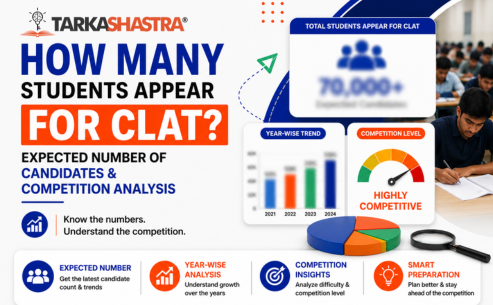
How Many Students Appear for CLAT 2027? Expected Number of Candidates & Competition Analysis
CLAT continues to attract a massive number of law aspirants every year, making it one of India’s most competitive entrance exams. Based on recent trends, the expected number of candidates appearing for CLAT 2027 is likely to remain between 75,000 and 90,000, with the most realistic estimate around 85,000.
The CLAT 2027 competition analysis is important because the number of available NLU seats is far lower than the total number of applicants. With only around 4,000 UG seats expected across participating NLUs, the CLAT 2027 seat-to-student ratio will remain highly competitive.
For aspirants, understanding how many students appear for CLAT 2027 helps set realistic preparation goals. It highlights the importance of consistent mock practice, reading speed, and accuracy.
CLAT Candidate Trends: Previous Year Data Analysis
The number of students appearing for CLAT has increased sharply over the last few years. This steady growth shows that CLAT is no longer a niche law entrance exam — it has become a mainstream national-level exam for students from Arts, Commerce, and Science backgrounds.
A major jump was seen between CLAT 2024 and CLAT 2026, indicating rising awareness about NLUs, corporate law careers, and legal education opportunities.
Year-Wise CLAT Registration & Appearance Trends
| Year | Registered Candidates | Appeared Candidates |
| 2023 | 54,253 | 51,469 |
| 2024 | 67,590 | 65,185 |
| 2025 | 78,914 | 75,361 |
| 2026 | 92,344 | 88,657 |
The data clearly suggests that CLAT 2027 applicants are unlikely to drop significantly. Instead, the CLAT 2027 competition is expected to remain near the high-80,000 range, keeping CLAT among the toughest law entrance exams in India.
How Many Students Are Expected to Appear for CLAT 2027?
Based on recent CLAT participation trends, the expected number of candidates appearing for CLAT 2027 is projected to remain between 75,000 and 90,000, while the most practical estimate remains around 85,000+.
The rise in CLAT 2027 applicants is mainly driven by the increasing popularity of NLUs and the growing awareness of law as a high-potential career option. More students are now preparing for CLAT alongside other national entrance exams, further increasing competition.
Why CLAT 2027 Candidate Numbers May Rise
- Growing popularity of corporate law and legal careers
- Increased awareness through coaching platforms and social media
- CLAT is accepted by multiple universities beyond NLUs
- More students from the Science and Commerce streams are attempting CLAT
With CLAT becoming a mainstream national exam, the CLAT 2027 competition analysis clearly indicates that aspirants should prepare for a highly competitive admission cycle.
CLAT 2027 Seats vs Candidates Ratio
The biggest reason for the intense competition in CLAT 2027 is the huge gap between the number of candidates and the number of available seats. While the expected number of CLAT 2027 applicants may cross 85,000, the total UG seats across participating NLUs are expected to remain around 3,900–4,000 seats.
This creates a very high CLAT 2027 seat-to-student ratio, making admission to top NLUs extremely competitive.
Expected CLAT 2027 Competition Ratio
| Expected Candidates | Expected UG Seats | Competition Ratio |
| 75,000 | 4,000 | 19:1 |
| 85,000 | 4,000 | 21:1 |
The real competition is not just about clearing CLAT 2027. Most students aim for top NLUs like NLSIU Bangalore, NALSAR Hyderabad, and NLU Delhi, where cutoff ranks are significantly higher. Even a small mark difference can lead to a major rank drop in such a crowded merit list.
Why Will CLAT 2027 Be Highly Competitive?
The CLAT 2027 competition analysis shows that the exam is difficult, not because of the syllabus size, but because of the quality of competition. Every year, thousands of serious aspirants compete within a very narrow score range, making even 1–2 marks extremely important.
CLAT 2027 is expected to remain highly competitive due to several reasons:
- Passage-heavy question pattern
- High focus on reading comprehension and legal reasoning
- Time pressure during long RC-based sections
- Increasing number of repeat aspirants
- Limited seats in top NLUs
Another major factor behind the CLAT 2027 competition level is that the exam rewards speed and accuracy rather than rote learning. Students must process lengthy passages quickly while maintaining high accuracy under pressure.
As a result, many candidates end up scoring in similar ranges, leading to significant fluctuations in rank. This is why securing admission into top NLUs requires not just preparation, but highly strategic preparation.
What CLAT 2027 Aspirants Should Learn From These Numbers?
The rising number of CLAT 2027 applicants clearly shows that students can no longer rely on last-minute preparation. With the CLAT 2027 expected competition likely crossing 85,000 candidates, aspirants need a structured and consistent preparation strategy.
Smart Preparation Priorities for CLAT 2027
- Build a daily reading habit for RC-heavy sections
- Practice mock tests regularly under timed conditions
- Improve accuracy in Legal and Logical Reasoning
- Revise Current Affairs consistently
- Focus on mock analysis, not just mock attempts
The CLAT 2027 competition analysis also highlights that small score differences can create major rank gaps. This makes time management and question selection extremely important during the exam.
Students who prepare consistently through reading practice, sectional tests, and full-length mocks usually perform far better than those who rely only on theory-based preparation.
Related Blogs You Should Also Read
To better understand the CLAT 2027 competition level, aspirants should also explore other important CLAT topics related to the syllabus, seats, and preparation strategy.
Recommended CLAT 2027 Blogs
- CLAT 2026 Exam Analysis: Section-Wise Review, Difficulty Level & Good Attempts
- CLAT 2027 Registration Process: Step-by-Step Application Guide
- CLAT 2027 Complete Guide: Exam Pattern, Syllabus, Dates & Preparation Tips
- Is CLAT 2027 Tough? Difficulty Level, Competition & Expert Analysis
- CLAT 2027 Registration Last Date: Important Deadlines & Updates
- CLAT 2027 Full Form: Meaning, Exam Purpose & Career Scope Explained
- Top Law Colleges in Hyderabad Through CLAT 2027: Fees, Placements & Ranking
- Top Law Colleges in Maharashtra Through CLAT 2027: Colleges, Fees & Cutoffs
These related guides help students build a more complete understanding of CLAT 2027 preparation and competition trends.
How Tarkashastra Helps You Prepare for CLAT 2027 Competition
With the number of students appearing for CLAT 2027 expected to remain extremely high, students need more than just basic preparation. Tarkashastra helps aspirants prepare strategically for the increasingly competitive CLAT 2027 through structured mentorship and exam-focused practice.
At Tarkashastra, students receive:
- CLAT-specific mock tests with detailed analysis
- Reading comprehension and Legal Reasoning practice
- Current Affairs preparation support
- Time-management and accuracy-building strategies
- Mentor guidance for improving weak areas
Since CLAT 2027 will remain highly competitive, consistent mock analysis and smart preparation become critical. Tarkashastra’s preparation approach focuses on helping students improve speed, accuracy, and rank performance for top NLUs.
Conclusion
CLAT 2027 is expected to see between 75,000 and 90,000 candidates, with the most realistic estimate around 85,000. At the same time, the number of available NLU seats will remain limited, keeping the CLAT 2027 competition level extremely high.
For aspirants, this means that success in CLAT 2027 will depend on consistent preparation, strong reading ability, mock-test practice, and accuracy under pressure.
Students who prepare strategically and remain disciplined throughout the preparation cycle are more likely to secure admission to top NLUs.
FAQs: How Many Students Appear for CLAT 2027?
1. How many students are expected to appear for CLAT 2027?
CLAT 2027 is expected to witness around 75,000 to 90,000 candidates, with the most realistic estimate being close to 85,000.
2. Why is CLAT 2027 expected to be highly competitive?
The competition is expected to remain high because the number of NLU seats is much lower than the number of applicants appearing for the exam.
3. How many NLU seats are expected through CLAT 2027?
Around 3,900–4,000 UG seats are expected across participating NLUs for CLAT 2027.
4. What will be the expected CLAT 2027 seat vs student ratio?
The expected competition ratio may remain between 19:1 and 21:1, depending on the final number of candidates appearing.
5. Has CLAT participation increased over the years?
Yes. CLAT registrations and appearances have increased significantly from 2023 to 2026, showing rising interest in legal education.
6. Is CLAT 2027 tougher because of the syllabus?
No. CLAT is difficult mainly because of intense competition, heavy passage-based questions, and high cutoff pressure, rather than syllabus size.
7. Which sections are most important for CLAT 2027 preparation?
Reading Comprehension, Legal Reasoning, Logical Reasoning, and Current Affairs are the most important scoring areas in CLAT 2027.
8. Can students from the Science and Commerce streams appear for CLAT 2027?
Yes. Students from the Arts, Commerce, and Science streams are all eligible to appear for CLAT 2027.
9. How should students prepare, considering the rising CLAT competition?
Students should focus on daily reading, mock tests, accuracy improvement, current affairs revision, and time management.
10. Is mock-test practice important for CLAT 2027?
Yes. Regular mock-test practice helps improve speed, question selection, accuracy, and exam temperament for highly competitive exams like CLAT.CLAT continues to attract a massive number of law aspirants every year, making it one of India’s most competitive entrance exams. Based on recent trends, the expected number of candidates appearing for CLAT 2027 is likely to remain between 75,000 and 90,000, with the most realistic estimate around 85,000.
The CLAT 2027 competition analysis is important because the number of available NLU seats is far lower than the total number of applicants. With only around 4,000 UG seats expected across participating NLUs, the CLAT 2027 seat-to-student ratio will remain highly competitive.
For aspirants, understanding how many students appear for CLAT 2027 helps set realistic preparation goals. It highlights the importance of consistent mock practice, reading speed, and accuracy.
CLAT Candidate Trends: Previous Year Data Analysis
The number of students appearing for CLAT has increased sharply over the last few years. This steady growth shows that CLAT is no longer a niche law entrance exam — it has become a mainstream national-level exam for students from Arts, Commerce, and Science backgrounds.
A major jump was seen between CLAT 2024 and CLAT 2026, indicating rising awareness about NLUs, corporate law careers, and legal education opportunities.
Year-Wise CLAT Registration & Appearance Trends
| Year | Registered Candidates | Appeared Candidates |
| 2023 | 54,253 | 51,469 |
| 2024 | 67,590 | 65,185 |
| 2025 | 78,914 | 75,361 |
| 2026 | 92,344 | 88,657 |
The data clearly suggests that CLAT 2027 applicants are unlikely to drop significantly. Instead, the CLAT 2027 competition is expected to remain near the high-80,000 range, keeping CLAT among the toughest law entrance exams in India.
How Many Students Are Expected to Appear for CLAT 2027?
Based on recent CLAT participation trends, the expected number of candidates appearing for CLAT 2027 is projected to remain between 75,000 and 90,000, while the most practical estimate remains around 85,000+.
The rise in CLAT 2027 applicants is mainly driven by the increasing popularity of NLUs and the growing awareness of law as a high-potential career option. More students are now preparing for CLAT alongside other national entrance exams, further increasing competition.
Why CLAT 2027 Candidate Numbers May Rise
- Growing popularity of corporate law and legal careers
- Increased awareness through coaching platforms and social media
- CLAT is accepted by multiple universities beyond NLUs
- More students from the Science and Commerce streams are attempting CLAT
With CLAT becoming a mainstream national exam, the CLAT 2027 competition analysis clearly indicates that aspirants should prepare for a highly competitive admission cycle.
CLAT 2027 Seats vs Candidates Ratio
The biggest reason for the intense competition in CLAT 2027 is the huge gap between the number of candidates and the number of available seats. While the expected number of CLAT 2027 applicants may cross 85,000, the total UG seats across participating NLUs are expected to remain around 3,900–4,000 seats.
This creates a very high CLAT 2027 seat-to-student ratio, making admission to top NLUs extremely competitive.
Expected CLAT 2027 Competition Ratio
| Expected Candidates | Expected UG Seats | Competition Ratio |
| 75,000 | 4,000 | 19:1 |
| 85,000 | 4,000 | 21:1 |
The real competition is not just about clearing CLAT 2027. Most students aim for top NLUs like NLSIU Bangalore, NALSAR Hyderabad, and NLU Delhi, where cutoff ranks are significantly higher. Even a small mark difference can lead to a major rank drop in such a crowded merit list.
Why Will CLAT 2027 Be Highly Competitive?
The CLAT 2027 competition analysis shows that the exam is difficult, not because of the syllabus size, but because of the quality of competition. Every year, thousands of serious aspirants compete within a very narrow score range, making even 1–2 marks extremely important.
CLAT 2027 is expected to remain highly competitive due to several reasons:
- Passage-heavy question pattern
- High focus on reading comprehension and legal reasoning
- Time pressure during long RC-based sections
- Increasing number of repeat aspirants
- Limited seats in top NLUs
Another major factor behind the CLAT 2027 competition level is that the exam rewards speed and accuracy rather than rote learning. Students must process lengthy passages quickly while maintaining high accuracy under pressure.
As a result, many candidates end up scoring in similar ranges, leading to significant fluctuations in rank. This is why securing admission into top NLUs requires not just preparation, but highly strategic preparation.
What CLAT 2027 Aspirants Should Learn From These Numbers?
The rising number of CLAT 2027 applicants clearly shows that students can no longer rely on last-minute preparation. With the CLAT 2027 expected competition likely crossing 85,000 candidates, aspirants need a structured and consistent preparation strategy.
Smart Preparation Priorities for CLAT 2027
- Build a daily reading habit for RC-heavy sections
- Practice mock tests regularly under timed conditions
- Improve accuracy in Legal and Logical Reasoning
- Revise Current Affairs consistently
- Focus on mock analysis, not just mock attempts
The CLAT 2027 competition analysis also highlights that small score differences can create major rank gaps. This makes time management and question selection extremely important during the exam.
Students who prepare consistently through reading practice, sectional tests, and full-length mocks usually perform far better than those who rely only on theory-based preparation.
Related Blogs You Should Also Read
To better understand the CLAT 2027 competition level, aspirants should also explore other important CLAT topics related to the syllabus, seats, and preparation strategy.
Recommended CLAT 2027 Blogs
- CLAT 2026 Exam Analysis: Section-Wise Review, Difficulty Level & Good Attempts
- CLAT 2027 Registration Process: Step-by-Step Application Guide
- CLAT 2027 Complete Guide: Exam Pattern, Syllabus, Dates & Preparation Tips
- Is CLAT 2027 Tough? Difficulty Level, Competition & Expert Analysis
- CLAT 2027 Registration Last Date: Important Deadlines & Updates
- CLAT 2027 Full Form: Meaning, Exam Purpose & Career Scope Explained
- Top Law Colleges in Hyderabad Through CLAT 2027: Fees, Placements & Ranking
- Top Law Colleges in Maharashtra Through CLAT 2027: Colleges, Fees & Cutoffs
These related guides help students build a more complete understanding of CLAT 2027 preparation and competition trends.
How Tarkashastra Helps You Prepare for CLAT 2027 Competition
With the number of students appearing for CLAT 2027 expected to remain extremely high, students need more than just basic preparation. Tarkashastra helps aspirants prepare strategically for the increasingly competitive CLAT 2027 through structured mentorship and exam-focused practice.
At Tarkashastra, students receive:
- CLAT-specific mock tests with detailed analysis
- Reading comprehension and Legal Reasoning practice
- Current Affairs preparation support
- Time-management and accuracy-building strategies
- Mentor guidance for improving weak areas
Since CLAT 2027 will remain highly competitive, consistent mock analysis and smart preparation become critical. Tarkashastra’s preparation approach focuses on helping students improve speed, accuracy, and rank performance for top NLUs.
Conclusion
CLAT 2027 is expected to see between 75,000 and 90,000 candidates, with the most realistic estimate around 85,000. At the same time, the number of available NLU seats will remain limited, keeping the CLAT 2027 competition level extremely high.
For aspirants, this means that success in CLAT 2027 will depend on consistent preparation, strong reading ability, mock-test practice, and accuracy under pressure.
Students who prepare strategically and remain disciplined throughout the preparation cycle are more likely to secure admission to top NLUs.
FAQs: How Many Students Appear for CLAT 2027?
1. How many students are expected to appear for CLAT 2027?
CLAT 2027 is expected to witness around 75,000 to 90,000 candidates, with the most realistic estimate being close to 85,000.
2. Why is CLAT 2027 expected to be highly competitive?
The competition is expected to remain high because the number of NLU seats is much lower than the number of applicants appearing for the exam.
3. How many NLU seats are expected through CLAT 2027?
Around 3,900–4,000 UG seats are expected across participating NLUs for CLAT 2027.
4. What will be the expected CLAT 2027 seat vs student ratio?
The expected competition ratio may remain between 19:1 and 21:1, depending on the final number of candidates appearing.
5. Has CLAT participation increased over the years?
Yes. CLAT registrations and appearances have increased significantly from 2023 to 2026, showing rising interest in legal education.
6. Is CLAT 2027 tougher because of the syllabus?
No. CLAT is difficult mainly because of intense competition, heavy passage-based questions, and high cutoff pressure, rather than syllabus size.
7. Which sections are most important for CLAT 2027 preparation?
Reading Comprehension, Legal Reasoning, Logical Reasoning, and Current Affairs are the most important scoring areas in CLAT 2027.
8. Can students from the Science and Commerce streams appear for CLAT 2027?
Yes. Students from the Arts, Commerce, and Science streams are all eligible to appear for CLAT 2027.
9. How should students prepare, considering the rising CLAT competition?
Students should focus on daily reading, mock tests, accuracy improvement, current affairs revision, and time management.
10. Is mock-test practice important for CLAT 2027?
Yes. Regular mock-test practice helps improve speed, question selection, accuracy, and exam temperament for highly competitive exams like CLAT.