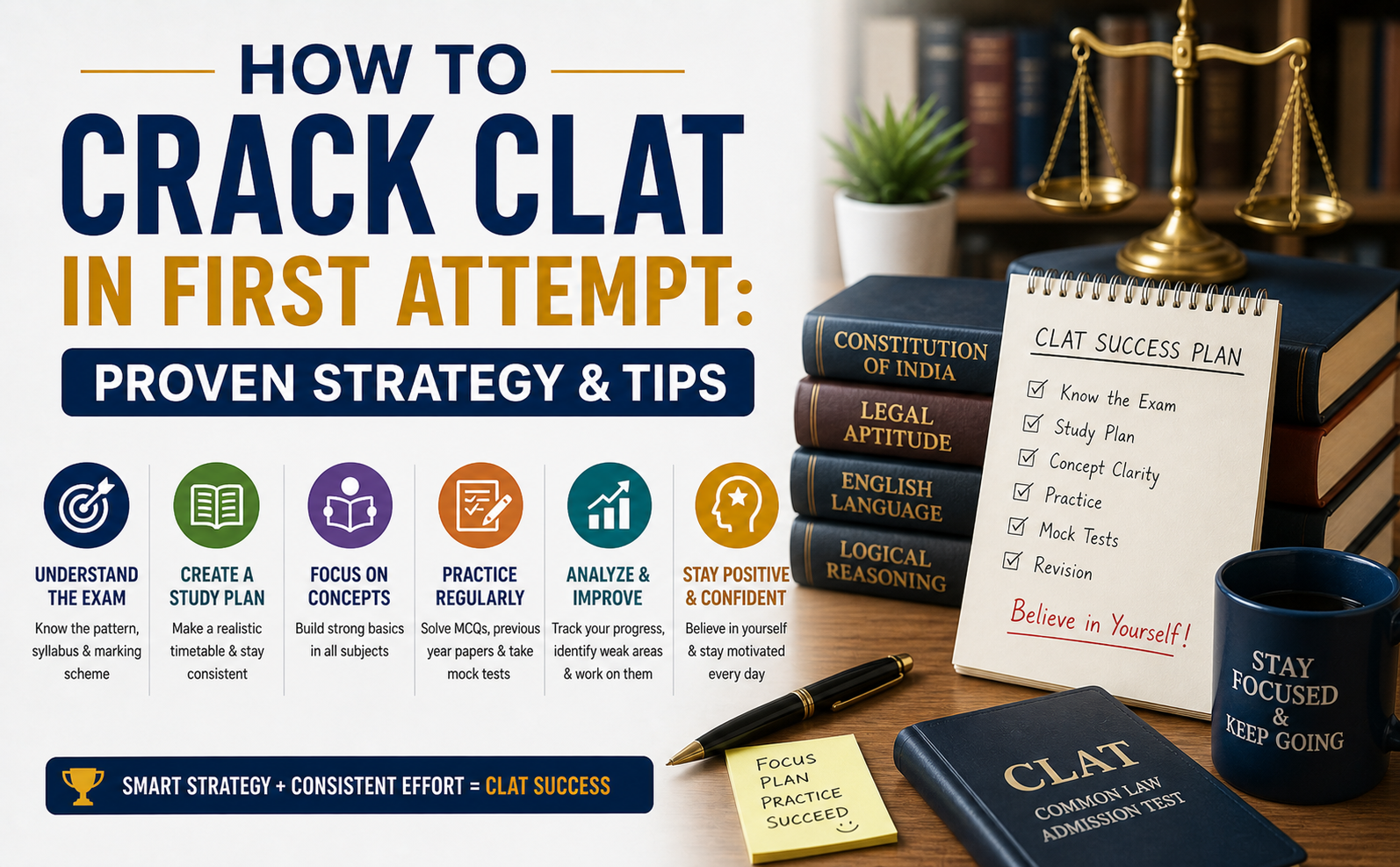
Cracking CLAT in your first attempt is a realistic goal—if you follow the right strategy. With over 90,000 aspirants competing for limited NLU seats, the exam demands more than just hard work; it requires a smart CLAT 2027 preparation strategy.
If you are starting your CLAT 2027 preparation in May, you already have a strong advantage. A well-planned CLAT 2027 study plan from May to December gives you enough time to build concepts, practice consistently, and master mocks.
This blog will show you exactly how to crack CLAT 2027 on your first attempt using a proven, structured approach—no fluff, only actionable strategy.
CLAT 2027 Exam Pattern & Strategy Base
Before building your CLAT 2027 preparation strategy, you must understand the exam structure. CLAT is a passage-based, comprehension-heavy exam, where reading speed and accuracy decide your rank.
CLAT 2027 Exam Pattern Overview
| Section | Weightage | Key Skill Tested |
| English Language | High | Reading comprehension, inference |
| Current Affairs & GK | High | Awareness + retention |
| Legal Reasoning | Highest | Application of principles |
| Logical Reasoning | High | Critical thinking |
| Quantitative Techniques | Low | Basic math + DI |
The CLAT 2027 exam pattern clearly shows that Legal Reasoning and English are the most scoring sections.
To crack CLAT 2027 on the first attempt, your strategy must focus on:
- Reading speed
- Accuracy over attempts
- Section-wise prioritisation
This forms the foundation of your CLAT 2027 study plan.
CLAT 2027 Month-wise Study Plan (May–December)
A clear CLAT 2027 study plan from May to December is the most critical factor if you want to crack CLAT on your first attempt. The next 7 months must be divided into focused phases—each with a specific outcome.
Phase 1: Foundation Building (May–June)
Start your CLAT 2027 preparation strategy with the basics.
| Focus Area | Daily Tasks | Goal |
| Reading | Newspaper + editorials | Improve comprehension speed |
| English | Vocabulary + RCs | Build language base |
| Logical | Basics + short sets | Concept clarity |
| Legal | Intro to principles | Understanding application |
Outcome: Strong reading habit + conceptual base
Phase 2: Concept + Practice (July–August)
This phase builds momentum in your CLAT 2027 preparation tips for beginners.
- Add Current Affairs preparation (daily + monthly revision)
- Start Legal topics (Constitution, Torts)
- Solve PYQs + sectional tests
- Begin 1 mock/week (from August)
Outcome: Improved accuracy + section familiarity
Phase 3: Application & Mock Phase (September–October)
| Activity | Frequency | Focus |
| Full-length mocks | 2 per week | Exam simulation |
| Sectional tests | Daily | Weak areas |
| Revision | Weekly | Retention |
- Complete syllabus by mid-October
- Focus on Logical + Legal application-based questions
Outcome: Exam-level readiness
Phase 4: Intensive Mock & Revision (November–December)
- Attempt 3–4 mocks/week
- Revise the last 6 months of Current Affairs
- Focus on error analysis + accuracy improvement
Based on a structured preparation approach
Outcome: Peak performance before exam
This CLAT 2027 study plan ensures that your preparation is progressive, targeted, and exam-focused, giving you the best chance to crack CLAT on your first attempt.
Subject-Wise Strategy to Crack CLAT 2027
To crack CLAT on the first attempt, your CLAT 2027 preparation strategy must be section-specific. Each subject demands a different approach—a random study will not work.
Section-Wise Strategy Overview
| Section | Strategy | Target Outcome |
| English Language | Daily RCs + vocabulary diary | 20+ marks |
| Current Affairs & GK | Newspaper + monthly revision | 20+ marks |
| Legal Reasoning | Case-based practice + concepts | 25+ marks |
| Logical Reasoning | Arguments, puzzles, inference | 20+ marks |
| Quantitative Techniques | Basic maths + DI sets | 8–10 marks |
Key Preparation Tips
English Language
- Focus on comprehension, tone, and inference
- Build reading speed through editorials
Current Affairs & GK
- Cover the last 6–8 months consistently
- Focus on legal developments and major events
Legal Reasoning
- Focus on application, not memorisation
- Solve principle-based questions daily
Logical Reasoning
- Practice assumptions, conclusions, arguments
- Improve analytical thinking
Quantitative Techniques
- Stick to basics (Class 10 level)
- Prioritise DI and arithmetic
Insight: Approach Legal and Logical sections with a “judge mindset” (logic-first thinking).
This CLAT 2027 preparation strategy ensures maximum scoring with minimum wasted effort.
Mock Test Strategy (Most Important Section)
A strong mock test strategy is the biggest differentiator if you want to crack CLAT on your first attempt. Your CLAT 2027 preparation strategy must revolve around mocks—not just studying.
Mock Plan for CLAT 2027
| Phase | Frequency | Focus |
| August | 1 mock/week | Pattern understanding |
| September–October | 2 mocks/week | Accuracy + speed |
| November–December | 3–4 mocks/week | Exam readiness |
Start mocks after 6–8 weeks of preparation
Golden Rules for Mock Analysis
- Spend 2x time analysing than solving
- Maintain an error log
- Identify:
- Weak sections
- Time-consuming questions
Insight: Mocks improve time management, accuracy, and strategy simultaneously.
This is the most critical part of your CLAT 2027 study plan.
Time Management & Daily Study Plan
To crack CLAT on the first attempt, consistency matters more than long hours. Your CLAT 2027 preparation strategy should follow a disciplined daily routine of 5–6 focused hours.
Ideal Daily Study Plan
| Activity | Time Allocation |
| Reading + RC | 2 hours |
| Legal Reasoning | 1 hour |
| Logical Reasoning | 1 hour |
| GK / Current Affairs | 1 hour |
- Weekly: 1 mock + detailed analysis
- Focus: consistency, revision, and accuracy
This structured CLAT 2027 study plan ensures steady progress without burnout.
Common Mistakes to Avoid in CLAT 2027 Preparation
Even with a solid CLAT 2027 preparation strategy, avoid these mistakes if you want to crack CLAT on your first attempt:
- Ignoring daily reading practice (hurts speed & comprehension)
- Not analysing mocks (biggest score killer)
- Over-focusing on Quant (low weightage section)
- Studying without a structured CLAT 2027 study plan
- Skipping Current Affairs revision
Insight: Improvement in CLAT comes from eliminating mistakes, not adding more material.
Avoid these, and your preparation becomes sharper and more effective.
How Tarkashastra Helps You Crack CLAT 2027
A structured CLAT 2027 preparation strategy is easier to execute with the right guidance. At Tarkashastra, students get a preparation system aligned with the actual demands of CLAT.
What You Get at Tarkashastra
| Feature | Benefit |
| Full-length mock tests | Real exam simulation + performance tracking |
| Section-wise strategy | Focused improvement in weak areas |
| Mentor guidance | Personalised preparation roadmap |
| Exam-focused material | No irrelevant content, only high-yield topics |
Tarkashastra helps you implement your May–December CLAT 2027 study plan effectively, turning strategy into results and helping you crack CLAT in your first attempt.
Related Blogs You Should Read
To strengthen your CLAT 2027 preparation strategy, also read:
- CLAT 2026 Exam Analysis: Section-Wise Review, Difficulty Level & Good Attempts
- CLAT 2027 Registration Process: Step-by-Step Application Guide
- CLAT 2027 Complete Guide: Exam Pattern, Syllabus, Dates & Preparation Tips
- Is CLAT 2027 Tough? Difficulty Level, Competition & Expert Analysis
- CLAT 2027 Registration Last Date: Important Deadlines & Updates
- CLAT 2027 Full Form: Meaning, Exam Purpose & Career Scope Explained
- Top Law Colleges in Hyderabad Through CLAT 2027: Fees, Placements & Ranking
- Top Law Colleges in Maharashtra Through CLAT 2027: Colleges, Fees & Cutoffs
These guides complement your CLAT 2027 study plan and help you make smarter preparation decisions based on exam patterns and your career goals.
Conclusion
Cracking CLAT in your first attempt is achievable with the right CLAT 2027 preparation strategy. With a structured May–December study plan, consistent mocks, and focused revision, success becomes predictable.
Stay consistent, avoid common mistakes, and trust your preparation—your NLU seat is within reach.
CLAT 2027 FAQs
1. Can I take the CLAT 2027 on my first attempt?
Yes, you can crack CLAT in your first attempt with a structured CLAT 2027 preparation strategy, consistent mocks, and strong reading skills. Many toppers clear CLAT in one attempt by following a smart study plan.
2. How many months are enough for CLAT 2027 preparation?
A 6–7 month preparation (May to December) is sufficient if you follow a focused CLAT 2027 study plan, practice daily, and take regular mock tests.
3. How many hours should I study daily for CLAT 2027?
You should study 5–6 focused hours daily, with proper subject distribution, and conduct weekly mock analyses for effective preparation.
4. What is the best strategy to crack CLAT 2027?
The best CLAT 2027 preparation strategy includes:
- Strong reading habit
- Section-wise preparation
- Regular mock tests + analysis
- Current Affairs revision
5. Which section is the most scoring in CLAT?
Legal Reasoning and English are the most scoring sections if prepared consistently, as they carry high weightage and predictable patterns.
6. When should I start mock tests for CLAT 2027?
You should start mocks after 6–8 weeks of preparation (around July/August) and gradually increase the frequency towards the exam.
7. Is CLAT 2027 difficult to crack?
CLAT is competitive but not difficult if you follow a proper CLAT 2027 study plan, focus on accuracy, and avoid common mistakes.
8. How important is Current Affairs in CLAT 2027?
Current Affairs is a high-weightage section, and covering the last 6–8 months thoroughly is essential for a good score.
9. Can I prepare for CLAT 2027 without coaching?
Yes, you can crack CLAT without coaching if you have the right resources, disciplined preparation, and regular mock analysis. However, guidance can improve efficiency.
10. What is the biggest mistake CLAT aspirants make?
The biggest mistake is not analysing mock tests; failing to do so leads to repeated errors and poor improvement in scores.