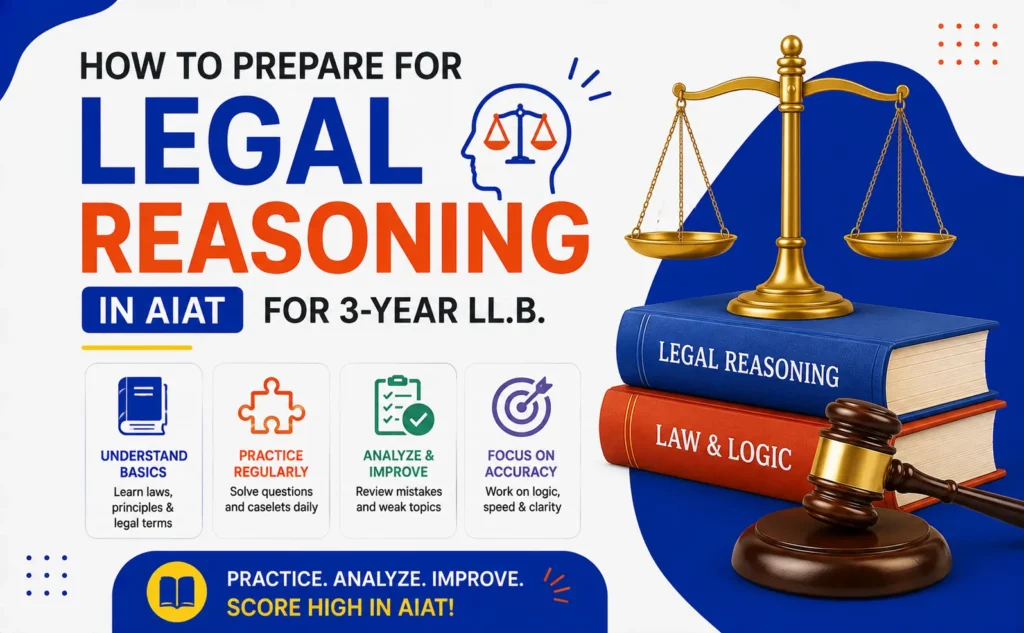
To prepare for Legal Reasoning in AIAT 2027, focus on understanding legal principles, identifying relevant facts, applying rules accurately and eliminating misleading options. For the 3-Year LL.B entrance exam, Legal Reasoning forms part of the broader syllabus alongside Reading Comprehension, Socio-Legal Issues, Politico-Legal Issues, Current Affairs and General Knowledge.
This guide explains the right preparation method, daily practice strategy, useful resources and common mistakes to avoid.
Where Does Legal Reasoning Fit into the AIAT 2027 Exam?
For the Symbiosis AIAT 2027 3-Year LL.B entrance exam, Legal Reasoning is part of a wider syllabus that also includes Reading Comprehension, Socio-Legal Issues, Politico-Legal Issues, Current Affairs and General Knowledge. Candidates should therefore prepare it as an interconnected skill rather than an isolated subject.
- The 3-Year LL.B paper as a 70-mark, 105-minute test comprising two subjective questions, 10 objective questions and a psychometric test. However, it does not specify a separate question count or fixed weightage exclusively for Legal Reasoning.
Aspirants should avoid relying on unofficial section-wise estimates until the official AIAT 2027 notification is released.
What Does Legal Reasoning Test in AIAT?
Many aspirants believe Legal Reasoning requires extensive knowledge of laws or legal provisions. In reality, it primarily tests your ability to read a legal principle, analyse the given facts and apply the principle logically to reach the correct conclusion. Strong analytical thinking, careful reading and objective decision-making matter far more than memorising legal textbooks.
For the 3-Year LL.B programme, the AIAT syllabus includes Legal Reasoning along with Reading Comprehension, Socio-Legal Issues, Politico-Legal Issues, General Knowledge and Current Affairs. This means candidates should develop both legal aptitude and the ability to interpret information accurately.
Legal Reasoning vs Legal Knowledge
| Legal Reasoning | Legal Knowledge |
| Tests your ability to apply a given legal principle to a factual situation | Tests your awareness of legal concepts, terms and current legal developments |
| Focuses on logical thinking and analysis | Focuses on recall and understanding |
| Requires careful interpretation of facts before choosing an answer | Requires familiarity with basic legal concepts and terminology |
How to Prepare for Legal Reasoning in AIAT 2027: A Step-by-Step Strategy
Preparing for Legal Reasoning is not about memorising legal provisions. It is about developing the ability to understand a legal principle, analyse the facts presented and apply the principle logically. A structured preparation strategy will help you build this skill consistently.
Step 1: Understand the Principle–Fact–Conclusion Approach
Most Legal Reasoning questions follow a simple pattern:
- Read the legal principle carefully.
- Identify the relevant facts.
- Apply the principle only to the given facts.
- Choose the conclusion that best follows from the principle.
Example:
If a question states that “A person who intentionally damages another person’s property is liable for compensation,” your task is not to recall legal provisions. Instead, determine whether the facts show intentional damage and apply the given principle accordingly.
Pro Tip: Never rely on your personal understanding of the law if it differs from the principle provided in the question.
Step 2: Build a Strong Foundation in Basic Legal Concepts
While AIAT primarily tests reasoning, familiarity with commonly used legal concepts makes solving questions faster and more accurate.
Focus on understanding concepts related to:
- Constitutional principles
- Law of Contracts
- Law of Torts
- Criminal law fundamentals
- Rights and duties
- Socio-legal and politico-legal issues
You do not need to study these topics in depth like an LL.B student. Aim to understand their basic principles and how they are applied in practical situations.
Step 3: Practise Legal Reasoning Questions Every Day
Consistency matters more than long study sessions. Allocate dedicated time to Legal Reasoning in your daily study schedule.
Suggested Daily Routine
- 15 minutes: Revise legal concepts
- 25 minutes: Solve Legal Reasoning questions
- 15 minutes: Analyse incorrect answers
- 5 minutes: Maintain an error log for revision
Reviewing your mistakes is just as important as solving new questions, as it helps you recognise recurring errors and improve accuracy over time.
Step 4: Strengthen Reading and Analytical Skills
The AIAT syllabus for the 3-Year LL.B programme also includes Reading Comprehension, Socio-Legal Issues and Politico-Legal Issues alongside Legal Reasoning. Improving your reading ability will therefore benefit multiple sections of the exam.
Develop the habit of reading quality editorials and legal-current-affairs articles. After reading, ask yourself:
- What is the main issue?
- Which facts are relevant?
- What principle or right is involved?
- What conclusion follows logically?
This exercise builds the analytical thinking required for Legal Reasoning questions.
Step 5: Solve Mock Tests Under Exam Conditions
Once your concepts are clear, start practising full-length AIAT mock tests and previous-year papers. Go through mock tests and previous-year questions to become familiar with the exam format and improve speed before the actual examination.
Analyse every mock test to identify:
- Frequently repeated mistakes
- Weak legal concepts
- Time-consuming question types
- Accuracy under pressure
What Is the Best Method for Solving AIAT Legal Reasoning Questions?
Success in AIAT Legal Reasoning depends on following a structured approach for every question rather than relying on intuition. A simple framework can help you improve both speed and accuracy.
Use the R-F-A-E Method
R – Read the Rule Carefully
Begin by reading the legal principle thoroughly. Pay close attention to qualifying words such as only, unless, intentionally, knowingly, or without consent, as they often determine the correct answer.
F – Filter the Facts
Next, identify the facts that are directly relevant to the legal principle. Ignore background information or emotional details that do not affect the legal outcome.
A – Apply the Rule
Apply only the legal principle provided in the question to the relevant facts. Avoid using your personal knowledge of the law or making assumptions beyond what is stated.
E – Eliminate Incorrect Options
Compare each option against the given principle. Eliminate answers that:
- Add facts not mentioned in the question
- Ignore an important condition in the principle
- Rely on personal opinions instead of legal reasoning
- Partially apply the rule while overlooking key facts
Quick Self-Check Before Selecting an Answer
Use this checklist during practice:
□ Did I understand the legal principle correctly?
□ Have I identified all the relevant facts?
□ Am I applying only the given principle?
□ Have I ignored personal assumptions?
□ Does my chosen option logically follow from the facts?
Pro Tip
Don’t rush to answer after reading the facts. Always read the principle first, then evaluate the facts through that legal lens. This habit significantly reduces avoidable mistakes and improves consistency in Legal Reasoning.
Visual Suggestion: Include a simple flowchart:
Read the Principle → Identify Relevant Facts → Apply the Principle → Eliminate Wrong Options → Select the Best Answer.
Which Books and Resources Should You Use for AIAT Legal Reasoning?
Choosing the right study material is just as important as following the right preparation strategy. Instead of referring to multiple books, focus on a few reliable resources and revise them thoroughly. Consistency and practice will always outperform collecting too many study materials.
The following books are recommended for Legal Aptitude and Legal Reasoning preparation:
| Resource | Why It Helps |
| Wiley’s ExamXpert Legal Awareness & Legal Reasoning | Builds strong conceptual understanding with beginner-friendly explanations. |
| Legal Awareness and Legal Reasoning by A. P. Bhardwaj | Covers legal principles, legal maxims and extensive practice questions commonly recommended for law entrance exams. |
| Universal’s Guide to CLAT & LL.B. Entrances | Provides ample practice questions and previous-year-style exercises to improve accuracy. |
| Arihant’s Guide to CLAT & LL.B. Entrances | Offers additional objective and descriptive practice to strengthen exam readiness. |
How to Use These Resources Effectively?
Instead of reading each book cover to cover, adopt a structured approach:
- Use one book to build concepts.
- Use another resource exclusively for practice.
- Attempt AIAT-specific mock tests regularly to adapt to the exam pattern.
- Maintain an error notebook to record recurring mistakes and revise them weekly.
How Tarkashastra Helps You Prepare for AIAT Legal Reasoning
A structured preparation strategy can make a significant difference in AIAT performance. At Tarkashastra, 3-Year LL.B aspirants receive concept-based Legal Reasoning guidance, AIAT-pattern mock tests, subjective writing practice, detailed performance analysis and personalised mentorship.
The focus is on helping students apply legal principles correctly, improve analytical thinking and build confidence through consistent practice.
Related Blogs You Should Read
- Symbiosis AIAT 2027: Complete Exam Guide
- Symbiosis AIAT 2027 Registration Process Explained
- Symbiosis AIAT 2027 Eligibility Criteria for 3-Year LLB
- Symbiosis AIAT 2027 Exam Pattern & Marking Scheme
- Symbiosis AIAT 2027 Syllabus: Section-Wise Analysis
- Symbiosis AIAT 2027 Preparation Strategy for Beginners
- Best Books for Symbiosis AIAT 2027 Preparation
Conclusion
Cracking Legal Reasoning in AIAT 2027 requires conceptual clarity, regular practice and smart revision—not memorisation. By understanding legal principles, solving principle-based questions and analysing your mock tests, you can steadily improve your accuracy.
If you’re preparing for the 3-Year LL.B programme at Symbiosis Law School, Pune, explore Tarkashastra’s AIAT courses, mock tests and expert guidance to prepare with confidence.
Frequently Asked Questions (FAQs)
1. How should I prepare for Legal Reasoning in AIAT 2027?
Focus on understanding legal principles, practising principle-based questions, improving analytical reasoning, solving mock tests and regularly reviewing your mistakes.
2. Do I need prior legal knowledge to score well in AIAT Legal Reasoning?
No. AIAT primarily evaluates your ability to apply legal principles to factual situations. Basic legal awareness is helpful, but strong reasoning and analytical skills are more important.
3. Which topics should I study for AIAT Legal Reasoning?
Build a basic understanding of Constitutional principles, Law of Contracts, Law of Torts, Criminal Law fundamentals, rights and duties, and socio-legal and politico-legal issues.
4. Which books are recommended for AIAT Legal Reasoning preparation?
Some useful resources include Wiley’s ExamXpert Legal Awareness & Legal Reasoning, Legal Awareness and Legal Reasoning by A. P. Bhardwaj, Universal’s Guide to CLAT & LL.B. Entrances and Arihant’s Guide to CLAT & LL.B. Entrances.
5. How much time should I dedicate to Legal Reasoning every day?
Aim to spend 45–60 minutes daily, including concept revision, question practice, mock analysis and error-log maintenance for consistent improvement.
6. Are mock tests important for AIAT Legal Reasoning?
Yes. Regular mock tests help improve time management, familiarise you with the exam pattern and identify weak areas that require additional practice.
7. What are the most common mistakes students make in Legal Reasoning?
Common mistakes include memorising laws instead of understanding principles, ignoring the legal rule provided, making assumptions, skipping mock tests and not analysing incorrect answers.
8. How can I improve my accuracy in Legal Reasoning?
Read the legal principle first, identify relevant facts, avoid personal assumptions, eliminate incorrect options systematically and review every mock test carefully.
9. Can I use CLAT preparation books for AIAT Legal Reasoning?
Yes. Standard CLAT Legal Aptitude books can strengthen your concepts and practice, but they should be supplemented with AIAT-specific mock tests and previous-year papers for exam-oriented preparation.
10. Can beginners crack AIAT Legal Reasoning with consistent preparation?
Absolutely. Even without a legal background, beginners can perform well by following a structured study plan, practising consistently and improving their analytical thinking through regular revision and mock tests.