Preparing for NIMCET requires more than simply completing the syllabus. Since the examination tests conceptual understanding, analytical thinking, logical reasoning, and problem-solving ability, candidates need a balanced preparation strategy that focuses on both knowledge and exam temperament.
Every year, thousands of graduates compete for admission to a limited number of MCA seats in participating NITs. Candidates who begin their preparation early generally have more time for concept building, revision, and mock tests, giving them a competitive advantage.
Whether you are starting your preparation from scratch or already have a basic understanding of the syllabus, this guide will help you create an effective roadmap for success.
Why a Preparation Strategy is Important
Many candidates spend months studying but fail to achieve their desired rank because they prepare without a structured plan.
A proper preparation strategy helps candidates:
- Complete the syllabus on time.
- Focus on high-weightage topics.
- Allocate study time efficiently.
- Improve conceptual understanding.
- Build speed and accuracy.
- Revise regularly.
- Perform confidently in the actual examination.
Instead of studying randomly, candidates should prepare according to the exam pattern, syllabus, and section-wise weightage.
Is 6 Months Enough for NIMCET Preparation?
Yes. Six months are generally sufficient to prepare for NIMCET if candidates study consistently and follow a disciplined preparation plan.
A six-month preparation period allows candidates to:
- Build strong fundamentals.
- Cover the complete syllabus.
- Solve previous years’ question papers.
- Attempt multiple mock tests.
- Revise important topics several times.
- Improve speed and time management.
However, success depends more on consistency than the number of study hours. Even candidates starting late can perform well if they study smartly and remain committed to their schedule.
Understand the Examination Before You Begin
Before starting preparation, candidates should thoroughly understand:
- Exam pattern
- Subject-wise syllabus
- Marking scheme
- Negative marking
- Section-wise weightage
- Previous years’ trends
Having a clear understanding of the examination helps candidates prepare more effectively and avoid wasting time on irrelevant topics.
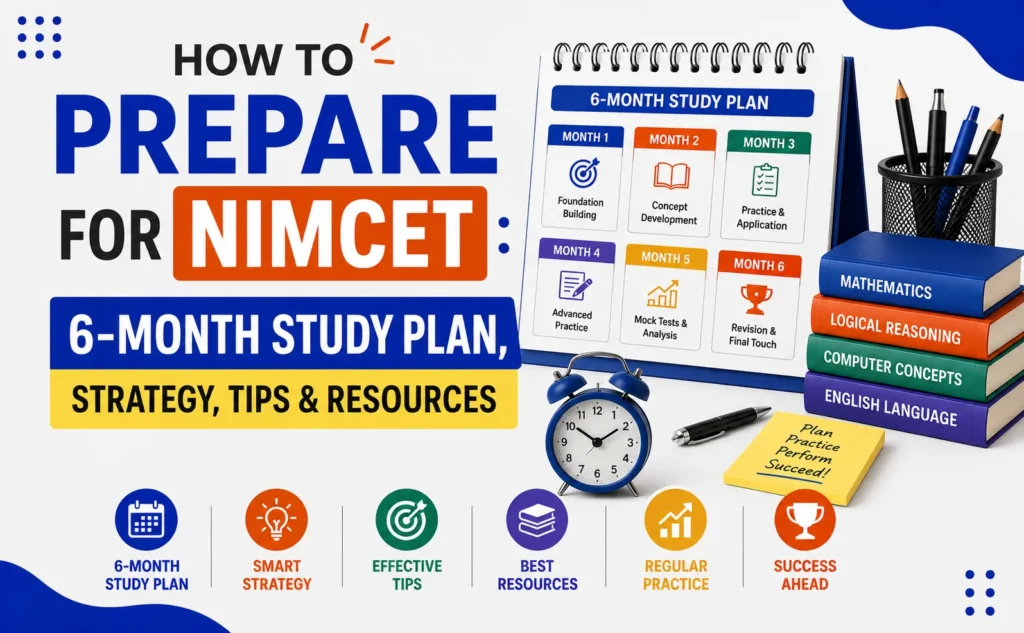
6-Month Study Plan for NIMCET 2027
A structured study plan enables candidates to complete the syllabus systematically while leaving sufficient time for revision and practice.
Month 1: Build Strong Fundamentals
The first month should focus entirely on understanding basic concepts.
Mathematics
- Algebra
- Calculus Basics
- Coordinate Geometry
- Trigonometry
Logical Reasoning
- Coding-Decoding
- Blood Relations
- Number Series
- Direction Sense
Computer Awareness
- Computer Fundamentals
- Operating Systems
- Basic Programming Concepts
English
- Grammar
- Vocabulary
- Reading Habit
At this stage, candidates should avoid rushing through the syllabus and instead focus on conceptual clarity.
Month 2: Complete Core Topics
Once the fundamentals are clear, candidates should move to more advanced concepts.
Mathematics
- Probability
- Statistics
- Matrices
- Differential Equations
- Vector Algebra
Logical Reasoning
- Seating Arrangement
- Puzzles
- Syllogism
- Data Interpretation
Computer Awareness
- Database Management Systems
- Computer Networks
- Internet Concepts
English
- Reading Comprehension
- Sentence Correction
- Error Detection
- Idioms and Phrases
Candidates should begin solving topic-wise practice questions after completing every chapter.
Month 3: Complete the Remaining Syllabus
The third month should focus on completing any pending topics and strengthening weak areas.
Candidates should:
- Revise completed chapters.
- Solve chapter-wise practice sets.
- Begin attempting sectional tests.
- Prepare short notes.
- Memorise formulas and important concepts.
By the end of Month 3, candidates should ideally complete the entire syllabus.
Month 4: Begin Intensive Practice
The fourth month should focus on improving speed, accuracy, and application of concepts.
Candidates should:
- Solve previous years’ question papers.
- Attempt sectional mock tests.
- Analyse mistakes after every test.
- Revise formulas daily.
- Focus on high-weightage chapters.
This is the stage where candidates begin developing their exam temperament.
Month 5: Mock Tests and Revision
The fifth month should revolve around mock tests and continuous revision.
Candidates should:
- Attempt two to three full-length mock tests every week.
- Analyse incorrect answers.
- Revise weak topics.
- Improve time management.
- practice difficult questions repeatedly.
Regular mock test analysis helps identify recurring mistakes and improve overall performance.
Month 6: Final Revision and Exam Readiness
The final month should be dedicated to revision rather than learning new concepts.
Candidates should:
- Revise short notes.
- Solve important questions.
- Attempt previous years’ papers.
- Take full-length mock tests.
- Maintain a healthy routine.
- Avoid unnecessary stress.
Confidence during the examination often comes from effective revision during the final month.
Suggested Daily Study Timetable
A balanced timetable ensures that every subject receives adequate attention.
| Time | Activity |
| 7:00 AM – 9:00 AM | Mathematics Practice |
| 9:00 AM – 9:30 AM | Break |
| 9:30 AM – 10:30 AM | Logical Reasoning |
| 10:30 AM – 11:30 AM | Computer Awareness |
| Afternoon | College/Work (if applicable) |
| 6:00 PM – 7:00 PM | General English |
| 7:15 PM – 8:30 PM | Revision |
| 8:30 PM – 9:30 PM | Practice Questions / Mock Test Analysis |
Candidates should customise this timetable according to their personal schedule while maintaining consistency.
Subject-wise Preparation Strategy
Mathematics
Mathematics carries the highest weightage in the examination and should receive maximum preparation time.
To score well:
- Build conceptual clarity before solving advanced questions.
- practice formulas daily.
- Solve numerical problems regularly.
- Maintain a formula notebook.
- Focus on speed and calculation accuracy.
- Attempt previous years’ Mathematics questions.
Consistent practice is the key to mastering this section.
Analytical Ability & Logical Reasoning
Logical Reasoning is one of the most scoring sections for candidates who practice consistently.
Preparation tips include:
- Solve puzzles daily.
- practice seating arrangement questions.
- Improve logical thinking through timed quizzes.
- Attempt data interpretation sets regularly.
- Analyse incorrect answers after practice sessions.
Even 30–45 minutes of reasoning practice every day can lead to significant improvement over time.
Computer Awareness
Although the Computer Awareness section carries fewer questions than Mathematics and Logical Reasoning, it can be one of the highest-scoring sections for candidates who prepare systematically. Most questions are concept-based and require a strong understanding of computer fundamentals rather than extensive programming knowledge.
Candidates should focus on the following preparation strategies:
- Study Computer Fundamentals before moving to advanced topics.
- Revise Operating Systems, Database Management Systems (DBMS), and Computer Networks regularly.
- Prepare short notes for important definitions and technical terms.
- practice multiple-choice questions after completing every topic.
- Stay consistent with revision instead of studying everything at the last minute.
Candidates from non-computer backgrounds should spend additional time strengthening their fundamentals during the initial months of preparation.
General English
General English may have the lowest weightage in NIMCET, but it can significantly improve the overall score if prepared consistently.
An effective strategy includes:
- Read English newspapers or editorials for 20–30 minutes daily.
- Learn 10–15 new vocabulary words every week.
- Revise grammar rules regularly.
- practice reading comprehension passages under timed conditions.
- Solve questions based on sentence correction, synonyms, antonyms, idioms, and error detection.
Rather than memorising vocabulary lists in one go, candidates should focus on gradual improvement through daily reading and practice.
Best Books for NIMCET 2027 Preparation
Selecting the right study material is as important as following a good study plan. Candidates should avoid referring to too many books simultaneously and instead focus on mastering a few reliable resources.
Mathematics
- Higher Engineering Mathematics by B.S. Grewal
- Quantitative Aptitude by R.S. Aggarwal
- Objective Mathematics by R.D. Sharma
Analytical Ability & Logical Reasoning
- A Modern Approach to Logical Reasoning by R.S. Aggarwal
- Analytical Reasoning by M.K. Pandey
Computer Awareness
- Computer Fundamentals by P.K. Sinha
- Objective Computer Awareness by Arihant Publications
General English
- Objective General English by S.P. Bakshi
- Word Power Made Easy by Norman Lewis
Candidates should supplement these books with previous years’ papers and mock tests for comprehensive preparation.
Importance of Mock Tests
Mock tests are one of the most valuable tools for NIMCET preparation. They help candidates experience the actual examination environment and improve both speed and accuracy.
Benefits of attempting mock tests include:
- Understanding the examination pattern.
- Improving time management.
- Identifying strengths and weaknesses.
- Reducing examination anxiety.
- Developing confidence before the actual exam.
- Learning how to balance speed with accuracy.
Candidates should begin attempting sectional tests after completing the basic syllabus and gradually move to full-length mock tests.
During the final two months of preparation, attempting at least two to three full-length mock tests every week is recommended.
Effective Revision Strategy
Revision is just as important as studying new topics. Without regular revision, candidates may forget concepts learned during the initial months of preparation.
An effective revision plan includes:
- Revising formulas every week.
- Updating short notes after completing each chapter.
- Revisiting difficult topics regularly.
- Solving mixed practice questions.
- Analysing mistakes made in mock tests.
The final month should primarily focus on revision instead of learning completely new topics.
Weekly Milestones to Track Your Preparation
A six-month study plan becomes more effective when it is divided into smaller weekly goals. Instead of focusing only on monthly targets, candidates should monitor their progress every week. This approach helps maintain consistency and ensures that no topic is left uncovered before the examination.
An ideal weekly routine may include:
- Completing one or two Mathematics chapters.
- Practicing Logical Reasoning for at least four to five days a week.
- Revising one Computer Awareness topic.
- Reading English editorials and learning new vocabulary.
- Attempting one sectional test every weekend.
- Reviewing mistakes and planning improvements for the following week.
Maintaining a study journal or progress tracker can help candidates stay motivated and identify areas that need additional attention.
Importance of Previous Year’s Question Papers
Previous years’ NIMCET question papers are among the most valuable preparation resources available to aspirants. They help candidates understand the examination pattern, frequently asked topics, and the overall difficulty level.
Benefits of solving previous years’ papers include:
- Understanding the type of questions asked.
- Identifying high-weightage chapters.
- Improving speed and problem-solving skills.
- Learning effective time management.
- Building confidence before the examination.
Candidates should attempt these papers in a timed environment and analyse every mistake carefully. Simply solving the papers is not enough—the learning comes from understanding why mistakes occurred and how to avoid them in future attempts.
How to Analyse Mock Test Performance
Attempting mock tests without analysing them limits their effectiveness. After every mock test, candidates should spend sufficient time reviewing their performance.
Points to analyse include:
- Number of correct and incorrect answers.
- Questions left unanswered.
- Time spent on each section.
- Frequently repeated mistakes.
- Weak concepts requiring revision.
- Accuracy percentage.
Candidates should maintain a separate notebook to record mistakes and revise those concepts before attempting the next mock test. Continuous analysis helps improve performance steadily over time.
Exam-Day Preparation Tips
Proper preparation on the day of the examination is just as important as months of study. Candidates should remain calm and avoid making last-minute changes to their preparation strategy.
Some important exam-day tips include:
- Reach the examination centre well before the reporting time.
- Carry the admit card and a valid photo ID.
- Avoid studying new topics on the examination day.
- Read all instructions carefully before beginning the test.
- Attempt easier questions first to build confidence.
- Avoid random guessing because of negative marking.
- Reserve the final few minutes to review unanswered or marked questions.
A calm and confident approach can help candidates perform to the best of their ability.
Maintaining Motivation During the Six-Month Preparation
Preparing for a competitive examination over several months can sometimes feel overwhelming. It is normal for candidates to experience periods of low motivation or fatigue. The key is to remain disciplined and focus on long-term goals.
Candidates can stay motivated by:
- Setting realistic daily and weekly targets.
- Celebrating small milestones after completing important chapters.
- Taking short breaks to avoid burnout.
- Maintaining a healthy sleep schedule and balanced diet.
- Exercising regularly to improve concentration.
- Studying with friends or joining a study group for accountability.
- Reminding themselves of their goal of securing admission to a top NIT.
Consistency is often more important than studying for very long hours. Even a few productive hours every day can produce excellent results over six months.
Final Preparation Checklist Before NIMCET 2027
As the examination approaches, candidates should ensure they have completed the following:
- The entire syllabus is completed at least three to four weeks before the exam.
- Revision of all important formulas and short notes.
- Previous years’ question papers solved.
- Multiple full-length mock tests attempted.
- Weak areas revised thoroughly.
- Admit card and examination documents verified.
- Healthy sleep schedule maintained during the final week.
- Confidence built through consistent revision and practice.
Following this checklist helps candidates enter the examination hall with confidence and a clear strategy for success.
Time Management Tips
Proper time management can make a significant difference in NIMCET preparation as well as during the examination.
Candidates should:
- Prepare a realistic daily timetable.
- Set weekly and monthly study goals.
- Allocate more time to Mathematics due to its higher weightage.
- Avoid spending excessive time on a single topic.
- Take short breaks between study sessions to maintain concentration.
- Follow a consistent study routine.
During the examination, candidates should first attempt questions they are confident about and revisit difficult ones later to minimise negative marking.
Common Mistakes to Avoid
Many aspirants lose valuable marks because of avoidable mistakes rather than lack of knowledge.
Some common mistakes include:
- Beginning preparation without understanding the syllabus.
- Ignoring Mathematics because it appears difficult.
- Depending entirely on shortcuts without building conceptual clarity.
- Avoiding mock tests until the last month.
- Not analysing mistakes after practice sessions.
- Referring to too many books simultaneously.
- Ignoring General English and Computer Awareness.
- Studying for long hours without revision.
- Attempting every question despite negative marking.
Avoiding these mistakes can considerably improve overall performance and confidence.
Recommended Resources for NIMCET Preparation
In addition to textbooks, candidates should use multiple learning resources for comprehensive preparation.
Useful resources include:
- Previous years’ NIMCET question papers.
- Online mock test series.
- Subject-wise practice questions.
- Formula handbooks.
- Educational YouTube lectures.
- Weekly revision notes.
- Performance analysis after every mock test.
Using diverse yet reliable resources helps candidates strengthen concepts from different perspectives.
How Tarkashastra Helps NIMCET Aspirants?
Preparing for NIMCET becomes easier with structured guidance and reliable study resources. Tarkashastra supports aspirants throughout their preparation journey by providing quality educational content and expert guidance.
Students can benefit from:
- Latest NIMCET notifications and important updates.
- Detailed syllabus and exam pattern analysis.
- Subject-wise preparation strategies.
- Previous years’ paper analysis.
- Mock tests and practice questions.
- Time management techniques.
- Counselling guidance.
- MCA college information and admission support.
- Expert tips to improve performance and confidence.
With the right preparation strategy and consistent effort, candidates can maximise their chances of securing admission to their preferred NIT.
Conclusion
Understanding how to prepare for NIMCET 2027 is the first step towards achieving a good rank in the examination. A structured six-month study plan, consistent revision, regular mock tests, and disciplined time management can help candidates build confidence and perform well on the exam day.
Although the official NIMCET 2027 notification is yet to be released, aspirants should not wait for the notification to begin their preparation. Starting early provides sufficient time to complete the syllabus, revise important topics, strengthen weak areas, and practice enough mock tests before the examination.
FAQs
1. Is 6 months enough for NIMCET preparation?
Yes. Six months are generally sufficient if candidates follow a structured study plan, complete the syllabus on time, practice regularly, and revise consistently.
2. How many hours should students study daily?
Most aspirants should aim for 5–7 hours of focused study every day. Candidates balancing college or work can adjust their schedule while maintaining consistency.
3. What is the best study plan for NIMCET?
An ideal study plan includes concept building during the first three months, intensive practice and mock tests in the next two months, and complete revision during the final month.
4. Which books are recommended for NIMCET preparation?
Popular books include Higher Engineering Mathematics by B.S. Grewal, Quantitative Aptitude by R.S. Aggarwal, Logical Reasoning by R.S. Aggarwal, Computer Fundamentals by P.K. Sinha, and Objective General English by S.P. Bakshi.
5. How can I improve my Mathematics score?
Focus on conceptual clarity, practice numerical problems daily, revise formulas regularly, solve previous years’ papers, and attempt Mathematics mock tests consistently.
6. How important are mock tests?
Mock tests are extremely important as they improve speed, accuracy, confidence, time management, and familiarity with the examination pattern.
7. How should I revise effectively?
Prepare short notes, revise formulas weekly, practice mixed questions, analyse mock test mistakes, and dedicate the final month primarily to revision.
8. What mistakes should be avoided during preparation?
Candidates should avoid studying without a plan, skipping revision, ignoring mock tests, referring to too many books, neglecting weaker subjects, and making random guesses during the examination.
9. How can I manage time effectively during preparation?
Create a realistic timetable, set weekly goals, prioritise high-weightage subjects, revise consistently, and maintain a healthy balance between study and rest.
10. How can I score a high percentile in NIMCET?
To achieve a high percentile, candidates should complete the syllabus early, strengthen Mathematics, practice regularly, attempt mock tests, analyse mistakes, improve accuracy, and maintain consistency throughout their preparation.