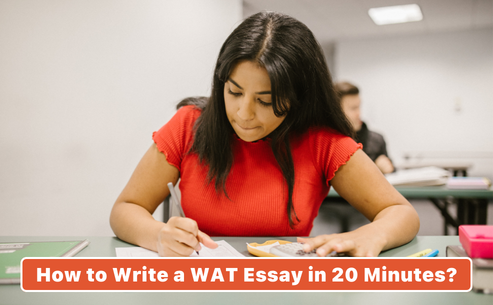
The Written Ability Test (WAT) is no longer a formality in MBA admissions. For IIMs and top B-schools, WAT plays a crucial role in evaluating a candidate’s clarity of thought, logical structuring, and written communication skills—abilities that a CAT percentile alone cannot reflect. Many aspirants lose out despite strong exam scores because they fail to write a focused essay within the limited time.
Knowing how to write a WAT essay in 20 minutes is therefore essential to convert interview calls into final admits.
What Is the Written Ability Test (WAT)? Format & Expectations
The Written Ability Test (WAT) is an essay-writing round conducted by IIMs and leading MBA colleges to assess a candidate’s ability to think critically and communicate ideas clearly in writing.
Typically, candidates are given 15–30 minutes to write an essay of around 150–300 words on a single topic. WAT topics usually include current affairs, business issues, social themes, or abstract ideas.
- Evaluators do not judge literary excellence. Instead, WAT assessment focuses on clarity of thought, logical flow, relevance of arguments, basic grammar, and structure.
Understanding these expectations is the first step in mastering WAT essay writing tips and planning effective Written Ability Test preparation.
Common Mistakes Candidates Make in WAT
Many aspirants underperform in the Written Ability Test due to avoidable mistakes rather than a lack of knowledge.
- A standard error is starting to write without planning, which leads to poor structure and repetition.
- Others misuse complex vocabulary, assuming WAT tests English proficiency, while evaluators actually value clarity.
- Writing extreme opinions without balance, including irrelevant facts, or failing to conclude properly, also lowers scores.
- Poor WAT time management strategy often results in unfinished essays or no proofreading, weakening an otherwise decent response.
The Ideal WAT Essay Structure (That Evaluators Love)
A high-scoring WAT essay follows a simple, logical structure that makes the evaluator’s job easy. Most IIMs expect a three-part format: introduction, body, and conclusion.
The introduction should briefly set the context and indicate the essay’s direction. The body must contain 2–3 well-connected arguments, each supported by reasoning or a relevant example. One idea per paragraph ensures clarity and flow. The conclusion should synthesise key points and end with a balanced or forward-looking perspective.
Within this structure, candidates can adapt frameworks such as Opinion–Reason–Significance (ORS) or Problem–Effect–Cause–Solution (PECS) to the topic. This format is central to effective WAT essay writing tips and MBA WAT essay strategy.
The 20-Minute WAT Writing Strategy (Step-by-Step Execution Plan)
To score well in the Written Ability Test, aspirants must follow a strict WAT time management strategy. The key to learning how to write a WAT essay in 20 minutes is disciplined execution, not creativity.
| Time Block | What to Do | Outcome |
| 0–3 minutes | Analyse the topic, identify keywords, decide your stance, jot 4–5 bullet points | Clear direction and structure |
| 4–6 minutes | Write the introduction with context and thesis | Focused opening |
| 7–15 minutes | Write the body (2–3 paragraphs, one idea each) | Logical argument development |
| 16–18 minutes | Write the conclusion | Balanced closure |
| 19–20 minutes | Proofread | Error-free submission |
During the first 3 minutes, avoid writing full sentences. Instead, outline arguments logically. This planning phase prevents deviation and repetition—two major reasons candidates lose marks.
The introduction should define the issue or present a neutral context, not personal anecdotes. In the body, use reasoning over data overload; one example is enough to support a point. Avoid jargon and extreme views.
The conclusion must summarise without repetition and may briefly indicate implications for business, society, or leadership. Reserve the final two minutes strictly for grammar, sentence clarity, and flow.
This structured approach forms the backbone of an effective MBA WAT essay strategy.
What Makes a High-Scoring WAT Essay? (Evaluator’s Lens)
A high-scoring WAT essay is evaluated on how clearly and logically a candidate presents ideas under time pressure. Evaluators prioritise clarity of thought over sophistication of language. Essays with a visible structure, smooth transitions, and relevant arguments score higher than verbose or fact-heavy responses.
Balanced reasoning is critical—acknowledging multiple perspectives reflects maturity and managerial thinking. Basic grammar and syntax matter, but minor errors are tolerated if communication is clear.
Importantly, WAT essays often influence Personal Interview discussions, so arguments must be defendable. Aligning content with these parameters is central to effective Written Ability Test preparation and WAT essay writing tips.
Types of WAT Topics You Should Be Ready For
Most WAT topics for MBA admissions fall into predictable categories. Candidates are commonly asked to write on current affairs, such as economic reforms or social trends; business and management issues; socio-economic problems; or abstract topics that test interpretation. Some prompts are opinion-based, while others require problem–solution analysis.
Effective Written Ability Test preparation involves practising across all categories so that you can quickly identify the theme and apply the right WAT essay format and structure within the limited time.
How to Practice WAT Effectively Before Interviews
Effective Written Ability Test preparation requires regular, timed practice. Aspirants should write one WAT essay in 20 minutes daily using pen and paper to simulate actual conditions.
- Reading newspaper editorials improves content depth and balance of arguments. After writing, self-evaluate the essay for structure, clarity, and the strength of its conclusion.
- Consistent feedback and revision help refine WAT essay writing tips and ensure steady improvement before the interview stage.
How Tarkashastra Helps You Master WAT & GDPI
At the interview stage, knowing how to write a WAT essay in 20 minutes is only part of the conversion process.
At Tarkashastra, WAT preparation is integrated with GDPI training so that written arguments align with interview responses. Students are trained to structure essays quickly, handle diverse WAT topics for MBA admissions, and defend viewpoints confidently in PI rounds.
With timed WAT practice, expert evaluation, and structured feedback, Tarkashastra helps aspirants strengthen their MBA WAT essay strategy and improve final selection outcomes.
Related Reads from Tarkashastra
To strengthen your Written Ability Test preparation, explore these related Tarkashastra resources:
- Best Strategy for WAT GD PI to Convert IIM Calls
- How to Convert IIM Call
- How to Crack IIM CAP Interview
- WAT GD PI Preparation After CAT Results
- WAT GD PI Preparation Roadmap: From Call to Convert
- PI Preparation for MBA Interviews
These reads complement your WAT essay writing tips and improve overall GDPI readiness.
Conclusion: Final Rules to Crack WAT in 20 Minutes
Cracking the Written Ability Test depends on execution, not inspiration. To master how to write a WAT essay in 20 minutes, always plan before writing, follow a clear structure, and prioritise clarity over vocabulary. Balanced arguments, strict time management, and quick proofreading significantly improve scores.
With focused practice and the right MBA WAT essay strategy, converting interview calls becomes far more achievable.
Frequently Asked Questions (FAQs)
1. What is the Written Ability Test (WAT) in MBA admissions?
The Written Ability Test (WAT) is an essay-writing round used by IIMs and top B-schools to evaluate clarity of thought, logical reasoning, and written communication skills.
2. How much time is given to write a WAT essay?
Most institutes give 15–30 minutes, with candidates typically expected to write 150–300 words.
3. What kind of topics are asked in WAT?
WAT topics usually cover current affairs, business and economy, social issues, or abstract themes.
4. Is WAT about English vocabulary and grammar?
No. WAT primarily tests clarity, structure, relevance, and balanced reasoning, not advanced vocabulary.
5. What is the ideal structure for a WAT essay?
A high-scoring WAT essay follows a clear introduction–body–conclusion structure with logical flow.
6. How can I write a WAT essay in 20 minutes effectively?
By following a strict time management strategy: planning (3 minutes), writing (15 minutes), and proofreading (2 minutes).
7. How important is time management in WAT?
Time management is critical. Poor planning often leads to incomplete essays or weak conclusions.
8. Can my WAT essay affect the Personal Interview (PI)?
Yes. Interviewers often ask questions based on your WAT essay, so arguments must be defendable.
9. How should I practice for the Written Ability Test?
Practice writing one timed WAT essay daily, read editorials regularly, and self-evaluate for structure and clarity.
10. How does Tarkashastra help in WAT preparation?
Tarkashastra integrates WAT, GD, and PI preparation, offering structured frameworks, timed practice, and expert feedback to improve conversion chances.