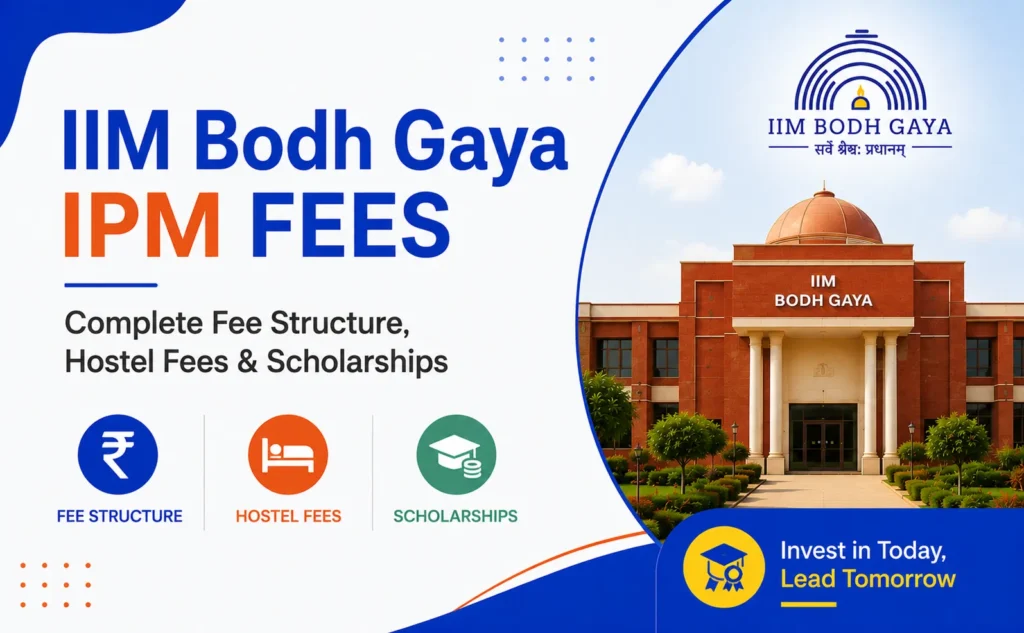
One of the most important factors students and parents consider before applying is the IIM Bodh Gaya IPM Fees 2027. Since the Integrated Programme in Management (IPM) is a five-year residential programme, understanding the complete fee structure helps families plan their finances well in advance.
Apart from tuition fees, students should also account for hostel accommodation, mess charges, refundable deposits, books, personal expenses, and other academic costs. Although the investment may appear significant, the programme offers students the opportunity to earn both a BBA and MBA degree from an Indian Institute of Management without appearing for CAT after graduation.
In this comprehensive guide, you’ll learn about:
- Complete fee structure
- Tuition fees
- Hostel fees
- Mess fees
- Scholarships
- Financial aid
- Education loans
- Total programme cost
- Return on Investment (ROI)
This guide is intended to help students understand the financial commitment involved in pursuing the IIM Bodh Gaya IPM 2027 programme.
Overview of IIM Bodh Gaya IPM Fees 2027
The IIM Bodh Gaya IPM Fees 2027 comprise multiple components that together cover the cost of academic instruction, campus facilities, residential accommodation, and student services.
The programme follows a different fee structure for the undergraduate phase and the MBA phase:
- First Three Years: Students pay the IPM programme fee applicable for each academic year.
- Final Two Years: Students pay the prevailing MBA programme fee applicable to that batch.
This structure ensures that students receive access to the same academic resources and facilities as MBA students during the final phase of the programme.
IIM Bodh Gaya IPM Fee Structure 2027
The official fee structure for the 2027–32 batch will be announced before admissions begin. Based on the latest available fee framework, students can expect the following fee components.
| Fee Component | Description |
| Tuition Fee | Academic instruction and course delivery |
| Hostel Fee | Residential accommodation |
| Mess Charges | Food and dining services |
| Library & Learning Resources | Digital and physical learning facilities |
| Examination Fee | Academic assessments |
| Student Activity Charges | Clubs, events, and student initiatives |
| Medical Insurance | Health insurance coverage |
| Refundable Security Deposit | Refundable at programme completion, subject to institute rules |
| Alumni Charges | Payable during the MBA phase, if applicable |
The exact amount for each component may be revised before the commencement of the 2027 academic session. Candidates should refer to the latest admission notification before making financial decisions.
Tuition Fees
The tuition fee forms the largest portion of the overall programme cost. It covers the academic curriculum, classroom instruction, faculty interaction, access to academic resources, laboratories, and other educational facilities.
The tuition fee generally includes:
- Classroom teaching
- Faculty lectures
- Academic support
- Course materials provided by the institute
- Digital learning platforms
- Academic administration
- Examination-related academic services
Students should note that tuition fees do not usually include personal expenses, travel costs, or optional certification programmes.
Programme Fee Structure Across Five Years
The Integrated Programme in Management consists of two academic phases.
Phase 1: Undergraduate (Years 1–3)
During the first three years, students study the undergraduate curriculum and pay the IPM fee prescribed by the institute.
This phase includes courses such as:
- Economics
- Mathematics
- Statistics
- Business Communication
- Psychology
- Accounting
- Marketing
- Organisational Behaviour
- Business Law
- Data Analytics
Phase 2: MBA (Years 4–5)
After successfully completing the undergraduate phase, students continue with the MBA curriculum.
The fee for these two years is generally aligned with the prevailing MBA fee structure applicable to that batch.
Students gain access to:
- MBA electives
- Summer internship opportunities
- Corporate projects
- Industry interaction
- Placement assistance
- International exposure opportunities (if applicable)
This integrated structure enables students to complete both degrees without participating in a separate MBA admission process.
What Is Included in the Fees?
Many students assume that the programme fee only covers classroom teaching. However, the fee generally includes access to a wide range of academic and campus facilities.
The programme fee typically covers:
- Academic instruction
- Classroom facilities
- Library membership
- Digital databases
- Wi-Fi-enabled campus
- Computer laboratories
- Examination services
- Student clubs and activities
- Sports facilities
- Academic mentoring
- Institute administration
- Learning management systems
Some expenses, such as hostel accommodation, mess charges, personal travel, laundry, and stationery, may be billed separately depending on the institute’s fee policy.
Admission Fee and Offer Acceptance Amount
Candidates receiving an admission offer are generally required to pay an offer acceptance amount within the stipulated deadline to confirm their seat.
Based on the latest admission policy, an offer acceptance amount of ₹90,000 is adjusted against the Semester I fee upon successful admission. Refund conditions are governed by the institute’s withdrawal policy.
Students should carefully read the refund and withdrawal guidelines before making the payment.
Semester-Wise Fee Payment
Rather than paying the complete programme fee at once, students usually pay fees semester-wise or according to the institute’s prescribed academic schedule.
A typical payment cycle includes:
| Stage | Payment |
| Admission Confirmation | Offer Acceptance Amount |
| Beginning of Semester | Semester Fee |
| Hostel Charges | As notified by the institute |
| Mess Charges | Periodically or semester-wise |
| Other Academic Charges | As applicable |
This phased payment structure reduces the financial burden and allows families to plan their educational expenses more effectively.
Registration and One-Time Charges
Apart from tuition fees, students may need to pay certain one-time charges during admission.
These may include:
- Refundable caution deposit
- Identity card charges
- Medical insurance
- Student welfare charges
- Registration fee
- Alumni fund (during MBA phase)
- Other institute-approved one-time payments
Most refundable deposits are returned after programme completion, subject to the institute’s rules and adjustment of any outstanding dues.
Factors That Influence the Total Cost
The overall cost of pursuing the IIM Bodh Gaya IPM 2027 programme depends on several factors beyond tuition fees.
These include:
- Duration of stay in hostel
- Annual revision in fee structure
- Personal expenses
- Books and study materials
- Laptop purchase
- Travel expenses
- Participation in optional programmes
- Medical expenses not covered by insurance
Students should therefore prepare a comprehensive financial plan that includes both mandatory and personal expenses before joining the programme.
Hostel Fees
Since the Integrated Programme in Management (IPM) is a fully residential programme, students are generally required to stay in the institute’s hostel unless otherwise permitted by the institute.
Hostel charges are separate from tuition fees and cover accommodation and basic residential facilities. The exact hostel fee for the 2027 batch will be announced along with the official fee structure.
Hostel facilities generally include:
- Furnished rooms
- Wi-Fi connectivity
- 24×7 security
- Common rooms
- Reading and study areas
- Laundry facilities
- Housekeeping support
- Recreation areas
- Medical assistance
The hostel fee may vary depending on the room type and institute policy for a particular academic year.
Mess Fees
Mess charges are collected separately from tuition and hostel fees.
The mess provides students with nutritious meals throughout the academic session. Charges generally depend on the approved mess budget and may vary each semester.
Mess facilities typically include:
- Breakfast
- Lunch
- Evening snacks
- Dinner
- Special meals during festivals and institute events
Students are advised to budget separately for mess expenses while planning the overall cost of the programme.
Other Academic Expenses
Apart from tuition, hostel, and mess charges, students should also plan for additional academic and personal expenses.
These may include:
- Laptop or computer
- Books and reference material
- Stationery
- Printing and photocopying
- Internet accessories
- Project work expenses
- Industrial visits
- Educational tours
- Certification courses (optional)
- Convocation charges
These costs vary depending on individual preferences and academic requirements.
Personal Living Expenses
Students should also maintain a budget for day-to-day living expenses.
Some common personal expenses include:
- Laundry
- Personal toiletries
- Mobile and internet recharge
- Local transportation
- Clothing
- Medical expenses not covered by insurance
- Entertainment
- Online subscriptions
- Emergency expenses
Managing personal finances wisely can help students avoid unnecessary expenditure during the five-year programme.
Scholarships at IIM Bodh Gaya
Many students are concerned about financing their education. To support deserving students, scholarships are available through various government schemes and external organisations.
Depending on eligibility, students may benefit from:
- Central Government Scholarship Schemes
- State Government Scholarship Schemes
- Post-Matric Scholarships
- Scholarships for SC/ST students
- Scholarships for OBC-NCL students
- Scholarships for EWS candidates
- Scholarships for PwD candidates
- Merit-based external scholarships
Students should regularly check the eligibility conditions and application deadlines for the scholarship schemes applicable to them.
Merit-Based Scholarships
Some organisations and educational trusts provide scholarships based on academic excellence.
These scholarships may consider:
- Class 10 marks
- Class 12 marks
- Academic performance during the IPM programme
- Financial background
- Overall merit
Students should explore scholarship opportunities well before the commencement of the academic session.
Need-Based Financial Assistance
Apart from scholarships, eligible students from economically weaker backgrounds may receive financial assistance under various government initiatives or external funding schemes.
Financial assistance is generally intended to reduce the burden of educational expenses for deserving candidates who demonstrate financial need.
The availability and eligibility criteria differ across schemes, and students should apply within the specified timelines.
Education Loans
Most major public and private sector banks provide education loans for students admitted to IIM Bodh Gaya.
An education loan can help cover:
- Tuition fees
- Hostel charges
- Mess fees
- Books
- Laptop purchase
- Examination fees
- Study materials
- Other approved educational expenses
Banks generally require proof of admission and fee details before processing the loan application.
Benefits of Taking an Education Loan
Education loans offer several advantages to students and parents.
Some key benefits include:
- Reduced financial burden on families
- Flexible repayment options
- Moratorium period during the course
- Tax benefits under applicable laws
- Coverage of most educational expenses
- Competitive interest rates offered by banks
Students should compare loan options from different financial institutions before making a decision.
Can Fees Be Paid in Installments?
Yes.
Instead of paying the complete programme fee at once, students generally pay the fees according to the institute’s academic schedule.
The payment structure typically includes:
- Admission confirmation amount
- Semester-wise tuition fee
- Hostel fee
- Mess charges
- Other applicable academic charges
Students should follow the payment schedule notified by the institute to avoid late payment penalties.
Estimated Total Cost of the Programme
The total investment for the five-year programme includes much more than tuition fees.
Students should budget for:
| Expense Category | Included |
| Tuition Fees | Yes |
| Hostel Fees | Yes |
| Mess Charges | Yes |
| Academic Charges | Yes |
| Library & Learning Resources | Yes |
| Medical Insurance | Yes |
| Laptop | Personal Expense |
| Books & Stationery | Personal Expense |
| Travel Expenses | Personal Expense |
| Daily Living Expenses | Personal Expense |
The overall cost depends on annual fee revisions, personal spending habits, and optional educational activities.
Sample Annual Student Budget
The following table illustrates a sample annual budget for planning purposes.
| Expense | Approximate Nature |
| Tuition Fee | Institute Charges |
| Hostel Fee | Institute Charges |
| Mess Fee | Institute Charges |
| Books & Study Material | Student Expense |
| Laptop | One-Time Purchase |
| Personal Expenses | Variable |
| Travel | Variable |
| Emergency Fund | Recommended |
This budget is only indicative and should be customized based on individual requirements.
Tips to Manage Education Expenses
Students can reduce financial stress by planning their expenses carefully throughout the programme.
Some practical tips include:
- Apply for scholarships as early as possible.
- Compare education loan options before applying.
- Maintain a monthly budget.
- Avoid unnecessary spending.
- Purchase books only when required.
- Use library resources extensively.
- Share accommodation resources wherever permitted.
- Track personal expenses regularly.
- Keep an emergency savings fund.
- Pay institute fees before the due date to avoid penalties.
Good financial planning allows students to focus more on academics and campus life rather than worrying about expenses.
Return on Investment (ROI)
One of the biggest questions students and parents ask before joining the programme is whether the IIM Bodh Gaya IPM Fees 2027 justify the long-term career benefits. While the total investment is higher than a traditional undergraduate degree, the programme provides students with both a BBA and an MBA from an Indian Institute of Management, eliminating the need to prepare for CAT after graduation.
The value of the programme extends beyond academics. Students benefit from industry exposure, internships, leadership development, networking opportunities, and access to campus placements during the MBA phase. For students committed to a career in management, the long-term return on investment can be significant.
Factors That Improve ROI
- Prestigious IIM brand value
- Dual degree (BBA + MBA)
- Strong academic curriculum
- Industry-oriented learning
- Internship opportunities
- MBA placement assistance
- Corporate networking opportunities
- Long-term career growth
- Strong alumni ecosystem
- Better earning potential over time
Rather than evaluating the programme only on its fee, students should consider the overall career opportunities and professional development it offers.
Fee Comparison with Other IPM Programmes
Many students compare IIM Bodh Gaya with other institutes before making their final decision.
| Institute | Programme | Duration | Entrance Exam |
| IIM Indore | IPM | 5 Years | IPMAT Indore |
| IIM Rohtak | IPM | 5 Years | IPMAT Rohtak |
| IIM Ranchi | IPM | 5 Years | IPMAT Indore |
| IIM Jammu | IPM | 5 Years | JIPMAT |
| IIM Bodh Gaya | IPM | 5 Years | JIPMAT |
While the fee structures differ across institutes, students should compare programmes based on:
- Academic curriculum
- Faculty
- Campus infrastructure
- Placement opportunities
- Industry exposure
- Internship opportunities
- Alumni network
- Brand value
- Learning environment
- Overall return on investment
Choosing a programme solely on the basis of fees may not always lead to the best long-term career outcome.
Is IIM Bodh Gaya IPM Worth the Cost?
For students who have already decided to pursue a career in management after Class 12, the answer is yes.
The programme offers a structured five-year pathway that combines undergraduate and postgraduate management education under one institution. Students gain access to experienced faculty, practical learning opportunities, internships, corporate exposure, and MBA placements without the uncertainty of appearing for CAT after graduation.
Although the financial investment is considerable, the value derived from an IIM education, professional network, and career opportunities makes the programme a worthwhile option for many aspirants.
Tips to Finance Your Education
Planning your finances before joining the programme can make the five-year journey much smoother.
Here are some useful suggestions:
- Apply for government scholarships as soon as admissions begin.
- Explore merit-based scholarship opportunities.
- Compare education loan interest rates across banks.
- Maintain a yearly education budget.
- Keep track of personal expenses.
- Use institute resources such as libraries and digital learning platforms.
- Save for personal and travel expenses in advance.
- Pay fees within the prescribed deadlines.
- Maintain an emergency fund for unexpected expenses.
- Discuss financial planning with your family before accepting the admission offer.
A well-planned financial strategy helps students focus on academics instead of worrying about expenses.
Why Choose Tarkashastra for JIPMAT Preparation?
Securing admission to IIM Bodh Gaya starts with a strong JIPMAT score. Tarkashastra provides specialised coaching and mentoring to help students prepare effectively for the entrance examination.
Students at Tarkashastra receive:
- Comprehensive JIPMAT preparation
- Expert faculty guidance
- Live and recorded classes
- Topic-wise concept building
- Practice questions and assignments
- Sectional and full-length mock tests
- Detailed performance analysis
- Doubt-solving sessions
- Personalised mentorship
- Regular revision and test strategies
With structured preparation and continuous evaluation, students can improve their performance and maximise their chances of securing admission to IIM Bodh Gaya.
Conclusion
Understanding the IIM Bodh Gaya IPM Fees 2027 is an important step in planning your management education. The programme involves tuition fees, hostel charges, mess fees, and other academic expenses, but it also offers exceptional value through an integrated BBA and MBA from an Indian Institute of Management.
Students should evaluate the programme by considering not only the total cost but also the quality of education, campus experience, internships, placement opportunities, and long-term career growth. By planning finances carefully, applying for scholarships, and exploring education loan options, aspiring candidates can make the investment more manageable and focus on achieving their academic and professional goals.
Frequently Asked Questions (FAQs)
1. What is the total fee for IIM Bodh Gaya IPM 2027?
The total programme cost includes tuition fees, hostel fees, mess charges, and other academic expenses. The final fee for the 2027 batch will be announced by the institute before admissions.
2. What is included in the fees?
The fees generally cover tuition, academic facilities, library access, digital learning resources, examinations, and various student services. Hostel, mess, and personal expenses may be charged separately.
3. How much are hostel fees?
Hostel fees are separate from tuition fees and depend on the institute’s approved fee structure. The exact amount for the 2027 batch will be notified before admissions.
4. Are scholarships available?
Yes. Eligible students can apply for various Central Government, State Government, and external scholarship schemes based on merit and financial need.
5. Is financial aid provided?
Financial assistance may be available through government schemes and eligible scholarship programmes. Students should check the applicable eligibility criteria before applying.
6. Can fees be paid in installments?
Yes. The institute generally follows a semester-wise payment schedule, allowing students to pay fees according to the academic calendar instead of paying the entire amount at once.
7. What are the additional expenses?
Students should budget for books, stationery, laptops, travel, personal expenses, laundry, and other day-to-day living costs in addition to the institute fees.
8. Is an education loan available?
Yes. Most leading public and private sector banks offer education loans to eligible students admitted to IIM Bodh Gaya, subject to their lending policies.
9. How does the fee compare with other IPM programmes?
The fee structure is broadly comparable with other IIM IPM programmes. Students should compare institutes based on academics, placements, infrastructure, and overall value rather than cost alone.
10. What is the ROI of IIM Bodh Gaya IPM?
The programme offers a strong long-term return on investment through an IIM degree, industry exposure, internship opportunities, and access to MBA placements, making it a valuable option for aspiring management professionals.