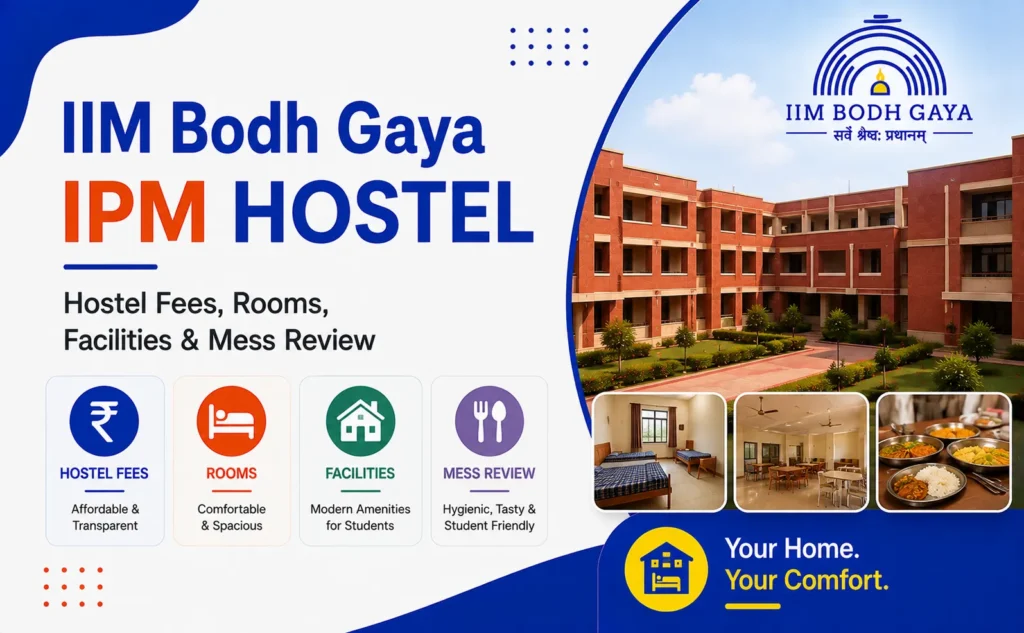
For students entering an IIM immediately after Class 12, academics are only one part of the overall experience. The residential environment can have a significant influence on college life, and the IIM Bodh Gaya IPM Hostel 2027 is an important part of the five-year Integrated Programme in Management experience.
The IPM is designed as a residential management programme. Students spend several years living and studying on campus, which means the hostel becomes more than just a place to sleep. It becomes a space where students interact with classmates, work on assignments, prepare for competitions, attend club activities, relax after classes and develop independence.
For parents, hostel-related questions are equally important. They generally want to know about accommodation, safety, rooms, food, internet facilities, study arrangements, cleanliness and overall living conditions.
For students, the questions may be slightly different:
- What are the hostel rooms like?
- Is hostel accommodation compulsory?
- How much does the hostel cost?
- Is a mess included?
- Is Wi-Fi available?
- Can students study comfortably?
- What is hostel life like?
- What facilities are available?
- How is the food?
- How safe is the campus?
This guide answers these questions and provides a detailed overview of IIM Bodh Gaya IPM hostel facilities, hostel fees, rooms, mess facilities and campus living.
IIM Bodh Gaya IPM Hostel Overview
The IPM at IIM Bodh Gaya is a residential programme, so campus accommodation forms an important part of the student experience.
Students live in an environment where academic and residential facilities are located within the broader campus ecosystem.
This provides several advantages:
- Shorter travel time between hostel and classrooms
- Easy access to the library
- Participation in evening activities
- Better peer interaction
- Access to sports and recreational activities
- Convenience during examinations
- Opportunities for group study
- Greater participation in clubs and committees
Instead of travelling to college every day, students can focus on academics and campus activities within a structured residential environment.
IIM Bodh Gaya IPM Hostel Fees 2027
The exact IIM Bodh Gaya IPM hostel fees for 2027 will depend on the fee structure notified for the 2027 admission cycle.
Students should understand that hostel expenses can be separate from tuition fees. The overall residential cost may include:
- Hostel accommodation
- Mess charges
- Electricity or utility-related charges, where applicable
- Maintenance-related charges
- Security deposits
- Other residential charges
The amount can change from one academic year to another.
Therefore, students should not rely on older fee figures while preparing the final budget for the 2027–32 batch.
A practical approach is to divide the total cost into three categories:
| Expense | Nature |
| Tuition Fee | Academic expense |
| Hostel Fee | Accommodation expense |
| Mess Fee | Food expense |
| Personal Expenses | Variable |
| Travel | Variable |
| Books and Stationery | Academic/personal |
| Laptop and Accessories | One-time/optional |
| Security Deposit | Usually refundable, subject to rules |
Are Hostel Fees Included in the Total IPM Fee?
Students should carefully distinguish between the programme fee and residential expenses.
The overall cost of studying at IIM Bodh Gaya can include multiple components, and hostel and mess charges may be specified separately in the institute’s fee structure.
Before admission, students should examine:
- Tuition fee
- Hostel fee
- Mess charges
- Deposits
- Medical insurance
- Student activity charges
- Other applicable charges
This gives families a clearer understanding of the actual cost of campus living.
Hostel Fees and Mess Fees
Hostel and mess expenses should ideally be considered together when preparing a residential budget.
A student may pay one amount for accommodation and another for food services.
The mess expenditure can vary depending on the institute’s arrangement and the applicable academic year.
Parents should therefore calculate:
Annual residential budget = Hostel charges + Mess charges + Personal expenses
This gives a more realistic estimate than considering the hostel fee alone.
IIM Bodh Gaya Hostel Rooms
Hostel rooms are designed to provide students with a comfortable space for sleeping, studying and personal activities.
Room arrangements can depend on:
- Student intake
- Year of study
- Hostel availability
- Gender
- Batch allocation
- Institute policies
Students should understand that room allocation is generally controlled by the institute and can change depending on operational requirements.
The exact room configuration for the 2027 batch should therefore be confirmed from the accommodation instructions issued at the time of admission.
What is Available Inside Hostel Rooms?
Hostel accommodation generally focuses on essential student requirements.
Depending on the assigned accommodation, students may have access to facilities such as:
- Bed
- Mattress
- Study table
- Chair
- Storage space
- Lighting
- Electrical points
- Internet connectivity
- Basic room furnishings
Students should check the institute’s accommodation instructions before purchasing personal items because some facilities may already be provided.
Study Facilities in the Hostel
Studying in a residential management programme does not stop when classroom teaching ends.
Students frequently need to work on:
- Assignments
- Presentations
- Case studies
- Group projects
- Reading
- Mock presentations
- Competitions
- Internship applications
Having a suitable study environment is therefore important.
Students can use their room for individual study and also access dedicated academic spaces such as the Learning Resource Centre.
The campus library provides individual and group study spaces, making it possible for students to shift between hostel-based study and formal academic spaces depending on their requirements.
Wi-Fi and Internet Facilities
Internet connectivity is an important requirement for modern management students.
Students regularly use online resources for:
- Academic research
- Presentations
- Assignments
- E-books
- Business databases
- Online learning
- Communication
- Applications
- Internship preparation
Campus connectivity helps students remain connected without having to depend entirely on mobile data.
Students should nevertheless maintain a backup mobile-data option for emergencies, especially when working on important submissions.
Mess Facilities at IIM Bodh Gaya
The mess is another major part of hostel life.
Students generally depend on the campus mess for their regular meals, making food quality and variety important aspects of residential life.
A typical student dining arrangement may include:
- Breakfast
- Lunch
- Evening snacks
- Dinner
The exact menu can vary depending on the mess schedule and student preferences.
What Kind of Food is Served?
The mess generally aims to provide regular meals suitable for a diverse student population.
Since students come from different parts of India, food preferences can vary considerably.
A residential mess may therefore include a combination of:
- North Indian dishes
- South Indian dishes
- Vegetarian meals
- Non-vegetarian options, where applicable
- Rice
- Roti
- Dal
- Vegetables
- Snacks
- Breakfast items
The exact menu should be checked after joining because it can change based on student feedback and mess arrangements.
Mess Committee and Student Participation
Student involvement is an important part of residential life.
The institute has a Hostel & Mess Committee, which provides a platform for students to participate in hostel- and mess-related matters.
This can give students an opportunity to communicate feedback regarding:
- Food
- Cleanliness
- Dining arrangements
- Hostel concerns
- Residential facilities
Such student participation is useful because hostel life involves hundreds of students with different preferences and requirements.
Can Students Order Outside Food?
Students may have access to food delivery services depending on campus rules, security regulations and the availability of delivery access.
However, students should not depend entirely on outside food.
The campus mess is designed to be the primary food arrangement for residential students, while outside food can be considered an occasional alternative subject to applicable rules.
Hostel Security at IIM Bodh Gaya
Security is especially important because the IPM includes students who enter college immediately after Class 12.
A residential campus generally requires systems for:
- Entry and exit management
- Security personnel
- Visitor control
- Hostel monitoring
- Identification
- Emergency response
- Campus supervision
Students should follow institute rules relating to visitors, timings and movement.
Parents can also discuss the institute’s specific residential policies during admission and orientation.
Is Hostel Compulsory for IPM Students?
Since IIM Bodh Gaya’s IPM is a residential programme, students should generally expect to stay on campus.
The residential structure is an integral part of the programme experience.
Exceptions, if any, would depend on institute policy and specific circumstances.
Students should not assume that they can independently arrange private accommodation outside campus without prior approval.
Hostel Life at IIM Bodh Gaya
Hostel life can be one of the most memorable aspects of the five-year IPM journey.
Students spend significant time with classmates outside the classroom.
This creates opportunities for:
- Friendships
- Peer learning
- Group study
- Sports
- Cultural activities
- Late-evening discussions
- Club activities
- Competitions
- Personal development
For many students, their hostel group becomes an important social and academic support system.
Peer Learning in Hostel
One of the biggest advantages of living with other IPM students is peer learning.
Students can discuss:
- Difficult academic concepts
- Assignments
- Case studies
- Mock tests
- Presentations
- Career opportunities
- Competitions
A student who struggles with one subject may find that another classmate has a stronger understanding of it.
This creates an informal learning ecosystem outside the classroom.
Group Projects and Hostel Life
Management education frequently includes group-based assignments.
Students may have to work together on:
- Presentations
- Business cases
- Research projects
- Business plans
- Marketing projects
- Finance assignments
- Competitions
Living on campus makes coordination easier because students are physically close to each other.
This can save travel time and allow teams to meet more frequently.
Hostel Life and Clubs
The hostel environment is closely connected with student clubs.
Students may return from classes and participate in:
- Finance Club activities
- Marketing events
- Consulting case preparation
- Entrepreneurship competitions
- Cultural programmes
- Sports
- Music
- Drama
- Student committee meetings
This makes residential life more active than simply attending classes and returning home.
Hostel Life During Exams
During examinations, hostel life can become more academically intensive.
Students may spend additional hours:
- Revising
- Solving questions
- Discussing concepts
- Preparing presentations
- Working on assignments
- Studying in the library
The availability of campus academic facilities is especially useful during these periods.
Students can move between their hostel room and the Learning Resource Centre depending on their study preference.
Hostel Life During Weekends
Weekends can provide students with more flexibility.
Students may use this time for:
- Sports
- Club activities
- Cultural programmes
- Personal study
- Group projects
- Exploring nearby areas
- Watching movies
- Socialising
- Rest
The experience depends heavily on the student’s personality and involvement in campus activities.
Student Housing and Independence
Living away from home teaches students several practical skills.
Students learn to manage:
- Time
- Money
- Laundry
- Food choices
- Academic schedules
- Personal responsibilities
- Social relationships
This independence is particularly valuable for students entering college directly after Class 12.
The first few weeks may require adjustment, but most students gradually develop their own routines.
Hostel Life for First-Year Students
For a student who has never lived away from home, the first year can be an adjustment period.
Students may initially experience:
- Homesickness
- New routines
- Shared living
- Different food
- Increased academic responsibility
- Greater independence
However, living with classmates can make the transition easier.
Peer groups, clubs and orientation activities can help new students become comfortable with campus life.
Hostel Cleanliness and Maintenance
Cleanliness is an important part of any residential campus.
Students should follow basic hostel rules regarding:
- Waste disposal
- Room cleanliness
- Common-area usage
- Food hygiene
- Laundry
- Maintenance complaints
Students should report maintenance issues through the prescribed institute mechanism rather than attempting unauthorized repairs.
Laundry Facilities
Laundry is another practical consideration for residential students.
Depending on the campus arrangement, students may have access to:
- Laundry services
- Washing facilities
- External laundry providers
- Dry-cleaning services
Students should confirm the exact arrangement after joining.
Maintaining a regular laundry schedule can prevent unnecessary inconvenience during busy academic periods.
Medical and Emergency Support
Students living away from home should have access to appropriate medical support.
Campus residential systems can provide access to medical assistance or help students reach nearby healthcare facilities when necessary.
Students should keep:
- Emergency contact information
- Basic personal medicines
- Identification documents
- Insurance information
The institute’s specific medical and emergency procedures should be understood during orientation.
Recreation and Common Areas
Hostel life should not be limited to academics.
Common spaces can provide students with opportunities to:
- Relax
- Socialise
- Watch events
- Play indoor games
- Meet classmates
- Participate in informal activities
Recreational facilities can help students maintain a healthy balance between academic responsibilities and personal time.
Sports and Hostel Life
Sports can become an important part of the residential experience.
Students can participate in activities such as:
- Cricket
- Football
- Basketball
- Volleyball
- Badminton
- Table tennis
- Fitness activities
Sports can also help students build friendships across different batches and programmes.
Cultural Life in the Hostel
With students from different parts of India, residential life can expose students to different languages, food traditions and cultural practices.
Students may celebrate:
- Festivals
- Cultural days
- National events
- Institute celebrations
- Music events
- Dance performances
These activities can make campus life more diverse and engaging.
Hostel and Academic Balance
One potential challenge of residential life is maintaining the right balance.
Students have access to many activities, but academics remain the primary responsibility.
A good routine can include:
Classes → Rest → Study → Club/Sports → Dinner → Revision → Sleep
Students who manage their time effectively can enjoy campus life without compromising academic performance.
Advantages of IIM Bodh Gaya IPM Hostel Life
The residential experience offers several advantages.
Convenience
Students live close to classrooms and academic facilities.
Peer Learning
Classmates are available for discussions and group work.
Networking
Students build relationships with peers, seniors and other members of the IIM community.
Independence
Students learn to manage daily responsibilities.
Extracurricular Exposure
Students can participate in clubs, sports and cultural activities.
Time Management
Students learn to balance academics and activities.
Professional Development
Student clubs and competitions provide opportunities to develop professional skills.
Challenges of Hostel Life
Hostel life also has certain challenges.
Students may need to adjust to:
- Shared accommodation
- Fixed residential rules
- Mess food
- Limited personal space
- Noise
- Academic pressure
- Social commitments
- Homesickness
These challenges are common in residential colleges and can usually be managed through communication, planning and a healthy routine.
What Should Students Carry to the Hostel?
Students should avoid carrying unnecessary items.
Useful items may include:
- Clothes
- Formal wear
- Comfortable footwear
- Basic toiletries
- Study materials
- Laptop
- Chargers
- Extension board, if permitted
- Basic medicines
- Water bottle
- Personal documents
- Small storage organisers
Students should first check the institute’s hostel instructions before purchasing large appliances or electrical equipment.
What Should Parents Know About Hostel Life?
Parents should understand that residential education is intended to encourage independence.
Students will be responsible for many daily decisions.
Parents can support them by encouraging:
- Good time management
- Healthy eating
- Regular communication
- Academic discipline
- Financial responsibility
- Participation in meaningful activities
At the same time, students should learn to solve routine problems independently.
IIM Bodh Gaya Hostel Experience: Overall Review
The overall hostel experience can be considered an important component of the IPM programme because of its residential structure.
The major positives include:
- Campus-based accommodation
- Peer interaction
- Easy access to academic facilities
- Student clubs
- Sports
- Cultural activities
- Group learning
- Independence
- Networking
The experience may also require students to adjust to shared living, institute rules and mess arrangements.
Overall, students who actively participate in campus life can gain much more from the residential experience than simply accommodation.
Why Hostel Life Matters for IPM Students
For students entering an IIM at 17 or 18 years of age, hostel life can contribute significantly to personal development.
Students learn to:
- Communicate with different personalities
- Resolve disagreements
- Work in teams
- Manage their schedules
- Become financially responsible
- Make independent decisions
- Adapt to new environments
These are valuable skills for future managers.
IIM Bodh Gaya IPM Hostel 2027: What Students Should Expect
Students joining the 2027–32 batch should expect a residential academic experience where accommodation, academics and extracurricular activities are closely connected.
The exact hostel room allocation, fees, mess charges and operational arrangements may be updated for the 2027 batch.
Therefore, students should use previous arrangements only as a general reference and check the final institute communication before joining.
Final Takeaway
The IIM Bodh Gaya IPM Hostel 2027 will form an important part of the five-year management journey. Since IPM is a residential programme, students can expect to spend a substantial part of their college life on campus.
Hostel life offers much more than accommodation. It provides opportunities for peer learning, friendships, group projects, club participation, sports, cultural activities and personal development.
Students should plan their finances by considering hostel fees, mess charges and personal expenses separately from tuition fees. The exact hostel and mess charges for the 2027 batch should be confirmed from the applicable fee notification.
For students entering college immediately after Class 12, living away from home can initially be challenging. However, it can also become one of the most valuable parts of the IPM experience by teaching independence, responsibility, communication and time management.
The quality of hostel life ultimately depends not only on physical facilities but also on how students use the residential environment. Students who participate actively in academics, clubs, sports and community activities are likely to gain the most from their campus experience.
Frequently Asked Questions
1. What are hostel fees for IIM Bodh Gaya IPM?
The exact IIM Bodh Gaya IPM hostel fees for 2027 will be announced for the relevant admission batch. Students should budget separately for accommodation, mess and personal expenses.
2. What type of rooms are available?
Room allocation depends on the institute’s accommodation policy, student intake and availability. Students should check the official hostel instructions for the exact room configuration applicable to their batch.
3. Are hostel facilities included in fees?
Hostel accommodation is generally treated as a separate component of the overall programme cost. Students should check the applicable fee structure to determine exactly which residential facilities are included.
4. How is the mess facility?
The campus mess provides regular meals for residential students, generally covering breakfast, lunch, snacks and dinner. The exact menu and arrangements can change according to the institute’s mess system.
5. What amenities are provided in the hostel?
Hostel amenities can include furnished accommodation, study arrangements, internet connectivity, common areas, security and access to campus facilities. Specific amenities depend on the accommodation assigned.
6. Is a hostel compulsory for students?
IPM is structured as a residential programme, so students should generally expect to stay on campus. Any exceptions would depend on the institute’s rules and approval.
7. How is hostel security managed?
Residential security generally involves controlled entry and exit, security personnel, visitor regulations and campus monitoring. Students are expected to follow the institute’s residential safety rules.
8. What is student life in the hostel?
Hostel life combines study, peer interaction, group projects, clubs, sports, cultural activities and informal socialising. It can be an important part of the overall IPM experience.
9. Are Wi-Fi and study facilities available?
Internet connectivity and academic facilities are available within the campus environment, while students can also use the Learning Resource Centre for individual and group study.
10. How is the hostel experience at IIM Bodh Gaya?
The hostel experience provides students with residential convenience, peer learning, independence and access to campus activities. Students should also be prepared to adjust to shared living, institute rules and mess arrangements.