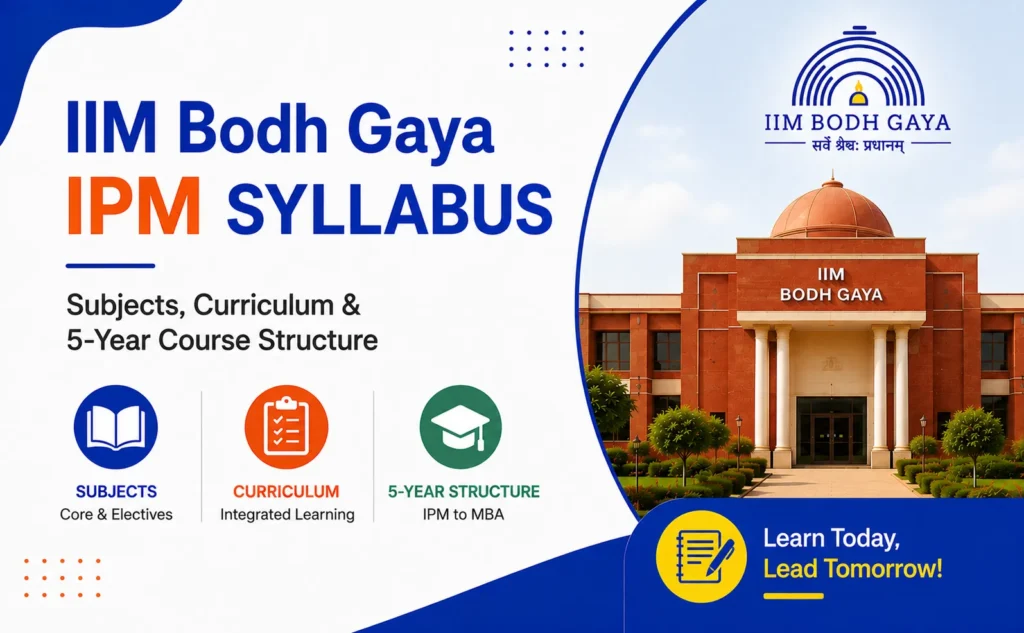
IIM Bodh Gaya IPM Syllabus 2027
The IIM Bodh Gaya IPM Syllabus 2027 is designed for students who want to begin management education after Class 12. The five-year programme combines undergraduate learning with postgraduate management education, gradually moving from foundational concepts to advanced management subjects.
Unlike a traditional BBA, the curriculum is multidisciplinary, covering areas such as economics, mathematics, statistics, psychology, sociology, communication, IT, and humanities during the initial years.
The final two years focus on the MBA curriculum, including advanced subjects, electives, and specialization-oriented courses. Overall, the programme builds students’ conceptual knowledge first and gradually develops skills in areas such as finance, marketing, strategy, organisational behaviour, and analytics.
IIM Bodh Gaya IPM 2027 Course Structure
The IIM Bodh Gaya IPM 5-year course structure can broadly be divided into two phases:
| Phase | Duration | Academic Structure |
| Foundation & Undergraduate Phase | Years 1–3 | Semester-based |
| MBA Phase | Years 4–5 | Trimester-based |
| Rural & Social Immersion | During undergraduate phase | Experiential learning |
| Final Qualification | 5 Years | BBA + MBA |
The first three years provide students with a broad academic foundation. The final two years focus on advanced management education through the MBA curriculum.
Students who successfully complete the five-year program receive the integrated qualification as prescribed by the institute. Students may also have an exit option after the first three years, subject to applicable academic requirements.
IIM Bodh Gaya IPM Subjects
The IIM Bodh Gaya IPM subjects cover several academic disciplines.
Major areas include:
- Accounting
- Economics
- Mathematics
- Statistics
- Finance
- Marketing
- Management
- Organizational Behavior
- Strategic Management
- Business Law
- Psychology
- Sociology
- Information Technology
- Communication
- Data Analytics
- Humanities
- Foreign Language
- Environmental Studies
- Performing Arts
This broad curriculum helps students understand business from multiple perspectives rather than focusing on a single specialization from the beginning.
Semester-Wise IIM Bodh Gaya IPM Syllabus
The first three years are divided into six semesters. Each semester combines core management courses with foundation and interdisciplinary subjects.
The exact course basket may be revised by the institute from time to time, so students should consider the 2027 curriculum as subject to the final academic structure applicable to their batch.
Semester 1
The first semester introduces students to fundamental concepts in management, accounting, economics, mathematics, marketing, and technology.
Major subjects include:
- Introduction to Accounting
- Principles of Management
- Managerial Economics-I
- Business Mathematics
- Principles of Marketing Management I
- Information Technology Management
- Business History
- Effective Language and Communication Skills—I
- Emotional Intelligence and Mindfulness
- Performing Arts
- Yoga or Physical Training
The semester focuses on building a strong academic foundation while developing communication, quantitative, and interpersonal skills.
Introduction to Accounting
Accounting is one of the first business subjects students encounter.
Students develop an understanding of:
- Accounting principles
- Financial transactions
- Journal entries
- Ledger accounts
- Financial statements
- Basic financial reporting
- Interpretation of accounting information
The subject creates the foundation for advanced finance and accounting courses later in the program.
Principles of Management
This course introduces students to the fundamental concepts of management.
Students learn about:
- Planning
- Organizing
- Staffing
- Directing
- Controlling
- Decision-making
- Leadership
- Managerial functions
It provides students with their first formal exposure to management as an academic discipline.
Managerial Economics
Managerial economics helps students understand how economic principles influence business decisions.
Topics generally include:
- Demand and supply
- Consumer behavior
- Production
- Cost
- Revenue
- Pricing
- Market structures
- Business decision-making
The subject becomes particularly useful when students later study strategy, finance, and marketing.
Business Mathematics
Mathematics is an important part of the IIM Bodh Gaya IPM curriculum.
Students develop quantitative reasoning through concepts relevant to business and management.
The course helps build a foundation for:
- Algebra
- Functions
- Equations
- Mathematical reasoning
- Quantitative analysis
- Business decision-making
Students interested in finance, economics, analytics, and consulting particularly benefit from strong quantitative skills.
Marketing Management
The introductory marketing course helps students understand how businesses identify and serve customer needs.
Students learn fundamental concepts such as
- Market segmentation
- Targeting
- Positioning
- Product
- Price
- Promotion
- Distribution
- Customer behavior
Marketing becomes more advanced as students move through the program.
Information Technology Management
Technology plays an important role in modern business.
Information Technology Management introduces students to the relationship between technology and business processes. It helps students understand how information systems can support organizational operations and managerial decisions.
Semester 2
The second semester expands the foundation developed during the first semester.
Major subjects include:
- Introduction to Cost and Management Accounting
- Critical Thinking and Writing Skills
- Spreadsheet Modelling
- Business and Company Law
- Indian Heritage and Culture
- Managerial Economics-II
- World Business History
- Business Statistics-I
- Introduction to Psychology
- The Science of Wellbeing
- Presentation Skills
- Performing Arts
- Yoga or Physical Training
This semester introduces students to statistics, psychology, law, and spreadsheet-based analytical skills.
Business Statistics
Statistics is an important component of the quantitative foundation.
Students learn how to:
- Organize data
- Analyze numerical information
- Identify patterns
- Interpret results
- Apply statistical techniques
- Support business decisions
Statistics later becomes useful in analytics, finance, marketing research, and operations.
Spreadsheet Modelling
Spreadsheet modelling gives students practical exposure to business analysis.
Students can use spreadsheets to work with:
- Data
- Calculations
- Forecasting
- Financial models
- Business scenarios
- Decision-making
This practical skill can be useful during internships and future management roles.
Business and Company Law
Business and Company Law introduces students to the legal environment surrounding organizations.
Students gain an understanding of how laws and regulations affect:
- Companies
- Contracts
- Business transactions
- Corporate activities
- Commercial relationships
Introduction to Psychology
Psychology introduces students to the study of human behavior.
This knowledge is relevant to management because managers work with employees, customers, teams, and stakeholders.
Psychology can support learning in:
- Leadership
- Consumer behavior
- Motivation
- Team management
- Organizational Behavior
- Communication
Semester 3
The third semester begins to introduce more advanced management concepts.
Important subjects include:
- Organizational Behavior
- Environmental Science
- Fundamentals of Corporate Finance
- Effective Language and Communication Skills
- Sociology
- Business Statistics II
- Introduction to Indian Economy
- India and World Geography
- Principles of Marketing Management-II
- Introduction to Strategic Management
- Foreign Language
- Dramatic Arts
The curriculum now starts connecting the foundation subjects with practical management concepts.
Organizational Behavior
Organizational behavior focuses on how individuals and groups function within organizations.
Students explore concepts related to:
- Motivation
- Leadership
- Teamwork
- Organizational culture
- Group behavior
- Employee relationships
- Workplace behavior
This subject is particularly useful for students interested in HR, consulting, and leadership.
Corporate Finance
Fundamentals of Corporate Finance introduces students to financial decision-making within organizations.
Students develop an understanding of:
- Investment decisions
- Financing decisions
- Risk
- Return
- Capital
- Financial planning
The subject creates a foundation for more advanced finance courses during the MBA phase.
Strategic Management
Strategic management introduces students to how organizations develop and implement strategies.
Students begin understanding:
- Competitive advantage
- Business strategy
- Industry analysis
- Strategic decisions
- Organizational positioning
These concepts become increasingly advanced during the MBA years.
Semester 4
The fourth semester continues the progression toward advanced management education.
Students can expect courses covering areas such as
- Financial Management
- Marketing
- Operations
- Organizational Behavior
- Business Analytics
- Economics
- Communication
- Research-oriented subjects
- Environmental and social studies
- Management-related electives
The exact combination of courses may vary depending on the academic structure applicable to the batch.
The emphasis increasingly shifts from basic concepts to application and analysis.
Semester 5
The fifth semester focuses more strongly on management applications.
Students may study areas such as
- Human Resource Management
- Operations Management
- Financial Management
- Marketing Management
- Business Analytics
- Entrepreneurship
- Strategic Management
- Research Methods
- Advanced communication
- Management electives
Students begin connecting theoretical concepts with real-world business situations through cases, projects, and experiential learning.
Semester 6
The sixth semester represents the final stage of the undergraduate component.
Students build advanced knowledge in management while preparing for the MBA phase.
The curriculum may include:
- Advanced management courses
- Business analytics
- Entrepreneurship
- Strategy
- Finance
- Marketing
- Operations
- Management electives
- Research projects
Students may also choose areas of interest depending on the specialization or elective structure offered by the institute.
Rural and Social Immersion
An important experiential component of the IPM curriculum is the Rural and Social Immersion experience.
Students get an opportunity to understand social and economic challenges outside the traditional classroom environment.
This type of experience can help students develop:
- Problem-solving ability
- Social awareness
- Communication
- Teamwork
- Adaptability
- Leadership
- Understanding of grassroots issues
It also helps students understand that management decisions can have broader economic and social consequences.
MBA Curriculum: Years 4 and 5
After completing the undergraduate phase, students move into the MBA component of the program.
The final two years follow the MBA structure and expose students to advanced management education.
Major areas include:
- Finance
- Marketing
- Operations
- Human Resources
- Strategy
- Business Analytics
- Information Systems
- Economics
- Entrepreneurship
- General Management
Students also get opportunities to study electives based on their interests and career goals.
Finance Subjects
Students interested in finance can develop knowledge in areas such as
- Financial Management
- Investment Analysis
- Corporate Finance
- Financial Markets
- Risk Management
- Banking
- Portfolio Management
Finance courses require strong numerical and analytical skills.
Marketing Subjects
Marketing-focused courses can cover areas such as
- Consumer Behavior
- Brand Management
- Digital Marketing
- Sales Management
- Marketing Strategy
- Market Research
- Product Management
These courses can prepare students for careers in brand management, marketing, sales, growth, and product-related roles.
Operations Subjects
Operations management focuses on how organizations efficiently produce and deliver products and services.
Students may study:
- Supply Chain Management
- Operations Strategy
- Quality Management
- Process Management
- Logistics
- Service Operations
These skills are relevant across manufacturing, e-commerce, consulting, and service industries.
Organizational Behavior and Human Resources
Students interested in people management can explore:
- Human Resource Management
- Leadership
- Organizational Behavior
- Talent Management
- Performance Management
- Employee Relations
These subjects help students understand how organizations attract, develop, and manage talent.
Business Analytics
Business analytics has become an important part of modern management education.
Students can develop skills in:
- Data interpretation
- Statistical analysis
- Business intelligence
- Data visualization
- Analytical decision-making
- Predictive thinking
Combining management education with analytics can create opportunities in consulting, technology, finance, and business strategy.
Entrepreneurship
Entrepreneurship courses expose students to the process of creating and managing new ventures.
Students can learn about:
- Opportunity identification
- Business models
- Market research
- Startup finance
- Product development
- Business planning
- Innovation
Students interested in entrepreneurship can also use the IIM environment to participate in startup activities and competitions.
Internships and Experiential Learning
Internships form an important part of the overall IPM learning experience.
Students can gain exposure through:
- Rural and Social Immersion
- Summer internships
- Live projects
- Case competitions
- Industry interactions
- Business simulations
- Corporate projects
These experiences help students understand how concepts learned in classrooms are applied in real organizations.
How is IIM Bodh Gaya IPM Different From a Regular BBA?
Although both programs provide undergraduate management education, the IPM has a much broader five-year structure.
| IIM Bodh Gaya IPM | Regular BBA |
| Five-year integrated programme | Usually three years |
| BBA + MBA pathway | Primarily undergraduate degree |
| IIM environment | Depends on institution |
| MBA-level education included | MBA requires separate admission |
| JIPMAT-based entry | Entrance or merit-based depending on college |
| Strong management focus | Varies by university |
| Residential IIM experience | Depends on college |
| Integrated career pathway | Separate postgraduate planning |
The biggest advantage is the integrated nature of the program.
Students do not have to complete a separate undergraduate degree and then compete for MBA admission through CAT.
Skills Developed Through the IPM
The IIM Bodh Gaya IPM curriculum is designed to develop both academic knowledge and practical skills.
Students can develop:
Quantitative Skills
Mathematics, statistics, and analytical courses improve numerical reasoning.
Communication Skills
Presentations, writing courses, and classroom participation help students become better communicators.
Leadership Skills
Projects, clubs, committees, and group activities create opportunities to develop leadership abilities.
Analytical Thinking
Case studies and quantitative courses encourage structured problem-solving.
Business Understanding
Students gradually learn how finance, marketing, operations, and strategy work together.
Teamwork
Group projects and campus activities help students understand collaboration.
Decision-Making
Management courses train students to evaluate alternatives and make business decisions.
Adaptability
Exposure to multiple disciplines prepares students to work in different business environments.
Is Mathematics Included in IIM Bodh Gaya IPM?
Yes. Mathematics is an important part of the foundation curriculum.
Students encounter business mathematics during the early stage of the program, followed by quantitative subjects such as statistics and finance.
Students who are comfortable with mathematics can benefit significantly from this quantitative foundation.
Are Management Subjects Taught From the First Year?
Yes.
Students are introduced to management subjects from the first year itself.
Courses such as Principles of Management and Marketing Management provide an early introduction to business, while later semesters gradually introduce finance, organizational behavior, strategy, and other advanced management concepts.
How Many Semesters Are There in IIM Bodh Gaya IPM?
The first three years are organized into six semesters, with two semesters in each academic year.
The final two years follow the MBA trimester structure, making the complete five-year program academically different from a conventional six-semester BBA.
How the Curriculum Progresses Over Five Years
The overall academic progression can be summarized as
Year 1: Foundation
Students build knowledge in mathematics, economics, accounting, management, communication, technology, and humanities.
Year 2: Integration
Students move into statistics, finance, organizational behavior, marketing, strategy, and social sciences.
Year 3: Advanced Undergraduate Management
Students deepen their management knowledge and prepare for the MBA phase.
Year 4: MBA Core
Students study advanced management disciplines and develop specialized knowledge.
Year 5: Advanced Management and Electives
Students pursue advanced courses, electives, internships, and placement-oriented preparation.
This gradual progression is one of the major strengths of the IPM curriculum.
Is the IIM Bodh Gaya IPM Syllabus Difficult?
The syllabus is academically demanding because it combines quantitative subjects, business courses, humanities, and management education.
Students may find subjects such as mathematics, statistics, economics, and finance challenging initially.
However, consistent study, classroom participation, regular revision, and practical application can make the curriculum manageable.
Students should develop a habit of studying consistently rather than relying only on examinations.
Who Should Choose IIM Bodh Gaya IPM?
The program can be suitable for students who:
- Are confident about pursuing management.
- Want to enter an IIM after Class 12.
- Enjoy business and economics.
- Are comfortable developing quantitative skills.
- Want an integrated BBA and MBA pathway.
- Are interested in leadership and entrepreneurship.
- Prefer multidisciplinary education.
- Want exposure to corporate and practical learning.
Students who are completely uncertain about pursuing management may want to compare IPM with other undergraduate options before committing to five years.
Final Takeaway
The IIM Bodh Gaya IPM Syllabus 2027 offers much more than a traditional undergraduate management curriculum. It starts with foundation courses and gradually progresses toward advanced management education.
During the first three years, students develop knowledge across mathematics, statistics, economics, accounting, marketing, management, psychology, sociology, communication, and technology. The final two years provide MBA-level education in areas such as finance, marketing, operations, strategy, analytics, and human resources.
The inclusion of internships, rural and social immersion, projects, presentations, and other experiential activities further strengthens the program.
For students who are clear about pursuing a management career after Class 12, the five-year IPM provides a structured pathway from foundational learning to advanced management education.
Frequently Asked Questions
1. What is the syllabus of IIM Bodh Gaya IPM 2027?
The syllabus combines foundation courses, quantitative subjects, economics, accounting, marketing, finance, management, communication, technology, and social sciences. The final two years follow the MBA curriculum.
2. What subjects are taught in the IPM program?
Major subjects include mathematics, economics, accounting, statistics, marketing, finance, organizational behavior, strategic management, business law, psychology, and business analytics.
3. How is the five-year curriculum structured?
The first three years focus on undergraduate foundation and management education through six semesters. The final two years follow the MBA trimester structure.
4. What are the foundation courses in IPM?
Foundation courses include mathematics, economics, statistics, communication, psychology, sociology, humanities, information technology, and other interdisciplinary subjects.
5. Is mathematics included in the curriculum?
Yes. Business mathematics is included in the early semesters, while quantitative concepts also appear in statistics, economics, finance, and analytics courses.
6. Are management subjects taught from the first year?
Yes. Students study subjects such as Principles of Management and Marketing Management from the beginning of the program, followed by more advanced management courses.
7. How many semesters are there in IPM?
The first three years contain six semesters. The final two years follow the MBA trimester structure rather than the traditional semester system.
8. Are internships included in the course?
Yes. The program includes experiential learning opportunities such as rural and social immersion, internships, live projects, and industry-oriented activities.
9. How is the curriculum different from BBA?
IPM integrates undergraduate and MBA-level management education into one five-year program. A regular BBA generally provides only undergraduate education, after which students must pursue a separate MBA.
10. What skills do students develop through IPM?
Students develop quantitative reasoning, communication, analytical thinking, leadership, teamwork, business knowledge, decision-making, and problem-solving skills through academic and experiential learning.