For students planning to pursue management immediately after Class 12, the Integrated Programme in Management has become an attractive alternative to the traditional BBA-BBA followed by the CAT-MBA route.
Among the institutes accepting JIPMAT, IIM Bodh Gaya and IIM Jammu are two important options.
Both offer a five-year integrated management programme, both provide residential campus experiences and both allow students to begin their management education directly after school.
However, choosing between them requires more than simply comparing their names.
Students should evaluate:
- Admission process
- JIPMAT requirements
- Fees
- Curriculum
- Placements
- Campus facilities
- Hostel life
- Student experience
- Brand reputation
- Alumni network
- ROI
- Career opportunities
The two institutes are relatively young compared with older IIMs, so their development trajectory is also important.
This comparison will help students understand the major differences between IIM Bodh Gaya IPM and IIM Jammu IPM and decide which programme may be more suitable for their goals.
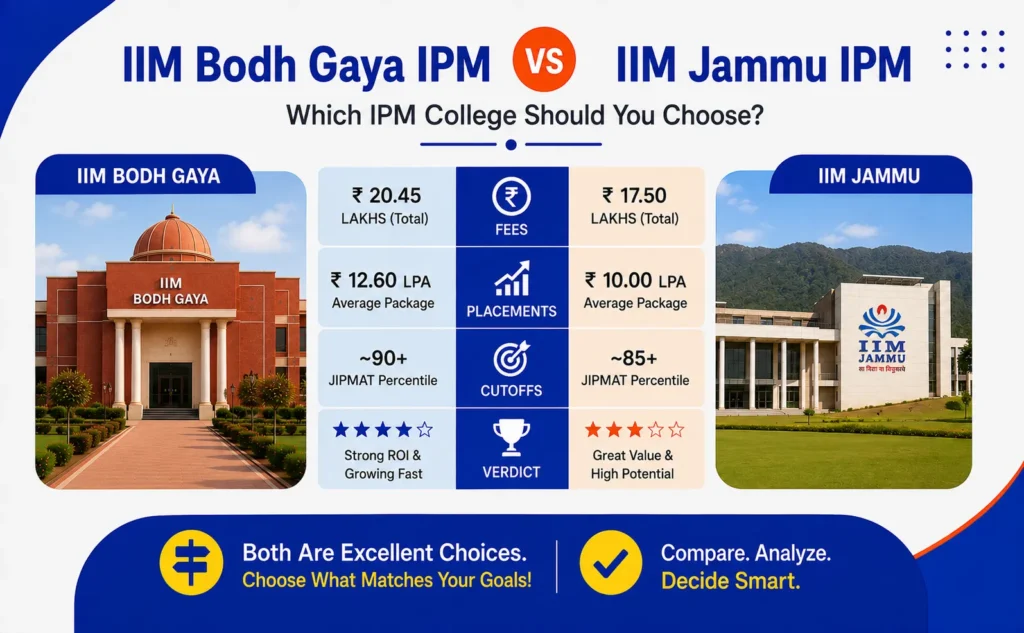
IIM Bodh Gaya IPM vs IIM Jammu IPM: Quick Comparison
| Factor | IIM Bodh Gaya IPM | IIM Jammu IPM |
| Duration | 5 years | 5 years |
| Entrance Exam | JIPMAT | JIPMAT |
| Programme Type | Integrated Management | Integrated Management |
| Undergraduate Degree | BBA | BBA |
| MBA Stage | Years 4 and 5 | Years 4 and 5 |
| Residential | Yes | Yes |
| Admission Interview | No under current JIPMAT route | No under current JIPMAT route |
| Curriculum | Multidisciplinary and experiential | Multidisciplinary and management-focused |
| Campus | Bodh Gaya, Bihar | Jammu, Jammu & Kashmir |
| Alumni Network | Developing | Developing |
| IPM History | Started in 2021 | Started in 2021 |
| Major Advantage | Holistic curriculum and JIPMAT route | Strong integration with MBA ecosystem |
Both institutes currently use JIPMAT for IPM admission, and the current IIM Jammu FAQ specifically states that its selection does not include an interview. IIM Bodh Gaya also identifies JIPMAT as the eligibility route for its IPM.
IIM Bodh Gaya IPM Overview
IIM Bodh Gaya started its Integrated Programme in Management in 2021.
The five-year programme is designed to provide students with management education from the foundation level.
The programme combines:
- Management
- Economics
- Mathematics
- Statistics
- Humanities
- Social sciences
- Communication
- Business subjects
- Experiential learning
The institute describes its IPM curriculum as holistic, with experiential learning and international immersion as important components.
Students who complete the programme progress into the MBA phase after the first three years, subject to the applicable academic requirements.
This makes IIM Bodh Gaya attractive to students who want an integrated management pathway rather than completing a separate undergraduate degree first.
IIM Jammu IPM Overview
IIM Jammu also offers a five-year integrated programme in management.
The first three years provide a multidisciplinary foundation, after which students enter the MBA phase.
The programme covers areas from humanities, social sciences and sciences to business and management.
IIM Jammu’s programme also emphasises:
- Case-based learning
- Experiential learning
- Simulations
- Group projects
- Internships
- Mentorship
- Life-skill development
Students need to meet the institute’s academic requirements to continue into the MBA stage.
The institute currently specifies a minimum CGPA requirement for progression into its MBA programme, along with applicable conduct requirements.
Admission Process Comparison
The admission process is one of the biggest similarities between the two institutes.
Both currently use JIPMAT as their primary entrance examination.
JIPMAT is conducted by the National Testing Agency and is specifically designed for admission to participating IIM IPM programmes.
For students targeting both institutes, this is a major advantage because one entrance examination can create opportunities at both institutions.
The broad process is:
Class 12 eligibility → JIPMAT → Merit/selection process → Admission
Students should still check the individual admission policy because eligibility requirements, category rules and merit calculations can change from year to year.
Is There an Interview?
Under the current admission structure, IIM Jammu states that there is no interview component in its IPM selection process.
IIM Bodh Gaya’s current JIPMAT-based admission route also does not use a separate personal interview for selection.
This makes both programmes different from IPM programmes, where candidates may need to clear a personal interview after the entrance examination.
For students who perform well in aptitude tests but are less comfortable with interviews, this can be an advantage.
JIPMAT and Cutoff Comparison
Since both institutes use JIPMAT, students often ask:
Which one has the higher cutoff?
There is no permanent cutoff.
The effective cutoff can change based on:
- Number of applicants
- Difficulty of JIPMAT
- Number of seats
- Category
- Candidate performance
- Merit calculation
- Previous-year competition
Students should therefore avoid treating a previous year’s cutoff as a guaranteed admission score.
A better strategy is to target a score comfortably above the historical competitive range rather than preparing only to cross a minimum threshold.
IIM Bodh Gaya IPM Fees
Fees are one of the most important factors in the decision.
IIM Bodh Gaya’s IPM fee structure has historically been comparatively moderate during the first three years compared with several other IIM IPM programmes.
However, students should consider the complete five-year cost.
Expenses can include:
- Tuition fees
- Hostel
- Mess
- Academic charges
- Student activities
- Books
- Laptop
- Personal expenses
- Travel
The fourth and fifth years are linked to the applicable MBA fee structure, so the final five-year cost should be calculated using the fee applicable to the student’s batch.
IIM Jammu IPM Fees
IIM Jammu also has a separate fee structure for the first three years, while the fourth and fifth years follow the prevailing MBA fee structure.
The institute states that its IPM course fee includes components such as tuition, hostel and access to facilities, including a library and internet, subject to the applicable fee structure.
Students should nevertheless examine the complete fee document before admission because additional expenses and revisions may apply.
Which Is Cheaper?
Fee structures can change for every batch, so students should not use old numbers as the final 2027 cost.
Historically, IIM Bodh Gaya has been competitive in terms of first-three-year academic fees.
IIM Jammu also offers a structured residential fee package.
The important point is to compare:
Total five-year cost rather than annual tuition alone.
A programme with lower tuition may still have significant hostel, mess and other expenses.
Placement Comparison
Placements are among the most important factors in any IPM comparison.
However, students must understand a major limitation.
Both IIM Bodh Gaya and IIM Jammu have relatively young IPM programmes.
Their institute-level MBA placement data has a longer history than their IPM-specific placement data.
Therefore, students should not assume that the average MBA package published by an institute represents the expected salary of an IPM graduate.
Instead, placement information should be treated as an indicator of the broader institute’s recruiter ecosystem.
IIM Bodh Gaya Placement Outlook
IIM Bodh Gaya has developed a growing recruiter network across sectors.
Career opportunities can include:
- Consulting
- Finance
- Banking
- Marketing
- Sales
- Analytics
- Operations
- General management
- Technology
- Business development
The institute currently reports a 100% placement record at the broader institute level, with an average package of ₹14.80 LPA and a highest package of ₹45.63 lakh in its latest placement highlights.
These figures should not be interpreted as IPM-only outcomes.
IIM Jammu Placement Outlook
IIM Jammu has also developed a growing placement ecosystem.
Students can explore career opportunities in:
- Finance
- Consulting
- Marketing
- Sales
- Operations
- Analytics
- General management
- Banking
- Technology
The institute has published placement reports for multiple MBA batches, providing a developing record of corporate recruitment.
For IPM students, the key long-term advantage is that the fourth and fifth years become integrated with the MBA ecosystem.
Which Has Better Placements?
It is difficult to declare a permanent winner based exclusively on current placement figures.
The most important point is that both institutes are still developing their IPM-specific placement history.
Therefore, students should compare:
- Recruiter quality
- Number of recruiters
- Average package
- Median package
- Roles offered
- Internship opportunities
- Sector diversity
- Alumni career progression
Rather than focusing only on the highest package.
Academics Comparison
Both programmes offer multidisciplinary management education.
IIM Bodh Gaya
Its curriculum emphasises:
- Experiential learning
- International immersion
- Management foundations
- Quantitative skills
- Economics
- Humanities
- Social sciences
- Leadership development
The institute also includes a rural and social immersion component, giving students exposure beyond conventional classroom learning.
IIM Jammu
Its curriculum emphasises:
- Humanities
- Social sciences
- Sciences
- Management
- Case studies
- Simulations
- Group projects
- Internships
- Mentorship
Both programmes therefore go beyond a traditional BBA curriculum.
Which Has Better Academics?
There is no clear universal winner.
Students who prefer experiential learning, social immersion and international exposure may find IIM Bodh Gaya attractive.
Students who prefer case-based learning, simulations, mentorship and strong integration with the MBA curriculum may prefer IIM Jammu.
The difference is more about learning approach than one programme being objectively superior.
Campus Facilities Comparison
Campus facilities matter because IPM is a residential five-year programme.
IIM Bodh Gaya
Students have access to:
- Academic buildings
- Classrooms
- Learning Resource Centre
- Hostels
- Sports
- Student clubs
- Discussion spaces
- Dining facilities
- Student committees
The campus is located in Bodh Gaya, a location with considerable historical and cultural significance.
IIM Jammu
IIM Jammu provides a residential academic environment with:
- Classrooms
- Library
- Hostels
- Sports facilities
- Student activity areas
- Dining facilities
- Technology infrastructure
The Jammu location also provides students with a distinctive geographical and cultural environment.
Which Campus Is Better?
This depends on personal preference.
Students who prefer a quieter, culturally significant location may appreciate Bodh Gaya.
Students who prefer Jammu and its surrounding environment may prefer IIM Jammu.
For both institutes, students should look at the quality of academic infrastructure, hostels, libraries, sports and student activities rather than choosing based only on location.
Student Life Comparison
Student life at both institutes includes:
- Academic activities
- Clubs
- Sports
- Cultural programmes
- Competitions
- Group projects
- Internships
- Student committees
Residential life creates opportunities for students to develop friendships and professional networks.
Students can also learn from peers from different states and academic backgrounds.
IIM Bodh Gaya Student Life
The student environment includes professional and cultural clubs covering areas such as:
- Finance
- Marketing
- Consulting
- Analytics
- Entrepreneurship
- Operations
- Music
- Drama
- Sports
This allows students to pursue interests outside the classroom.
The Bodh Gaya location also offers a relatively peaceful environment for students who prefer less urban surroundings.
IIM Jammu Student Life
IIM Jammu students participate in:
- Clubs
- Competitions
- Sports
- Cultural events
- Academic activities
- Corporate events
- Student committees
The Jammu environment provides a different campus experience and exposure to the region’s culture and geography.
Both institutes can provide a strong residential experience, but student participation ultimately determines how enriching campus life becomes.
Reputation Comparison
Both are relatively young IIMs.
Therefore, neither has the decades-long institutional legacy of IIM Ahmedabad, Bangalore, Calcutta, Lucknow or Indore.
IIM Jammu has developed a growing institutional reputation and an established IPM ecosystem.
IIM Bodh Gaya has also expanded rapidly and recently strengthened its academic profile through international accreditation.
The brand difference between the two is therefore not large enough to make the decision by itself.
Alumni Network
Alumni networks are particularly important for:
- Mentorship
- Internships
- Career advice
- Referrals
- Networking
- Entrepreneurship
Because both IPM programmes are relatively young, their IPM-specific alumni networks are still developing.
Students should therefore think about alumni growth over the next five to ten years rather than only the current size of the network.
ROI Comparison
ROI is one of the most important factors for families.
A simple ROI calculation is:
ROI = Career outcome ÷ Total educational investment
But salary alone is not enough.
Students should consider:
- Total five-year fees
- Hostel and mess costs
- Education loan interest
- Internship opportunities
- Placement prospects
- Salary growth
- Career progression
- Alumni network
If the fee difference is significant, the lower-cost option may provide better financial ROI.
If one institute eventually delivers substantially stronger career outcomes, the higher cost may potentially be justified.
Which Offers Better ROI?
There is no universal answer.
IIM Bodh Gaya may appeal more to cost-conscious students, particularly if its applicable fee structure remains lower.
IIM Jammu may appeal to students who prioritise its specific academic environment and developing institutional ecosystem.
The final ROI depends much more on the student’s individual career outcome than on the institute alone.
Career Opportunities
Graduates from both programmes can potentially pursue careers in:
Consulting
Business analyst, strategy and consulting roles.
Finance
Banking, financial analysis, corporate finance and risk.
Marketing
Brand management, sales, digital marketing and growth.
Analytics
Business analytics, data analysis and strategy.
Operations
Supply chain, operations and process management.
General Management
Management trainee, business development and strategy roles.
The student’s skills, internships and academic performance will significantly influence the actual opportunities available.
Who Should Choose IIM Bodh Gaya?
IIM Bodh Gaya may be suitable for students who:
- Prefer the JIPMAT route
- Want an integrated BBA-MBA pathway
- Like a multidisciplinary curriculum
- Value experiential learning
- Want a quieter campus environment
- Are comfortable with the institute’s developing ecosystem
- Want to participate actively in clubs and competitions
Who Should Choose IIM Jammu?
IIM Jammu may be suitable for students who:
- Prefer its campus and location
- Want a JIPMAT-based IIM IPM
- Like case-based and experiential learning
- Value strong integration with the MBA programme
- Prefer its developing alumni ecosystem
- Want to experience the Jammu region
Final Thoughts
Both IIM Bodh Gaya IPM and IIM Jammu IPM are credible options for students seeking an IIM-based management education after Class 12.
If fees, experiential learning and Bodh Gaya’s academic environment are your priorities, IIM Bodh Gaya can be a strong choice.
If you prefer IIM Jammu’s campus, curriculum structure and overall student environment, it can be equally worth considering.
There is no universal winner.
The best choice is the institute that offers the right combination of fees, academics, career opportunities, campus experience and ROI for your individual goals.
Frequently Asked Questions
1. Which is better, IIM Bodh Gaya IPM or IIM Jammu IPM?
Both are strongly developing IPM options; the better choice depends on fees, campus preference, academics and career goals.
2. What are the fee differences?
Both have separate first-three-year fee structures and prevailing MBA fees for the final two years. Students should compare the complete five-year cost before deciding.
3. Which college offers better placements?
Both have developing placement ecosystems. Institute-level placement data should be compared carefully because it does not necessarily represent IPM-only outcomes.
4. How do admission processes compare?
Both currently use JIPMAT, making the entrance route similar. Students should still check the applicable admission policy for their batch.
5. Which campus has better facilities?
Both offer classrooms, hostels, libraries, sports and student activity facilities. The better campus depends largely on personal preference.
6. How is student life at both institutes?
Both provide residential student life with clubs, sports, competitions, cultural activities and peer learning.
7. Which programme offers better ROI?
ROI depends on total fees and individual career outcomes. Students should compare complete programme costs with realistic placement expectations.
8. How do career opportunities compare?
Both can lead to careers in consulting, finance, marketing, analytics, operations and general management.
9. Which IPM has a better reputation?
Both are young IIMs with growing reputations. Students should evaluate current outcomes as well as long-term institutional growth.
10. Which college should aspirants prefer?
Aspirants should compare fees, JIPMAT performance, curriculum, campus, placements and personal career goals before choosing between the two.