Choosing an integrated programme in management after class 12 can be a major career decision. Students who want to enter management education early often compare multiple IIMs before deciding where to apply.
Among the newer IIM-based IPM options, IIM Bodh Gaya and IIM Ranchi are two institutes that attract considerable attention.
Both provide a five-year integrated management pathway, residential education and exposure to the IIM ecosystem. However, they are not identical.
Their admission examinations are different. Their selection processes are different. Their fee structures are different. Their curriculum structures have different features. Their placement histories are also at different stages.
Therefore, students searching for IIM Bodh Gaya IPM vs IIM Ranchi IPM should not make the decision simply by asking which institute has the bigger name.
A better comparison involves:
- Admission process
- Entrance examination
- Cutoff
- Fees
- Curriculum
- Faculty
- Placements
- Internships
- Campus life
- Alumni network
- Brand value
- ROI
- Long-term career opportunities
This article provides a detailed comparison for students planning their IPM journey around 2027.
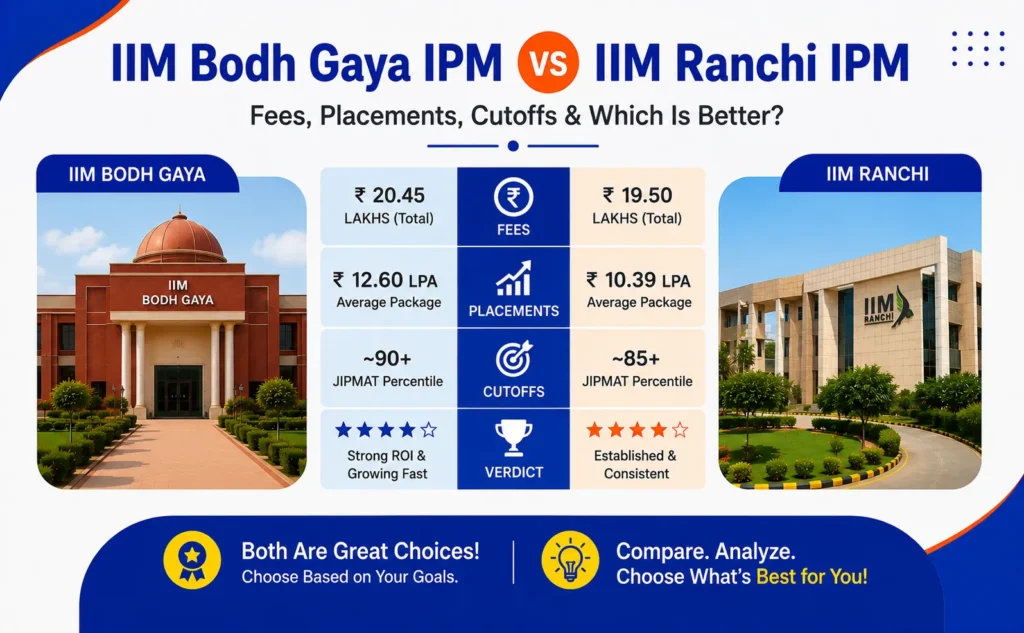
IIM Bodh Gaya IPM vs IIM Ranchi IPM: Quick Comparison
| Factor | IIM Bodh Gaya IPM | IIM Ranchi IPM |
| Programme | 5-year IPM | 5-year IPM |
| Entrance Exam | JIPMAT | IPMAT conducted by IIM Indore |
| Personal Interview | Current JIPMAT route does not use PI | Yes, under current criteria |
| Academic Profile | Considered under admission policy | Considered in final merit |
| Programme Structure | BBA + MBA | BBA + MBA |
| First 3-Year Fee | Around ₹4.75–4.85 lakh per year in recent structures | ₹17.25 lakh total for 3 years in 2025-30 structure |
| Last 2 Years | Prevailing MBA fee | Prevailing MBA fee |
| Residential | Yes | Yes |
| IPM History | Started in 2021 | IPM batch began earlier |
| Major Entrance Advantage | JIPMAT route | IPMAT route |
| Overall Position | Growing IIM | More established IPM ecosystem |
The exact fees and admission criteria for the 2027 batch can change, so students should treat current figures as reference points rather than final 2027 numbers. IIM Bodh Gaya’s current admission portal lists IPM 2026–31, while IIM Ranchi has released its 2026–31 admission information.
IIM Bodh Gaya IPM: Overview
IIM Bodh Gaya launched its five-year Integrated Programme in Management in 2021.
The programme is designed for students entering management education after Class 12.
Students completing the full programme are awarded BBA and MBA degrees by the institute. Students can also exit after the first three years with a BBA, subject to fulfilling the programme requirements.
The first three years follow a semester-based structure, while the final two years follow the prevailing MBA structure.
The curriculum is designed around:
- Management
- Economics
- Mathematics
- Statistics
- Humanities
- Social sciences
- Communication
- Business subjects
- Experiential learning
Students also undergo a compulsory rural and social immersion internship during the programme.
IIM Ranchi IPM: Overview
IIM Ranchi also offers a five-year integrated programme in management.
The programme combines undergraduate education with MBA-level management education.
According to the institute, the first three years provide a multidisciplinary foundation covering humanities, social sciences, arts and sciences. The programme then transitions into the regular MBA curriculum during the fourth and fifth years.
Students can also exit after three years with a BBA if they meet the relevant programme requirements.
IIM Ranchi’s programme includes:
- Classroom learning
- Case analysis
- Experiential learning
- Simulations
- Group projects
- Internships
- Mentorship
- Life-skill courses
The programme is fully residential.
Admission Process Comparison
The admission process is one of the biggest differences between the two institutes.
IIM Bodh Gaya
IIM Bodh Gaya currently uses JIPMAT for its IPM admission route.
JIPMAT is conducted by the National Testing Agency for the participating IIMs.
The admission process is therefore primarily entrance-test driven, with the institute’s applicable academic eligibility and merit criteria also being relevant.
IIM Ranchi
IIM Ranchi currently accepts IPMAT conducted by IIM Indore.
Its current admission criteria include:
- IPMAT score
- Personal Interview
- Academic profile
The initial shortlist is based on IPMAT performance, while the final consolidated merit list combines the admission-test score, PI score and academic profile.
This creates a major strategic difference.
JIPMAT vs IPMAT for IIM Bodh Gaya and IIM Ranchi
If your primary target is IIM Bodh Gaya, you need to prepare for JIPMAT.
If your primary target is IIM Ranchi, you need to prepare for the IPMAT conducted by IIM Indore.
The two examinations have overlapping aptitude areas but differ in structure, competition and preparation strategy.
Students targeting both institutes should ideally prepare broadly for:
- Quantitative Ability
- Logical Reasoning
- Data Interpretation
- Verbal Ability
- Reading Comprehension
- Speed and accuracy
However, preparation should eventually be aligned with the specific examination pattern.
Which Entrance Exam Is More Difficult?
There is no universal answer.
The difficulty depends on:
- Number of applicants
- Exam pattern
- Competition
- Time pressure
- Question selection
- Candidate preparation
IPMAT Indore is highly competitive because it also serves as the entrance route for IIM Indore and is accepted by other institutes.
JIPMAT has its own competitive pool, particularly among students targeting IIM Bodh Gaya and IIM Jammu.
Therefore, students should not select an institute merely because they believe one entrance exam is easier.
Cutoff Comparison
Cutoff comparison is another area where students need to be careful.
A “cutoff” can mean different things:
- Minimum eligibility
- Sectional threshold
- Shortlisting cutoff
- Provisional admission cutoff
- Final merit cutoff
- Safe score
These are not interchangeable.
IIM Bodh Gaya Cutoff
IIM Bodh Gaya has historically used category-wise JIPMAT criteria and merit thresholds.
For example, the published 2025 admission policy stated that candidates meeting the applicable category-wise sectional percentile requirement could enter the merit-list process. A government-published document also reported a provisional-admission score cutoff of 333 for General, 300 for EWS and 280 for NC-OBC in that admission cycle.
These figures should not be treated as the guaranteed 2027 cutoff.
IIM Ranchi Cutoff
IIM Ranchi’s process is different because it uses IPMAT followed by PI and academic-profile evaluation.
The institute’s current admission criteria state that initial shortlisting for PI is based purely on IPMAT performance, with equal weightage to verbal ability and quantitative ability in the initial shortlist calculation.
Therefore, comparing one JIPMAT score directly with one IPMAT score is not meaningful.
Which Has the Easier Admission Process?
From a process perspective, IIM Bodh Gaya can appear more straightforward because the current JIPMAT-based route does not involve the same PI stage used by IIM Ranchi.
IIM Ranchi requires candidates to clear the initial IPMAT-based shortlist and then perform in the personal interview.
However, “fewer stages” does not automatically mean “easier admission”.
JIPMAT itself remains competitive, and students need a strong score to maximise their chances.
IIM Bodh Gaya IPM Fees
Fee is one of the biggest differences between the two programmes.
IIM Bodh Gaya’s recent published structure for the first three years has been around ₹4.75 lakh per year, with the final two years linked to the prevailing MBA fee structure.
The exact amount for the 2027 batch may be revised.
Therefore, students should not assume that the 2025 or 2026 figure will remain unchanged for 2027.
The total cost should include:
- Tuition
- Hostel
- Mess
- Academic expenses
- Student activities
- Personal expenses
- Travel
- Other applicable charges
IIM Ranchi IPM Fees
IIM Ranchi’s published IPM information states that the fee for the 2025–30 batch for the first three years was ₹17.25 lakh, excluding caution deposit, alumni fee and mess expenses.
The final two years are charged according to the prevailing MBA fee for those years.
This makes the first three years considerably more expensive than the corresponding recently published IIM Bodh Gaya structure.
However, students must compare the complete five-year cost rather than only the first three years.
Fees Comparison
| Fee Factor | IIM Bodh Gaya | IIM Ranchi |
| First 3 Years | Around ₹14–15 lakh in recent structure | ₹17.25 lakh for 2025-30 |
| Last 2 Years | Prevailing MBA fee | Prevailing MBA fee |
| Mess | Additional/applicable | Additional |
| Hostel | Additional/applicable | Residential cost applicable |
| Scholarship | Available as per policy | Merit-cum-means scholarships |
| 2027 Fee | Not yet final | Not yet final |
The fee advantage currently leans towards IIM Bodh Gaya for the first three years.
Scholarship Comparison
Financial aid can significantly affect the ROI of an IPM.
IIM Ranchi currently highlights merit-cum-means scholarships and states that its scholarship pool is worth ₹1 crore annually across its programmes, including IPM.
IIM Bodh Gaya also follows applicable scholarship and financial-aid policies.
Students should check the exact scholarship criteria for the relevant batch because eligibility can depend on:
- Academic performance
- Family income
- Category
- Government rules
- Institute-specific policy
A student receiving substantial financial aid may find the ROI of either programme considerably better.
Placement Comparison
Placements are one of the most important factors in the IIM Bodh Gaya vs IIM Ranchi decision.
IIM Ranchi currently has a more mature placement history.
For 2024–25, the institute reported:
- MBA average CTC: ₹19.29 LPA
- MBA highest CTC: ₹50.39 LPA
- MBA-HR average CTC: ₹19.02 LPA
- MBA-BA average CTC: ₹19.87 LPA
The institute also reported PPO and recruiter growth during the placement cycle.
IIM Bodh Gaya’s current placement page reports:
- 100% placement rate
- 200+ recruiting companies
- ₹14.80 LPA average package
- ₹45.63 lakh highest CTC
It also reports higher averages for the top 25%, 50% and 75% of the placement cohort.
Important Placement Disclaimer
Students should not directly compare these numbers as if they represent IPM-only placement outcomes.
Both institutes’ published placement statistics primarily represent broader postgraduate management cohorts.
The IPM programmes have relatively younger placement histories compared with their MBA programmes.
Therefore:
Institute-level placement data is an indicator of the broader ecosystem, not a guarantee of an individual IPM student’s salary.
This distinction is particularly important when calculating ROI.
Which Has Better Placements?
Based on currently published institute-level placement data, IIM Ranchi has the stronger recent placement numbers.
Its 2024–25 MBA average CTC was ₹19.29 LPA, compared with IIM Bodh Gaya’s reported institute-level average of ₹14.80 LPA.
However, this does not mean every IIM Ranchi IPM student will earn more than every IIM Bodh Gaya IPM student.
Individual outcomes depend on:
- Academic performance
- Internships
- Skills
- Communication
- Role preference
- Interview performance
- Recruitment cycle
Curriculum Comparison
Both programmes offer multidisciplinary management education.
IIM Bodh Gaya emphasises experiential learning, international immersion and a holistic curriculum.
Its first three years use a semester system, followed by the MBA structure in the final two years. Students also undergo a rural and social immersion internship.
IIM Ranchi’s curriculum includes humanities, social sciences, arts and sciences in the foundation stage, followed by a cross-disciplinary business core and regular MBA curriculum.
It also includes case analysis, simulations, group projects, internships and mentorship.
Which Curriculum Is Better?
There is no universal winner.
IIM Bodh Gaya may appeal to students who like:
- Experiential learning
- Social immersion
- International exposure
- Mindful leadership
- Multidisciplinary education
IIM Ranchi may appeal to students who prefer:
- Case-based learning
- Simulations
- Business projects
- Mentorship
- Broader exposure to management disciplines
Both are designed to develop management capabilities.
The better curriculum is the one that matches the student’s learning style and career goals.
Campus Life Comparison
Campus life is another important factor because both are residential programmes.
IIM Bodh Gaya
The campus provides:
- Academic infrastructure
- Hostels
- Library
- Sports
- Clubs
- Student committees
- Cultural activities
- Professional events
Bodh Gaya offers a relatively peaceful environment with significant historical and cultural importance.
IIM Ranchi
IIM Ranchi provides a residential academic environment with:
- Classrooms
- Hostels
- Library
- Sports
- Student clubs
- Professional activities
- Competitions
- Corporate interaction
Ranchi as a city provides a larger urban environment than Bodh Gaya.
Which Campus Is Better?
This depends on personal preference.
Choose based on:
IIM Bodh Gaya: if you prefer a quieter campus environment and are comfortable with Bodh Gaya.
IIM Ranchi: if you prefer a larger city environment and a stronger established IPM ecosystem.
Neither location automatically produces better career outcomes.
Brand Value Comparison
IIM Ranchi currently has an advantage in institutional maturity.
It has a longer operating history and an established IPM alumni base.
IIM Bodh Gaya is younger but has been expanding its academic and professional ecosystem.
An important recent development is IIM Bodh Gaya’s AACSB accreditation, which strengthens its international academic credentials.
Therefore, the brand comparison can be summarised as:
IIM Ranchi = more established IPM ecosystem
IIM Bodh Gaya = younger but rapidly developing ecosystem
Alumni Network Comparison
Alumni networks become more valuable over time.
IIM Ranchi has an earlier IPM cohort and therefore a relatively more developed IPM alumni network.
IIM Bodh Gaya’s IPM began in 2021, so its alumni base is still growing.
This difference matters for:
- Mentorship
- Referrals
- Career guidance
- Internships
- Industry connections
However, the gap should gradually reduce as more IPM batches graduate from IIM Bodh Gaya.
Industry Exposure
Both institutes provide opportunities for students to interact with companies through:
- Internships
- Competitions
- Guest sessions
- Corporate events
- Case competitions
- Student clubs
IIM Ranchi IPM students have already demonstrated strong participation in national competitions.
For example, current IPM students have secured positions in competitions involving institutions and companies such as IIM Calcutta, IIM Lucknow, FMS Delhi and L’Oréal.
This provides evidence of active student participation beyond classroom academics.
ROI Comparison
ROI should be calculated using total cost and realistic career outcomes.
A simple framework is:
ROI = Career Outcome ÷ Total Educational Investment
However, students should not use the highest package to calculate ROI.
Instead, consider:
- Total five-year cost
- Median or average outcomes
- Career progression
- Internship quality
- Education loan burden
- Opportunity cost
IIM Bodh Gaya has a potential cost advantage during the first three years.
IIM Ranchi currently has stronger institute-level placement averages.
Therefore, the ROI comparison is not automatically one-sided.
Which Has Better ROI?
If the primary consideration is lower initial academic cost, IIM Bodh Gaya has an advantage based on recently published fee structures.
If the primary consideration is stronger recent institute-level placement outcomes, IIM Ranchi has an advantage.
Therefore:
Lower cost: IIM Bodh Gaya
Stronger current placement numbers: IIM Ranchi
More established IPM ecosystem: IIM Ranchi
JIPMAT-based admission: IIM Bodh Gaya
IPMAT + PI route: IIM Ranchi
The final ROI depends on the student’s individual outcome.
Which Is Better for Students After Class 12?
For a student who wants a simpler JIPMAT-based admission route and values lower first-three-year fees, IIM Bodh Gaya may be attractive.
For a student who is comfortable with IPMAT and personal interview preparation and prioritises an established IPM ecosystem, IIM Ranchi may be preferable.
There is no universal answer.
Which One Should JIPMAT Aspirants Choose?
If you are specifically preparing for JIPMAT, IIM Bodh Gaya is the natural target among these two because IIM Ranchi currently uses IPMAT conducted by IIM Indore.
Therefore, students should not assume that a strong JIPMAT score can be used for IIM Ranchi IPM.
The two admission pathways are separate.
Which One Should IPMAT Aspirants Choose?
If you are preparing for IPMAT Indore, IIM Ranchi becomes a relevant option.
However, students should also evaluate the other institutions accepting IPMAT scores.
IPMAT preparation can therefore create a broader set of opportunities.
Final Decision Framework
IIM Bodh Gaya IPM vs IIM Ranchi IPM: Final Verdict
The choice between IIM Bodh Gaya IPM and IIM Ranchi IPM depends largely on a student’s priorities.
Choose IIM Bodh Gaya if you prefer the JIPMAT route, a comparatively lower first-three-year fee structure, a quieter campus, and a developing academic ecosystem.
Choose IIM Ranchi if you prefer the IPMAT route, are comfortable with a personal interview, and value a more established IPM ecosystem, alumni base, and recent institute-level placement outcomes.
Overall, IIM Ranchi currently has an edge in institutional maturity and IPM development, while IIM Bodh Gaya stands out for its JIPMAT-based admission route and relatively lower cost.
Before deciding, compare entrance exam, fees, curriculum, placements, alumni, campus life, career goals, and ROI. The better option is ultimately the one that fits your academic strengths, financial situation, and long-term goals.
Frequently Asked Questions
1. Which is better between IIM Bodh Gaya IPM and IIM Ranchi IPM?
IIM Ranchi currently has an advantage in institutional maturity, IPM ecosystem and recent institute-level placement performance, while IIM Bodh Gaya offers a JIPMAT route and a comparatively lower recent first-three-year fee structure.
2. How do fees compare between both programmes?
IIM Bodh Gaya’s recent first-three-year fee has been around ₹4.75–4.85 lakh per year, while IIM Ranchi’s published 2025–30 fee was ₹17.25 lakh for the first three years, excluding certain charges. Both charge prevailing MBA fees for the final two years.
3. Which institute has better placements?
IIM Ranchi currently reports stronger institute-level placement numbers, including a ₹19.29 LPA average MBA CTC for 2024–25. IIM Bodh Gaya reports an overall average package of ₹14.80 LPA. These are institute-level figures, not guaranteed IPM-specific outcomes.
4. How do cutoffs differ?
IIM Bodh Gaya uses JIPMAT, while IIM Ranchi uses IPMAT conducted by IIM Indore, followed by PI and academic evaluation. Therefore, their cutoff scores cannot be directly compared.
5. Which campus offers better facilities?
Both institutes provide residential academic environments, libraries, sports, hostels, clubs and student activities. The better campus depends on whether the student prefers Bodh Gaya’s quieter environment or Ranchi’s larger urban setting.
6. How is the curriculum different?
Both programmes combine multidisciplinary foundation education with management studies and an MBA phase. IIM Bodh Gaya emphasises experiential learning and rural/social immersion, while IIM Ranchi highlights cases, simulations, projects, internships and mentorship.
7. Which programme has better ROI?
ROI depends on total cost and individual career outcomes. IIM Bodh Gaya has a recent fee advantage, while IIM Ranchi currently has stronger institute-level placement averages. Students should evaluate both factors together.
8. Which college has stronger brand value?
IIM Ranchi currently has greater institutional and IPM maturity. IIM Bodh Gaya is a younger IIM but has been developing rapidly and recently secured AACSB accreditation, strengthening its international academic profile.
9. Which IPM should students choose after Class 12?
Students should choose based on their entrance-exam strength, financial capacity, career goals and preference for campus environment. JIPMAT-focused students may prefer IIM Bodh Gaya, while IPMAT-focused students can consider IIM Ranchi.
10. What factors should be considered before choosing?
Students should compare the entrance exam, selection process, fees, scholarships, curriculum, placements, internships, alumni network, campus life, location, brand value and long-term ROI before making the final decision.