Introduction
The Integrated Programme in Management Aptitude Test (IPMAT) conducted by IIM Indore is one of India’s most competitive management entrance examinations after Class 12. Every year, thousands of students compete for a limited number of seats, making the IIM Indore IPMAT cutoff trends an important factor in preparation planning.
Understanding previous year cutoffs helps students set realistic targets, evaluate competition levels, and develop an effective preparation strategy. While cutoffs vary depending on exam difficulty, applicant quality, and seat availability, historical data provides valuable insights into expected score ranges and safe targets.
Why Analyzing IPMAT Cutoffs Is Important
Many students focus only on preparation and ignore cutoff analysis.
However, cutoff trends help in:
- Setting realistic score targets
- Understanding competition levels
- Evaluating preparation progress
- Identifying safe score ranges
- Planning mock test goals
- Understanding category-wise requirements
A student targeting IIM Indore should always prepare above the expected cutoff rather than merely aiming to clear it.
Understanding IIM Indore Cutoffs
IIM Indore typically uses sectional cutoffs across the following:
Sections
| Section | Marks |
| Quantitative Ability (Short Answer) | 60 |
| Quantitative Ability (MCQ) | 120 |
| Verbal Ability (MCQ) | 180 |
| Total | 360 |
Students must generally clear sectional cutoffs in all sections before being considered for further stages of the admission process.
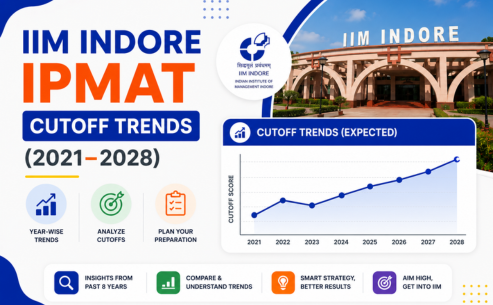
IIM Indore IPMAT Cutoff Trends (2021–2025)
The following table summarizes broad general category trends observed across recent years.
| Year | Approximate Overall Trend |
| 2021 | Moderate |
| 2022 | Higher than 2021 |
| 2023 | Slight dip due to exam difficulty |
| 2024 | Significant rise |
| 2025 | Stable to moderately high |
Historical analysis indicates that cutoffs have generally remained competitive, with fluctuations driven primarily by paper difficulty and applicant quality.
General Category Cutoff Trend Analysis
Recent years show that general category candidates continue to face the highest competition.
Sectional Cutoff Trends
| Year | QA (SA) | QA (MCQ) | VA |
| 2022 | 20 | 21 | 125 |
| 2023 | 12 | 11 | 96 |
| 2024 | 24 | 35 | 113 |
| 2025 | 24 | 28 | 112 |
The sharp decline in 2023 was largely attributed to increased exam difficulty, particularly in quantitative sections. The cutoff rebounded strongly in 2024 as the exam normalized and competition intensified.
Reserved Category Cutoff Trends
Reserved category cutoffs have also shown gradual increases over time.
NC-OBC Trend
| Year | Overall Trend |
| 2022 | Moderate |
| 2023 | Slight Increase |
| 2024 | Higher |
| 2025 | Stable |
EWS Trend
The EWS category has seen relatively strong competition, with cutoffs rising alongside general category trends.
SC and ST Trends
SC and ST cutoffs remain lower than General and OBC categories but have gradually increased as more students from these categories participate in the examination.
Major Factors Influencing IPMAT Cutoffs
Several factors influence yearly cutoff variations.
1. Exam Difficulty
The most important factor is exam difficulty.
Example
- Difficult paper → Lower cutoffs
- Easier paper → Higher cutoffs
The 2023 examination demonstrated how increased difficulty can substantially reduce sectional cutoffs (LPT).
2. Number of Applicants
As IPM programs become more popular, applicant numbers continue to increase.
For example, official admission-related information shows substantial participation in recent IPMAT admission cycles, intensifying competition.
3. Quality of Applicants
Higher-performing applicant pools often push cutoffs upward even when seat numbers remain unchanged.
4. Number of Seats
If seat intake remains relatively stable while applications increase, cutoffs tend to rise.
5. Admission Policy Changes
Changes in:
- Weightage systems
- Interview criteria
- Selection processes
can indirectly affect cutoff levels.
How Competition Impacts Cutoffs
Competition is one of the strongest drivers of cutoff growth.
Rising Popularity of IPM Programs
Over the past several years:
- More students have become aware of IPM programs.
- Coaching support has improved.
- More serious aspirants begin preparation earlier.
As a result, even small improvements in average student performance can increase cutoffs significantly.
Safe Score Analysis for 2028 Aspirants
Students should never prepare only for the cutoff.
Instead, they should target a safe score.
Suggested Targets
| Category | Competitive Target Range |
| General | 190+ |
| EWS | 160+ |
| NC-OBC | 150+ |
| SC | 100+ |
| ST | 80+ |
These ranges are based on recent cutoff patterns and safe-score discussions published by major IPMAT preparation platforms. Actual cutoffs may vary depending on exam conditions.
Can Previous Year Cutoffs Predict 2028 Cutoffs?
The answer is partially yes.
Previous cutoffs cannot predict exact future cutoffs because:
- Exam difficulty changes annually.
- Competition changes yearly.
- Applicant quality fluctuates.
However, cutoff trends help establish realistic score targets.
What Historical Data Can Predict
✔ Competition level
✔ Safe score ranges
✔ Sectional benchmarks
✔ Preparation targets
What Historical Data Cannot Predict
✘ Exact cutoff score
✘ Exact percentile
✘ Future exam difficulty
Section-Wise Cutoff Analysis
Quantitative Ability (Short Answer)
This section often creates differentiation among candidates.
Trend
- High fluctuation
- Sensitive to difficulty level
- Strong influence on selection
Students weak in quantitative aptitude often fail to clear sectional cutoffs despite having good overall scores.
Quantitative Ability (MCQ)
Historically one of the most challenging sections.
Trend
- Large year-to-year variation
- Strong impact from question difficulty
The 2024 cycle witnessed a substantial increase in QA-MCQ cutoffs after the dip seen in 2023.
Verbal Ability
Verbal ability generally exhibits greater stability than quantitative sections.
Trend
- Consistently important
- Less volatile than quantitative ability
- Major contributor to total score
Students with strong reading comprehension and vocabulary often gain a competitive advantage.
Cutoff Trend Forecast for 2028
While exact predictions are impossible, current trends suggest:
Expected Scenario
| Factor | Likely Impact |
| Increased Applicants | Higher Competition |
| Better Coaching Access | Higher Average Scores |
| Growing Awareness | Higher Cutoffs |
| Stable Seat Intake | Competitive Selection |
Therefore, 2028 aspirants should prepare assuming cutoffs will remain highly competitive.
How Students Should Use Cutoff Data
Many students misuse cutoff information.
Correct Approach
Use cutoffs to:
- Set score targets
- Track mock performance
- Identify sectional weaknesses
- Plan revision strategies
Incorrect Approach
Do not:
- Aim only for cutoff scores
- Ignore sectional benchmarks
- Depend on expected cutoffs
Always maintain a margin above historical cutoff levels.
Preparation Strategy Based on Cutoff Trends
If You Are Scoring Below Target
Focus on:
- Fundamentals
- Accuracy
- Topic revision
If You Are Near the Cutoff Range
Focus on:
- Mock tests
- Time management
- Weak area improvement
If You Are Above the Safe Score Range
Focus on:
- Consistency
- Interview preparation
- Advanced practice
Key Takeaways from IIM Indore Cutoff Trends
| Observation | Impact |
| Competition is increasing | Higher preparation standards needed |
| Quantitative sections fluctuate most | Strong QA preparation required |
| Verbal section remains important | Balanced preparation necessary |
| Sectional cutoffs matter | Every section must be cleared |
| Safe scores exceed cutoffs | Aim above minimum requirements |
Conclusion
The IIM Indore IPMAT cutoff trends from 2021 to 2028 highlight the growing competitiveness of IPM admissions. While cutoffs fluctuate due to exam difficulty and applicant quality, the overall trend indicates sustained competition and increasing performance standards. Students should use IPMAT cutoff trends, previous years’ cutoff data, and detailed cutoff analysis to establish realistic targets and preparation goals. Rather than preparing only to clear cutoffs, aspirants should aim for scores comfortably above historical benchmarks to maximize their chances of receiving an interview call and securing admission to IIM Indore.
FAQs
1. How have IIM Indore IPMAT cutoffs changed since 2021?
Overall, cutoffs have remained highly competitive, with temporary fluctuations due to exam difficulty. The general trend shows increasing competition and higher performance expectations.
2. What was the highest cutoff in recent years?
Among recent years, 2024 and 2025 saw relatively high cutoff levels after the dip observed in 2023, especially in quantitative sections.
3. What factors influence cutoff trends?
Major factors include exam difficulty, number of applicants, quality of applicants, seat availability, and admission policy changes.
4. How does competition impact cutoffs?
As more students prepare seriously and applicant numbers increase, cutoffs generally rise because higher scores become necessary for shortlisting.
5. Are sectional cutoffs applicable?
Yes. IIM Indore typically uses sectional cutoffs, and candidates must clear all sections to remain eligible for further selection stages.
6. What is the trend for general category candidates?
General category candidates consistently face the highest competition and generally require the highest scores across all sections.
7. How have reserved category cutoffs changed?
Reserved category cutoffs have gradually increased over time due to rising competition and greater participation among aspirants.
8. Can previous cutoffs predict 2028 cutoffs?
Previous cutoffs can indicate trends and safe score ranges but cannot accurately predict exact future cutoffs because exam conditions change every year.
9. What is considered a safe score based on trends?
For general category candidates, a score above 190 is often considered competitive based on recent trends, though actual requirements may vary yearly.
10. How should students use cutoff data for preparation?
Students should use cutoff data to set realistic score targets, evaluate mock-test performance, identify weaknesses, and create effective preparation plans rather than simply aiming for the minimum cutoff.