Introduction
Understanding the IIM Indore IPMAT Syllabus 2029 is the first step toward effective preparation for the Integrated Programme in Management (IPM) offered by IIM Indore. A clear understanding of the IPMAT Indore syllabus and its topic wise syllabus helps students identify high-priority areas, create a study plan, and maximize their scores in the IPMAT 2029 examination.
What is the IIM Indore IPMAT Syllabus 2029?
The IIM Indore IPMAT Syllabus 2029 covers the subjects and concepts that students must prepare to crack the Integrated Programme in Management Aptitude Test (IPMAT) conducted by IIM Indore. The exam serves as the gateway to the prestigious five-year IPM program and evaluates candidates on their quantitative aptitude, analytical ability, verbal skills, and logical thinking.
Unlike many entrance examinations, IIM Indore does not release an official chapter-wise syllabus. However, based on previous years’ exam trends and question papers, the IPMAT Indore syllabus can be divided into three sections:
| Section | Focus Area |
| Quantitative Ability (MCQ) | Mathematical aptitude and problem-solving |
| Quantitative Ability (Short Answer) | Conceptual application and calculations |
| Verbal Ability (MCQ) | Reading comprehension, grammar, vocabulary, and reasoning |
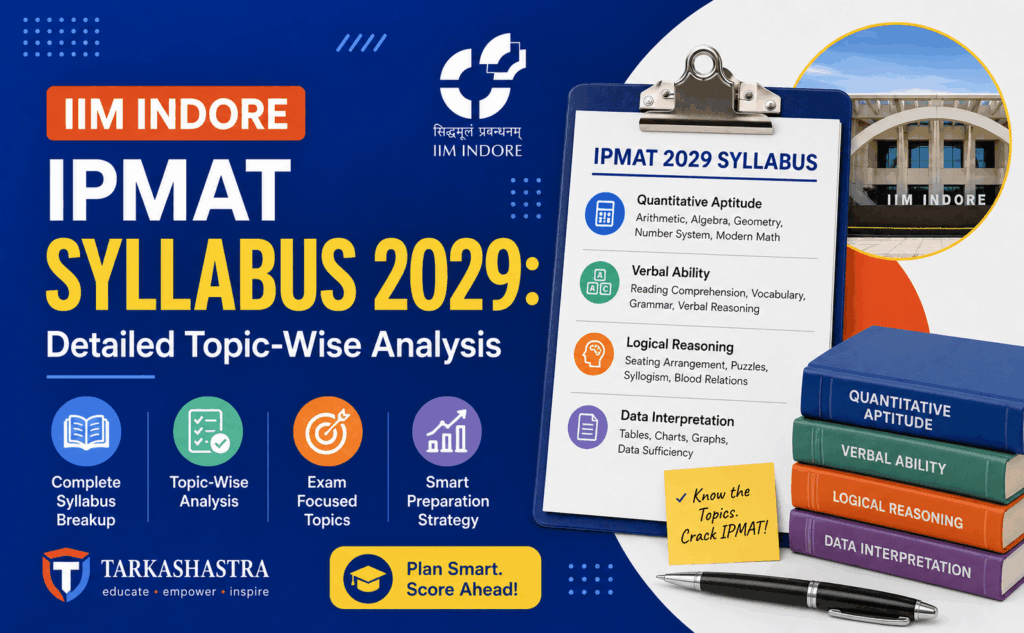
The topic wise syllabus includes Arithmetic, Algebra, Geometry, Number System, Modern Mathematics, Reading Comprehension, Grammar, Vocabulary, and Verbal Reasoning, making it essential for students to prepare comprehensively across both quantitative and verbal domains.
IPMAT Indore 2029 Exam Pattern at a Glance
Before diving deeper into the IIM Indore IPMAT Syllabus 2029, candidates must understand the examination pattern. The IPMAT exam is divided into three sections, each designed to assess different skills required for success in the IPM program.
| Section | Number of Questions | Time Duration |
| Quantitative Ability (MCQ) | 30 | 40 Minutes |
| Quantitative Ability (Short Answer) | 15 | 40 Minutes |
| Verbal Ability (MCQ) | 45 | 40 Minutes |
| Total | 90 | 120 Minutes |
For MCQ sections, candidates receive +4 marks for every correct answer and -1 mark for every incorrect answer. The Quantitative Ability (Short Answer) section does not have negative marking. Since each section has a fixed time limit, students must develop strong time-management skills while covering the IPMAT Indore syllabus and practicing the topic wise syllabus thoroughly.
Key Highlights of IPMAT 2029 Exam Pattern
| Feature | Details |
| Exam Mode | Computer-Based Test (CBT) |
| Total Questions | 90 |
| Total Duration | 120 Minutes |
| Sections | 3 |
| Negative Marking | Yes (MCQ Sections Only) |
| Selection Process | Aptitude Test + Personal Interview |
The exam pattern clearly indicates that success in IPMAT requires a balanced command of both Quantitative Ability and Verbal Ability.
IIM Indore IPMAT Syllabus 2029 – Quantitative Ability (Topic-Wise Analysis)
The Quantitative Ability section is often considered the most challenging part of the IIM Indore IPMAT Syllabus 2029. It tests conceptual clarity, problem-solving skills, calculation speed, and logical thinking. Based on previous IPMAT trends, Arithmetic and Algebra generally contribute the highest number of questions, making them crucial components of the IPMAT Indore syllabus.
Number System
Number System forms the foundation of the topic wise syllabus and frequently appears in both MCQ and Short Answer sections.
Important Topics:
- Divisibility Rules
- HCF & LCM
- Factors and Multiples
- Remainders
- Surds and Indices
- Cyclicity
- Unit Digit
Preparation Tip: Focus on understanding concepts rather than memorizing shortcuts.
Arithmetic
Arithmetic is one of the highest-weightage areas in the IIM Indore IPMAT Syllabus 2029.
Important Topics:
- Percentages
- Profit & Loss
- Ratio & Proportion
- Simple & Compound Interest
- Time & Work
- Time, Speed & Distance
- Mixtures & Allegations
- Partnership
- Boats & Streams
Arithmetic questions are generally scoring and can significantly improve overall performance.
Algebra
Algebra consistently contributes a large share of questions in the IPMAT Indore syllabus.
Important Topics:
- Linear Equations
- Quadratic Equations
- Logarithms
- Functions
- Progressions
- Inequalities
- Modulus
Students should pay special attention to logarithms, functions, and quadratic equations, which have appeared regularly in previous exams.
Geometry & Mensuration
Geometry tests analytical and visualization skills.
Important Topics:
- Lines and Angles
- Triangles
- Circles
- Polygons
- Coordinate Geometry
- Mensuration
- Heights and Distance
Coordinate Geometry has shown notable weightage in recent IPMAT examinations.
Modern Mathematics
Modern Mathematics is increasingly important in the topic wise syllabus.
Important Topics:
- Set Theory
- Probability
- Permutations & Combinations
- Matrices & Determinants
- Statistics
- Mean, Median & Data Arrangement
Recent IPMAT papers have featured multiple questions from Set Theory, Data Arrangement, and Permutations & Combinations, making them high-priority topics for IPMAT 2029 preparation.
Quantitative Ability Priority Matrix
| Priority Level | Topics |
| Very High | Arithmetic, Algebra |
| High | Number System, Set Theory, Coordinate Geometry |
| Medium | Probability, Matrices, Mensuration |
| Revision Focus | Statistics, Heights & Distance |
IIM Indore IPMAT Syllabus 2029 – Verbal Ability (Topic-Wise Analysis)
The Verbal Ability section plays a crucial role in the IIM Indore IPMAT Syllabus 2029 and accounts for nearly half of the total questions in the examination. A strong command of reading comprehension, grammar, vocabulary, and verbal reasoning can significantly improve a candidate’s overall score. According to recent trends, Reading Comprehension remains the most important area of the IPMAT Indore syllabus.
Reading Comprehension
Reading Comprehension is the highest-weightage topic in the topic wise syllabus and tests a student’s ability to understand, interpret, and analyze passages.
Important Areas:
- Main Idea Questions
- Inference-Based Questions
- Author’s Tone
- Vocabulary in Context
- Critical Analysis
Students should develop a daily reading habit through newspapers, editorials, and business magazines to improve comprehension speed and accuracy.
Vocabulary
Vocabulary-based questions assess word knowledge and contextual understanding.
Important Topics:
- Synonyms & Antonyms
- Idioms & Phrases
- Phrasal Verbs
- Confusing Words
- Foreign Words and Etymology
Building a strong vocabulary can help students tackle multiple question types confidently.
Grammar
Grammar questions test the correctness and structure of the English language.
Important Topics:
- Subject-Verb Agreement
- Tenses
- Prepositions & Conjunctions
- Error Spotting
- Modifiers & Parallelism
Grammar remains one of the most scoring areas for well-prepared candidates.
Verbal Reasoning
This area evaluates logical flow and sentence arrangement skills.
Important Topics:
- Para Jumbles
- Para Completion
- Sentence Completion
- Logical Consistency
- Assumption-Based Questions
Recent IPMAT papers have consistently included Para Jumbles, Para Completion, and Fillers, making them essential preparation areas.
Verbal Ability Priority Matrix
| Priority Level | Topics |
| Very High | Reading Comprehension |
| High | Grammar, Para Completion |
| Medium-High | Vocabulary, Phrasal Verbs |
| Medium | Para Jumbles, Logical Consistency |
Most Important Topics for IPMAT 2029 Based on Recent Trends
While the entire IIM Indore IPMAT Syllabus 2029 is important, certain topics have consistently received higher weightage in recent examinations. Students should prioritize these areas while planning their preparation strategy for the IPMAT Indore syllabus.
| High-Priority Topics | Medium-Priority Topics |
| Arithmetic | Geometry & Mensuration |
| Algebra | Probability |
| Reading Comprehension | Vocabulary |
| Grammar | Number System |
| Set Theory | Matrices & Determinants |
| Data Arrangement | Verbal Reasoning |
Recent exam trends indicate that Arithmetic, Algebra, Reading Comprehension, Grammar, Set Theory, and Data Arrangement frequently contribute a significant portion of the questions, making them the most scoring areas of the topic wise syllabus.
How to Prepare for the IIM Indore IPMAT Syllabus 2029
Cracking IPMAT requires a structured approach rather than random preparation. Since the IIM Indore IPMAT Syllabus 2029 covers a wide range of quantitative and verbal topics, students should focus on building concepts before attempting advanced questions.
Effective Preparation Strategy
| Preparation Stage | Focus Area |
| Foundation Phase | Arithmetic, Algebra, Grammar Basics |
| Practice Phase | Topic-wise Questions and Sectional Tests |
| Mock Test Phase | Full-Length Mocks and Time Management |
| Revision Phase | Weak Areas and Error Analysis |
To master the IPMAT Indore syllabus, solve mock tests regularly, analyze mistakes, improve reading habits, and maintain consistency. A well-planned study routine can significantly improve performance across the entire topic wise syllabus.
Prepare for IPMAT 2029 with Tarkashastra
Preparing for the IIM Indore IPMAT Syllabus 2029 becomes significantly easier with expert guidance, structured study plans, and regular practice. At Tarkashastra, students receive comprehensive support covering the entire IPMAT Indore syllabus, from Quantitative Ability fundamentals to advanced Verbal Ability preparation.
Our IPMAT preparation program includes:
- Complete Topic-Wise Syllabus Coverage
- Live Interactive Classes
- Sectional & Full-Length Mock Tests
- Performance Analytics and Feedback
- Doubt-Solving Sessions
- Personalized Mentorship
Whether you’re starting early or intensifying your preparation, Tarkashastra helps students master the topic wise syllabus through a systematic approach designed to maximize scores and improve selection chances for IIM Indore’s prestigious IPM program.
Conclusion
The IIM Indore IPMAT Syllabus 2029 is designed to assess a candidate’s quantitative aptitude, verbal ability, analytical thinking, and problem-solving skills. Since IIM Indore does not release an official chapter-wise syllabus, understanding the IPMAT Indore syllabus through previous exam trends is essential for effective preparation. Students should focus on high-weightage topics such as Arithmetic, Algebra, Reading Comprehension, Grammar, and Set Theory while maintaining a balanced approach across all sections. Consistent practice, regular mock tests, and a well-structured study plan will help aspirants master the topic wise syllabus and improve their chances of securing admission to IIM Indore’s prestigious Integrated Programme in Management (IPM)
FAQs
1. What is the IIM Indore IPMAT syllabus for 2029?
The IIM Indore IPMAT Syllabus 2029 includes Quantitative Ability (MCQ and Short Answer) and Verbal Ability. It covers topics such as Arithmetic, Algebra, Geometry, Number System, Reading Comprehension, Grammar, Vocabulary, and Verbal Reasoning.
2. Which topics are included in Quantitative Ability?
Quantitative Ability includes Arithmetic, Algebra, Number System, Geometry, Mensuration, Coordinate Geometry, Probability, Permutations & Combinations, Set Theory, Functions, Logarithms, and Statistics.
3. Which topics are included in Verbal Ability?
Verbal Ability covers Reading Comprehension, Grammar, Vocabulary, Synonyms, Antonyms, Idioms, Phrasal Verbs, Para Jumbles, Para Completion, Sentence Completion, and Error Spotting.
4. Which topics carry the highest weightage?
Arithmetic, Algebra, Reading Comprehension, Grammar, Set Theory, and Data Arrangement are generally considered the highest-weightage topics based on recent IPMAT exam trends.
5. Has the syllabus changed recently?
No major changes have been announced in the IPMAT syllabus in recent years. However, the number of questions from specific topics may vary from one exam to another.
6. What books cover the syllabus effectively?
Books by Arun Sharma for Quantitative Ability, Norman Lewis for Vocabulary, and Wren & Martin for Grammar are widely recommended for comprehensive IPMAT preparation.
7. How long does syllabus completion take?
Most students can complete the syllabus in 6 to 12 months, depending on their current academic level, preparation strategy, and daily study schedule.
8. What is the best revision strategy?
The best revision strategy is to revise formulas and concepts regularly, solve sectional tests, take mock exams, and analyze mistakes to strengthen weak areas.
9. Which topics should beginners prioritize?
Beginners should start with Arithmetic, Number System, Basic Algebra, Reading Comprehension, Grammar, and Vocabulary, as these topics build a strong foundation for advanced concepts.
10. How should students create a study plan?
Students should divide their preparation into concept building, practice, mock testing, and revision phases. A balanced plan with consistent study hours and regular mock tests is ideal for IPMAT preparation.