Introduction
After Class 12, management aspirants in India often find themselves choosing between two prestigious pathways: an Integrated Programme in Management (IPM) offered by the Indian Institutes of Management (IIMs) and the Bachelor of Management Studies (BMS) offered by the University of Delhi (DU).
Both options are highly respected, attract thousands of applicants every year, and open doors to careers in business, consulting, finance, marketing, analytics, and entrepreneurship. However, they differ significantly in terms of duration, curriculum, fees, campus experience, placements, and long-term career opportunities.
Should you spend five years pursuing an integrated management programme at an IIM, or should you choose a three-year BMS degree at Delhi University and later pursue an MBA?
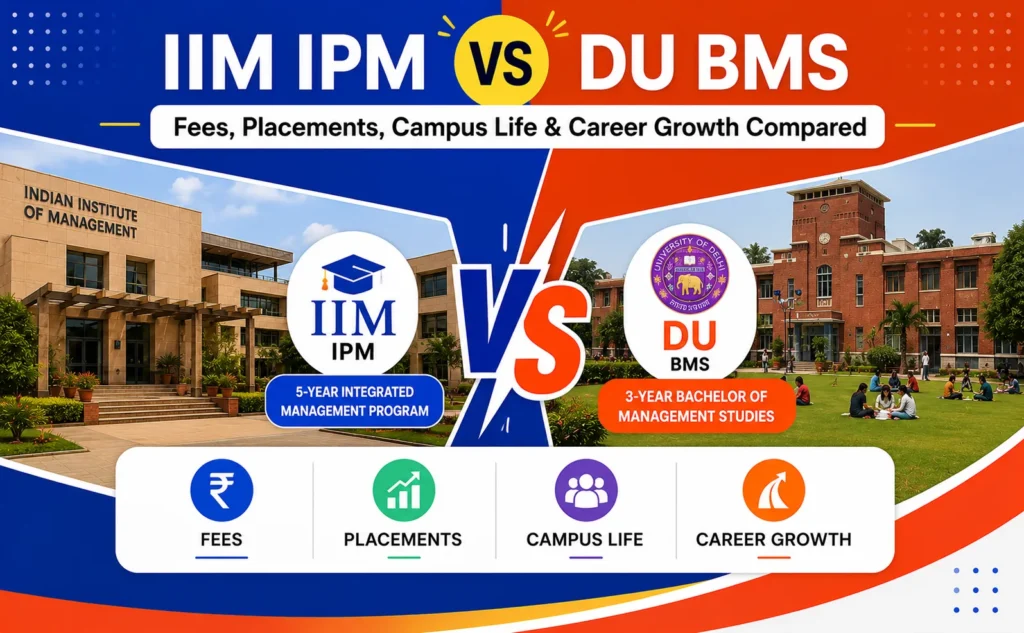
This comprehensive comparison of IIM IPM vs DU BMS 2028 explores every important factor—from fees and placements to campus life and return on investment (ROI)—to help students and parents make an informed decision.
Understanding the Two Programmes
Before comparing them, it is important to understand what each programme offers.
What Is IIM IPM?
The Integrated Programme in Management (IPM) is a five-year integrated management programme offered by selected IIMs. Students enter immediately after Class 12 and complete both undergraduate-level and postgraduate-level management education within a single academic pathway.
Leading IIMs offering IPM or equivalent undergraduate management programmes include the following:
- IIM Indore
- IIM Rohtak
- IIM Ranchi
- IIM Shillong
- IIM Bodh Gaya
- IIM Jammu
- IIM Amritsar
- IIM Sirmaur (through its undergraduate management pathway)
The curriculum combines liberal arts, economics, mathematics, statistics, business studies, and advanced management education.
What Is DU BMS?
The Bachelor of Management Studies (BMS) is a three-year undergraduate management degree offered by colleges affiliated with the University of Delhi.
The programme focuses on:
- Business management
- Marketing
- Finance
- Human resources
- Organisational behaviour
- Entrepreneurship
Students completing BMS often pursue an MBA from IIMs or other top business schools to further enhance their careers.
Quick Comparison: IIM IPM vs DU BMS
| Parameter | IIM IPM | DU BMS |
| Duration | 5 Years | 3 Years |
| Degree Path | Integrated Management | Undergraduate Degree |
| MBA Included | Yes | No |
| Institution Type | IIM | Delhi University |
| Fees | Higher | Significantly Lower |
| Admission Difficulty | Extremely High | Highly Competitive |
| Alumni Network | Strong IIM Network | Strong DU Network |
| Campus Life | Residential | Urban & Day-Scholar Focus |
| Long-Term Career Value | Excellent | Excellent with MBA |
Admission Process Comparison
Admission is one of the biggest differentiators.
IIM IPM Admission 2028
Students generally need to:
- Appear for IPMAT or institute-specific entrance examinations.
- Meet eligibility requirements.
- Clear interviews (where applicable).
- Secure a high merit ranking.
Admission is highly competitive because of limited seats.
DU BMS Admission 2028
Admission is generally based on:
- National-level entrance examinations or university admission processes (as applicable for the admission year).
- Merit ranking.
- Eligibility criteria prescribed by the University of Delhi.
Thousands of students compete every year for a limited number of seats in top DU colleges.
Which Is More Competitive?
Both programmes are difficult to enter.
However, due to limited seats and the prestige of the IIM brand, admission to IPM programmes is generally considered more competitive.
Winner: DU BMS (Slightly More Accessible)
Fee Comparison
Cost is one of the biggest deciding factors for students and parents.
IIM IPM Fees 2028
Students typically pay for:
- Tuition fees
- Hostel accommodation
- Academic resources
- Student activities
- Campus facilities
Since the programme lasts five years, the total investment is substantial.
DU BMS Fees 2028
The fee structure generally includes:
- Tuition fees
- Examination charges
- University fees
- Miscellaneous academic expenses
As a government university programme, DU BMS is significantly more affordable than most IIM IPM programmes.
Which Is More Affordable?
There is a clear winner.
Winner: DU BMS
For students seeking a quality management education at a relatively low cost, DU BMS offers exceptional value.
Curriculum Comparison
The academic structure of both programmes differs considerably.
IIM IPM Curriculum
The BMS vs IPM curriculum comparison begins with IPM’s interdisciplinary approach.
Students study:
- Economics
- Mathematics
- Statistics
- Psychology
- Sociology
- Liberal Arts
- Communication
- Finance
- Marketing
- Operations
- Strategy
- Business Analytics
The later years align closely with postgraduate management education.
DU BMS Curriculum
The BMS programme focuses more directly on business and management subjects, including:
- Principles of Management
- Financial Management
- Marketing Management
- Human Resource Management
- Organisational Behaviour
- Business Law
- Business Analytics
- Entrepreneurship
The emphasis is on practical business education at the undergraduate level.
Which Curriculum Is Better?
IIM IPM Advantages
- Broader academic exposure
- Interdisciplinary learning
- Integrated management education
- Leadership development
DU BMS Advantages
- Business-focused learning from the beginning
- Greater flexibility after graduation
Winner: IIM IPM
Placement Comparison
Placements are one of the biggest concerns for aspirants.
IPM vs BMS Placement Comparison
IIM IPM Placements
Graduates benefit from:
- Strong recruiter confidence
- IIM brand recognition
- Extensive alumni network
- Corporate partnerships
Common sectors include:
- Consulting
- Finance
- Product Management
- Marketing
- Technology
- Analytics
DU BMS Placements
Placement opportunities vary depending on the college.
Top DU colleges attract recruiters from:
- Consulting
- Banking
- FMCG
- E-commerce
- Financial Services
- Technology
Many students also choose higher studies instead of immediate employment.
Which Programme Offers Better Placements?
If the comparison is between IIM IPM and an average DU BMS college, the IIM generally has an advantage because of its integrated management ecosystem.
However, top DU colleges have an excellent placement record for undergraduate programmes and should not be underestimated.
Winner: IIM IPM (Overall)
Average Salary Comparison
Many students compare colleges solely based on average salary.
However, salary depends on factors such as the following:
- Recruiter participation
- Economic conditions
- Student performance
- Industry demand
Rather than focusing only on salary numbers, students should consider the following:
- Career progression
- Alumni network
- Leadership opportunities
- Brand value
Both pathways have produced graduates with successful careers across industries.
ROI Comparison
One of the most debated topics is IPM ROI vs BMS ROI.
What Determines ROI?
ROI includes:
- Educational investment
- Placement opportunities
- Brand value
- Networking
- Career growth
- Alumni support
IIM IPM ROI
Advantages include:
- Integrated management education
- Strong placements
- IIM brand
- Powerful alumni network
DU BMS ROI
Advantages include:
- Extremely affordable education
- Strong placements at top colleges
- Opportunity to pursue an MBA later
Which Programme Offers Better ROI?
The answer depends on the student’s goals.
If you gain admission to a top DU college, the low fee structure can result in exceptional ROI.
However, for students focused on long-term management careers, the IIM brand and integrated programme often provide greater lifetime value.
Winner: Tie (Depends on Individual Goals)
Campus Life Comparison
One of the most overlooked aspects is student experience.
Campus Life at IIM IPM
Most IIMs offer fully residential campuses.
Students benefit from:
- Hostel life
- Student clubs
- Cultural festivals
- Sports events
- Leadership committees
- National competitions
- Peer networking
The immersive residential environment encourages holistic development.
Campus Life at DU BMS
Most DU colleges are non-residential.
Students experience:
- Vibrant college festivals
- Active student societies
- Cultural diversity
- Exposure to Delhi’s corporate ecosystem
- Networking through internships and events
The DU environment offers a dynamic urban college experience.
Which Campus Life Is Better?
If you prefer:
- Residential learning
- Close-knit communities
- Continuous peer interaction
Choose IIM IPM.
If you prefer:
- City life
- Flexible college experience
- Urban networking
Choose DU BMS.
Winner: Tie (Depends on Preference)
Industry Connections
IIM IPM
Students receive:
- Live business projects
- Corporate guest lectures
- Industry competitions
- Consulting events
- Leadership conferences
DU BMS
Top colleges offer:
- Internship drives
- Industry seminars
- Guest lectures
- Corporate competitions
Which Programme Has Better Industry Connections?
The IIM ecosystem generally provides stronger structured industry engagement.
Winner: IIM IPM
Internship Opportunities
Internships play a crucial role in career development.
IIM IPM
Students typically undertake the following:
- Summer internships
- Live consulting projects
- Research assignments
- Industry immersion programmes
DU BMS
Students are encouraged to pursue the following:
- Corporate internships
- NGO projects
- Startup internships
- Freelancing opportunities
Delhi’s location also offers easy access to numerous companies and organisations.
Are internships provided in both programmes?
Yes.
Both pathways encourage practical learning through internships.
Winner: Tie
Recruiters Hiring from IPM and DU BMS
Recruiters at IIMs
Students often receive opportunities from companies in:
- Consulting
- Investment Banking
- FMCG
- Technology
- Analytics
- Product Management
Recruiters at DU BMS
Top DU colleges attract recruiters from sectors including the following:
- Banking
- Consulting
- Consumer Goods
- Technology
- E-commerce
- Financial Services
The exact recruiter mix varies by college and year.
Alumni Network Comparison
IIM Alumni
The IIM ecosystem provides access to one of India’s strongest management alumni networks.
Graduates occupy leadership roles across:
- Global consulting firms
- Fortune 500 companies
- Startups
- Government organisations
- International businesses
DU Alumni
Delhi University has one of the largest alumni networks in India.
Its graduates include:
- Entrepreneurs
- Corporate leaders
- Civil servants
- Politicians
- Academics
- Media professionals
For management-specific networking, however, the IIM alumni ecosystem is generally more focused.
Winner: IIM IPM
Long-Term Career Growth
The ultimate objective of any management education is sustained career growth.
IIM IPM Advantages
- Integrated learning
- Strong brand recognition
- Extensive alumni support
- Leadership development
- Better networking
DU BMS Advantages
- Lower educational investment
- Flexibility in choosing an MBA later
- Excellent undergraduate experience
- Strong foundation in management
Which Programme Is Better?
Students certain about a long-term management career may benefit more from an IIM IPM.
Students who want flexibility or are targeting a top MBA after graduation may find DU BMS equally rewarding.
Who Should Choose IIM IPM?
Choose an IIM IPM if you:
- Want an integrated management education.
- Prefer a residential campus.
- Value the IIM brand.
- Seek long-term management leadership roles.
- Want strong corporate networking opportunities.
Who Should Choose DU BMS?
Choose DU BMS if you:
- Want affordable education.
- Prefer a three-year undergraduate programme.
- Plan to pursue an MBA later.
- Enjoy the urban college experience.
- Value flexibility in career planning.
Final Verdict: IIM IPM or DU BMS?
When comparing IIM IPM vs DU BMS 2028, there is no universal winner.
The right choice depends on your career goals, financial situation, and preferred learning environment.
Choose IIM IPM if:
- You secure admission to a reputed IIM.
- You want an integrated management journey.
- You value the IIM ecosystem, alumni network, and residential learning.
Choose DU BMS if:
- You secure admission to a top DU college.
- You want a highly affordable yet respected management degree.
- You plan to pursue an MBA from a leading institution after graduation.
From a long-term management perspective, IIM IPM generally offers stronger placement ecosystems, structured leadership development, and powerful alumni support. However, DU BMS delivers outstanding value for money and can be an excellent pathway to top MBA programmes and successful corporate careers.
How Tarkashastra Helps Students Prepare for IPMAT and DU Management Entrance Exams
At Tarkashastra, students receive comprehensive preparation for both IIM IPM admissions and DU management entrance examinations through:
- Quantitative aptitude preparation
- Verbal ability training
- Logical reasoning practice
- Mock tests with detailed analysis
- Interview preparation (where applicable)
- College selection guidance
- Admission counselling
Whether your goal is an IIM IPM programme or a top DU BMS college, a structured preparation strategy can significantly improve your chances of success.
FAQs
1. How do fees compare between IIM IPM and DU BMS?
IIM IPM programmes generally have a much higher total cost due to their five-year duration and residential structure, while DU BMS is significantly more affordable.
2. Which programme offers better placements?
IIM IPM programmes generally offer stronger placement ecosystems, though top DU BMS colleges also achieve impressive placement outcomes.
3. How is campus life different?
IIMs offer a residential campus experience, whereas DU BMS provides an urban college life with vibrant student societies and city exposure.
4. What is the ROI for each programme?
DU BMS offers exceptional ROI because of its low fees, while IIM IPM provides strong long-term ROI through brand value, placements, and networking.
5. Which programme is better for long-term career growth?
Students committed to management careers often benefit more from the IIM ecosystem, while DU BMS offers flexibility for those planning an MBA later.
6. What is the average salary for graduates?
Salary outcomes vary each year depending on recruiters, market conditions, and individual performance.
7. How do curricula differ?
IIM IPM combines interdisciplinary undergraduate education with postgraduate management studies, whereas DU BMS focuses on undergraduate business and management subjects.
8. Are internships provided in both programmes?
Yes. Both IIM IPM and DU BMS encourage internships, live projects, and practical industry exposure.
9. Which recruiters hire from IPM vs BMS?
Graduates from both pathways are recruited by companies across consulting, finance, marketing, technology, analytics, FMCG, and e-commerce sectors, although recruiter mixes differ by institution.
10. Which programme should a student choose after Class 12?
Students certain about pursuing a management career and who secure admission to an IIM should strongly consider the IPM. Those seeking affordability, flexibility, and a later MBA can confidently choose a top DU BMS programme.