Introduction
The Integrated Programme in Management (IPM) at IIM Jammu is more than just a management degree—it is a complete residential learning experience. While academics remain the foundation of the programme, the institute places equal emphasis on leadership development, innovation, collaboration, cultural diversity, extracurricular participation, and student well-being.
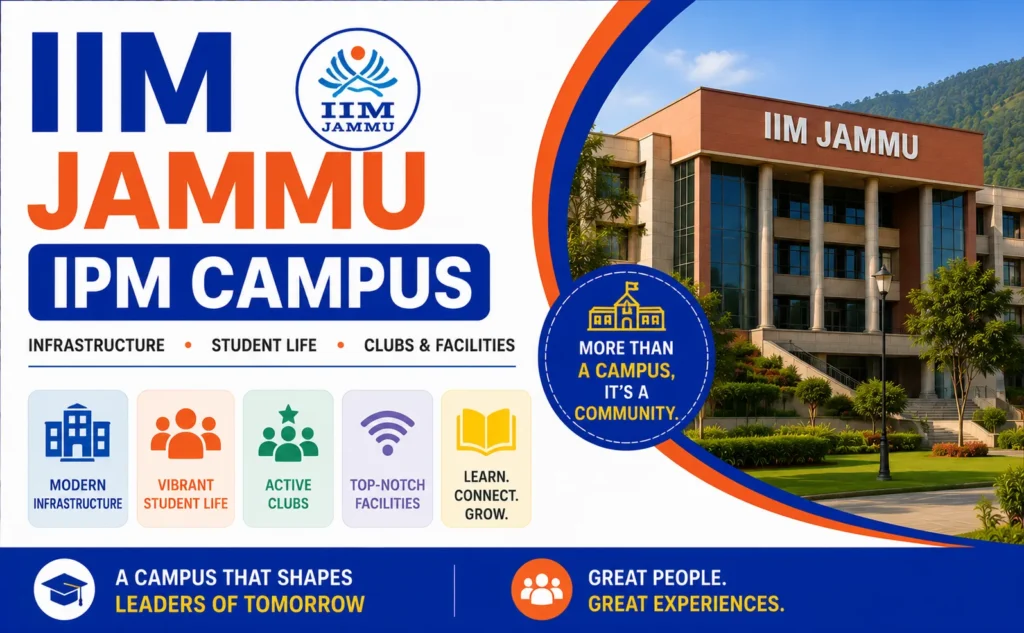
The IIM Jammu IPM Campus 2027 has been designed to provide students with an environment where learning extends beyond classrooms. Modern academic infrastructure, technology-enabled teaching, comfortable residential facilities, sports complexes, student clubs, innovation centres, libraries, and recreational spaces collectively contribute to a holistic educational experience.
Whether you are an aspirant or a parent, understanding campus life is an important part of choosing the right institute. This detailed guide explains everything about the IIM Jammu IPM Campus 2027, including infrastructure, facilities, student life, clubs, events, sports, technology resources, and campus amenities.
Overview of IIM Jammu IPM Campus 2027
IIM Jammu follows a fully residential model, allowing students to remain immersed in academics, peer learning, and campus activities throughout the programme.
Campus Highlights
| Particular | Details |
| Campus Type | Fully Residential |
| Programme | Integrated Programme in Management (IPM) |
| Academic Infrastructure | Smart Classrooms, Seminar Halls, Auditorium |
| Library | Digital & Physical Resources |
| Hostel | Separate Accommodation for Boys & Girls |
| Internet | Campus-wide Wi-Fi |
| Sports | Indoor & Outdoor Facilities |
| Student Clubs | Academic, Cultural, Entrepreneurship & Sports Clubs |
| Healthcare | Medical Support Available |
| Campus Environment | Green, Modern & Technology Enabled |
The permanent Jagti campus has been developed with modern infrastructure to support management education and student life.
IIM Jammu Infrastructure
One of the major strengths of the institute is its modern infrastructure.
The campus has been developed to support:
- Academic excellence
- Research
- Innovation
- Entrepreneurship
- Student engagement
- Residential learning
The infrastructure combines academic buildings, residential facilities, administrative blocks, recreational spaces, sports facilities, and common activity areas.
Academic Buildings
The academic blocks include facilities required for modern management education.
Students benefit from:
- Smart classrooms
- Lecture halls
- Seminar rooms
- Conference halls
- Discussion rooms
- Faculty offices
- Collaborative learning spaces
These facilities encourage interactive teaching and case-based learning.
Smart Classrooms
Technology-enabled classrooms provide an engaging learning environment.
Features generally include:
- Digital teaching systems
- Audio-visual equipment
- Smart presentation tools
- High-speed internet
- Interactive learning support
The institute follows a modern teaching approach that integrates classroom discussions, presentations, case studies, simulations, and collaborative projects.
Seminar Halls and Auditoriums
The campus includes seminar halls and auditoriums used for the following:
- Guest lectures
- Corporate interactions
- Conferences
- Student presentations
- Workshops
- Cultural programmes
- Academic events
Industry experts, entrepreneurs, policymakers, and alumni frequently interact with students through these platforms.
Library Facilities
The IPM library is one of the most valuable academic resources available to students.
The Learning Resource Centre supports teaching, research, and self-learning.
Students have access to:
- Printed books
- Reference books
- National journals
- International journals
- Research publications
- E-books
- E-journals
- Business databases
- Newspapers
- Magazines
The library also provides digital access to several online academic resources.
Digital Library
Modern management education relies heavily on digital learning.
Students can access:
- Online databases
- Digital journals
- Research repositories
- Case studies
- Management publications
- E-learning resources
Digital resources allow students to continue learning beyond classroom hours.
Computer Labs and Technology Resources
Technology plays an important role in management education.
Students generally have access to:
- Computer laboratories
- Internet-enabled systems
- Software applications
- Data analysis tools
- Programming resources
- Learning Management Systems (LMS)
The curriculum itself introduces students to Excel, data analytics, R, Python, computational thinking, and AI-related concepts during the undergraduate years.
Campus Wi-Fi
Yes.
The IIM Jammu IPM Campus is Wi-Fi enabled.
Students can use internet connectivity for:
- Research
- Assignments
- Online classes
- Presentations
- Group projects
- Digital library access
- Learning platforms
Reliable connectivity is essential for management education and collaborative learning.
Innovation and Entrepreneurship
The institute promotes entrepreneurship and innovation through academic initiatives, incubation support, workshops, and industry interaction.
Students interested in building start-ups receive opportunities to:
- Participate in entrepreneurship events
- Attend innovation workshops
- Interact with founders
- Present business ideas
- Work on entrepreneurial projects
Entrepreneurship is also integrated into the academic curriculum.
Student Life at IIM Jammu
One of the biggest attractions of the programme is the vibrant student community.
The IPM student life experience combines:
- Academics
- Clubs
- Competitions
- Cultural activities
- Sports
- Community engagement
- Leadership opportunities
- Industry exposure
Students interact with peers from diverse academic, cultural, and geographical backgrounds.
Campus Diversity
The institute attracts students from different parts of India.
Students come from:
- Science
- Commerce
- Arts
- Urban backgrounds
- Rural backgrounds
- Different states
- Diverse cultures
This diversity enhances peer learning and classroom discussions.
Student Clubs
The institute encourages active participation in student-driven clubs.
Popular categories include:
Academic Clubs
Students organise:
- Case discussions
- Research activities
- Knowledge sessions
- Guest lectures
Finance Club
Activities include:
- Stock market discussions
- Investment competitions
- Financial modelling sessions
Marketing Club
Students participate in:
- Branding competitions
- Marketing campaigns
- Consumer research
- Business quizzes
Entrepreneurship Club
The Entrepreneurship Club promotes the following:
- Business idea competitions
- Start-up discussions
- Innovation workshops
- Founder interactions
Consulting Club
Students solve real-world business cases and participate in consulting competitions.
Cultural Club
The Cultural Club organises the following:
- Dance performances
- Music events
- Festivals
- Talent competitions
Literary Club
Activities include:
- Debates
- Public speaking
- Creative writing
- Quiz competitions
Sports Club
The sports club coordinates the following:
- Inter-hostel competitions
- Annual sports events
- Fitness initiatives
- Team sports
Student Activities
The IPM activities extend far beyond academics.
Students regularly participate in:
- Case competitions
- Hackathons
- Business simulations
- Group projects
- Industry workshops
- Guest lectures
- Leadership programmes
- Cultural festivals
- Community outreach
These activities help develop practical management skills.
Leadership Development
The institute places strong emphasis on leadership.
Students develop leadership skills through:
- Club management
- Event coordination
- Committee responsibilities
- Team projects
- Student governance
These experiences prepare students for managerial roles.
Sports Facilities
The IPM sports facilities support both recreation and fitness.
Students generally have access to:
Outdoor Sports
- Cricket
- Football
- Volleyball
- Basketball
Indoor Sports
- Badminton
- Table Tennis
- Chess
- Carrom
Fitness
- Gymnasium
- Fitness equipment
- Open activity spaces
Sports contribute to physical well-being and teamwork.
Recreation Facilities
Residential life includes multiple recreational spaces.
Students can enjoy:
- Common rooms
- Indoor games
- Television rooms
- Student lounges
- Open seating areas
- Social gathering spaces
These facilities help students relax after academic sessions.
Hostel and Residential Life
The fully residential campus provides students with opportunities to:
- Build lifelong friendships
- Collaborate academically
- Participate in late-night discussions
- Prepare for competitions
- Develop interpersonal skills
Hostel life plays an important role in personality development.
Cultural Festivals
The institute celebrates various cultural events throughout the year.
Students participate in:
- Traditional festivals
- Annual cultural fests
- Talent showcases
- Music competitions
- Dance performances
- Theatre events
These events strengthen campus bonding.
Academic Events
Academic activities include:
- Management conclaves
- Business competitions
- Research conferences
- Faculty lectures
- Industry seminars
- Alumni interactions
These programmes expose students to current business trends.
Guest Lectures
Industry interaction remains an important feature of campus life.
Students regularly attend sessions by:
- CEOs
- Entrepreneurs
- Management professionals
- Government officials
- Consultants
- Alumni
Such interactions help students understand practical business challenges.
International Exposure
The IPM curriculum includes opportunities for international exchange programmes based on merit and institute norms during the undergraduate phase. Students who qualify can gain exposure to global academic environments and cross-cultural learning experiences.
Community Engagement
Students participate in:
- Social internships
- Community projects
- NGO initiatives
- Rural immersion programmes
- CSR-related activities
These experiences build social responsibility alongside managerial competence.
Campus Amenities
The IPM campus amenities include:
- Wi-Fi
- Library
- Hostel
- Mess
- Medical facilities
- Sports infrastructure
- Student activity spaces
- Banking/ATM support (where available)
- Parking
- Administrative support
These amenities create a comfortable living and learning environment.
Healthcare and Wellness
Student well-being is supported through:
- Basic medical assistance
- Health insurance coverage (as applicable under institute policies)
- Emergency medical support
- Counselling and wellness initiatives
The institute encourages students to maintain a healthy academic-life balance.
Student Events
The institute hosts numerous events throughout the academic year.
These include:
- Orientation programmes
- Freshers’ events
- Cultural festivals
- Sports meets
- Academic competitions
- Management conclaves
- Farewell ceremonies
Most events are organised by student committees with faculty guidance, helping students develop event management, teamwork, budgeting, and leadership skills.
Campus Security
Safety remains a priority.
Security measures generally include:
- 24×7 security personnel
- CCTV surveillance in common areas
- Controlled campus access
- Identity verification
- Hostel wardens
- Emergency support systems
These measures contribute to a safe residential environment.
Support Services on Campus
Students receive multiple academic and non-academic support services.
These include:
Academic Support
- Faculty mentoring
- Academic advising
- Library assistance
- Learning resources
Career Support
- Internship guidance
- Placement assistance
- Corporate interaction
- Career counselling
Student Welfare
- Hostel administration
- Medical support
- Wellness initiatives
- Administrative assistance
IT Support
- Wi-Fi connectivity
- Computer support
- Learning Management System access
Benefits of Campus Living
Studying on a residential campus offers several advantages.
Students benefit from:
- Continuous peer learning
- Better faculty interaction
- Strong networking opportunities
- Leadership development
- Cultural exposure
- Time management
- Professional growth
- Holistic personality development
These experiences complement classroom learning and prepare students for future managerial careers.
Why Choose Tarkashastra for IPM Preparation?
A vibrant campus experience begins with securing admission to the right institute. At Tarkashastra, students receive comprehensive preparation for JIPMAT through experienced faculty, concept-based teaching, structured study material, sectional practice, mock tests, previous-year paper discussions, and personalized mentoring.
In addition to entrance exam preparation, Tarkashastra guides students through institute selection, admission counselling, scholarship awareness, and understanding campus life, helping aspirants make informed decisions about pursuing the IPM programme at IIM Jammu and other leading management institutes.
Final Thoughts
The IIM Jammu IPM Campus 2027 offers much more than modern buildings and classrooms. It provides an ecosystem where academic excellence, leadership development, innovation, extracurricular participation, and residential learning come together to shape future business leaders.
From smart classrooms and a well-equipped digital library to sports facilities, entrepreneurship initiatives, student clubs, cultural events, and technology-enabled learning, every aspect of campus life contributes to a well-rounded educational experience. The fully residential model further strengthens peer learning, networking, and personal development, making the IIM Jammu campus an ideal environment for aspiring management professionals.
Frequently Asked Questions (FAQs)
1. What is the campus infrastructure like?
The campus features modern academic buildings, smart classrooms, seminar halls, an auditorium, residential hostels, sports facilities, a digital library, Wi-Fi connectivity, and student activity spaces designed to support holistic management education.
2. What clubs are available for students?
Students can participate in academic, finance, marketing, entrepreneurship, consulting, cultural, literary, and sports clubs, along with various student committees and special-interest groups.
3. How is student life at IIM Jammu IPM?
Student life is vibrant and combines academics, residential learning, club activities, cultural programmes, sports, leadership opportunities, industry interaction, and community engagement.
4. Are there sports and recreation facilities?
Yes. Students have access to outdoor sports such as cricket, football, basketball, and volleyball, along with indoor games like badminton, table tennis, chess, and fitness facilities.
5. How big is the library?
The institute provides a comprehensive learning resource centre with extensive collections of books, journals, e-books, databases, and digital learning resources. The exact collection size changes over time as new resources are added.
6. Are there computer labs and technology resources?
Yes. Students have access to computer laboratories, internet-enabled systems, software tools, digital learning platforms, and technology resources that support the curriculum, including analytics and programming courses.
7. What extracurricular activities are available?
Students participate in cultural festivals, case competitions, business simulations, hackathons, debates, entrepreneurship events, sports tournaments, management conclaves, and community outreach programmes.
8. Is the campus Wi-Fi enabled?
Yes. The campus is Wi-Fi enabled, allowing students to access online learning resources, research databases, digital library services, and collaborative platforms.
9. How are student events organised?
Most student events are organised by student clubs and committees under faculty guidance. Students take responsibility for planning, budgeting, marketing, coordination, and execution, providing valuable leadership experience.
10. What support services are provided on campus?
The campus provides academic mentoring, career guidance, placement support, library services, IT support, hostel administration, medical assistance, wellness initiatives, and student welfare services to ensure a supportive learning environment.