Introduction
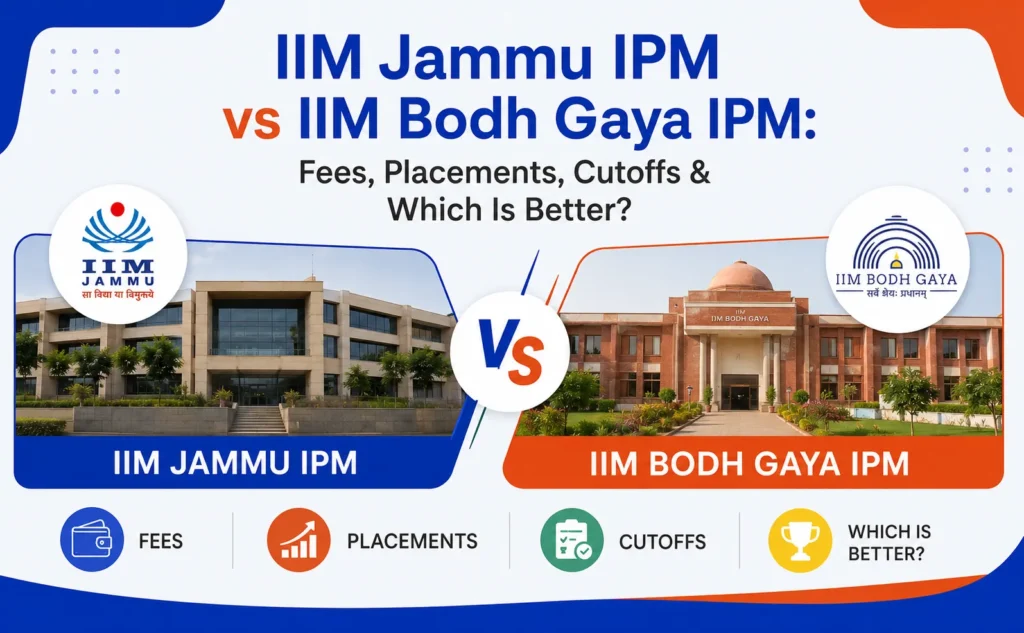
Choosing the right Integrated Programme in Management (IPM) after Class 12 is an important decision for management aspirants. Among the popular choices, IIM Jammu IPM and IIM Bodh Gaya IPM have gained significant attention due to their quality education, modern curriculum, and growing reputation.
This comparison of IIM Jammu IPM vs IIM Bodh Gaya IPM 2027 covers key factors like fees, curriculum, placements, cutoffs, campus facilities, and ROI to help you choose the programme that best matches your career goals.
Why Compare IIM Jammu IPM and IIM Bodh Gaya IPM?
Although both institutes belong to the prestigious Indian Institute of Management ecosystem, they have developed their own academic culture and institutional strengths.
Students usually compare these programmes because:
- Both offer a five-year Integrated Programme in Management (IPM).
- Both are newer IIMs with rapidly growing reputations.
- Both attract students through the JIPMAT entrance examination.
- Both provide a direct pathway to an MBA after Class 12.
- Both focus on holistic management education.
Since the admission process is competitive, many candidates receive opportunities from both institutes and must decide which one better aligns with their aspirations.
Understanding the IPM Programme
Before comparing the institutes, it is important to understand what an integrated programme in management offers.
The IPM combines undergraduate education with postgraduate management studies in a single five-year course. Instead of completing a bachelor’s degree first and preparing for MBA entrance examinations later, students begin management education immediately after Class 12.
The curriculum typically includes:
- Economics
- Mathematics
- Statistics
- Psychology
- Communication Skills
- Sociology
- Business Management
- Marketing
- Finance
- Operations
- Strategy
- Entrepreneurship
- Analytics
This integrated approach helps students develop managerial thinking from an early stage while gradually transitioning into advanced MBA-level coursework.
IIM Jammu at a Glance
IIM Jammu has established itself as one of the fastest-growing new-generation IIMs. The institute has invested significantly in academic excellence, research, faculty recruitment, infrastructure, and industry collaborations.
Some key highlights include:
- Modern campus infrastructure
- Experienced faculty members
- International collaborations
- Research-oriented environment
- Student-driven clubs and committees
- Leadership development initiatives
- Industry interaction through seminars and workshops
Its Integrated Programme in Management aims to develop future business leaders through a balanced mix of academic learning and practical exposure.
IIM Bodh Gaya at a Glance
IIM Bodh Gaya has also witnessed steady growth since its establishment. Located in one of India’s most historically significant cities, the institute combines academic excellence with a strong emphasis on holistic education.
The institute focuses on:
- Experiential learning
- Global perspective
- Innovation
- Entrepreneurship
- Leadership development
- Ethical business practices
- Research culture
Its IPM programme has become increasingly popular among students looking for an integrated management education within the IIM ecosystem.
IIM Jammu IPM vs IIM Bodh Gaya IPM 2027: Key Comparison Parameters
Students should avoid judging an institute based on a single factor. Instead, a comprehensive comparison provides a more realistic picture.
Some of the most important parameters include:
| Comparison Parameter | Importance |
| Tuition Fees | Very High |
| Placement Opportunities | Very High |
| Cutoff Trends | High |
| Curriculum | High |
| Faculty Quality | Very High |
| Campus Infrastructure | High |
| Student Life | High |
| Alumni Network | Moderate |
| Industry Exposure | Very High |
| ROI | Very High |
Considering all these factors together helps students choose the institute that best matches their goals.
IIM Jammu IPM vs IIM Bodh Gaya IPM Fees
One of the biggest deciding factors for students and parents is the overall cost of education.
When comparing IIM Jammu IPM vs IIM Bodh Gaya IPM fees, candidates should look beyond tuition fees alone.
The total educational cost generally includes:
- Tuition fees
- Hostel charges
- Mess charges
- Library fees
- Examination fees
- Student activity fees
- Security deposits
- Miscellaneous expenses
Since fee structures may be revised periodically by the institutes, students should always verify the latest admission brochure before accepting an offer.
Fee Comparison Factors
| Expense Category | IIM Jammu | IIM Bodh Gaya |
| Tuition Fee | Comparable | Comparable |
| Hostel Charges | Applicable | Applicable |
| Mess Charges | Applicable | Applicable |
| Academic Fees | Included | Included |
| Student Activities | Included | Included |
Overall, both institutes fall within a similar fee range, making other factors such as placements, academics, and campus experience equally important in the final decision.
Scholarships and Financial Assistance
Both institutes recognise that financial constraints should not prevent talented students from pursuing higher education.
Students may benefit from:
- Government scholarships
- Central sector scholarships
- State scholarships
- Merit-based financial assistance
- Need-based support
- Educational loans from banks
Candidates should explore all available scholarship opportunities during the admission process.
Curriculum Comparison
A strong curriculum is the foundation of any management programme.
Both institutes follow an integrated approach where students first build fundamental knowledge before progressing to advanced management subjects.
Common Foundation Subjects
Students generally study:
- Economics
- Mathematics
- Statistics
- English Communication
- Psychology
- Sociology
- Political Science
- Environmental Studies
These subjects strengthen analytical thinking and communication skills.
Advanced Management Subjects
During later years, students learn:
- Marketing Management
- Financial Management
- Human Resource Management
- Operations Management
- Business Analytics
- Strategic Management
- Organisational Behaviour
- Entrepreneurship
- Supply Chain Management
- International Business
The advanced curriculum prepares students for leadership positions across industries.
Academic Flexibility
Modern management education extends beyond classroom lectures.
Both IIM Jammu and IIM Bodh Gaya encourage students to engage in:
- Case study discussions
- Group projects
- Business simulations
- Research assignments
- Corporate internships
- Industry visits
- Presentations
- Workshops
- Competitions
Such experiential learning enhances problem-solving and decision-making skills.
Faculty Comparison
Faculty quality significantly influences the learning experience.
When comparing the IPM faculty comparison, both institutes have recruited professors with strong academic credentials and industry experience.
Faculty members typically possess:
- Doctoral qualifications from reputed institutions
- National and international research publications
- Consulting experience
- Corporate exposure
- Expertise in specialised management domains
Students benefit from interactive classroom discussions and mentorship throughout the programme.
Teaching Methodology
Both institutes emphasise active learning through:
- Harvard-style case discussions
- Classroom debates
- Industry examples
- Simulation exercises
- Project-based learning
- Peer collaboration
This approach encourages students to think critically rather than relying solely on theoretical concepts.
Research and Innovation
Research plays an important role in management education.
Both institutes encourage students and faculty to participate in:
- Research projects
- Academic conferences
- Journal publications
- Innovation challenges
- Entrepreneurship initiatives
Students interested in higher education or research careers gain valuable exposure through these activities.
Industry Exposure
Management education becomes meaningful when students interact with the corporate world.
Both institutes organise:
- Guest lectures by industry experts
- Corporate workshops
- Leadership talks
- Internship programmes
- Live consulting projects
- Business competitions
Such initiatives help students understand current business trends and improve their employability.
International Exposure
Global business requires global perspectives.
Both institutes are gradually expanding opportunities through:
- International collaborations
- Student exchange initiatives
- Joint academic programmes
- International conferences
- Cross-cultural learning opportunities
Although these initiatives continue to evolve, they contribute to creating globally aware management graduates.
Learning Environment
A supportive academic environment plays a crucial role in student success.
Both institutes focus on:
- Interactive classrooms
- Digital learning resources
- Faculty mentoring
- Peer collaboration
- Continuous assessment
- Skill development
- Leadership training
Students are encouraged to take ownership of their learning while participating actively in academic and extracurricular activities.
IIM Jammu IPM vs IIM Bodh Gaya IPM Placements
Placements are one of the most significant deciding factors for students comparing integrated management programmes. While the first three years of an IPM focus on building strong academic foundations, students also look ahead to the MBA phase and the career opportunities available after graduation.
When comparing IIM Jammu IPM vs IIM Bodh Gaya IPM 2027, it is important to understand that placement outcomes depend on multiple factors:
- Institute reputation
- Student performance
- Academic consistency
- Internship experience
- Industry exposure
- Communication skills
- Leadership qualities
- Economic conditions
- Recruiter participation
Rather than relying solely on average salary figures, students should evaluate the overall placement ecosystem.
IPM Placement Comparison
Both IIM Jammu and IIM Bodh Gaya benefit from being part of the Indian Institutes of Management ecosystem. As students progress to the MBA phase, they gain access to structured placement support, corporate interactions, and career development initiatives.
Placement Preparation
Both institutes provide students with opportunities such as:
- Resume-building workshops
- Mock interviews
- Aptitude training
- Case interview preparation
- Group discussion practice
- Corporate mentoring
- Internship guidance
- Personality development sessions
These activities prepare students for recruitment processes well before final placements begin.
Recruiting Sectors
Graduates from both institutes typically receive opportunities in diverse sectors, including:
- Consulting
- Banking and Financial Services
- Information Technology
- FMCG
- E-commerce
- Manufacturing
- Healthcare
- Analytics
- Retail
- Education
- Logistics
- Startups
This diversity enables students to pursue careers aligned with their interests and strengths.
Common Recruiter Profiles
Although recruiter participation may vary across years, students generally receive opportunities in areas such as:
| Sector | Typical Roles |
| Consulting | Business Analyst, Associate Consultant |
| Finance | Financial Analyst, Risk Analyst |
| Marketing | Marketing Executive, Brand Associate |
| Operations | Operations Analyst, Supply Chain Executive |
| HR | HR Associate, Talent Acquisition |
| Analytics | Data Analyst, Business Analyst |
| Product Management | Product Associate |
| Sales | Management Trainee, Business Development |
The exact recruiters and compensation packages differ each year, but both institutes continue to expand their corporate relationships.
Internship Opportunities
Internships play a major role in management education.
Students at both institutes receive opportunities to work on:
- Live business projects
- Corporate internships
- NGO projects
- Startup assignments
- Research internships
- Consulting engagements
Internships help students:
- Apply classroom concepts
- Build professional networks
- Develop practical skills
- Improve placement prospects
Career Development Support
Both institutes invest in preparing students for long-term careers rather than just placements.
Career development initiatives often include:
- Soft skills training
- Leadership development
- Communication workshops
- Public speaking sessions
- Industry interaction
- Alumni mentoring
- Corporate networking events
These initiatives contribute significantly to employability.
IIM Jammu IPM vs IIM Bodh Gaya IPM Cutoff Comparison
One of the most frequently searched topics is the IPM cutoff comparison.
Both institutes admit students primarily through the Joint Integrated Programme in Management Admission Test (JIPMAT). However, the final selection depends on multiple factors rather than the entrance examination alone.
These generally include:
- Entrance examination score
- Category-wise merit
- Reservation policies
- Eligibility criteria
- Academic qualifications
- Institute-specific admission policies
Factors Affecting Cutoffs
Cutoffs vary every year depending on:
- Number of applicants
- Difficulty level of the examination
- Seat availability
- Overall student performance
- Category-wise competition
- Admission policies
Therefore, students should avoid relying on previous years’ cutoffs as absolute benchmarks.
Admission Competitiveness
Both institutes have become increasingly competitive due to:
- Rising awareness of IPM programmes
- Growing demand for IIM education after Class 12
- Limited number of seats
- Expanding popularity of JIPMAT
As more students appear for the examination each year, admission standards continue to become more competitive.
Merit List Comparison
The IPM merit list comparison depends primarily on performance in the admission process.
Both institutes publish merit lists based on:
- Entrance examination performance
- Eligibility verification
- Reservation criteria
- Seat availability
Students should focus on achieving a competitive score rather than targeting a specific historical cutoff.
ROI Comparison
Return on Investment (ROI) is one of the most practical aspects of choosing a management programme.
When comparing the IPM ROI comparison, students should consider both financial and non-financial returns.
Financial Factors
ROI depends on:
- Total educational cost
- Placement opportunities
- Career progression
- Salary growth
- Professional development
Non-Financial Factors
Equally important benefits include:
- Brand recognition
- Leadership development
- Professional network
- Alumni connections
- Entrepreneurial opportunities
- Global exposure
- Personal growth
These benefits often continue generating value throughout a graduate’s career.
ROI Comparison Table
| Factor | IIM Jammu | IIM Bodh Gaya |
| Tuition Investment | Comparable | Comparable |
| Brand Value | Strong | Strong |
| Industry Exposure | Growing | Growing |
| Career Support | Good | Good |
| Alumni Network | Expanding | Expanding |
| Long-Term ROI | High | High |
Overall, both institutes offer promising long-term returns for students committed to making the most of available opportunities.
Campus Comparison
Campus life significantly influences the student experience over five years.
IIM Jammu Campus
Students benefit from:
- Modern classrooms
- Digital learning facilities
- Well-equipped library
- Hostel accommodation
- Sports facilities
- Student activity spaces
- Seminar halls
- Technology-enabled learning
The institute has invested considerably in creating a contemporary academic environment.
IIM Bodh Gaya Campus
The campus emphasises:
- Peaceful learning environment
- Smart classrooms
- Library resources
- Hostel facilities
- Recreational spaces
- Sports infrastructure
- Academic centres
- Student collaboration areas
Its surroundings also provide a unique cultural and historical atmosphere that many students appreciate.
Infrastructure Comparison
Both campuses continue to expand and improve.
Common facilities include:
- Wi-Fi-enabled campus
- Computer laboratories
- Libraries
- Auditoriums
- Medical support
- Cafeteria
- Hostel accommodation
- Sports facilities
- Student clubs
- Innovation spaces
Both institutions continue investing in infrastructure to support growing student populations.
Student Experience
The IPM student experience extends beyond academics.
Students spend five years building friendships, leadership skills, and professional networks.
Both institutes encourage participation in:
- Cultural festivals
- Sports competitions
- Management events
- Entrepreneurship clubs
- Literary societies
- Music and dance clubs
- Debate competitions
- Social initiatives
Such activities contribute significantly to personality development.
Academic Culture
Both institutes promote collaborative learning rather than excessive competition.
Students regularly participate in:
- Team projects
- Case discussions
- Research assignments
- Presentations
- Workshops
- Corporate competitions
These experiences help students develop essential managerial competencies.
Student Diversity
A diverse student community enhances classroom discussions.
Students come from:
- Different states
- Urban and rural backgrounds
- Various academic boards
- Different socio-economic backgrounds
This diversity helps students develop broader perspectives and stronger interpersonal skills.
Leadership Opportunities
Leadership development is central to both IPM programmes.
Students can serve as:
- Club coordinators
- Event organisers
- Committee members
- Student representatives
- Entrepreneurship leaders
Such responsibilities build confidence and prepare students for future managerial roles.
Alumni Comparison
One area where both institutes continue to grow is their alumni network.
Since both IPM programmes are relatively recent, the alumni base is still expanding.
However, graduates are gradually contributing to:
- Corporate leadership
- Entrepreneurship
- Consulting
- Higher education
- Research
- Public sector roles
- Family businesses
As more graduating batches enter the workforce, alumni influence is expected to strengthen significantly.
Industry Connections
Industry partnerships continue to evolve at both institutes.
Students benefit from:
- Corporate guest lectures
- Leadership summits
- Business conclaves
- Live consulting projects
- Internship collaborations
- Networking events
These initiatives improve exposure to real-world business practices.
Innovation and Entrepreneurship
Both institutes encourage entrepreneurial thinking through:
- Startup incubation support
- Innovation challenges
- Business plan competitions
- Faculty mentoring
- Entrepreneurial workshops
Students interested in launching ventures receive valuable guidance and institutional support.
Which Institute Offers Better Student Life?
Choosing between the two depends on personal preferences.
IIM Jammu may appeal to students who prefer:
- Rapidly growing infrastructure
- Strong leadership initiatives
- Expanding industry collaborations
- Dynamic campus development
IIM Bodh Gaya may appeal to students who value:
- Peaceful academic environment
- Experiential learning
- Innovation-driven culture
- Historical and cultural surroundings
Overall, both institutions provide a vibrant student experience that combines academic rigour with extracurricular development.
Which Programme Should You Choose Based on Your Profile?
Choosing between IIM Jammu IPM and IIM Bodh Gaya IPM 2027 depends on your individual goals rather than simply selecting the institute with a stronger reputation. Both programmes offer quality management education, experienced faculty, modern campuses, and the prestige of the IIM brand. The better choice is the one that aligns with your academic interests, career aspirations, and personal preferences.
Choose IIM Jammu IPM If You:
- Prefer a rapidly growing IIM with expanding industry collaborations.
- Want a modern campus with strong infrastructure.
- Value leadership development and corporate exposure.
- Are looking for an institute with increasing national visibility.
- Prefer an academic environment focused on innovation and management excellence.
Choose IIM Bodh Gaya IPM if you:
- Prefer a peaceful academic environment for focused learning.
- Value experiential learning and a holistic curriculum.
- Are interested in entrepreneurship and research opportunities.
- Want to study in a culturally rich and historically significant location.
- Prefer a close-knit campus community.
Choose Either Institute If You:
- Want to begin management education immediately after Class 12.
- Are committed to making the most of the opportunities available.
- Value the credibility of the IIM ecosystem.
- Plan to build a long-term career in management.
- Believe personal effort matters more than institutional comparisons.
Side-by-Side Comparison
| Parameter | IIM Jammu IPM | IIM Bodh Gaya IPM |
| IIM Brand | Strong | Strong |
| Fees | Comparable | Comparable |
| Placement Support | Growing | Growing |
| Curriculum | Industry-oriented | Experiential |
| Faculty | Experienced | Experienced |
| Infrastructure | Modern | Modern |
| Campus Environment | Dynamic | Peaceful |
| Student Life | Active | Collaborative |
| Industry Exposure | Strong | Growing |
| Entrepreneurship | Good | Good |
| Alumni Network | Expanding | Expanding |
| ROI | High | High |
| Future Growth | Very High | High |
| National Recognition | Increasing | Increasing |
Expert Recommendation
Students often spend a significant amount of time comparing institutes based on rankings, placements, and fee structures. While these are important considerations, success in management education ultimately depends on how effectively you utilise the opportunities available.
If your priorities include leadership development, corporate exposure, and a fast-growing institution, IIM Jammu can be an excellent choice.
If you prefer a balanced academic environment with a strong focus on experiential learning and personal development, IIM Bodh Gaya is equally capable of helping you achieve your goals.
Remember that both institutions are still evolving, and their reputation will continue to strengthen as more batches graduate and contribute to industry and society.
How Tarkashastra Can Help You Secure Admission?
Getting into an IPM programme requires much more than preparing for the entrance examination. Students need a structured strategy, regular mock tests, concept clarity, and expert guidance throughout the admission journey.
At Tarkashastra, students receive comprehensive preparation for JIPMAT and other IPM entrance exams through:
- Complete concept-based classroom learning
- Comprehensive study material
- Section-wise practice questions
- Full-length mock tests
- Performance analysis
- Doubt-solving sessions
- Interview guidance (where applicable)
- Personalised mentoring
- Exam strategy sessions
- Regular performance tracking
Whether your target is IIM Jammu IPM, IIM Bodh Gaya IPM, or any other leading IPM programme, a disciplined preparation strategy can significantly improve your chances of success.
Final Verdict
The comparison between IIM Jammu IPM and IIM Bodh Gaya IPM 2027 shows that both institutes offer quality management education within the prestigious IIM ecosystem. They provide integrated curricula, experienced faculty, modern infrastructure, and strong long-term career opportunities.
IIM Jammu is known for its rapid growth, leadership-focused environment, and expanding industry connections, while IIM Bodh Gaya stands out for its student-centric approach, experiential learning, and supportive academic culture.
Rather than looking for a universally “better” institute, students should choose the one that best aligns with their learning style and career goals. With the right approach, either programme can provide a strong foundation for a successful management career.
Frequently Asked Questions (FAQs)
1. How do fees compare between IIM Jammu and IIM Bodh Gaya IPM?
Both institutes have broadly comparable fee structures. Students should also consider hostel charges, mess fees, and other academic expenses while calculating the total cost of the five-year programme.
2. Which has better placements?
Both institutes continue to strengthen their placement ecosystem. Placement outcomes depend on recruiter participation, market conditions, and individual student performance rather than the institute alone.
3. How do cutoffs differ?
Both institutes admit students primarily through JIPMAT. The cutoff varies every year depending on the number of applicants, exam difficulty, seat availability, and category-wise competition.
4. Which programme offers better ROI?
Both programmes provide a strong long-term return on investment through the IIM brand, management education, career opportunities, and professional development. ROI ultimately depends on how effectively students utilise the available opportunities.
5. How is the faculty quality compared?
Both IIM Jammu and IIM Bodh Gaya have experienced faculty members with doctoral qualifications, research expertise, and industry exposure, ensuring a high-quality learning experience.
6. What about campus facilities?
Both institutes offer modern campuses with smart classrooms, libraries, hostels, sports facilities, digital learning resources, and spaces for student activities and innovation.
7. How is student life different?
IIM Jammu offers a dynamic and rapidly evolving campus environment, while IIM Bodh Gaya is known for its collaborative culture and peaceful academic atmosphere. Both encourage participation in clubs, events, competitions, and leadership activities.
8. Which IPM is more popular among students?
Both programmes have gained popularity due to the growing demand for integrated management education. Student preference often depends on career goals, campus preferences, and admission opportunities.
9. How do alumni outcomes compare?
As relatively new IPM programmes, both institutes are still building their alumni networks. Graduates are increasingly contributing to consulting, finance, marketing, entrepreneurship, analytics, higher education, and corporate leadership.
10. Which programme should I choose based on my profile?
Choose IIM Jammu if you prioritise rapid institutional growth, leadership development, and strong corporate exposure. Choose IIM Bodh Gaya if you value experiential learning, a collaborative campus culture, and a balanced academic environment. Both programmes offer excellent long-term career prospects.