Introduction
The IPMAT Exam Paper Analysis provides valuable insights into how the examination has evolved over the years. By studying Previous papers, aspirants can understand changing question patterns, identify recurring high-weightage topics, and evaluate the overall IPMAT difficulty trends.
A detailed IPMAT paper review helps students recognize which sections have become more challenging and which continue to offer scoring opportunities. Understanding these historical trends not only improves preparation efficiency but also enables candidates to develop a smarter strategy for upcoming IPMAT examinations.
Why IPMAT Exam Paper Analysis is Important
A detailed IPMAT Exam Paper Analysis helps aspirants understand the structure, difficulty level, and evolving nature of the examination. By reviewing previous years’ papers, students can identify recurring topics, section-wise trends, and areas that consistently carry higher weightage.
This IPMAT paper review also highlights changes in question styles, allowing candidates to adapt their preparation strategies accordingly. Understanding IPMAT difficulty trends enables students to focus on important concepts, improve time management, and set realistic score targets
. Rather than relying on guesswork, aspirants can use exam analysis to build a focused, data-driven preparation plan that maximizes their chances of success.
Benefits of IPMAT Exam Paper Analysis
| Benefit | Impact on Preparation |
| Understand Difficulty Trends | Helps anticipate exam complexity |
| Identify High-Weightage Topics | Enables focused preparation |
| Track Pattern Changes | Improves adaptability |
| Improve Time Management | Enhances exam performance |
| Set Realistic Score Targets | Supports strategic planning |
IPMAT Difficulty Trends Over the Years
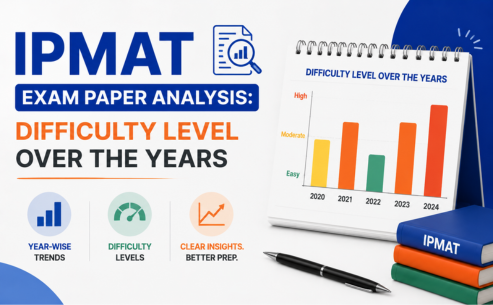
One of the most important aspects of an IPMAT Exam Paper Analysis is understanding how the exam’s difficulty level has evolved over time. While the overall structure of the examination has remained largely consistent, the complexity of questions and the emphasis on application-based problem-solving have gradually increased.
Recent IPMAT difficulty trends indicate that candidates are expected to demonstrate stronger conceptual understanding rather than rely solely on formulas and memorization. As competition for IPM seats continues to grow, even moderate papers can feel challenging due to higher cut-offs and increased competition.
Year-Wise IPMAT Difficulty Analysis
| Year | Overall Difficulty Level |
| 2021 | Moderate |
| 2022 | Moderate to Difficult |
| 2023 | Moderate |
| 2024 | Moderate to Difficult |
| 2025 | Moderate |
| 2026 | Moderate to Difficult |
Key Observations from IPMAT Paper Review
| Trend | Observation |
| Quantitative Ability | Consistently the toughest section |
| Verbal Ability | Most scoring section |
| Question Style | More application-oriented |
| Competition Level | Increasing year after year |
A comprehensive IPMAT paper review shows that although the overall difficulty fluctuates slightly from year to year, Quantitative Ability remains the primary differentiator among candidates. Meanwhile, Verbal Ability continues to provide scoring opportunities for well-prepared aspirants. Understanding these IPMAT difficulty trends can help students prepare more strategically and avoid surprises on exam day.
Quantitative Ability Analysis Over the Years
The Quantitative Ability section has consistently been the most challenging component of the IPMAT examination. A detailed IPMAT Exam Paper Analysis reveals that this section plays a crucial role in determining overall performance and sectional Cut-off clearance.
Over the years, the focus has gradually shifted from straightforward formula-based questions to application-oriented problems that test conceptual clarity, logical thinking, and problem-solving skills. As a result, students who develop strong fundamentals and practice extensively tend to perform significantly better in this section.
Topic-Wise Trends in Quantitative Ability
| Topic | Trend Over the Years |
| Algebra | Consistently High Weightage |
| Arithmetic | Consistently High Weightage |
| Data Interpretation | Increasing Importance |
| Number Systems | Stable |
| Geometry & Mensuration | Moderate Weightage |
| Modern Mathematics | Moderate Weightage |
Key Insights from IPMAT Exam Paper Analysis
| Observation | Trend |
| Toughest Section | Quantitative Ability MCQ |
| Most Important Topics | Algebra & Arithmetic |
| Emerging Area | Data Interpretation |
| Question Style | Application-Based |
One of the most noticeable IPMAT difficulty trends is the growing emphasis on conceptual application rather than direct calculations. Algebra and Arithmetic have remained dominant topics in almost every IPMAT paper review, making them essential for aspirants.
Additionally, Data Interpretation has gained importance in recent years, reflecting the exam’s increasing focus on analytical thinking and real-world problem-solving. Students preparing for future examinations should prioritize these areas while maintaining a balanced approach across the entire syllabus.
Verbal Ability Analysis Over the Years
The Verbal Ability section has traditionally been the most scoring part of the examination and remains a key highlight in every IPMAT Exam Paper Analysis. Unlike Quantitative Ability, where difficulty levels fluctuate significantly, Verbal Ability has maintained a relatively stable pattern over the years.
However, recent IPMAT difficulty trends indicate a gradual shift from direct vocabulary-based questions to comprehension-driven and context-based questions. As a result, students with strong reading habits and analytical interpretation skills often gain a competitive advantage.
Topic-Wise Trends in Verbal Ability
| Topic | Trend Over the Years |
| Reading Comprehension | Consistently High Weightage |
| Fill in the Blanks | High Weightage |
| Para Jumbles | Stable |
| Sentence Completion | Stable |
| Contextual Vocabulary | Increasing Importance |
Key Insights from IPMAT Paper Review
| Observation | Trend |
| Most Scoring Section | Verbal Ability |
| Highest Weightage Area | Reading Comprehension |
| Emerging Trend | Context-Based Questions |
| Difficulty Level | Easy to Moderate |
A detailed IPMAT paper review shows that Reading Comprehension consistently accounts for a significant portion of the Verbal Ability section. Additionally, contextual vocabulary and sentence-based questions have become more prominent in recent years.
These IPMAT difficulty trends suggest that students should focus on improving reading speed, comprehension accuracy, and language interpretation skills rather than relying solely on memorizing vocabulary lists.
Section-Wise Difficulty Level Comparison
A comprehensive IPMAT Exam Paper Analysis shows that not all sections contribute equally to the overall difficulty of the examination. While Verbal Ability is generally considered the most scoring section, Quantitative Ability often becomes the deciding factor due to its higher complexity and stricter sectional cut-offs.
Reviewing IPMAT difficulty trends over the years reveals that the Quantitative Ability MCQ section consistently challenges students with application-based and time-consuming questions, whereas the Verbal Ability section remains relatively approachable.
Section-Wise Difficulty Comparison
| Section | Difficulty Level |
| Quantitative Ability (MCQ) | High |
| Quantitative Ability (SA) | Moderate |
| Verbal Ability | Easy to Moderate |
Key Observations from IPMAT Paper Review
| Section | Key Challenge |
| QA MCQ | Complex problem-solving and time pressure |
| QA SA | Conceptual accuracy and calculations |
| Verbal Ability | Reading speed and comprehension accuracy |
Based on historical IPMAT paper review data, aspirants should allocate more preparation time to Quantitative Ability while leveraging Verbal Ability as a scoring opportunity. Understanding these IPMAT difficulty trends helps students create a balanced preparation strategy and improve overall exam performance.
Major Changes Observed in IPMAT Papers
A detailed IPMAT Exam Paper Analysis highlights several notable changes in the examination over the years. One of the biggest IPMAT difficulty trends has been the shift from direct formula-based questions to application-oriented problem-solving.
Quantitative Ability questions now focus more on conceptual understanding, while Verbal Ability increasingly emphasizes contextual interpretation and comprehension skills. These changes indicate that exam setters are prioritizing analytical thinking over rote learning.
Major Changes in Recent IPMAT Papers
| Change | Impact on Aspirants |
| More Application-Based Questions | Greater focus on concepts |
| Reduced Direct Formula Questions | Increased analytical thinking |
| Stronger Reading Comprehension Focus | Improved reading skills required |
| Higher Competition Levels | Better accuracy needed |
As reflected in multiple years of IPMAT paper review, students who focus on conceptual clarity, problem-solving ability, and comprehension skills are better equipped to handle evolving exam patterns.
What IPMAT 2029 Aspirants Can Learn from Previous Years
One of the biggest advantages of studying IPMAT Exam Paper Analysis is the ability to learn from previous years’ trends and apply those insights to future preparation. Historical IPMAT difficulty trends clearly indicate that success in the exam depends on conceptual clarity, consistency, and effective time management rather than last-minute preparation.
Aspirants who understand recurring patterns and frequently tested topics can allocate their study time more efficiently and improve their overall performance.
Key Lessons from Previous IPMAT Papers
| Learning | Action for Aspirants |
| Algebra & Arithmetic dominate QA | Prioritize these topics early |
| Reading Comprehension carries high weightage | Develop a daily reading habit |
| Application-based questions are increasing | Focus on concepts over memorization |
| Accuracy is critical | Avoid excessive guesswork |
| Mock tests improve performance | Practice regularly under exam conditions |
Preparation Takeaways
- Build strong fundamentals in Quantitative Ability.
- Strengthen Reading Comprehension and contextual vocabulary.
- Analyze mock tests to identify weak areas.
- Focus on sectional cut-offs as well as overall scores.
- Improve speed without compromising accuracy.
By leveraging insights from IPMAT paper review and understanding long-term IPMAT difficulty trends, students can create a smarter preparation strategy and approach the examination with greater confidence and Score good.
Learn from IPMAT Trends with Tarkashastra
Understanding historical exam patterns is one thing; using those insights effectively is what truly makes a difference. Through detailed IPMAT Exam Paper Analysis, students can identify recurring trends, high-weightage topics, and section-wise challenges. However, translating this knowledge into a successful preparation strategy requires structured guidance, regular practice, and expert mentorship.
At Tarkashastra, students are trained using previous year papers, detailed IPMAT paper review sessions, sectional performance analysis, and full-length mock tests that closely simulate actual exam conditions. By studying long-term IPMAT difficulty trends, mentors help students focus on the areas that matter most while improving speed, accuracy, and exam temperament.
Why Choose Tarkashastra for IPMAT Preparation?
| Feature | Benefit |
| Previous Year Paper Analysis | Understand recurring exam patterns |
| Full-Length Mock Tests | Experience real exam conditions |
| Sectional Performance Reports | Identify strengths and weaknesses |
| Expert Mentorship | Receive personalized guidance |
| Topic-Wise Practice Sessions | Strengthen high-weightage areas |
| Performance Tracking | Monitor progress continuously |
Whether you are beginning your preparation or aiming to improve your score, Tarkashastra’s structured IPMAT coaching programs can help you convert IPMAT Exam Paper Analysis into a practical and effective preparation strategy.
Conclusion
A thorough IPMAT Exam Paper Analysis reveals that while the exam pattern has remained relatively stable, the nature of questions has evolved significantly over the years. The most notable IPMAT difficulty trends include a growing emphasis on application-based Quantitative Ability questions and comprehension-focused Verbal Ability sections. By learning from previous papers and conducting a detailed IPMAT paper review, aspirants can identify high-priority topics, improve their preparation strategy, and enhance their chances of success. Consistent practice, mock tests, and data-driven preparation remain the keys to performing well in the IPMAT examination.
FAQs
1. How has IPMAT difficulty changed over the years?
The overall IPMAT difficulty level has remained moderate to difficult, with a growing focus on application-based and concept-driven questions.
2. Which year had the toughest paper?
Difficulty varies by student experience, but recent papers such as 2022, 2024, and 2026 were generally considered more challenging than average.
3. Which section is usually hardest?
The Quantitative Ability MCQ section is typically the toughest due to its complex and time-consuming questions.
4. What trends are visible in recent papers?
Recent papers emphasize conceptual understanding, analytical thinking, and application-based problem-solving over direct formula-based questions.
5. How does analysis help preparation?
IPMAT exam paper analysis helps students identify important topics, understand difficulty trends, and create a focused preparation strategy.
6. Which topics appear repeatedly?
Algebra, Arithmetic, Reading Comprehension, Fill in the Blanks, and Data Interpretation frequently appear in IPMAT papers.
7. Has the pattern changed?
The overall structure has remained largely unchanged, but question styles have become more application-oriented over time.
8. What lessons can students learn?
Students should focus on conceptual clarity, consistent practice, time management, and mock test analysis.
9. How should aspirants adapt?
Aspirants should prioritize high-weightage topics, improve accuracy, and regularly solve previous year papers and mock tests.
10. What is expected in future exams?
Future IPMAT exams are likely to continue emphasizing analytical thinking, conceptual understanding, and balanced performance across all sections.