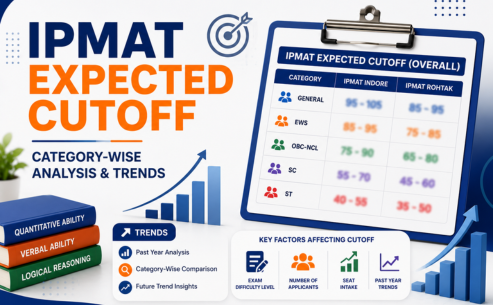
What to Expect from the IPMAT 2029 Cutoff?
The IPMAT 2029 expected cutoff is expected to be one of the most crucial factors determining admission opportunities for aspirants targeting IIM Indore, IIM Rohtak, and other IPM institutes.
With the popularity of Integrated Programme in Management (IPM) courses increasing every year, competition is likely to become even more intense for the 2029 admission cycle.
Understanding the IPMAT cutoff 2029 can help candidates set realistic score targets and create an effective preparation strategy. This article provides a detailed category-wise analysis of the expected cutoff 2029, including projected trends for the IPMAT Indore cutoff 2029 and IPMAT Rohtak cutoff 2029, helping students plan their preparation with greater confidence.
What Determines the IPMAT 2029 Cutoff?
Several factors influence the IPMAT 2029 cutoff each year. Understanding these factors can help aspirants estimate the level of competition and set appropriate score targets.
Key Factors Affecting the IPMAT Cutoff 2029
| Factor | Impact on Cutoff |
| Number of Applicants | Higher registrations generally increase the cutoff. |
| Exam Difficulty Level | A tougher paper may lead to a lower cutoff, while an easier exam can push cutoffs higher. |
| Seat Availability | Limited seats at IIMs increase competition and cutoff scores. |
| Reservation Policy | Category-wise reservations result in different cutoff levels. |
| Candidate Performance | Strong overall performance can raise the expected cutoff 2029. |
As IPM programs continue to attract more students nationwide, the IPMAT cutoff 2029 is expected to remain competitive across all categories. Candidates should therefore aim for scores above the minimum qualifying benchmark rather than focusing solely on clearing the cutoff.
IPMAT Indore Cutoff 2029: Expected Category-Wise Analysis
The IPMAT Indore cutoff 2029 is expected to remain highly competitive due to the growing popularity of the Integrated Programme in Management and the limited number of seats available at IIM Indore.
Unlike some other IPM institutes, IIM Indore follows a sectional cutoff system, meaning candidates must clear the minimum qualifying marks in each section along with the overall cutoff to be considered for the Personal Interview (PI) round.
Based on recent trends, the Quantitative Ability (Short Answer), Quantitative Ability (MCQ), and Verbal Ability sections are likely to continue playing a significant role in the shortlisting process.
Previous cutoff data indicates that sectional balance is critical for securing a PI call. Candidates who perform exceptionally well in one section but fail to meet the minimum requirement in another may not qualify for the next stage.
Expected IPMAT Indore Cutoff 2029
| Category | Expected Overall Cutoff |
| General | 200+ |
| EWS | 145+ |
| OBC-NCL | 135+ |
| SC | 110+ |
| ST | 90+ |
| PwD | 70+ |
Expected figures are based on previous cutoff trends, increasing applicant numbers, and seat availability.
Aspirants targeting the IPMAT Indore cutoff 2029 should aim for scores well above the minimum cutoff.
Since competition continues to increase every year, achieving a safe score can significantly improve a candidate’s chances of receiving a PI shortlist, progressing successfully through the IPMAT selection process, and securing a final admission offer.
The IPMAT 2029 cutoff for IIM Indore is therefore expected to reward candidates with strong sectional consistency and overall accuracy.
IPMAT Rohtak Cutoff 2029: Expected Category-Wise Analysis
The IPMAT Rohtak cutoff 2029 is expected to remain competitive as the number of applicants for IIM Rohtak’s IPM program continues to grow. Unlike IIM Indore, which emphasises sectional cutoffs, IIM Rohtak primarily focuses on overall performance in the entrance examination while preparing its shortlist for the subsequent admission stages.
Recent cutoff trends indicate that the General category cutoff has remained significantly higher than reserved category cutoffs due to intense competition. The increasing popularity of the IPM program and limited seat availability are likely to influence the expected cutoff 2029 for all categories.
According to recent cutoff data, more than 1,000 candidates met the minimum cutoff requirements across categories, highlighting the growing competition among aspirants.
Expected IPMAT Rohtak Cutoff 2029
| Category | Expected Cutoff Range |
| General | 390–410 |
| EWS | 350–370 |
| OBC-NCL | 320–340 |
| SC | 260–290 |
| ST | 180–220 |
| PwD/DAP | 220–260 |
Candidates aiming to comfortably clear the IPMAT Rohtak cutoff 2029 should target scores above the projected cutoff range.
Since the IPMAT cutoff 2029 may increase depending on exam difficulty and applicant performance, maintaining a safety margin can significantly improve admission prospects at IIM Rohtak.
Safe Score vs Cutoff: What Should You Actually Target?
Many aspirants mistakenly believe that clearing the IPMAT 2029 cutoff guarantees admission. In reality, there is a significant difference between the minimum cutoff and a safe score.
The cutoff is simply the minimum score required to qualify for the next stage, whereas a safe score improves the chances of receiving a shortlist and securing final admission.
The distinction between cutoff and safe score has been highlighted in recent IPMAT analyses, where candidates scoring comfortably above the cutoff had a stronger probability of conversion.
Expected Cutoff vs Safe Score for 2029
| Institute | Expected Cutoff | Safe Score Target |
| IIM Indore | 200+ | 220+ |
| IIM Rohtak | 390–410 | 420+ |
To stay on the safer side, candidates should prepare for the safe score rather than merely aiming to clear the IPMAT cutoff 2029. This strategy can significantly improve admission prospects at both IIM Indore and IIM Rohtak.
How to Score Above the IPMAT 2029 Cutoff
Clearing the IPMAT 2029 cutoff requires more than just completing the syllabus. Candidates should focus on achieving balanced sectional performance, especially for IIM Indore, where sectional cutoffs play a crucial role in shortlisting.
Recent trends suggest that accuracy and consistency are often more important than attempting a large number of questions.
Tips to Beat the IPMAT Cutoff 2029
- Take regular mock tests and analyse mistakes.
- Strengthen Quantitative Ability fundamentals.
- Improve Reading Comprehension and Verbal Ability.
- Solve previous years’ IPMAT papers.
- Focus on sectional balance along with the overall score.
Following these strategies can help candidates comfortably surpass the expected cutoff 2029 and improve their chances of admission.
Why Tarkashastra is the Right Choice for IPMAT 2029 Preparation
Preparing for the IPMAT 2029 cutoff requires a structured study plan, expert guidance, and continuous performance evaluation. At Tarkashastra, students receive comprehensive preparation support designed specifically for IPMAT aspirants targeting top institutes such as IIM Indore and IIM Rohtak.
The institute offers concept-focused classroom training, regular mock tests, sectional practice sessions, and personalised mentorship to help students stay ahead of the competition.
Since the IPMAT Indore cutoff 2029 and IPMAT Rohtak cutoff 2029 are expected to remain competitive, Tarkashastra emphasises both sectional excellence and overall score improvement.
Students also benefit from detailed performance analysis, doubt-solving sessions, interview-preparation guidance, and proven strategies aligned with the latest 2029 IPMAT cutoff trends.
By focusing on safe-score targets rather than minimum qualifying marks, Tarkashastra helps aspirants maximise their chances of securing admission to their dream IPM program.
Conclusion
The IPMAT 2029 cutoff is expected to remain highly competitive as applications continue to rise across top IPM institutes. Rather than focusing solely on the minimum qualifying marks, aspirants should focus on achieving safe scores, maintaining sectional balance, and practising consistently. A strategic preparation approach can significantly improve admission chances at IIM Indore and IIM Rohtak.
FAQs
1. What is the expected IPMAT 2029 cutoff?
The IPMAT 2029 cutoff is expected to remain competitive, with IIM Indore likely requiring around 200+ marks and IIM Rohtak around 390–410 marks for General category candidates.
2. How does the cutoff vary by category?
The cutoff differs across categories such as General, EWS, OBC-NCL, SC, ST, and PwD due to reservation policies. Reserved category candidates generally have lower cutoff requirements than General category candidates.
3. What is a safe score?
A safe score is higher than the minimum cutoff and improves the chances of receiving a shortlist and final admission. For IPMAT 2029, a safe score may be 220+ for IIM Indore and 420+ for IIM Rohtak.
4. What affects the cutoff?
The IPMAT cutoff 2029 depends on factors such as the number of applicants, exam difficulty level, seat availability, reservation policies, and overall candidate performance.
5. Are sectional cutoffs applicable?
Yes, IIM Indore follows sectional cutoffs for Quantitative Ability (SA), Quantitative Ability (MCQ), and Verbal Ability. Candidates must clear each section along with the overall cutoff.
6. What were previous cutoffs?
Recent trends show strong competition, with IIM Indore maintaining sectional eligibility requirements and IIM Rohtak recording General category cutoffs above 350 marks in recent admission cycles.
7. Will competition increase the cutoff?
If application numbers continue to rise, the expected cutoff 2029 may increase. Higher competition often leads to higher cutoff scores, especially for the General category.
8. What is the expected cutoff for Indore?
The IPMAT Indore cutoff 2029 is expected to be around 200+ marks for General category candidates, with category-wise variations for EWS, OBC, SC, ST, and PwD candidates.
9. What is the expected cutoff for Rohtak?
The IPMAT Rohtak cutoff 2029 is expected to range between 390 and 410 marks for General category candidates, depending on exam difficulty and competition levels.
10. How can students clear the cutoff?
Students can improve their chances by taking regular mock tests, strengthening Quantitative and Verbal Ability skills, solving previous-year papers, and focusing on both sectional and overall performance.