Introduction
The IPMAT 2028 Exam is the foundation of your preparation for one of India’s most competitive undergraduate management entrance exams conducted by IIM Indore and IIM Rohtak.
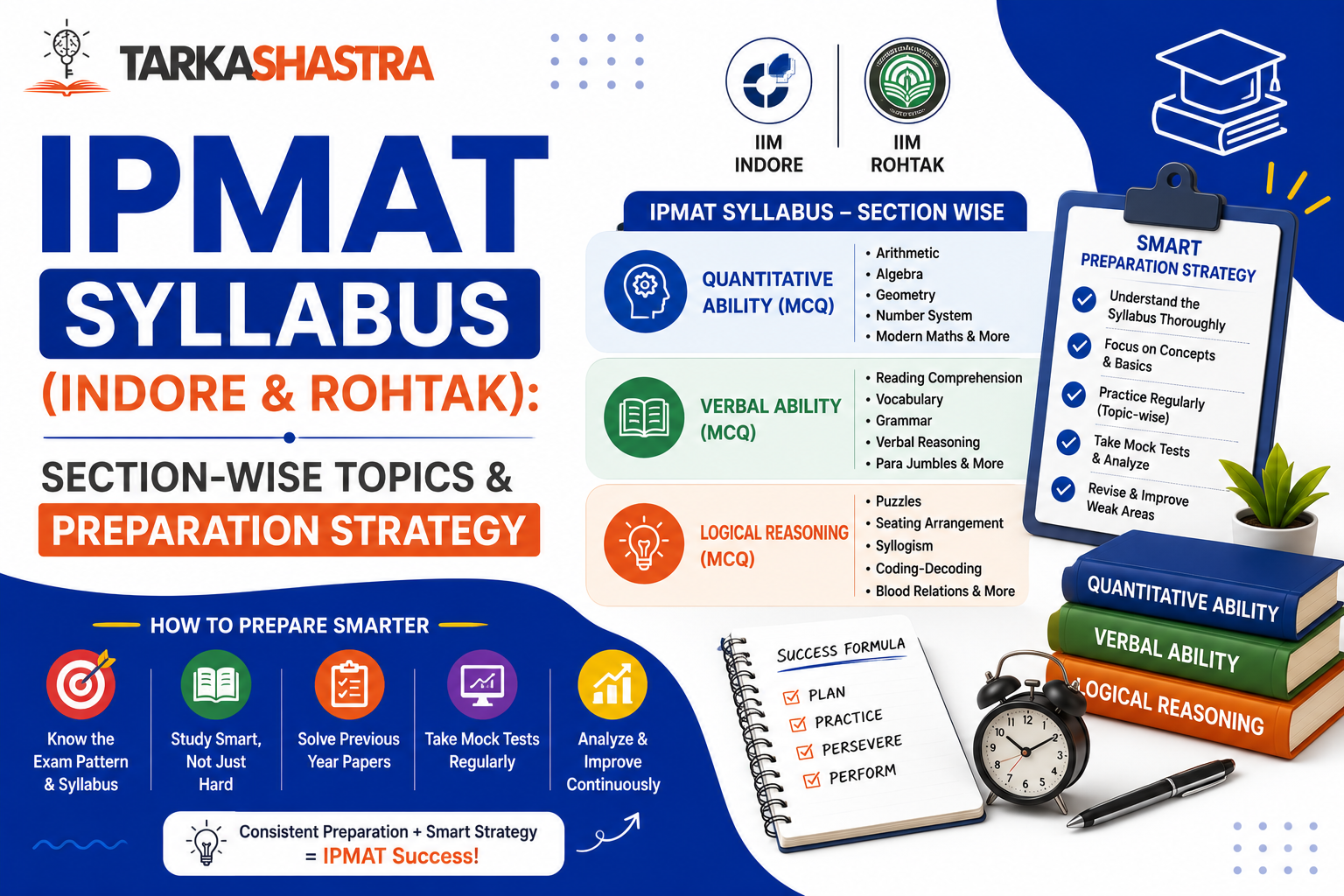
The IPMAT 2028 syllabus includes three major sections: Quantitative Ability, Verbal Ability, and Logical Reasoning (for Rohtak), covering topics like arithmetic, algebra, reading comprehension, grammar, and data interpretation.
If you aim to secure admission into the prestigious 5-year IPM program, understanding the syllabus is not optional—it is essential.
Overview of IPMAT Syllabus 2028
IIM Indore or IIM Rohtak does not officially define the IPMAT syllabus 2028, but it is derived from previous exam trends and patterns. Broadly, the IPMAT 2028 syllabus covers three sections: Quantitative Ability, Verbal Ability, and Logical Reasoning.
The IPMAT Indore 2028 syllabus consists of Quantitative Ability and Verbal Ability sections. In contrast, the IPMAT Rohtak 2028 syllabus has Quantitative Ability, Verbal Ability, and an additional Logical Reasoning section.
As a result, candidates should prepare for Logical Reasoning only if taking IPMAT Rohtak.
Understanding the IPMAT syllabus 2028 helps students prioritise topics, avoid irrelevant study, and build a focused preparation strategy.
IPMAT Indore Exam Pattern
The IPMAT Indore exam is divided into three sections covering Quantitative and Verbal Ability, each with a fixed time limit and a mix of question types, including MCQs and short answers, with selective negative marking.
| Section | Question Type | No. of Questions | Maximum Marks | Time Limit | Correct Marks | Incorrect Marks |
| Quantitative Ability | MCQs | 30 | 120 | 40 minutes | +4 | -1 |
| Quantitative Ability | Descriptive (Short Answer) | 15 | 60 | 40 minutes | +4 | 0 |
| Verbal Ability | MCQs + Type in the Answer | 45 | 180 | 40 minutes | +4 | -1 (for MCQs) |
IPMAT Rohtak Exam Pattern 2028
The IPMAT Rohtak exam is divided into three sections covering Quantitative,Logical Reasoning and Verbal Ability, each with a fixed time limit and a mix of question types, including MCQs and short answers, with selective negative marking.
| Section | Question Type | No. of Questions | Maximum Marks | Time Limit | Correct Marks | Incorrect Marks |
| Quantitative Ability | Multiple Choice Questions (MCQs) | 40 | 160 | 40 minutes | +4 | -1 |
| Logical Reasoning | Multiple Choice Questions (MCQs) | 40 | 160 | 40 minutes | +4 | -1 |
| Verbal Ability | Multiple Choice Questions (MCQs) | 40 | 160 | 40 minutes | +4 | -1 |
IPMAT Exam Syllabus Section Wise (Indore)
The IPMAT subjects for IIM Indore include Quantitative Ability and Verbal Ability, which are basically your Mathematics and English Language.
Quantitative Ability (Mathematics)
| Topic | Subtopics |
| Number System | Divisibility, Remainders, LCM, HCF, Odd/Even, etc. |
| Work-Related Problems | Work and Time, Efficiency, Man-days |
| Time, Speed, and Distance | Relative Speed, Average Speed, Time, and Distance Formula |
| Pipes and Cisterns | Inlet, Outlet, Time-based problems |
| Permutations and Combinations | Factorial Notation, Counting Principles |
| Probability | Basic Probability, Conditional Probability |
| Averages and Percentages | Average Calculation, Percentage Increase/Decrease |
| Partnership | Partnership Sharing, Profit/Loss Division |
| Vectors | Addition, Subtraction, Dot and Cross Product |
| Roots, Indices, and Surds | Laws of Indices, Square Roots, Cube Roots, Simplifications |
| Matrices and Determinants | Matrix Operations, Determinants, Inverse |
| Integration & Differentiation | Basic Concepts, Differentiation Rules, Integration Formulas |
| Simple & Compound Interest | SI, CI Formulas, Problems Based on Interest Calculation |
| Profit & Loss | Marked Price, Discount, Cost Price, Selling Price |
| Geometry and Mensuration | 2D and 3D Shapes, Area, Perimeter, Volume |
| Algebra | Linear, Quadratic Equations, Sequences and Series |
| Trigonometry | Trig Functions, Identities, Heights and Distances |
| Ratio and Proportion | Proportionality, Variation, Solving Ratio Problems |
| Mixtures and Alligation | Weighted Average, Mixing Problems |
Verbal Ability (English Language)
| Topic | Subtopics |
| Deductive Reasoning | Logical Deduction, Validity of Arguments |
| Logical Consistency | Statements, Assumptions, Validity |
| Syllogisms | Venn Diagrams, Types of Syllogism |
| Inference-Based Passages | Reading Comprehension, Drawing Conclusions |
| Idioms and Phrases | Meaning, Usage in Context |
| Foreign Words | Meaning, Contextual Usage |
| Analogies | Verbal Analogies, Pairing Similar Words |
| Tenses, Modifiers & Parallelism | Grammar, Sentence Structure, Consistency |
| Reading Comprehensions | Passage-Based Questions, Understanding and Analysis |
| Noun and Pronoun Errors | Agreement, Usage, Proper Forms |
| Antonyms-Synonyms | Vocabulary, Meaning Comparison |
| Prepositions and Conjunctions | Usage and Rules for Prepositions and Conjunctions |
| Etymology and Roots | Word Origins, Meaning through Roots |
| Subject-Verb Agreement | Sentence Construction, Agreement Rules |
IPMAT Exam Syllabus Section Wise (Rohtak)
IPMAT Rohtak subjects include Quantitative Ability, Logical Reasoning, and Verbal Ability.
Quantitative Ability
| Topic | Subtopics |
| Profit and Loss | Cost Price, Selling Price, Profit Calculation |
| Linear and Quadratic Equations | Solving Linear and Quadratic Equations, Roots |
| Simple and Compound Interest | SI and CI Formulas, Calculations on Interest |
| Ratio and Proportion | Ratio Proportions, Variation Problems |
| Mixtures and Alligation | Mixture Problems, Weighted Average |
| Permutations and Combinations, Probability | Factorial Notation, Counting Principles, Basic Probability |
| Mensuration and Geometry | Area, Volume, Surface Area of 2D and 3D Shapes |
| Averages & Percentages | Averages, Percentage Calculations |
| Roots, Indices, Surds | Simplifying Roots and Indices, Surds |
| Time, Speed & Distance | Speed-Related Problems, Time, Distance Formula |
| Work-Related Problems | Work Efficiency, Time, and Work Problems |
| Pipes & Cisterns | Water Flow, Pipe Filling and Emptying |
| Number System | Divisibility, LCM, HCF, Odd/Even, Number Properties |
| Algebra | Linear Equations, Expressions, Polynomials |
| Partnership | Profit Sharing, Partnership Problems |
Logical Reasoning
| Topic | Subtopics |
| Inferences and Judgments | Making Conclusions from Statements, Judgment Rules |
| Critical Reasoning | Analysis of Arguments, Logical Fallacies |
| Assertions and Reasons | Validity of Statements and Reasons |
| Course of Action | Identifying Courses Based on Given Situations |
| Strong and Weak Arguments | Distinguishing Between Strong and Weak Arguments |
| Probably True or False | Understanding Probabilities in Logical Context |
| Statements and Assumptions | Analyzing Statements and Assumptions |
| Syllogisms | Logical Deduction, Venn Diagram Representation |
| Binary Logic | Logical Operators, True/False Statements |
| Coding and Decoding | Decoding Message Patterns, Number/Alphabet Coding |
| Blood Relations | Family Tree, Relationships Analysis |
| Logical Sequence Series | Identifying Patterns in Sequences |
| Arrangements | Seating Arrangements, Logical Organization |
| Venn Diagrams | Set Theory, Intersection/Union Operations |
| Cubes and Dices | 3D Shapes, Problem-Solving with Cubes and Dice |
Verbal Ability
| Topic | Subtopics |
| Deductive Reasoning | Logical Deduction, Validity of Statements |
| Subject-Verb Agreement | Grammar Rules, Sentence Structure |
| Inference-based Passages | Reading and Drawing Conclusions |
| Etymology and Roots | Word Origins, Contextual Meaning |
| Logical Consistency | Analyzing Logical Flow in Sentences |
| Prepositions and Conjunctions | Proper Usage of Prepositions and Conjunctions |
| Idioms and Phrases | Meaning and Usage in Context |
| Analogies | Identifying Relationships Between Pairs of Words |
| Tenses, Modifier & Parallelism | Grammar and Sentence Correction |
| Reading Comprehensions | Passage Analysis and Question Answering |
| Noun and Pronoun Errors | Sentence Construction and Error Identification |
| Antonyms-Synonyms | Vocabulary and Meaning Comparisons |
IPMAT Indore vs Rohtak – Key Differences
Understanding the differences within the IPMAT syllabus 2028 helps you plan a targeted preparation strategy for both exams. While the IPMAT Indore syllabus 2028 focuses heavily on advanced Quantitative Ability, the IPMAT Rohtak syllabus 2028 offers a more balanced approach.
- Sections: Indore (QA + VA), Rohtak (QA + VA + LR)
- Difficulty Level: Indore is more Quant-intensive
- Question Type: Indore includes Short Answer; Rohtak is fully MCQ-based
- Focus: Indore → conceptual depth, Rohtak → speed and accuracy
Aligning your preparation with the IPMAT exam syllabus section wise is crucial for success.
Preparation Strategy for IPMAT 2028
A well-structured approach is essential to crack the IPMAT syllabus 2028, as the exam demands both conceptual clarity and application skills. Based on expert insights, your preparation should be focused and consistent.
Quantitative Ability Strategy
- For the IPMAT QA syllabus 2028, begin with strengthening basics in arithmetic and algebra.
- Gradually move to advanced topics like probability and geometry.
- The IPMAT Indore syllabus 2028 requires extra focus on higher-level math such as matrices and calculus.
- While the IPMAT Rohtak 2028 syllabus demands speed and accuracy.
- Daily practice and formula revision are essential.
Verbal Ability Strategy
- To master the IPMAT verbal ability syllabus 2028, build a daily reading habit.
- Focus on reading comprehension, vocabulary, and grammar rules. Indore requires inference-based understanding
- whereas Rohtak emphasizes grammar accuracy.
Logical Reasoning Strategy (Rohtak)
- Practice puzzles, seating arrangements, and statement-based questions regularly.
- Focus on improving logical clarity and solving speed.
General Strategy
- Take regular mock tests, analyze mistakes, and revise weak areas.
- Consistency, time management, and smart practice are key to mastering the IPMAT syllabus 2028.
Conclusion
The IPMAT syllabus 2028 is extensive but manageable with the right approach. By understanding the IPMAT exam syllabus section-wise and adapting your strategy for both the IPMAT Indore syllabus 2028 and IPMAT Rohtak syllabus 2028, you can maximise your chances of success. Stay consistent, practice smartly, and focus on conceptual clarity to crack IPMAT 2028.