Introduction
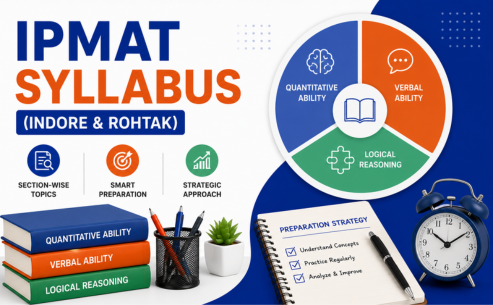
The IPMAT Syllabus 2029 is the foundation of a successful preparation strategy for students aspiring to secure admission into the prestigious Integrated Programme in Management (IPM) offered by IIM Indore and IIM Rohtak
Before starting preparation, it is essential to understand the complete IPMAT exam syllabus 2029, as it helps candidates identify important topics, allocate study time effectively, and focus on high-scoring areas.
While the official authorities do not release a detailed chapter-wise syllabus, an analysis of previous examinations provides a clear picture of the topics that frequently appear in the exam.
The IPMAT Indore syllabus 2029 primarily focuses on Quantitative Ability and Verbal Ability, whereas the IPMAT Rohtak syllabus 2029 includes an additional Logical Reasoning section.
Understanding these differences can help students create a targeted preparation plan and avoid spending time on irrelevant topics.
For students searching for the latest IPMAT syllabus PDF 2029, this guide covers all the important sections, topic-wise coverage, expected weightage trends ,total marks, and preparation strategies needed to excel in the examination.
Whether your target is IIM Indore or IIM Rohtak, a thorough understanding of the IPMAT Syllabus 2029 is the first step toward achieving a high score and securing admission to a top management institute.
IPMAT 2029 Exam Pattern at a Glance
Before diving deeper into the IPMAT Syllabus 2029, it is important to understand the exam structure. The exam pattern determines how the syllabus is tested and helps students allocate preparation time efficiently.
Although both IIM Indore and IIM Rohtak conduct entrance examinations for admission to their Integrated Programme in Management (IPM), there are notable differences in their patterns.
The IPMAT Indore syllabus 2029 focuses on Quantitative Ability and Verbal Ability, while the IPMAT Rohtak syllabus 2029 includes an additional Logical Reasoning section.
Understanding these differences can help candidates tailor their preparation according to their target institute.
IPMAT Indore 2029 Exam Pattern
| Section | Number of Questions | Duration |
| Quantitative Ability (Short Answer) | 15 | 40 Minutes |
| Quantitative Ability (MCQ) | 30 | 40 Minutes |
| Verbal Ability (MCQ) | 45 | 40 Minutes |
| Total | 90 | 120 Minutes |
The Indore exam places significant emphasis on Quantitative Aptitude through two separate sections, making mathematical proficiency crucial for success.
IPMAT Rohtak 2029 Exam Pattern
| Section | Number of Questions | Duration |
| Quantitative Ability | 40 | 40 Minutes |
| Logical Reasoning | 40 | 40 Minutes |
| Verbal Ability | 40 | 40 Minutes |
| Total | 120 | 120 Minutes |
The Rohtak exam follows a balanced structure, giving equal weightage to Quantitative Ability, Logical Reasoning, and Verbal Ability.
Each correct answer carries four marks, while incorrect answers attract a negative marking penalty. By understanding the marking scheme it will easy for student to score good.
IPMAT Indore vs IPMAT Rohtak: Quick Comparison
| Feature | IPMAT Indore | IPMAT Rohtak |
| Total Questions | 90 | 120 |
| Quantitative Sections | 2 | 1 |
| Logical Reasoning | No Separate Section | Yes |
| Verbal Ability | Yes | Yes |
| Duration | 120 Minutes | 120 Minutes |
| Focus Area | Quant + Verbal | Quant + LR + Verbal |
A clear understanding of the exam pattern allows students to approach the IPMAT exam syllabus 2029 strategically.
Candidates targeting Indore should devote additional attention to Quantitative Ability, while Rohtak aspirants must maintain a balanced preparation across all three sections.
IPMAT 2029 Exam Pattern at a Glance
Before diving deeper into the IPMAT Syllabus 2029, it is important to understand the exam structure. The exam pattern determines how the syllabus is tested and helps students allocate preparation time efficiently.
Although both IIM Indore and IIM Rohtak conduct entrance examinations for admission to their Integrated Programme in Management (IPM), there are notable differences in their patterns.
The IPMAT Indore syllabus 2029 focuses on Quantitative Ability and Verbal Ability, while the IPMAT Rohtak syllabus 2029 includes an additional Logical Reasoning section.
Understanding these differences can help candidates tailor their preparation according to their target institute.
IPMAT Indore 2029 Exam Pattern
| Section | Number of Questions | Duration |
| Quantitative Ability (Short Answer) | 15 | 40 Minutes |
| Quantitative Ability (MCQ) | 30 | 40 Minutes |
| Verbal Ability (MCQ) | 45 | 40 Minutes |
| Total | 90 | 120 Minutes |
The Indore exam places significant emphasis on Quantitative Aptitude through two separate sections, making mathematical proficiency crucial for success.
IPMAT Rohtak 2029 Exam Pattern
| Section | Number of Questions | Duration |
| Quantitative Ability | 40 | 40 Minutes |
| Logical Reasoning | 40 | 40 Minutes |
| Verbal Ability | 40 | 40 Minutes |
| Total | 120 | 120 Minutes |
The Rohtak exam follows a balanced structure, giving equal weightage to Quantitative Ability, Logical Reasoning, and Verbal Ability. Each correct answer carries four marks, while incorrect answers attract a negative marking penalty.
IPMAT Indore vs IPMAT Rohtak: Quick Comparison
| Feature | IPMAT Indore | IPMAT Rohtak |
| Total Questions | 90 | 120 |
| Quantitative Sections | 2 | 1 |
| Logical Reasoning | No Separate Section | Yes |
| Verbal Ability | Yes | Yes |
| Duration | 120 Minutes | 120 Minutes |
| Focus Area | Quant + Verbal | Quant + LR + Verbal |
A clear understanding of the exam pattern allows students to approach the IPMAT exam syllabus 2029 strategically. Candidates targeting Indore should devote additional attention to Quantitative Ability, while Rohtak aspirants must maintain a balanced preparation across all three sections.
IPMAT Rohtak Syllabus 2029
The IPMAT Rohtak syllabus 2029 is slightly different from the Indore exam as it evaluates candidates across three sections—Quantitative Ability, Logical Reasoning, and Verbal Ability.
The inclusion of Logical Reasoning makes the exam more diverse and requires aspirants to develop analytical, mathematical, and language skills simultaneously.
Students targeting IIM Rohtak should focus on balancing their preparation across all three sections rather than concentrating only on aptitude or English.
Quantitative Ability Syllabus
The Quantitative Ability section tests numerical aptitude and problem-solving ability.
| Topic Area | Important Topics |
| Arithmetic | Percentages, Profit & Loss, SI & CI, Ratio & Proportion, Averages, Mixtures |
| Algebra | Linear Equations, Quadratic Equations, Inequalities |
| Number System | Divisibility, HCF, LCM, Remainders |
| Geometry & Mensuration | Triangles, Circles, Coordinate Geometry |
| Modern Mathematics | Set Theory, Probability, Permutation & Combination |
| Data Interpretation | Tables, Charts, Graph-Based Questions |
Based on previous exam trends, Arithmetic, Probability, Set Theory, and Number System have consistently contributed a significant number of questions.
Logical Reasoning Syllabus
Logical Reasoning is a unique component of the IPMAT Rohtak syllabus 2029 and plays a crucial role in determining overall performance.
| Topic Area | Important Topics |
| Arrangements | Linear, Circular, Matrix Arrangements |
| Analytical Reasoning | Coding-Decoding, Number Series |
| Logical Concepts | Blood Relations, Directions |
| Decision-Based Questions | Data Sufficiency |
| Reasoning Puzzles | Clocks, Calendars, Visual Reasoning |
| Critical Reasoning | Statements, Conclusions, Syllogisms |
Among all LR topics, Seating Arrangements, Coding-Decoding, Directions, and Data Sufficiency frequently carry higher weightage and should be prioritised during preparation.
Verbal Ability Syllabus
The Verbal Ability section evaluates reading, grammar, and vocabulary skills.
| Topic Area | Important Topics |
| Reading Comprehension | Passage-Based Questions, Inferences |
| Vocabulary | Synonyms, Antonyms, Fill in the Blanks |
| Grammar | Sentence Correction, Usage-Based Questions |
| Verbal Ability | Para Jumbles, Idioms & Phrases |
Previous paper analysis indicates that Reading Comprehension, Vocabulary, and Sentence Correction collectively account for a major portion of the Verbal Ability section.
Students who thoroughly cover the IPMAT Rohtak syllabus 2029 and consistently practice section-wise questions can significantly improve their speed, accuracy, and overall score in the examination.
IPMAT 2029 High-Weightage Topics You Should Prioritise
While covering the entire IPMAT Syllabus 2029 is important, smart preparation involves identifying topics that consistently carry higher weightage in the exam. An analysis of previous years’ papers for both the IPMAT Indore syllabus 2029 and IPMAT Rohtak syllabus 2029 reveals that certain chapters repeatedly contribute a significant share of questions.
Prioritising these topics can help aspirants maximise their scores while ensuring efficient use of preparation time.
High-Weightage Topics in IPMAT 2029
| Section | High-Priority Topics | Why They Matter |
| Quantitative Ability | Arithmetic, Algebra, Geometry | Frequently tested and form the foundation of advanced questions |
| Number System | HCF & LCM, Remainders, Divisibility | Regularly appear in both Indore and Rohtak exams |
| Modern Mathematics | Probability, Permutation & Combination, Set Theory | High-scoring topics with recurring questions |
| Data Interpretation | Tables, Charts, Graphs | Improves overall aptitude score with practice |
| Reading Comprehension | Inference-Based Questions, Vocabulary in Context | Consistently contributes major weightage in Verbal Ability |
| Vocabulary | Synonyms, Antonyms, Idioms & Phrases | Frequently asked across both exams |
| Grammar | Sentence Correction, Error Spotting | Important for accuracy in Verbal Ability |
| Logical Reasoning (Rohtak) | Seating Arrangements, Coding-Decoding, Directions | Among the highest-weightage LR topics |
Topic Prioritisation Strategy
Students preparing according to the IPMAT exam syllabus 2029 should ideally follow the 80-20 rule. Begin with high-weightage areas such as Arithmetic, Algebra, Reading Comprehension, Vocabulary, and Logical Reasoning Arrangements before moving to lower-frequency topics.
This approach ensures that a substantial portion of the exam can be covered early in the preparation cycle.
For IPMAT Indore aspirants, extra attention should be given to Geometry, Algebra, and Reading Comprehension. Meanwhile, candidates targeting IIM Rohtak should dedicate additional time to Logical Reasoning topics such as Seating Arrangements, Data Sufficiency, and Coding-Decoding, which frequently appear in the examination.
By focusing on these high-return chapters within the IPMAT Syllabus 2029, students can improve both efficiency and confidence while preparing for one of India’s most competitive management entrance examinations.
Preparation Strategy for IPMAT Syllabus 2029
Understanding the IPMAT Syllabus 2029 is only the first step; converting that understanding into a structured preparation plan is what ultimately determines success. Since both the IPMAT Indore syllabus 2029 and IPMAT Rohtak syllabus 2029 cover a wide range of topics, students should focus on consistency, conceptual clarity, and regular practice rather than relying on last-minute preparation.
1. Build Strong Fundamentals
Begin with the basics of Mathematics and English before moving to advanced-level questions. Focus on understanding concepts rather than memorising formulas.
A strong foundation in Arithmetic, Algebra, Grammar, and Vocabulary makes tackling difficult questions significantly easier.
2. Follow a Topic-Wise Study Plan
Divide the IPMAT exam syllabus 2029 into manageable sections and allocate weekly goals. Start with high-weightage topics such as Arithmetic, Reading Comprehension, Probability, and Logical Reasoning Arrangements before covering less frequently tested areas.
3. Practice Previous Year Questions and Mock Tests
Solving previous year papers helps students understand question patterns, difficulty levels, and time management requirements. Regular mock tests also improve speed, accuracy, and exam temperament.
4. Identify and Improve Weak Areas
One of the most effective preparation techniques is analysing mistakes after every mock test. Students should identify weak topics, revisit concepts, and practice targeted questions until they achieve consistency.
5. Develop a Reading Habit
Reading newspapers, editorials, and quality non-fiction content daily can significantly improve Reading Comprehension, vocabulary, and analytical thinking skills, which are crucial for both Indore and Rohtak aspirants.
A disciplined approach to the IPMAT Syllabus 2029, combined with regular revision and mock-test analysis, can substantially improve a candidate’s chances of securing admission to IIM Indore or IIM Rohtak.
How Tarkashastra Helps Students Master the IPMAT Syllabus 2029
Preparing for the IPMAT Syllabus 2029 requires much more than simply completing chapters and solving questions. To secure admission to top institutes like IIM Indore and IIM Rohtak, students need a structured study plan, expert mentorship, regular assessments, and continuous performance tracking.
This is where Tarkashastra plays a crucial role in guiding aspirants throughout their preparation journey.
At Tarkashastra, the preparation approach is designed around the complete IPMAT exam syllabus 2029, ensuring that students systematically cover every section of the examination while focusing on high-weightage topics and proven exam strategies.
What Students Gain at Tarkashastra
- Comprehensive coverage of the IPMAT Indore syllabus 2029 and IPMAT Rohtak syllabus 2029
- Concept-focused classroom and online learning programs
- Structured study plans and personalised preparation roadmaps
- Topic-wise practice sheets and sectional tests
- Full-length mock tests based on the latest exam trends
- Detailed performance analysis and improvement strategies
- Dedicated doubt-solving sessions with expert mentors
- Guidance for Personal Interview (PI) and subsequent admission stages
One of the biggest challenges faced by IPMAT aspirants is managing the vast syllabus while maintaining consistency.
Tarkashastra helps students overcome this challenge through a disciplined preparation framework that combines concept learning, practice, revision, and test analysis. Instead of studying randomly, students follow a roadmap designed to maximise efficiency and score improvement.
Whether a student is targeting IIM Indore, IIM Rohtak, or multiple IPM programs, Tarkashastra provides the academic support, mentorship, and preparation ecosystem needed to transform syllabus coverage into exam success.
Conclusion
The IPMAT Syllabus 2029 serves as the blueprint for every aspirant aiming to secure admission to the prestigious IPM programs offered by IIM Indore and IIM Rohtak. A clear understanding of the IPMAT Indore syllabus 2029, IPMAT Rohtak syllabus 2029, and overall IPMAT exam syllabus 2029 enables students to prepare strategically, focus on high-weightage topics, and avoid unnecessary effort on less important areas.
Success in IPMAT is not determined by the number of hours studied but by the quality of preparation, consistency of practice, and ability to learn from mistakes. By building strong fundamentals, prioritising important topics, attempting regular mock tests, and following a structured study plan, aspirants can significantly improve their chances of achieving a competitive score.
With the right guidance, disciplined preparation, and a thorough command of the IPMAT Syllabus 2029, students can confidently move closer to their goal of earning a seat at one of India’s leading management institutes.
FAQs
1. What is the IPMAT 2029 syllabus?
The IPMAT 2029 syllabus includes Quantitative Ability and Verbal Ability for IIM Indore, while IIM Rohtak additionally includes Logical Reasoning.
2. Is the syllabus different for Indore and Rohtak?
Yes. Indore tests Quantitative Ability and Verbal Ability, whereas Rohtak tests Quantitative Ability, Verbal Ability, and Logical Reasoning.
3. What topics are included in Quantitative Aptitude?
Key topics include Arithmetic, Algebra, Geometry, Number System, Probability, Permutation & Combination, and Data Interpretation.
4. What topics are included in Verbal Ability?
The section covers Reading Comprehension, Grammar, Vocabulary, Para Jumbles, Sentence Correction, and Fill in the Blanks.
5. Which topics are most important?
Arithmetic, Algebra, Geometry, Reading Comprehension, Vocabulary, Probability, and Seating Arrangements (for Rohtak) are among the most important topics.
6. Has the syllabus changed recently?
The core syllabus has remained largely unchanged in recent years, though question patterns and weightage may vary.
7. How should I complete the syllabus?
Start with fundamentals, cover high-weightage topics first, solve practice questions regularly, and take mock tests consistently.
8. Which books cover the syllabus?
Popular books include R.D. Sharma for Mathematics, R.S. Aggarwal for Quantitative Aptitude, and Word Power Made Easy by Norman Lewis for Vocabulary.
9. How long does syllabus completion take?
Most students can complete the syllabus in 4–6 months with consistent preparation and revision.
10. What is the best revision strategy?
Revise concepts weekly, maintain short notes, solve mixed-topic questions, and analyse mock tests to improve weak areas.