Introduction
The Symbiosis AIAT difficulty level is shaped less by question volume and more by analytical writing, legal awareness, comprehension, current affairs and time pressure. For the SLS Pune 3-Year LL.B programme, candidates must handle subjective writing, objective questions and a psychometric component within a structured test format.
This analysis examines the last five years to identify year-wise difficulty, recurring challenges, changing trends and practical preparation lessons, helping aspirants understand what makes AIAT demanding and how to prepare strategically.
What Is the Overall Difficulty Level of Symbiosis AIAT?
- The Symbiosis AIAT for the 3-Year LL.B programme is generally moderate but analytically demanding.
- Its difficulty comes from balancing subjective writing, objective questions and the psychometric test within 105 minutes.
- Candidates must demonstrate clear reasoning, strong comprehension and awareness of legal and socio-political issues.
- Since the writing section carries substantial weight, poor structure or weak arguments can affect the final score significantly.
How Was the Last 5-Year Symbiosis AIAT Difficulty Level Analysed?
To provide a meaningful last 5-year Symbiosis AIAT difficulty level analysis, the exam cannot be judged solely by whether students found it “easy” or “hard.” Instead, the analysis should consider multiple factors that influence the actual level of challenge for the 3-Year LL.B entrance exam.
The assessment is based on the following parameters:
- Complexity of the subjective writing questions
- Difficulty of Reading Comprehension passages
- Standard of Legal Reasoning and socio-legal questions
- Weightage of Current Affairs and General Knowledge
- Time management required across different sections
- Overall balance between objective and subjective components
Last 5-Year Symbiosis AIAT Difficulty Level: Year-Wise Analysis
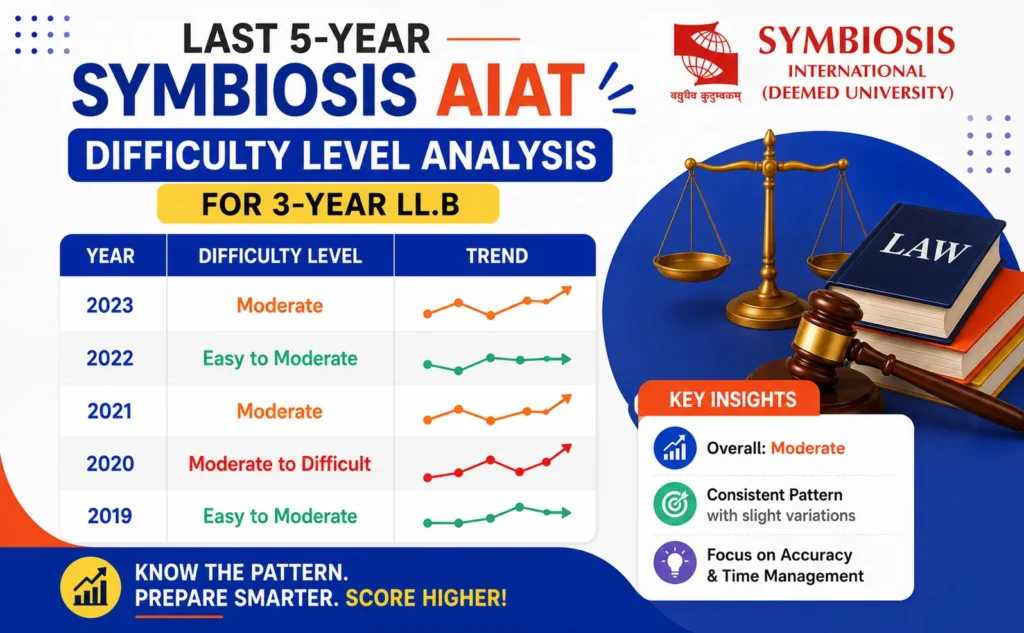
Although the Symbiosis AIAT has undergone changes in its format over the years, one trend has remained consistent for the 3-Year LL.B programme—the examination rewards analytical thinking, structured writing and awareness of contemporary legal and socio-political issues more than rote memorisation. The table below summarises the overall trend observed across recent AIAT examinations.
| Exam Year | Overall Difficulty | Key Observation |
| AIAT 2022 | Moderate | Balanced paper with greater emphasis on analytical writing. |
| AIAT 2023 | Moderate | Reading comprehension and legal reasoning required careful interpretation. |
| AIAT 2024 | Moderate to Difficult | Subjective writing demanded better argument structure and current-affairs awareness. |
| AIAT 2025 | Moderate | Well-balanced paper with focus on legal and socio-legal understanding. |
| AIAT 2026 | Moderate | Tested reasoning ability, writing skills and time management rather than factual recall. |
Key Trends Observed
Across the last five years, several patterns have remained consistent:
- Subjective writing has continued to be the most decisive component.
- Legal reasoning and socio-legal awareness have carried greater importance than memorised facts.
- Reading comprehension passages have tested interpretation rather than vocabulary alone.
- Current affairs have been integrated with legal and contemporary issues instead of asking isolated factual questions.
- Candidates with effective time management have generally performed better, especially in the writing section.
Which Parts of the Symbiosis AIAT Have Been the Most Challenging?
While the overall Symbiosis AIAT difficulty level has generally remained moderate, some sections have consistently required greater preparation than others. Based on the exam pattern and syllabus for the 3-Year LL.B programme, the following components demand the highest level of analytical ability.
- Subjective Writing
The writing section is often the biggest differentiator because it evaluates how well candidates can organise ideas, present logical arguments and express their opinions on legal or socio-political issues within a limited time.
- Legal Reasoning and Socio-Legal Issues
Rather than testing legal knowledge alone, AIAT assesses a candidate’s ability to apply logical reasoning to legal situations. Questions often require careful interpretation instead of direct factual recall, making conceptual clarity essential.
- Reading Comprehension
Reading Comprehension goes beyond vocabulary and grammar. Candidates are expected to identify arguments, draw inferences and understand the author’s perspective, all while maintaining speed and accuracy.
- General Knowledge and Current Affairs
The General Knowledge section rewards students who regularly follow national and international developments, particularly those related to law, governance and society. Consistent newspaper reading and monthly current affairs revision are more effective than last-minute cramming.
- Psychometric Test
The psychometric test is designed to evaluate personality traits, decision-making and behavioural consistency rather than academic knowledge. Candidates should answer honestly and consistently instead of trying to predict the “correct” response.
What Trends Can Be Seen Across the Last Five Years?
Although the exact questions have varied, the last 5-year Symbiosis AIAT difficulty level analysis reveals several consistent patterns that can help aspirants prepare more strategically for the 3-Year LL.B entrance exam.
Key Trends Observed
- Analytical writing has remained the most influential section, making structured arguments more important than memorised content.
- Legal reasoning continues to test application rather than theoretical legal knowledge, rewarding logical thinking and problem-solving.
- Current affairs are closely linked with legal, political and social issues, requiring candidates to understand events instead of simply recalling facts.
- Reading comprehension emphasises interpretation and critical analysis, not just reading speed.
- Time management remains a decisive factor, as candidates must balance subjective writing, MCQs and the psychometric test within the prescribed duration.
What Does the Difficulty Trend Mean for AIAT Aspirants?
Understanding the Symbiosis AIAT difficulty level is valuable only if it helps you prepare more effectively. The last five years indicate that success in the 3-Year LL.B entrance exam depends on developing analytical and writing skills alongside subject knowledge.
How Should You Prepare?
Use this checklist to align your preparation with the exam’s evolving demands:
- Practise writing well-structured answers on legal and socio-political topics.
- Strengthen your legal reasoning through scenario-based questions rather than rote learning.
- Read newspapers and legal current affairs regularly to build contextual understanding.
- Solve Reading Comprehension passages under timed conditions to improve both speed and accuracy.
- Attempt full-length AIAT mock tests to become comfortable with the exam format and time allocation.
- Review your mistakes after every mock test and focus on improving weak areas instead of repeatedly solving familiar questions.
How Should You Prepare for a Moderate-to-Difficult Symbiosis AIAT?
Aspirants should prepare for the Symbiosis AIAT by focusing on the skills the exam consistently evaluates rather than attempting to memorise large volumes of information. Since the 3-Year LL.B entrance exam assesses writing ability, legal reasoning and analytical thinking, a structured preparation strategy is far more effective than last-minute revision.
5-Step Preparation Strategy
- Understand the Exam Pattern First
Familiarise yourself with the weightage, question types and time allocation for subjective writing, MCQs and the psychometric test before beginning your preparation.
- Build Strong Legal and Current Affairs Awareness
Read quality newspapers, legal news and socio-political developments daily. Focus on understanding issues rather than memorising headlines.
- Practise Timed Writing Regularly
Develop the habit of writing clear, logical and well-structured responses within a fixed time limit. This improves both content quality and speed.
- Attempt Mock Tests and Previous Year Papers
Solve full-length AIAT mock tests under exam-like conditions and analyse every attempt to identify recurring mistakes and weak areas.
- Review and Refine Your Strategy
Track your performance after each mock, strengthen weaker sections and revise consistently instead of repeatedly studying only your favourite topics.
How Tarkashastra Helps You Prepare for the Symbiosis AIAT
Understanding the Symbiosis AIAT difficulty level is useful only when it shapes your preparation. At Tarkashastra, students preparing for the SLS Pune 3-Year LL.B entrance exam receive guidance based on previous-year trends, exam patterns and AIAT-specific requirements.
The preparation focuses on:
- Previous-year paper analysis and mock tests
- Subjective writing practice
- Legal Reasoning, Reading Comprehension and Current Affairs
- Time management and performance analysis
This approach helps aspirants build the skills needed to perform confidently, regardless of the paper’s difficulty.
Conclusion
The last 5-year Symbiosis AIAT difficulty level analysis shows that the exam has remained largely moderate, with the real challenge lying in analytical writing, legal reasoning, reading comprehension and effective time management rather than factual memorisation. Aspirants who understand these recurring trends and prepare accordingly are better equipped to perform confidently on exam day.
If you’re aiming for admission to the SLS Pune 3-Year LL.B programme, explore Tarkashastra’s AIAT preparation resources, mock tests, previous-year paper analysis and expert guidance to build a focused strategy and maximise your chances of success.
Frequently Asked Questions (FAQs)
- Is the Symbiosis AIAT difficult for the 3-Year LL.B programme?
The Symbiosis AIAT is generally considered moderate in difficulty. However, its analytical writing, legal reasoning and time-bound format make it challenging for candidates who rely only on rote learning.
- Has the AIAT difficulty level changed over the last five years?
While the overall difficulty has remained fairly consistent, the exam has increasingly emphasised analytical thinking, structured writing and the application of legal concepts.
- Which section is usually the most challenging in AIAT?
The subjective writing section is often the most challenging because it tests argumentation, clarity of thought and time management.
- Is Legal Reasoning more important than General Knowledge?
Both sections are important, but Legal Reasoning generally has a greater impact on overall performance as it evaluates analytical and problem-solving skills.
- Do previous-year AIAT papers help in preparation?
Yes. Solving previous-year papers helps candidates understand question patterns, important topics, difficulty trends and effective time management.
- Does AIAT have negative marking?
No. According to the prescribed exam pattern, there is no negative marking for the objective questions.
- How should I prepare if the AIAT difficulty level increases?
Focus on strengthening analytical writing, legal reasoning, reading comprehension and current affairs while practising full-length mock tests under timed conditions.
- Is the psychometric test difficult?
The psychometric test does not assess legal knowledge. It evaluates personality traits and decision-making, so candidates should answer honestly and consistently.
- Can AIAT be cracked without coaching?
Yes. With a clear understanding of the syllabus, regular practice, previous-year paper analysis and disciplined revision, many candidates can prepare effectively through self-study.
- What should aspirants expect from the next AIAT?
Although the exact paper cannot be predicted, candidates should expect a balanced exam that continues to assess analytical writing, legal reasoning, reading comprehension and awareness of contemporary legal issues.