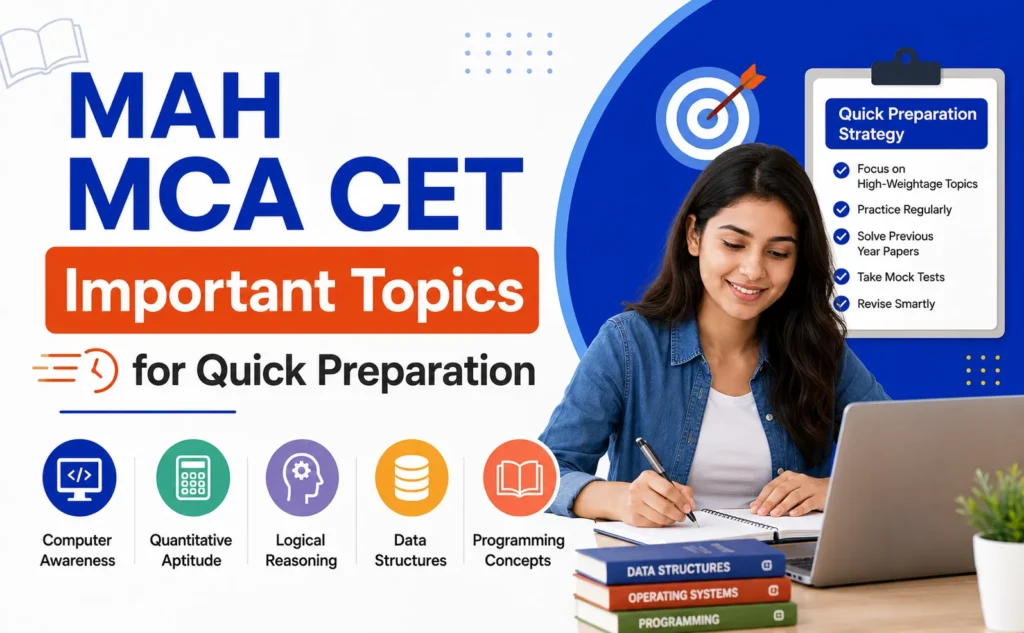
Every year, thousands of students appear for the MAH MCA CET with the goal of securing admission to top MCA colleges in Maharashtra. While completing the entire syllabus is ideal, many students struggle with time management during preparation.
The key to scoring well is identifying the most important topics, understanding their weightage, and allocating study time wisely. Instead of giving equal attention to every chapter, candidates should prioritise concepts that are frequently tested and easier to score.
This article provides a complete subject-wise analysis of the MAH MCA CET important topics 2027, helping students prepare smarter rather than harder.
Why Is It Important to Identify Priority Topics?
Understanding priority topics helps candidates use their preparation time more efficiently and improve their chances of scoring well.
Not every chapter contributes equally to the examination. Some topics appear repeatedly over the years and carry higher weightage than others. Preparing these areas first ensures that candidates cover the maximum scoring portion of the syllabus before moving to lower-priority chapters.
A focused study plan also reduces stress during the final weeks of preparation and makes revision more manageable.
Which Topics Are Most Important for MAH MCA CET 2027?
The most important topics are those that are frequently asked, conceptually significant, and carry relatively higher weightage across different sections of the examination.
Candidates should prioritise the following subjects:
- Mathematics
- Logical Reasoning
- English
- Computer Concepts
Each section contains certain high-scoring chapters that should be completed before less important topics.
Important Mathematics Topics
Mathematics is one of the highest-weightage sections in MAH MCA CET and requires consistent practice.
Priority Topics
- Algebra
- Arithmetic
- Number System
- Percentage
- Profit and Loss
- Ratio and Proportion
- Average
- Time and Work
- Time, Speed and Distance
- Probability
- Permutation and Combination
- Geometry
- Mensuration
- Data Interpretation
These chapters form the core of the Mathematics syllabus and appear regularly in previous examinations.
High-Scoring Mathematics Topics
Students with limited preparation time should first complete:
- Percentage
- Ratio and Proportion
- Average
- Number System
- Algebra
- Probability
These chapters generally offer good scoring opportunities with regular practice.
Important Logical Reasoning Topics
Logical Reasoning is considered one of the easiest scoring sections because it focuses on analytical thinking rather than calculations.
Priority Topics
- Seating Arrangement
- Coding-Decoding
- Blood Relations
- Direction Sense
- Series
- Analogy
- Statements and Conclusions
- Syllogisms
- Puzzle-Based Questions
- Data Sufficiency
- Classification
- Ranking
Candidates should solve a variety of question types to become familiar with different reasoning patterns.
High-Scoring Reasoning Topics
The following topics frequently appear in the examination:
- Coding-Decoding
- Seating Arrangement
- Puzzles
- Blood Relations
- Series
- Statements and Conclusions
Regular practice improves speed significantly.
Important English Topics
The English section tests grammar, vocabulary, and comprehension skills.
Priority Topics
- Reading Comprehension
- Sentence Correction
- Error Detection
- Synonyms
- Antonyms
- Fill in the Blanks
- Articles
- Prepositions
- Subject-Verb Agreement
- Tenses
- Idioms and Phrases
Students should read English newspapers regularly to improve vocabulary and comprehension.
High-Scoring English Topics
Candidates should prioritise:
- Grammar
- Vocabulary
- Reading Comprehension
- Sentence Correction
These topics contribute to a large portion of the English section.
Important Computer Concepts Topics
The Computer Concepts section evaluates fundamental technical knowledge.
Priority Topics
- Computer Fundamentals
- Operating System
- Database Management System (DBMS)
- Programming Basics
- Networking
- Internet Concepts
- Computer Awareness
- Cloud Computing
- Cyber Security Basics
Candidates should focus on understanding concepts rather than memorising definitions.
High-Scoring Computer Topics
The most important technical topics include:
- DBMS
- Operating Systems
- Computer Fundamentals
- Programming Basics
These chapters are frequently asked and relatively straightforward to prepare.
Which Topics Have the Highest Weightage?
Although the official weightage may vary each year, previous trends suggest the following priority areas.
| Subject | High-Weightage Topics |
| Mathematics | Algebra, Arithmetic, Probability, Data Interpretation |
| Logical Reasoning | Seating Arrangement, Coding-Decoding, Puzzles |
| English | Reading Comprehension, Grammar, Vocabulary |
| Computer Concepts | DBMS, Operating System, Computer Fundamentals |
Candidates should complete these chapters before moving to lower-priority topics.
High-Scoring Topics That Should Never Be Skipped
Some chapters consistently help candidates secure easy marks and should always be included in the preparation plan.
These include:
Mathematics
- Algebra
- Percentage
- Number System
- Probability
Logical Reasoning
- Coding-Decoding
- Seating Arrangement
- Blood Relations
English
- Reading Comprehension
- Grammar
- Synonyms and Antonyms
Computer Concepts
- DBMS
- Operating System
- Programming Basics
Skipping these topics can reduce the overall scoring potential in the examination.
How Should Students Cover Important Topics Efficiently?
A structured study strategy allows candidates to complete high-priority chapters without feeling overwhelmed.
Follow these practical tips:
- Begin with the highest-weightage topics in each subject.
- Divide the syllabus into daily study targets.
- Practice topic-wise MCQs after completing each chapter.
- Revise formulas, grammar rules, and technical definitions regularly.
- Attempt sectional mock tests every week.
- Analyse mistakes and revisit weak areas.
- Increase the number of full-length mock tests during the final month.
Consistency is more important than studying for long hours occasionally.
Quick Preparation Checklist
Before moving to full-length mock tests, candidates should confirm that they have:
| Checklist | Status |
| Completed High-Weightage Mathematics Topics | ✔ |
| Practiced Major Reasoning Chapters | ✔ |
| Revised Grammar and Vocabulary | ✔ |
| Studied Computer Fundamentals | ✔ |
| Solved Topic-wise MCQs | ✔ |
| Attempted Sectional Tests | ✔ |
| Revised Weak Areas | ✔ |
| Prepared Short Notes | ✔ |
This checklist helps candidates evaluate their preparation and identify remaining gaps.
What Should Students Study in the Last 15 Days?
The final 15 days before the MAH MCA CET should be dedicated to revision, mock tests, and strengthening high-weightage topics instead of learning entirely new concepts.
Many students make the mistake of starting new chapters just before the examination. This often leads to confusion and reduced confidence. Instead, candidates should revise concepts they have already studied and focus on improving accuracy.
During the last two weeks, students should:
- Revise Mathematics formulas daily.
- Practise Logical Reasoning puzzles and seating arrangement questions.
- Solve Reading Comprehension passages and grammar exercises.
- Revise DBMS, Operating Systems, and Computer Fundamentals.
- Attempt one full-length mock test every two or three days.
- Analyse mistakes after every mock test.
- Revise short notes prepared during earlier stages of preparation.
A balanced revision schedule helps candidates retain information and perform confidently in the examination.
Which Topics Are Easiest to Score?
Some chapters require less preparation time but offer good scoring opportunities in the examination.
Students should prioritise these scoring topics during revision.
Mathematics
- Percentage
- Average
- Ratio and Proportion
- Number System
- Profit and Loss
Logical Reasoning
- Coding-Decoding
- Blood Relations
- Direction Sense
- Series
- Analogy
English
- Synonyms
- Antonyms
- Grammar Rules
- Fill in the Blanks
- Sentence Correction
Computer Concepts
- Computer Fundamentals
- Internet Concepts
- Computer Awareness
- DBMS Basics
- Operating System Concepts
These topics are relatively easier to master with regular practice and can contribute significantly to the overall score.
Which Topics Are Repeated Every Year?
Although the exact questions change every year, certain concepts are consistently tested in the MAH MCA CET examination.
Candidates should pay special attention to these frequently repeated areas:
| Subject | Frequently Asked Topics |
| Mathematics | Algebra, Arithmetic, Probability, Data Interpretation |
| Logical Reasoning | Seating Arrangement, Coding-Decoding, Blood Relations, Puzzles |
| English | Reading Comprehension, Grammar, Vocabulary |
| Computer Concepts | DBMS, Operating Systems, Networking, Computer Fundamentals |
Analysing previous years’ question papers helps students recognise these recurring patterns and prepare more effectively.
How Can Students Do Quick Revision?
Quick revision is most effective when candidates focus on concepts rather than trying to reread entire textbooks.
Some practical revision techniques include:
- Revise handwritten notes instead of lengthy study material.
- Prepare formula sheets for Mathematics.
- Revise grammar rules and vocabulary lists daily.
- Solve one reasoning set every day.
- Revise important DBMS, Operating System, and Networking concepts.
- Attempt topic-wise quizzes.
- Review mistakes made in previous mock tests.
Short revision sessions spread throughout the day are often more effective than long, uninterrupted study hours.
What Should Beginners Prioritise?
Beginners should first complete the fundamental concepts before attempting advanced practice questions.
A recommended order is:
- Computer Fundamentals
- Basic Mathematics
- Logical Reasoning
- English Grammar
- Vocabulary
- DBMS
- Operating Systems
- Networking
- Mock Tests
This sequence builds confidence gradually while covering the most important concepts first.
Which Topics Can Be Skipped?
Ideally, candidates should not skip any topic mentioned in the official syllabus. However, if preparation time is limited, they should prioritise high-weightage chapters before spending time on less frequently tested concepts.
Instead of skipping chapters completely:
- Complete high-priority topics first.
- Revise moderate-weightage topics next.
- Cover low-weightage topics only after finishing the important ones.
Candidates should avoid leaving entire subjects untouched, as even a few questions from each section can influence the final score.
How Can Students Improve Their Score Quickly?
Improving scores in the final weeks depends on consistent practice, strategic revision, and effective time management.
Candidates can improve their performance by:
- Solving previous years’ question papers.
- Attempting regular mock tests.
- Analysing incorrect answers carefully.
- Revising weak chapters repeatedly.
- Improving calculation speed in Mathematics.
- Strengthening grammar and vocabulary.
- Practising reasoning questions under timed conditions.
- Revising technical concepts using short notes.
Small daily improvements often lead to significant score gains over time.
Smart Preparation Strategy for MAH MCA CET 2027
A smart preparation strategy focuses on productivity rather than the number of study hours.
Follow this approach:
- Complete high-weightage topics first.
- Study difficult subjects during your most productive hours.
- Reserve evenings for revision.
- Attempt one sectional test after completing every major topic.
- Take one full-length mock test every week initially and increase the frequency during the final month.
- Analyse mistakes after every test instead of simply checking the score.
- Maintain concise revision notes for quick review.
This strategy helps candidates prepare systematically without feeling overwhelmed.
15-Day Quick Revision Plan
| Days | Revision Focus |
| Days 1–3 | Mathematics (Algebra, Arithmetic, Number System) |
| Days 4–6 | Logical Reasoning (Puzzles, Coding-Decoding, Blood Relations) |
| Days 7–8 | English (Grammar, Vocabulary, Reading Comprehension) |
| Days 9–10 | Computer Concepts (DBMS, OS, Networking) |
| Days 11–12 | Previous Years’ Papers |
| Day 13 | Full-Length Mock Test |
| Day 14 | Analyse Mistakes and Revise Weak Areas |
| Day 15 | Final Revision and Formula Review |
This timetable ensures that every subject receives adequate attention before the examination.
Common Mistakes During Last-Minute Preparation
Many candidates lose valuable marks because of avoidable preparation mistakes.
Some common errors include:
- Starting new chapters just before the examination.
- Ignoring mock test analysis.
- Revising only favourite subjects.
- Spending excessive time on difficult questions.
- Neglecting English and Computer Concepts.
- Not revising formulas regularly.
- Studying continuously without taking short breaks.
Avoiding these mistakes helps candidates remain calm and confident during the examination.
Final Revision Checklist
Before the examination, candidates should ensure they have completed the following:
| Checklist | Status |
| Revised High-Weightage Mathematics Topics | ✔ |
| Practised Logical Reasoning Daily | ✔ |
| Revised Grammar and Vocabulary | ✔ |
| Completed Computer Concepts Revision | ✔ |
| Solved Previous Years’ Papers | ✔ |
| Attempted Full-Length Mock Tests | ✔ |
| Analysed Mistakes | ✔ |
| Revised Formula Sheets and Short Notes | ✔ |
Following this checklist helps candidates enter the examination with confidence and a clear understanding of the syllabus.
Conclusion
Preparing for the MAH MCA CET important topics 2027 does not necessarily require studying every chapter with equal intensity. Instead, candidates should identify high-weightage, frequently repeated, and scoring topics across Mathematics, Logical Reasoning, English, and Computer Concepts to make the best use of their preparation time.A smart preparation strategy includes completing priority topics first, revising regularly, solving previous years’ papers, and attempting mock tests to improve speed and accuracy. During the final weeks, candidates should focus on quick revision rather than learning new concepts. With disciplined preparation and a strategic approach, students can maximise their scores and improve their chances of securing admission to their preferred MCA college.
FAQs
1. Which topics are most important for MCA CET?
The most important topics include Algebra, Arithmetic, Logical Reasoning puzzles, Coding-Decoding, Reading Comprehension, Grammar, DBMS, Operating Systems, and Computer Fundamentals.
2. Which topics have the highest weightage?
High-weightage topics generally include Algebra, Probability, Seating Arrangement, Coding-Decoding, Reading Comprehension, Grammar, DBMS, and Operating Systems.
3. What should be studied in the last 15 days?
Students should focus on revising formulas, grammar rules, reasoning concepts, Computer Concepts, previous years’ papers, and mock tests instead of starting new chapters.
4. Which topics are easiest to score?
Topics such as Percentage, Average, Coding-Decoding, Blood Relations, Grammar, Synonyms, Computer Fundamentals, and Internet Concepts are generally considered easier to score.
5. Which topics are repeated every year?
Frequently repeated topics include Algebra, Arithmetic, Seating Arrangement, Coding-Decoding, Reading Comprehension, Grammar, DBMS, Operating Systems, and Networking.
6. How can students do quick revision?
Candidates should revise short notes, formula sheets, vocabulary lists, grammar rules, and previously attempted mock tests instead of rereading entire textbooks.
7. What should beginners prioritise?
Beginners should first build a strong foundation in Mathematics, Logical Reasoning, English Grammar, Computer Fundamentals, DBMS, and Operating Systems before moving to advanced practice.
8. Which topics can be skipped?
No topic should be skipped entirely. However, if preparation time is limited, candidates should complete high-weightage topics first and cover lower-priority chapters later.
9. How can students improve their score quickly?
Students can improve their scores by revising regularly, solving previous years’ papers, analysing mock tests, strengthening weak areas, and practising under timed conditions.
10. What is the smartest preparation strategy?
The best strategy is to prioritise high-weightage topics, follow a structured revision schedule, attempt regular mock tests, analyse mistakes, and maintain concise revision notes for quick review before the examination.