Introduction
If you’re planning to pursue an MBA or MMS from one of Maharashtra’s top management institutes, understanding the MBA CET 2027 exam pattern should be one of your first steps.
Many students jump directly into preparation without fully understanding how the exam is structured. However, knowing the number of questions, section-wise weightage, marking scheme, and time allocation can help you prepare smarter from day one.
The MBA CET is known for its speed-based format. Unlike several other MBA entrance exams, it offers candidates the flexibility to move freely between sections and attempt all questions without the fear of negative marking. This makes strategy just as important as subject knowledge.
Let’s break down the MBA CET 2027 exam pattern in detail.
MBA CET 2027 Exam Pattern: Quick Overview
The MBA CET 2027 is expected to be conducted as a computer-based examination consisting of 200 multiple-choice questions. Candidates are allotted 150 minutes to complete the examination.
| Particulars | Details |
| Exam Name | MBA CET 2027 |
| Mode of Exam | Computer-Based Test (Online) |
| Medium | English |
| Total Questions | 200 |
| Total Marks | 200 |
| Duration | 150 Minutes |
| Question Type | Multiple Choice Questions (MCQs) |
| Options per Question | 5 |
| Negative Marking | No |
| Sectional Time Limit | None |
One of the biggest advantages of MBA CET is the absence of sectional timing. Candidates can decide how much time they want to spend on each section based on their strengths.
MBA CET 2027 Sections and Weightage
The examination evaluates candidates across four key skill areas that are considered important for management education.
Section-Wise Distribution
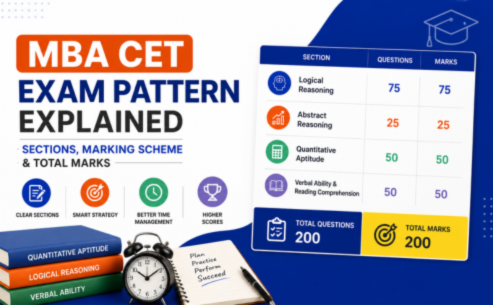
| Section | Number of Questions | Marks |
| Logical Reasoning | 75 | 75 |
| Abstract Reasoning | 25 | 25 |
| Quantitative Aptitude | 50 | 50 |
| Verbal Ability & Reading Comprehension | 50 | 50 |
| Total | 200 | 200 |
A quick look at the distribution shows that Logical Reasoning carries the highest weightage. With 75 questions, it contributes nearly 38% of the entire paper.
For students targeting top MBA colleges through CET, strong performance in Logical Reasoning often becomes a major differentiator.
MBA CET 2027 Marking Scheme
Before discussing exam strategy, it’s important to understand how the MBA CET scoring system works.
| Response Type | Marks |
| Correct Answer | +1 |
| Incorrect Answer | 0 |
| Unattempted Question | 0 |
| Negative Marking | No |
Every correct answer earns one mark, while incorrect responses carry no penalty.
This feature makes MBA CET different from many competitive examinations. Since there is no negative marking, candidates can attempt a larger number of questions and improve their chances of maximizing their score.
However, random guessing should not replace smart decision-making. The goal should always be to combine high attempts with reasonable accuracy.
Total Marks and Time Available
The MBA CET paper carries a total of 200 marks, with every question worth one mark.
| Parameter | Details |
| Total Questions | 200 |
| Total Marks | 200 |
| Marks per Question | 1 |
| Duration | 150 Minutes |
| Average Time per Question | 45 Seconds |
At first glance, 150 minutes may seem sufficient. However, when divided across 200 questions, candidates get an average of approximately 45 seconds per question.
This is why speed, quick decision-making, and regular mock test practice become crucial components of preparation.
Expected Difficulty Level of MBA CET Sections
The exact difficulty level can vary slightly from one exam slot to another, but the overall pattern generally remains consistent.
| Section | Expected Difficulty |
| Logical Reasoning | Moderate and Time-Consuming |
| Abstract Reasoning | Moderate |
| Quantitative Aptitude | Moderate to Difficult |
| Verbal Ability & Reading Comprehension | Moderate to Difficult |
Logical Reasoning is often considered the most lengthy section because of puzzles, arrangements, and analytical reasoning sets.
Quantitative Aptitude and Verbal Ability can become scoring areas for students who have built strong fundamentals through consistent practice.
Important Features of the MBA CET 2027 Exam Pattern
Before beginning your preparation journey, keep these important points in mind:
- The exam contains 200 MCQs.
- Every question carries one mark.
- There is no negative marking.
- There is no sectional time limit.
- Candidates can move freely across sections.
- Time management plays a crucial role.
- Higher attempts generally improve scoring opportunities.
- Logical Reasoning has the highest weightage.
These characteristics make MBA CET a unique exam where strategy and speed often have a significant impact on final performance.
How Should Students Prepare According to the MBA CET 2027 Pattern?
A good preparation strategy aligns with the actual structure of the examination.
Logical Reasoning
Since it carries the maximum weightage, students should focus on:
- Seating Arrangements
- Puzzles
- Coding-Decoding
- Blood Relations
- Critical Reasoning
- Input-Output
Quantitative Aptitude
Key areas include:
- Arithmetic
- Algebra
- Geometry
- Data Interpretation
Verbal Ability & Reading Comprehension
Important topics are:
- Reading Comprehension
- Vocabulary
- Grammar
- Para Jumbles
- Sentence Arrangement
Students should also develop the habit of taking full-length mock tests regularly. Mock tests not only improve speed but also help identify personal strengths and weaknesses.
How Tarkashastra Supports MBA CET Aspirants
Preparing for MBA CET requires more than just studying concepts. It also demands exam-specific strategy, time management, and consistent practice.
At Tarkashastra, the preparation approach is built around the actual MBA CET examination pattern and the challenges students face during the exam.
Students receive:
- MBA CET-focused mock tests
- Section-wise preparation plans
- Logical Reasoning strategy sessions
- Time-management guidance
- Detailed performance analysis
- Updated study material aligned with the latest exam trends
The objective is not just to complete the syllabus but to help students develop the speed, accuracy, and confidence required on exam day.
Final Thoughts
MBA CET 2027 is a fast-paced examination that rewards smart preparation and effective time management. With 200 questions to be solved in 150 minutes, candidates must focus on both accuracy and speed.
A clear understanding of the exam pattern allows students to allocate preparation time wisely, prioritize high-weightage sections, and approach the examination with confidence.
Start early, practice consistently, analyze your mock tests, and build a strategy that works for you. With the right preparation and guidance, achieving a strong MBA CET percentile becomes a realistic and achievable goal.
Frequently Asked Questions (FAQs)
1. What is the MBA CET 2027 exam pattern?
MBA CET 2027 is expected to consist of 200 multiple-choice questions divided across Logical Reasoning, Abstract Reasoning, Quantitative Aptitude, and Verbal Ability & Reading Comprehension. The exam duration is 150 minutes.
2. How many sections are there in MBA CET?
There are four sections:
- Logical Reasoning
- Abstract Reasoning
- Quantitative Aptitude
- Verbal Ability & Reading Comprehension
3. What is the marking scheme of MBA CET?
Candidates receive one mark for every correct answer.
4. Is there negative marking in MBA CET?
No. MBA CET does not impose any negative marking for incorrect answers.
5. How many questions are asked in MBA CET?
The examination consists of 200 questions.
6. What is the duration of MBA CET?
Candidates get 150 minutes (2 hours and 30 minutes) to complete the exam.
7. Which section carries the highest weightage?
Logical Reasoning carries the highest weightage with 75 questions.
8. Is there any sectional time limit?
No. Candidates are free to switch between sections during the examination.
9. How should students prepare for MBA CET?
Students should focus on strengthening fundamentals, practicing mocks regularly, and allocating additional attention to Logical Reasoning due to its higher weightage.
10. What is an effective attempt strategy?
Attempt straightforward questions first, maintain speed throughout the paper, and take advantage of the no-negative-marking policy while ensuring reasonable accuracy.