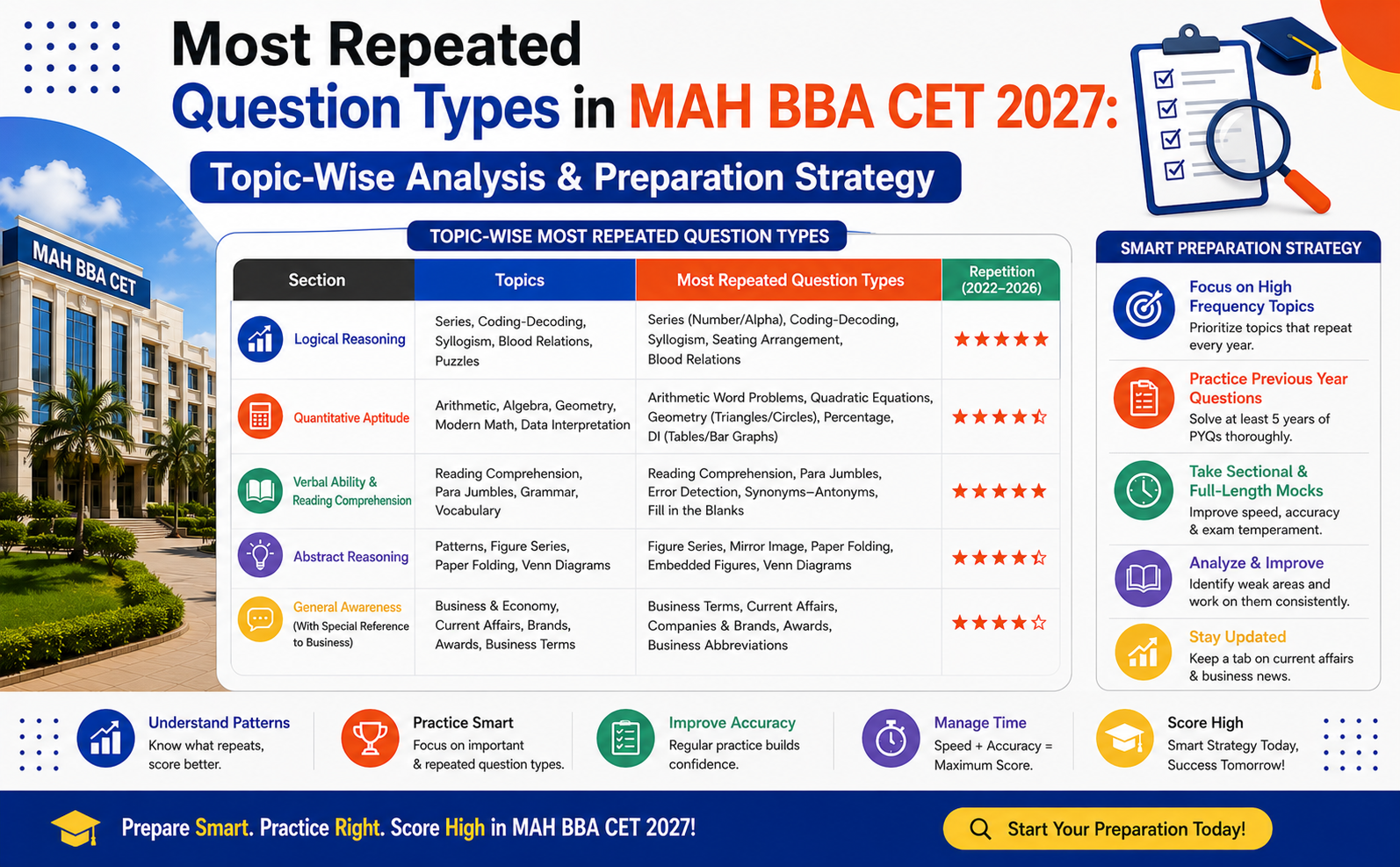
The MAH BBA CET has quickly become one of the most important entrance examinations for students seeking admission into top BBA programs across Maharashtra. While many students focus only on completing the syllabus, high scorers understand that identifying the most repeated question types in MAH BBA CET 2027 can significantly improve accuracy, speed, and overall score.
A detailed analysis of previous years’ papers reveals that certain concepts, formats, and question patterns appear consistently. Understanding these recurring trends allows students to prioritize preparation, allocate study time efficiently, and maximize marks with focused practice.
In this article, we will analyze the most repeated question types, identify high-frequency topics section-wise, and discuss an effective preparation strategy for MAH BBA CET 2027.
Understanding MAH BBA CET 2027 Exam Pattern
Before analyzing repeated questions, it is important to understand the structure of the examination.
| Section | Approximate Weightage |
| English Language | High |
| Reasoning (Logical & Analytical) | High |
| General Knowledge | Moderate |
| Computer Basics | Moderate |
| Quantitative Aptitude | High |
The exam primarily tests aptitude, logical thinking, language skills, and awareness. Over the years, question styles have remained largely consistent, making pattern analysis extremely useful.
Why Analyzing Repeated Question Types Matters
Students often assume entrance exams are unpredictable. However, examination authorities generally maintain a stable framework.
Benefits of studying repeated questions include:
- Better understanding of examiner preferences
- Faster question recognition during the exam
- Improved accuracy
- Higher confidence
- Efficient revision
- Better time management
Students who solve previous-year papers often notice that many questions are not identical but follow the same logic and structure.
Topic-Wise Analysis of Most Repeated Question Types in MAH BBA CET 2027
Quantitative Aptitude
Quantitative Aptitude consistently contributes a significant portion of the paper.
1. Percentage-Based Questions
These are among the most frequently asked questions.
Common formats include:
- Profit and loss
- Discount calculations
- Population growth
- Percentage increase/decrease
- Exam score comparisons
Example Pattern
If the price of a product increases by 20% and consumption decreases by 10%, find the net expenditure change.
Preparation Strategy
- Master percentage conversions.
- Learn shortcut techniques.
- Practice calculation-intensive questions daily.
2. Ratio and Proportion
This topic appears almost every year.
Common question types:
- Partnership problems
- Distribution questions
- Mixing and replacement
- Direct and indirect proportion
Preparation Strategy
- Memorize standard ratio concepts.
- Practice mixed ratio questions.
- Learn fraction-ratio conversions.
3. Time, Speed and Distance
Highly predictable and scoring.
Repeated formats:
- Relative speed
- Train problems
- Boat and stream
- Average speed
Preparation Strategy
- Learn standard formulas.
- Solve questions under timed conditions.
4. Time and Work
One of the most repeated question categories.
Common patterns:
- Individual efficiency
- Combined work
- Pipe and cistern
- Work completion comparisons
Preparation Strategy
Focus on:
- LCM method
- Efficiency-based shortcuts
- Alternate work patterns
5. Simple and Compound Interest
Appears regularly in previous papers.
Common questions:
- Interest comparison
- Difference between SI and CI
- Multi-year investments
Preparation Strategy
Practice direct formula-based questions extensively.
Logical Reasoning
Reasoning is often the highest-scoring section for well-prepared students.
1. Series Completion
Repeated almost every year.
Common formats:
- Number series
- Alphabet series
- Mixed series
Example
2, 6, 12, 20, 30, ?
Preparation Strategy
Identify:
- Difference patterns
- Square patterns
- Multiplication patterns
2. Coding-Decoding
A favorite question type in MAH BBA CET.
Common variations:
- Letter coding
- Number coding
- Symbol coding
Preparation Strategy
Practice at least 15–20 questions daily.
3. Blood Relations
Highly predictable and scoring.
Common patterns:
- Family trees
- Generation-based questions
- Relationship identification
Preparation Strategy
Use diagrams instead of mental calculations.
4. Seating Arrangement
One of the most frequently repeated logical reasoning topics.
Common formats:
- Circular arrangement
- Linear arrangement
- North-South facing arrangement
Preparation Strategy
Practice diagram-based solving methods.
5. Syllogisms
A regular feature in the exam.
Common question types:
- Statement-conclusion
- Venn diagram syllogisms
- Logical deduction
Preparation Strategy
Master Venn diagram approaches.
6. Direction Sense
Frequently asked and generally easy.
Typical questions:
- Distance traveled
- Direction changes
- Final position identification
Preparation Strategy
Practice visualization techniques.
English Language: Most Repeated Question Types
English is often the easiest section to improve with consistent practice.
1. Reading Comprehension
Almost guaranteed every year.
Common areas:
- Business
- Education
- Technology
- Social issues
Preparation Strategy
- Read newspapers daily.
- Practice inference-based questions.
2. Synonyms and Antonyms
Frequently repeated.
Common format:
Choose the word closest in meaning.
Preparation Strategy
Build vocabulary through daily reading.
3. Error Detection
A highly recurring question type.
Common concepts:
- Subject-verb agreement
- Tenses
- Articles
- Prepositions
Preparation Strategy
Revise grammar fundamentals thoroughly.
4. Sentence Rearrangement
Appears regularly.
Students must arrange sentences in logical order.
Preparation Strategy
Focus on:
- Connectors
- Chronological flow
- Pronoun references
5. Fill in the Blanks
One of the easiest scoring areas.
Common topics:
- Vocabulary
- Grammar
- Contextual usage
Preparation Strategy
Improve reading habits and vocabulary.
General Knowledge: Most Repeated Areas
Unlike other sections, exact questions may not repeat, but themes often do.
1. Current Affairs
Frequently covered areas:
- Government schemes
- Sports events
- Awards
- International organizations
Preparation Strategy
Study the previous 6–8 months of current affairs.
2. Indian History
Common topics:
- Freedom movement
- Constitutional developments
- Important leaders
3. Geography
Repeated concepts include:
- Capitals
- Rivers
- States
- International borders
4. Economics and Business Awareness
Growing importance in recent papers.
Topics include:
- Banking
- Inflation
- GDP
- RBI
Computer Basics: Frequently Repeated Questions
Computer awareness remains a scoring section.
1. MS Office
Repeated topics:
- MS Word
- MS Excel
- MS PowerPoint
Common Questions
- Shortcut keys
- File extensions
- Spreadsheet functions
2. Internet and Networking
Frequently asked concepts:
- URL
- HTTP
- Browsers
- Search engines
3. Hardware and Software
Common areas:
- Input devices
- Output devices
- Operating systems
4. Computer Generations
A recurring theoretical topic.
Students should know:
- First generation
- Second generation
- Third generation
- Fourth generation
- Fifth generation
Which Section Has the Most Predictable Questions?
Based on previous-year analysis:
| Section | Predictability |
| Quantitative Aptitude | High |
| Logical Reasoning | Very High |
| Computer Basics | Very High |
| English Language | High |
| General Knowledge | Moderate |
Logical Reasoning and Computer Basics usually contain the most predictable question patterns.
How to Analyze Previous Year Papers Effectively
Many students solve papers without extracting insights.
Use this method:
Step 1: Categorize Questions
Create a sheet with:
| Topic | Frequency |
| Percentage | – |
| Ratio | – |
| Coding-Decoding | – |
| Seating Arrangement | – |
| RC | – |
Step 2: Identify High-Frequency Areas
Mark topics appearing repeatedly.
Step 3: Create Topic Buckets
Divide topics into:
- High frequency
- Medium frequency
- Low frequency
Step 4: Prioritize Accordingly
Spend:
- 50% time on high-frequency topics
- 30% time on medium-frequency topics
- 20% time on low-frequency topics
Best Preparation Strategy for Repeated Questions in MAH BBA CET 2027
Phase 1: Build Concepts
Duration: 2 Months
Focus on:
- Quant basics
- Grammar
- Reasoning fundamentals
- Computer awareness
Phase 2: Topic-Wise Practice
Duration: 1 Month
Solve:
- 100+ questions per topic
- Previous-year papers
- Sectional tests
Phase 3: Pattern Recognition
Duration: 15 Days
Track:
- Frequently repeated structures
- Common traps
- Time-consuming formats
Phase 4: Mock Test Strategy
Duration: Final Month
Take:
- Full-length mocks
- Sectional mocks
- Time-bound practice tests
Analyze mistakes after every mock.
Does Practicing Repeated Questions Improve Scores?
Absolutely.
Students who focus on recurring patterns generally:
- Solve faster
- Make fewer mistakes
- Improve confidence
- Increase accuracy
- Achieve higher percentiles
The objective is not memorization but pattern recognition.
High-Priority Topics for MAH BBA CET 2027
| Section | High-Priority Topics |
| Quant | Percentage, Ratio, SI-CI, Time & Work, Time-Speed-Distance |
| Reasoning | Coding-Decoding, Seating Arrangement, Blood Relations, Series |
| English | RC, Vocabulary, Grammar, Error Detection |
| GK | Current Affairs, Economics, Government Schemes |
| Computer | MS Office, Internet Basics, Hardware & Software |
Students should ensure complete mastery of these topics before moving to less frequent areas.
How Tarkashastra Helps Students Crack MAH BBA CET
At Tarkashastra, preparation is designed around actual exam trends rather than random practice.
Students receive:
- Topic-wise preparation plans
- Previous-year pattern analysis
- Sectional tests
- Mock examinations
- Performance tracking
- Expert mentorship
- Strategy sessions for maximizing scores
By focusing on high-frequency question types and proven exam strategies, students can improve both speed and accuracy in MAH BBA CET 2027.
Conclusion
Understanding the Most Repeated Question Types MAH BBA CET 2027 can provide a significant advantage during preparation. Previous-year trends indicate that topics such as Percentage, Ratio, Time and Work, Coding-Decoding, Seating Arrangement, Reading Comprehension, Current Affairs, and Computer Basics consistently appear in the examination.
Students who systematically analyze question patterns, prioritize high-frequency topics, and practice mock tests regularly are more likely to achieve higher scores and secure admission into top BBA colleges. Rather than studying everything equally, focus on recurring concepts, master predictable question formats, and build a structured preparation strategy for MAH BBA CET 2027.
FAQs
1. What are the most repeated question types in MAH BBA CET 2027?
Percentage, Ratio, Coding-Decoding, Seating Arrangement, Blood Relations, Reading Comprehension, and Computer Basics are among the most repeated question categories.
2. Which topics appear most frequently in MAH BBA CET?
Quantitative Aptitude and Logical Reasoning topics tend to appear most consistently every year.
3. How can students analyze previous-year question patterns?
By categorizing questions topic-wise, tracking frequency, and identifying recurring structures across multiple papers.
4. What is the best preparation strategy for repeated questions?
Master concepts first, practice topic-wise questions, analyze patterns, and regularly take mock tests.
5. Are Quantitative Aptitude questions repeated every year?
The exact questions may not repeat, but the concepts and formats frequently recur.
6. Which section has the most predictable questions?
Logical Reasoning and Computer Basics are generally the most predictable sections.
7. How should students prioritize topics based on repetition?
Focus first on high-frequency topics, then medium-frequency areas, and finally low-frequency topics.
8. Does practicing repeated question types improve scores?
Yes. It enhances speed, accuracy, confidence, and overall exam performance.
9. How can students track topic-wise trends?
Create a spreadsheet and record the frequency of topics appearing in previous papers.
10. Which question types should students focus on for a high percentile?
Percentage, Time and Work, Coding-Decoding, Seating Arrangement, Reading Comprehension, Current Affairs, and Computer Awareness offer the highest scoring potential.