NIMCET is one of the most competitive MCA entrance examinations in India, conducted for admission to MCA programmes offered by participating National Institutes of Technology (NITs). Every year, thousands of graduates compete for a limited number of seats, making it essential to understand the examination pattern before starting preparation.
Many candidates spend months studying but fail to perform well because they are unfamiliar with the structure of the examination. A clear understanding of the exam pattern helps candidates allocate their preparation time efficiently, prioritise high-weightage sections, and develop an effective exam-day strategy.
Since the official notification for NIMCET 2027 has not yet been released, the information provided in this article is based on previous years’ trends and should be treated as expected until officially confirmed.
What is the NIMCET 2027 Exam Pattern?
The NIMCET 2027 exam pattern defines the structure of the entrance examination, including:
- Mode of examination
- Number of questions
- Subject-wise sections
- Total marks
- Examination duration
- Marking scheme
- Negative marking
- Question paper format
Understanding each of these components enables candidates to prepare strategically and manage time effectively during the examination.
NIMCET 2027 Exam Pattern Highlights (Expected)
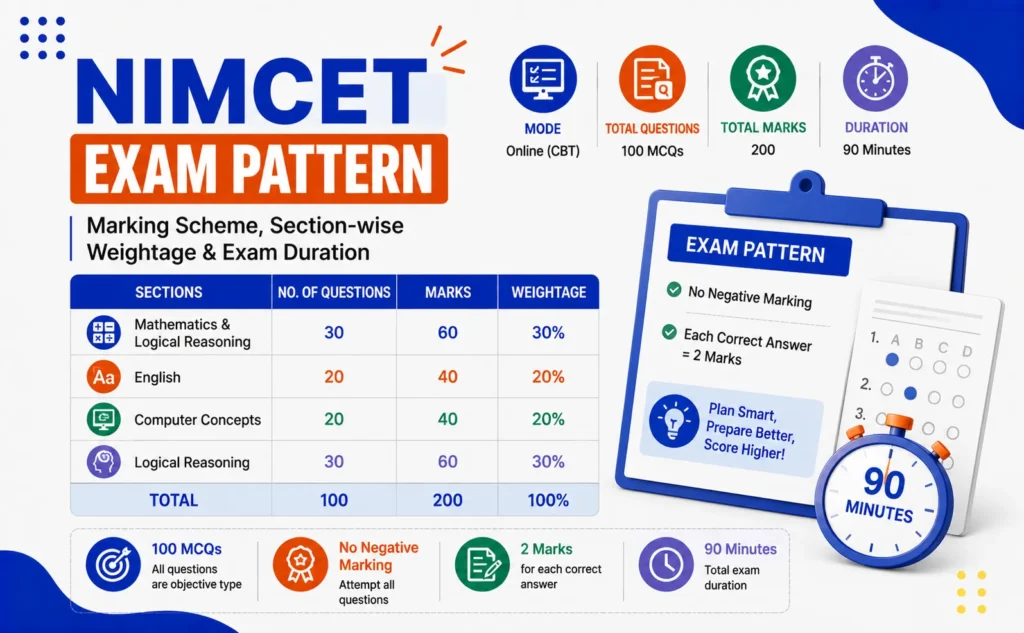
The table below summarises the expected exam pattern based on previous years.
| Particular | Expected Details |
| Examination Mode | Computer-Based Test (CBT) |
| Examination Type | Objective (Multiple Choice Questions) |
| Medium | English |
| Total Questions | 120 |
| Total Marks | 1000 |
| Duration | 2 Hours (120 Minutes) |
| Sections | Mathematics, Analytical Ability & Logical Reasoning, Computer Awareness, General English |
| Negative Marking | Applicable (Expected) |
Candidates should wait for the official notification for confirmation of these details.
Mode of Examination
The NIMCET 2027 examination is expected to be conducted in Computer-Based Test (CBT) mode.
Candidates will answer questions using a computer at their allotted examination centre.
There is no offline or pen-and-paper examination.
Before the examination begins, candidates are generally provided with instructions regarding navigation, question selection, marking answers, and submission of the test.
Becoming familiar with computer-based examinations can improve confidence and reduce exam-day anxiety.
Medium of Examination
The examination is expected to be conducted entirely in English.
All questions, instructions, and options will be presented in English only.
Candidates should therefore strengthen their reading comprehension and become comfortable understanding technical and mathematical terminology in English.
Total Number of Questions
The NIMCET 2027 question paper is expected to contain 120 multiple-choice questions.
Each question will have multiple answer options, with only one correct answer.
Since the paper contains a large number of questions to be completed within a limited time, speed and accuracy become equally important.
Candidates should regularly solve full-length mock tests to improve both.
Total Marks
The total expected marks for the examination are 1000 marks.
Different sections carry different marks because the questions are assigned different weightages.
This makes it important for candidates to understand which sections contribute more towards the final score and prepare accordingly.
NIMCET 2027 Exam Duration
The total duration of the examination is expected to be 2 hours (120 minutes).
Candidates must complete all four sections within this fixed time.
There is no separate sectional timing.
Therefore, effective time management plays a significant role in achieving a high score.
Candidates should develop a strategy for deciding:
- Which section to attempt first
- How much time to spend on each section
- Which difficult questions to skip initially
- When to revisit unanswered questions
Practising under timed conditions can greatly improve performance during the actual examination.
NIMCET 2027 Section-wise Weightage (Expected)
The expected section-wise distribution of questions is based on previous examination patterns.
| Section | Expected Number of Questions |
| Mathematics | 50 |
| Analytical Ability & Logical Reasoning | 40 |
| Computer Awareness | 20 |
| General English | 10 |
| Total | 120 Questions |
From the table, it is clear that Mathematics carries the highest number of questions and therefore deserves maximum preparation time.
Mathematics Section
Mathematics is generally considered the most important section of the NIMCET examination.
It carries the highest weightage and significantly influences the overall score.
The section usually evaluates a candidate’s understanding of graduation-level mathematical concepts such as:
- Algebra
- Calculus
- Coordinate Geometry
- Trigonometry
- Probability
- Statistics
- Vectors
- Matrices
- Differential Equations
- Numerical Methods
Candidates should build strong conceptual clarity instead of relying solely on memorisation.
Daily practice and solving previous years’ questions are essential for success in this section.
Analytical Ability and Logical Reasoning
This section evaluates the candidate’s logical thinking, analytical skills, and problem-solving ability.
Common topics generally include:
- Series
- Coding-Decoding
- Blood Relations
- Direction Sense
- Seating Arrangement
- Puzzles
- Syllogism
- Statement and Conclusion
- Logical Sequences
- Data Interpretation
Regular practice is the key to improving speed and accuracy in this section.
Candidates should solve a variety of reasoning questions to become familiar with different problem types.
Computer Awareness
The Computer Awareness section tests a candidate’s understanding of basic computer concepts.
The syllabus generally includes:
- Computer Fundamentals
- Operating Systems
- Programming Basics
- Internet Concepts
- Database Management Systems
- Computer Networks
- Software and Hardware
- Input and Output Devices
- Memory Units
- Cyber Security Basics
Most questions in this section are concept-based rather than calculation-intensive.
Candidates from BCA, B.Sc. (Computer Science), and IT backgrounds often find this section relatively easier, but aspirants from other disciplines should devote sufficient preparation time to strengthen their fundamentals.
General English
The General English section carries the least number of questions but can contribute valuable marks to the final score.
This section typically assesses:
- Vocabulary
- Grammar
- Sentence Correction
- Reading Comprehension
- Synonyms and Antonyms
- Fill in the Blanks
- Error Detection
- Idioms and Phrases
Regular reading of newspapers, magazines, and English editorials, along with vocabulary practice, can significantly improve performance in this section.
Although it has a lower weightage, candidates should not ignore it, as every mark can make a difference in the final ranking.
Why Understanding the Exam Pattern is Important
Many aspirants begin preparing without fully understanding the structure of the examination. This often leads to poor time management and inadequate focus on high-weightage sections.
A thorough understanding of the NIMCET 2027 exam pattern helps candidates:
- Plan a balanced study schedule.
- Prioritise important sections.
- Improve time management.
- Practise mock tests effectively.
- Build confidence before the examination.
- Develop an exam-day strategy.
Candidates who prepare according to the official pattern generally perform better than those who study without a structured approach.
NIMCET 2027 Marking Scheme (Expected)
Understanding the NIMCET 2027 marking scheme is essential for scoring well in the examination. Since different sections carry different marks per question, candidates should plan their attempts strategically.
Based on previous years’ trends, the expected marking scheme is as follows:
| Section | Questions | Marks per Question | Maximum Marks |
| Mathematics | 50 | 12 | 600 |
| Analytical Ability & Logical Reasoning | 40 | 6 | 240 |
| Computer Awareness | 20 | 6 | 120 |
| General English | 10 | 4 | 40 |
| Total | 120 | — | 1000 Marks |
From the above distribution, it is clear that Mathematics contributes the largest share of the total marks. Candidates aiming for a high rank should therefore devote maximum preparation time to this section while maintaining a balanced approach to the remaining sections.
Is Negative Marking Applicable?
Yes. Based on previous years’ examination pattern, negative marking is expected in NIMCET 2027.
The expected negative marking scheme is:
- Mathematics: -3 marks for every incorrect answer.
- Analytical Ability & Logical Reasoning: -1.5 marks for every incorrect answer.
- Computer Awareness: -1.5 marks for every incorrect answer.
- General English: -1 mark for every incorrect answer.
There is no penalty for unanswered questions.
Because of negative marking, candidates should avoid random guessing. Attempt only those questions where there is a reasonable chance of selecting the correct answer.
Section-wise Difficulty Level
The overall difficulty level of the NIMCET examination is generally considered moderate to difficult.
Mathematics
Difficulty Level: Moderate to Difficult
This section requires conceptual understanding, strong calculation skills, and regular practice. It is usually the most challenging section for many candidates.
Analytical Ability & Logical Reasoning
Difficulty Level: Moderate
Questions are generally scored if candidates practise consistently. Speed and logical thinking play an important role.
Computer Awareness
Difficulty Level: Easy to Moderate
Candidates with computer science backgrounds usually find this section easier. Others can score well by revising fundamental concepts.
General English
Difficulty Level: Easy to Moderate
Most questions are straightforward and can be answered quickly with good vocabulary and grammar knowledge.
Which Section Has the Highest Weightage?
Among all four sections, Mathematics carries the highest weightage in both the number of questions and total marks.
The section contributes:
- 50 questions
- 600 marks
This means that nearly 60% of the total score depends on Mathematics alone.
Candidates should therefore allocate more study time to Mathematics while ensuring that they do not neglect the other sections, as overall performance determines the final rank.
Has the NIMCET Exam Pattern Changed?
As of now, no official changes have been announced for NIMCET 2027.
Based on previous years, the examination is expected to continue with:
- Computer-Based Test (CBT)
- 120 multiple-choice questions
- Four sections
- 1000 total marks
- Two-hour duration
- Negative marking
If the conducting authority introduces any changes in the question paper pattern, marking scheme, or syllabus, they will be mentioned in the official notification.
Candidates should regularly visit the official website and follow trusted educational platforms like Tarkashastra for the latest updates.
What is a Good Attempt in NIMCET 2027?
A “good attempt” depends on several factors, including:
- Difficulty level of the examination
- Number of correct answers
- Accuracy
- Negative marking
- Overall competition
Generally, candidates should focus on:
- Maximising accuracy rather than attempting every question.
- Securing strong marks in Mathematics.
- Avoiding unnecessary negative marking.
- Attempting easy and moderate questions first.
- Managing time effectively across all sections.
Instead of targeting a fixed number of questions, candidates should aim for a high percentage of correct answers.
How to Prepare According to the NIMCET 2027 Exam Pattern
Understanding the exam pattern allows candidates to prepare more strategically.
Prioritise Mathematics
Since Mathematics has the highest weightage, candidates should dedicate the largest portion of their preparation time to strengthening concepts and practising numerical problems.
Follow the Section-wise Weightage
Allocate study hours according to the marks distribution instead of spending equal time on every subject.
Practise Mock Tests
Attempt full-length mock tests regularly to become familiar with the computer-based examination environment and improve time management.
Solve Previous Years’ Papers
Analysing previous years’ question papers helps candidates understand frequently asked topics and the overall difficulty level.
Improve Accuracy
Negative marking makes accuracy more important than the total number of attempts. Focus on selecting correct answers instead of making random guesses.
Revise Regularly
Revision strengthens conceptual understanding and improves retention. Candidates should revise formulas, reasoning techniques, computer concepts, and vocabulary consistently.
Common Mistakes to Avoid
Many aspirants lose valuable marks due to avoidable mistakes during preparation and the examination.
Some common mistakes include:
- Ignoring Mathematics because it appears difficult.
- Spending excessive time on one section.
- Guessing answers despite negative marking.
- Neglecting General English and Computer Awareness.
- Not practising mock tests.
- Failing to analyse previous years’ papers.
- Poor time management during the examination.
- Beginning preparation without understanding the exam pattern.
Avoiding these mistakes can significantly improve overall performance.
How Tarkashastra Helps NIMCET Aspirants
Preparing for NIMCET requires more than simply studying textbooks. Candidates need structured guidance, reliable study material, and regular practice.
Tarkashastra supports aspirants through:
- Latest NIMCET notifications and updates.
- Detailed syllabus and exam pattern analysis.
- Subject-wise preparation strategies.
- Previous years’ paper analysis.
- Mock tests and practice questions.
- Time management techniques.
- Counselling guidance.
- MCA college selection support.
- Expert tips for improving scores.
With the right guidance and consistent preparation, candidates can improve their chances of securing admission to their preferred NIT.
Conclusion
The NIMCET 2027 Exam Pattern provides candidates with a clear understanding of how the examination is structured. Knowing the number of questions, section-wise weightage, marking scheme, examination duration, and negative marking allows aspirants to prepare efficiently and avoid surprises on the exam day.
Although the official NIMCET 2027 exam pattern has not yet been released, it is expected to remain largely similar to previous years. Candidates should begin their preparation early, focus on high-weightage sections such as Mathematics, practise mock tests regularly, and improve their accuracy to maximise their score.
FAQs
1. What is the NIMCET 2027 exam pattern?
The NIMCET 2027 examination is expected to be conducted as a computer-based test consisting of 120 multiple-choice questions from Mathematics, Analytical Ability & Logical Reasoning, Computer Awareness, and General English.
2. How many sections are there in NIMCET 2027?
The examination is expected to have four sections: Mathematics, Analytical Ability & Logical Reasoning, Computer Awareness, and General English.
3. What is the exam duration?
The expected duration of the examination is 2 hours (120 minutes).
4. How many questions are asked in NIMCET?
Based on previous years’ trends, the question paper is expected to contain 120 multiple-choice questions.
5. What is the marking scheme?
The expected marking scheme awards 12 marks per Mathematics question, 6 marks per Analytical Ability & Logical Reasoning question, 6 marks per Computer Awareness question, and 4 marks per General English question, making a total of 1000 marks.
6. Is negative marking applicable?
Yes. Negative marking is expected. Incorrect answers may attract penalties of -3, -1.5, or -1 mark, depending on the section.
7. Which section has the highest weightage?
Mathematics has the highest weightage, contributing 50 questions and 600 marks.
8. Has the exam pattern changed?
As of now, no official changes have been announced. The pattern is expected to remain similar to previous years until the official notification is released.
9. What is considered a good attempt in NIMCET?
A good attempt depends on the difficulty level and accuracy. Candidates should prioritise correct answers over attempting every question, as negative marking can reduce the overall score.
10. How should I prepare according to the exam pattern?
Candidates should focus more on Mathematics, practise section-wise mock tests, solve previous years’ papers, improve time management, revise regularly, and maintain high accuracy while attempting questions.