Preparing for NIMCET without understanding the syllabus is like travelling without a map. Every successful candidate begins by analysing the syllabus and planning a structured study schedule. Since NIMCET is one of the most competitive MCA entrance examinations in India, aspirants must focus on the right topics rather than studying everything indiscriminately.
The syllabus provides clarity regarding what to study and helps candidates allocate more time to high-weightage areas. It also allows aspirants to choose appropriate study material, solve relevant mock tests, and monitor their preparation effectively.
As the official notification for NIMCET 2027 is yet to be released, the syllabus discussed in this article is based on previous years’ examination patterns and should be considered expected until officially confirmed.
What is the NIMCET 2027 Syllabus?
The NIMCET 2027 syllabus refers to the complete list of subjects and topics from which questions are expected to be asked in the entrance examination.
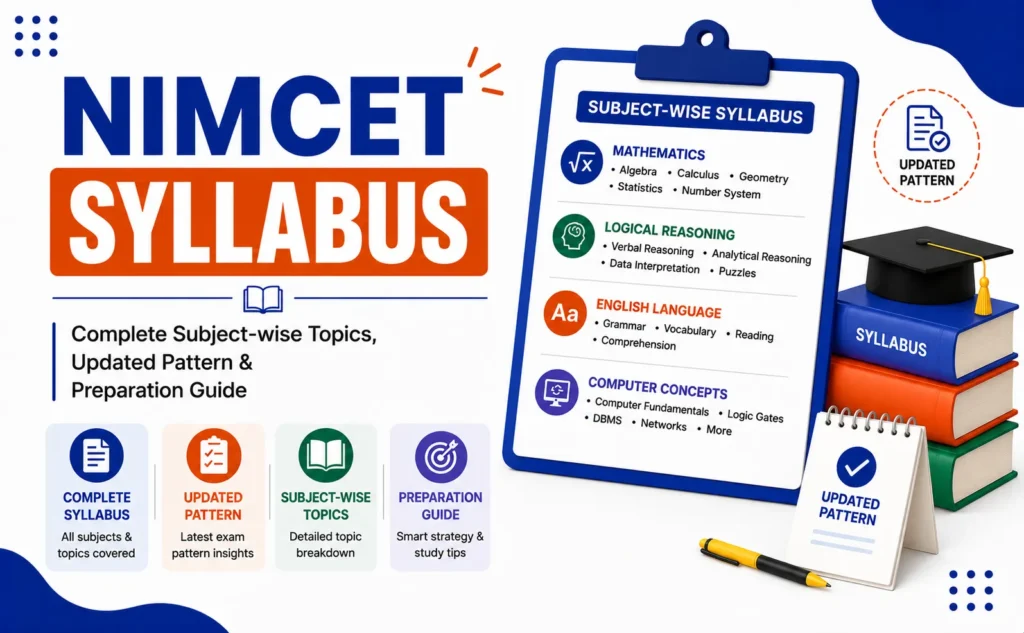
The syllabus is divided into four major sections:
- Mathematics
- Analytical Ability & Logical Reasoning
- Computer Awareness
- General English
Each section evaluates different skills required for pursuing a Master of Computer Applications (MCA) programme. While Mathematics carries the highest weightage, the remaining sections also play a significant role in determining the final score.
Understanding the syllabus enables candidates to prepare systematically instead of relying on guesswork.
NIMCET 2027 Syllabus Overview (Expected)
Based on previous years’ trends, the expected syllabus is summarised below:
| Section | Expected Focus Areas |
| Mathematics | Algebra, Calculus, Coordinate Geometry, Probability, Statistics, Trigonometry, Matrices, Differential Equations |
| Analytical Ability & Logical Reasoning | Series, Coding-Decoding, Blood Relations, Seating Arrangement, Puzzles, Data Interpretation, Syllogism |
| Computer Awareness | Computer Fundamentals, Operating Systems, Programming Basics, DBMS, Networks, Internet, Software & Hardware |
| General English | Grammar, Vocabulary, Reading Comprehension, Sentence Correction, Synonyms & Antonyms |
Candidates should prepare all four sections thoroughly to maximise their overall score.
Mathematics Syllabus
Mathematics is the most important section of the NIMCET examination because it carries the highest weightage in terms of both questions and marks. Strong conceptual understanding and regular practice are essential for scoring well.
The expected Mathematics syllabus includes the following topics:
Algebra
Questions may be asked from:
- Sets and Relations
- Functions
- Complex Numbers
- Quadratic Equations
- Sequences and Series
- Binomial Theorem
- Permutations and Combinations
Algebra forms the foundation for many advanced mathematical concepts, making it an essential topic for preparation.
Calculus
Calculus is another high-weightage area and generally includes:
- Limits
- Continuity
- Differentiation
- Applications of Derivatives
- Integration
- Definite and Indefinite Integrals
- Differential Equations
Candidates should focus on conceptual clarity as well as problem-solving techniques.
Coordinate Geometry
Expected topics include:
- Straight Lines
- Circles
- Conic Sections
- Parabola
- Ellipse
- Hyperbola
Visualising graphs and practicing numerical problems can improve accuracy in this section.
Trigonometry
Important topics include:
- Trigonometric Ratios
- Identities
- Heights and Distances
- Inverse Trigonometric Functions
- Properties of Triangles
Memorising standard identities and practicing applications is recommended.
Probability and Statistics
Candidates should prepare topics such as:
- Probability
- Conditional Probability
- Bayes’ Theorem
- Random Variables
- Mean
- Median
- Mode
- Variance
- Standard Deviation
These concepts frequently appear in competitive examinations and require regular practice.
Matrices and Determinants
This topic generally covers:
- Matrix Operations
- Types of Matrices
- Determinants
- Inverse of Matrix
- Rank of Matrix
- Systems of Linear Equations
Candidates should focus on speed and accuracy while solving matrix-based problems.
Vector Algebra
Expected topics include:
- Vector Operations
- Dot Product
- Cross Product
- Direction Cosines
- Vector Equations
Understanding geometric interpretation can simplify many questions.
Numerical Methods
Candidates should prepare:
- Numerical Approximation
- Error Analysis
- Numerical Integration
- Numerical Differentiation
Although this topic has relatively fewer questions, it can contribute valuable marks.
Analytical Ability & Logical Reasoning Syllabus
This section evaluates logical thinking, analytical skills, and decision-making ability. It is generally considered a scoring section for candidates who practice consistently.
Expected topics include:
Verbal Reasoning
- Coding-Decoding
- Blood Relations
- Direction Sense
- Alphabet Test
- Number Series
- Letter Series
- Analogy
- Classification
- Statement and Conclusion
- Statement and Assumption
Non-Verbal Reasoning
Candidates should prepare:
- Figure Series
- Mirror Images
- Paper Folding
- Embedded Figures
- Pattern Recognition
- Cube and Dice
- Figure Classification
Analytical Reasoning
Important topics include:
- Seating Arrangement
- Ranking
- Order and Arrangement
- Scheduling Problems
- Family Tree
- Logical Puzzles
Data Interpretation
Candidates should practice interpreting:
- Bar Graphs
- Pie Charts
- Line Graphs
- Tables
- Caselets
- Mixed Graphs
Improving calculation speed is essential for this topic.
Computer Awareness Syllabus
The Computer Awareness section assesses a candidate’s understanding of computer fundamentals and basic IT concepts. Candidates from computer science backgrounds may find this section comparatively easier, while others should build a strong conceptual foundation.
The expected syllabus includes the following topics:
Computer Fundamentals
- History of Computers
- Generations of Computers
- Types of Computers
- Input Devices
- Output Devices
- Storage Devices
- Memory Units
Operating Systems
Candidates should understand:
- Functions of Operating Systems
- Windows
- Linux
- File Management
- Process Management
- Memory Management
- Scheduling Concepts
Programming Fundamentals
Important topics include:
- Programming Languages
- Variables
- Data Types
- Operators
- Control Statements
- Loops
- Functions
- Arrays
- Basic Algorithms
Candidates are generally expected to understand programming concepts rather than write lengthy code.
Database Management Systems (DBMS)
Expected topics include:
- Database Concepts
- Relational Model
- SQL Basics
- Keys
- Normalisation
- Transactions
- ER Diagrams
These topics are frequently covered in MCA entrance examinations.
Computer Networks
Candidates should prepare:
- Network Topologies
- OSI Model
- TCP/IP
- Internet Protocols
- LAN
- WAN
- Network Devices
Basic networking concepts are commonly tested in the Computer Awareness section.
Internet and Cyber Security
The syllabus is expected to include:
- Internet Basics
- Web Browsers
- Search Engines
- Cyber Security
- Computer Viruses
- Malware
- Firewalls
- Digital Safety
Understanding these concepts is increasingly important due to the growing role of technology in everyday life.
By covering these subject-wise topics thoroughly and revising them consistently, candidates can build a strong foundation for the NIMCET examination.
General English Syllabus
Although the General English section carries the lowest weightage in NIMCET, it can significantly improve a candidate’s overall score. Since many questions are straightforward, candidates with good language skills can secure valuable marks in a short amount of time.
The expected General English syllabus includes:
Grammar
Candidates should prepare the following topics:
- Parts of Speech
- Tenses
- Articles
- Prepositions
- Subject-Verb Agreement
- Active and Passive Voice
- Direct and Indirect Speech
- Sentence Correction
- Error Detection
Strong grammar fundamentals help candidates answer questions quickly and accurately.
Vocabulary
Vocabulary-based questions generally include:
- Synonyms
- Antonyms
- One-Word Substitutions
- Idioms and Phrases
- Word Usage
- Spellings
Reading newspapers, editorials, and quality magazines regularly can improve vocabulary naturally.
Reading Comprehension
Candidates should practice:
- Passage-based Questions
- Main Idea Identification
- Inference-based Questions
- Vocabulary in Context
- Theme Identification
Developing reading speed and comprehension skills is essential for performing well in this section.
Verbal Ability
Other important topics include:
- Fill in the Blanks
- Sentence Completion
- Para Jumbles
- Sentence Arrangement
- Cloze Test
Regular practice improves both speed and accuracy.
Important High-Weightage Topics for NIMCET 2027
Although every topic mentioned in the syllabus is important, certain chapters have consistently carried higher weightage in previous years.
Mathematics
- Calculus
- Algebra
- Probability
- Matrices
- Coordinate Geometry
- Differential Equations
Analytical Ability & Logical Reasoning
- Seating Arrangement
- Coding-Decoding
- Blood Relations
- Data Interpretation
- Logical Puzzles
- Statement and Conclusion
Computer Awareness
- Computer Fundamentals
- Operating Systems
- Database Management Systems
- Computer Networks
- Programming Basics
- Internet Concepts
General English
- Grammar
- Vocabulary
- Reading Comprehension
- Sentence Correction
Candidates should prioritise these chapters while ensuring that the remaining syllabus is also covered thoroughly.
Has the NIMCET 2027 Syllabus Changed?
As of now, no official changes have been announced regarding the NIMCET 2027 syllabus.
Based on previous years, the syllabus is expected to remain largely unchanged. However, the conducting authority may introduce minor modifications or revise certain topics when the official notification is released.
Candidates are advised to regularly visit the official NIMCET website and stay connected with Tarkashastra for the latest syllabus updates and preparation guidance.
Where to Download the NIMCET 2027 Syllabus PDF?
The official NIMCET 2027 syllabus PDF is expected to be released along with the official notification.
Candidates will be able to access it through the official NIMCET website once it is published.
The syllabus PDF generally contains:
- Complete subject-wise syllabus
- Exam pattern
- Eligibility criteria
- Important instructions
- Other examination-related information
Candidates should always download the syllabus from official sources to ensure accuracy.
How to Prepare Syllabus-Wise for NIMCET 2027
Preparing according to the syllabus helps candidates avoid wasting time on irrelevant topics.
- Start with Mathematics
Since Mathematics carries the highest weightage, candidates should devote the maximum preparation time to this section.
Focus on conceptual clarity before solving advanced-level questions.
- Prepare Reasoning Daily
Logical Reasoning improves with consistent practice rather than memorisation.
Attempt reasoning questions every day to improve speed and analytical thinking.
- Strengthen Computer Fundamentals
Candidates from non-computer backgrounds should first understand basic concepts before moving to advanced topics.
Short notes and concept revision can be highly effective for this section.
- Improve English Regularly
Spend at least 20–30 minutes daily reading newspapers, learning new vocabulary, and practicing grammar exercises.
Consistent practice is more effective than studying English only occasionally.
- Solve Previous Years’ Papers
Previous years’ papers help candidates:
- Understand the examination pattern.
- Identify frequently asked topics.
- Improve time management.
- Analyse strengths and weaknesses.
Candidates should solve papers in a timed environment for the best results.
- Attempt Mock Tests
Mock tests simulate the actual examination and help candidates:
- Build confidence.
- Improve speed.
- Enhance accuracy.
- Learn time management.
- Identify weak areas.
Regular mock test analysis is just as important as attempting the tests themselves.
Subject-wise Preparation Strategy for Maximum Score
- Mathematics Strategy
Mathematics contributes the highest marks in the examination and therefore requires maximum attention. Candidates should begin with fundamental concepts before moving on to advanced problem-solving.
A few effective strategies include:
- Prepare formulas chapter-wise and revise them regularly.
- Solve at least 25–30 numerical problems every day.
- Practise questions from previous years to understand recurring patterns.
- Focus on speed and calculation accuracy.
- Maintain a separate notebook for important formulas and shortcuts.
Candidates should avoid memorising formulas without understanding their applications.
- Analytical Ability & Logical Reasoning Strategy
Logical Reasoning is one of the highest-scoring sections if practised consistently.
Candidates should:
- Solve reasoning puzzles daily.
- Practise coding-decoding and seating arrangement questions regularly.
- Improve logical thinking by solving timed quizzes.
- Analyse mistakes after every mock test.
- Focus on both speed and accuracy.
Even 30–45 minutes of daily reasoning practice can significantly improve performance.
- Computer Awareness Strategy
Many candidates underestimate this section because it contains fewer questions. However, every mark contributes to the final rank.
Preparation tips include:
- Understand computer fundamentals before studying advanced topics.
- Revise Operating Systems and Database Management Systems regularly.
- Learn common networking concepts and Internet terminology.
- Read short notes instead of lengthy textbooks during revision.
- Attempt computer awareness quizzes to improve retention.
Candidates from non-computer backgrounds should begin preparation early to build confidence.
- General English Strategy
General English is often considered the easiest section, but it still requires regular practice.
Candidates should:
- Read English newspapers every day.
- Learn 15–20 new vocabulary words weekly.
- Practise grammar exercises regularly.
- Solve comprehension passages under timed conditions.
- Revise idioms, phrases, and sentence correction questions frequently.
Developing a daily reading habit improves both vocabulary and comprehension.
Common Mistakes to Avoid While Preparing the Syllabus
Many aspirants struggle because they make avoidable mistakes during preparation.
Some common mistakes include:
- Ignoring Mathematics due to its difficulty.
- Studying without understanding the syllabus.
- Neglecting Computer Awareness and English.
- Memorising formulas without understanding concepts.
- Not revising regularly.
- Skipping mock tests.
- Avoiding previous years’ question papers.
- Studying too many books instead of mastering a few reliable resources.
Avoiding these mistakes can significantly improve preparation quality.
How Tarkashastra Helps NIMCET Aspirants
Preparing for NIMCET requires the right strategy, reliable resources, and continuous guidance. Tarkashastra supports aspirants throughout their preparation journey by offering structured learning resources and expert guidance.
Students can benefit from:
- Latest NIMCET notifications and updates.
- Detailed syllabus and exam pattern analysis.
- Subject-wise preparation strategies.
- Previous years’ paper analysis.
- Mock tests and practice questions.
- Study plans and revision techniques.
- Counselling guidance.
- MCA college selection support.
- Expert preparation tips.
With consistent preparation and the right guidance, candidates can significantly improve their chances of securing admission to their preferred NIT.
Conclusion
The NIMCET 2027 Syllabus serves as the foundation for effective preparation. A clear understanding of the subject-wise topics enables candidates to create a focused study plan, prioritise high-weightage chapters, and prepare efficiently for the examination.
Although the official NIMCET 2027 syllabus has not yet been released, it is expected to remain similar to previous years. Candidates should begin their preparation early, revise consistently, solve mock tests, and practice previous years’ papers to strengthen their concepts and improve their performance.
FAQs
1. What is the NIMCET 2027 syllabus?
The NIMCET 2027 syllabus is expected to include four major sections: Mathematics, Analytical Ability & Logical Reasoning, Computer Awareness, and General English. The official syllabus will be released with the notification.
2. Which subjects are included in NIMCET 2027?
The examination is expected to cover Mathematics, Analytical Ability & Logical Reasoning, Computer Awareness, and General English.
3. What topics are important in Mathematics?
Important Mathematics topics include Calculus, Algebra, Coordinate Geometry, Probability, Statistics, Matrices, Differential Equations, Trigonometry, and Vector Algebra.
4. What is included in the Reasoning syllabus?
The Reasoning syllabus generally includes Coding-Decoding, Blood Relations, Seating Arrangement, Direction Sense, Puzzles, Data Interpretation, Statement and Conclusion, Syllogism, and Logical Reasoning.
5. Is Computer Awareness included in NIMCET?
Yes. The Computer Awareness section is expected to include topics such as Computer Fundamentals, Operating Systems, Programming Basics, Database Management Systems, Computer Networks, Internet Concepts, and Cyber Security.
6. What English topics are asked in NIMCET?
The General English section generally covers Grammar, Vocabulary, Reading Comprehension, Sentence Correction, Synonyms, Antonyms, Fill in the Blanks, Idioms and Phrases, and Error Detection.
7. Which chapters have the highest weightage?
Mathematics topics such as Calculus, Algebra, Probability, and Matrices generally carry high weightage. In addition, Seating Arrangement, Coding-Decoding, Database Management Systems, Computer Networks, Grammar, and Reading Comprehension are also considered important.
8. Has the NIMCET syllabus changed?
As of now, no official changes have been announced. The syllabus is expected to remain similar to previous years until the official notification is released.
9. Where can I download the NIMCET 2027 syllabus PDF?
The official NIMCET 2027 syllabus PDF will be available on the official NIMCET website after the release of the notification. Candidates should always download it from official sources.
10. How should I prepare according to the syllabus?
Candidates should begin with Mathematics, practice Logical Reasoning daily, strengthen Computer Awareness concepts, improve English regularly, solve previous years’ papers, take mock tests, revise consistently, and focus on conceptual understanding rather than rote learning.