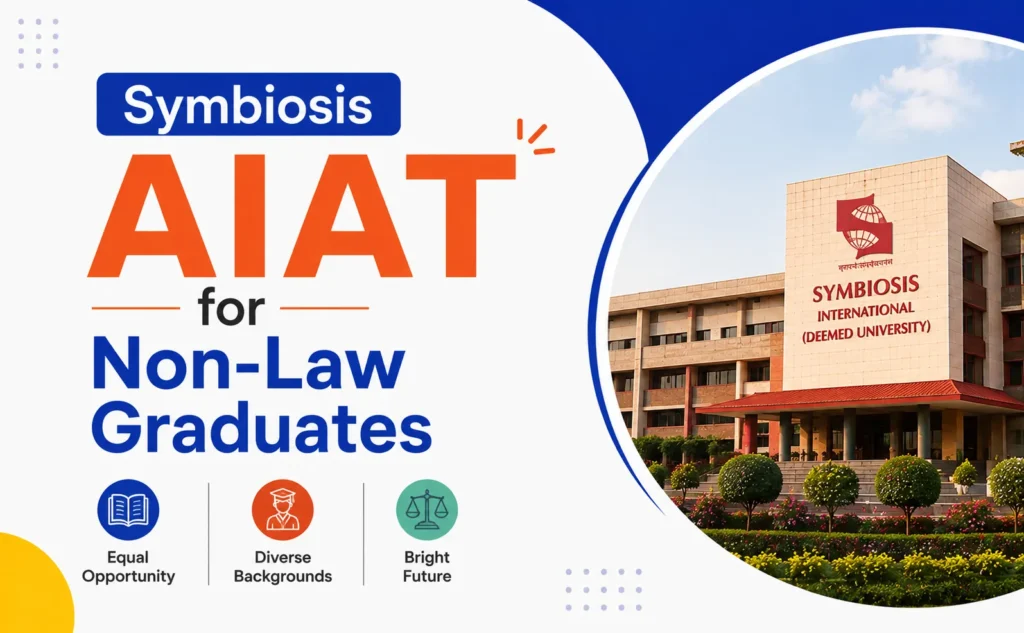
Yes, non-law graduates can apply for Symbiosis AIAT 2027 for admission to the Three-Year LL.B. programme at Symbiosis Law School, Pune, provided they meet the prescribed eligibility criteria. Candidates from engineering, commerce, management, science, humanities and other disciplines are eligible because the programme accepts graduates from any recognised stream.
This guide explains eligibility, the AIAT format, common beginner challenges and a practical preparation strategy for candidates without prior legal education.
Who Is Eligible for Symbiosis AIAT 2027 for the Three-Year LL.B.?
Non-law graduates can apply for the Symbiosis Three-Year LL.B. programme if they have completed an undergraduate degree in any discipline from a recognised institution. Applicants should have secured at least 45% marks, while candidates belonging to the SC or ST category require 40% marks or an equivalent grade.
Candidates awaiting their final qualifying results may also apply, subject to meeting the admission requirements later.
Accepted backgrounds may include:
- BA
- BCom
- BBA
- BSc
- BTech or BE
- BCA
- Other recognised bachelor’s degrees
Are Non-Law Graduates at a Disadvantage in AIAT?
Non-law graduates may face an initial learning curve, especially with legal terminology, principle-based reasoning, socio-legal issues, and structured argument writing. However, AIAT does not require candidates to study an entire LL.B. syllabus before appearing.
The exam focuses on skills such as:
- legal reasoning;
- reading comprehension;
- general knowledge and current affairs;
- analysis of social and legal issues;
- clear written expression.
What Does AIAT Test in Three-Year LL.B. Applicants?
For the Three-Year LL.B. programme, AIAT evaluates a combination of writing ability, legal reasoning, comprehension, general awareness and behavioural consistency.
The test includes:
- Writing Sample: Two subjective questions assessing clarity, structure, argument quality and understanding of social or legal issues.
- Objective Questions: Ten MCQs covering Legal Reasoning, Reading Comprehension, General Knowledge and current affairs.
- Psychometric Test: A separate component designed to assess behavioural responses and consistency.
According to the referenced exam pattern, the Writing Sample carries 40 marks, the objective section carries 20 marks, and the Psychometric Test carries 10 marks, making the examination worth 70 marks in total.
How Should Non-Law Graduates Prepare for Symbiosis AIAT 2027?
Non-law graduates should begin with the exam structure rather than advanced legal theory. The most effective approach is to build foundational legal reasoning, improve reading and writing skills, follow current affairs, and practise under timed conditions.
1. Understand the AIAT Pattern
Review the Writing Sample, Legal Reasoning, Reading Comprehension, General Knowledge and Psychometric Test requirements before creating a study plan.
2. Build Basic Legal Reasoning Skills
Learn how to apply a legal principle to a given set of facts. Focus on understanding the rule, identifying relevant facts and selecting the most logical conclusion.
3. Follow Current Legal and Social Issues
Read reliable newspapers and track important constitutional, judicial, political and social developments. This supports both General Knowledge and subjective writing.
4. Practise Structured Writing
Use a simple format:
- Introduce the issue.
- Present balanced arguments.
- Support them with relevant examples.
- End with a clear conclusion.
5. Improve Reading Comprehension
Practise identifying the main argument, tone, assumptions, inference, and supporting evidence in editorials and long-form articles.
6. Attempt Timed Mock Tests
Analyse every mock for conceptual errors, weak arguments, slow reading, and poor time allocation. Experts also recommend using mock tests and previous papers to understand question framing and improve speed.
How Can Your Non-Law Background Become an Advantage?
A non-law degree can give you valuable transferable skills for Symbiosis AIAT 2027. The key is to connect your academic or professional experience with the abilities tested in the Three-Year LL.B. admission process.
| Graduation Background | Transferable Strength |
| Engineering | Logical reasoning and problem-solving |
| Commerce | Business, finance and commercial awareness |
| Management | Communication and corporate understanding |
| Humanities | Critical reading and structured writing |
| Science | Evidence-based analysis and research |
| Work experience | Practical judgement and professional maturity |
For example, an engineering graduate may use analytical thinking in Legal Reasoning, while a commerce graduate may understand corporate or financial issues more quickly.
Common Preparation Mistakes Non-Law Graduates Should Avoid
Non-law graduates often lose marks not because they lack legal knowledge, but because their preparation is unfocused.
Avoid these common mistakes:
- Treating AIAT as a memory-based law examination
- Ignoring the Writing Sample until the final weeks
- Reading legal concepts without practising application-based questions
- Depending only on static General Knowledge
- Collecting too many books and resources
- Delaying mock tests and timed practice
- Writing one-sided answers on socio-legal issues
- Assuming a non-law background is automatically a disadvantage
How Tarkashastra Helps Non-Law Graduates Prepare for AIAT
Non-law graduates often need structured support to understand legal reasoning, organise current affairs and develop strong subjective answers. Tarkashastra addresses these gaps through focused preparation for the Symbiosis Three-Year LL.B. entrance process.
Students receive support through:
- beginner-friendly legal reasoning lessons;
- Writing Sample practice and feedback;
- current-affairs and socio-legal issue preparation;
- sectional and full-length mock tests;
- performance analysis and error tracking;
- Personal Interaction guidance.
Related Blogs You Should Read
- Symbiosis AIAT 2027: Complete Exam Guide
- Symbiosis AIAT 2027 Registration Process Explained
- Symbiosis AIAT 2027 Eligibility Criteria for 3-Year LLB
- Symbiosis AIAT 2027 Exam Pattern & Marking Scheme
- Symbiosis AIAT 2027 Syllabus: Section-Wise Analysis
- Symbiosis AIAT 2027 Preparation Strategy for Beginners
- Best Books for Symbiosis AIAT 2027 Preparation
- Symbiosis AIAT 2027 Writing Sample: Tips & Topics
- Symbiosis AIAT 2027 Psychometric Test Guide
- What Is a Good Score in Symbiosis AIAT 2027
- Symbiosis AIAT 2027 Selection Process Explained
- Symbiosis AIAT 2027 Merit List & Counselling Process
- Symbiosis AIAT 2027 Previous Year Paper Analysis
Conclusion: A Non-Law Background Should Not Stop Your AIAT Journey
A non-law background does not prevent you from pursuing the Three-Year LL.B. at Symbiosis Law School, Pune. Graduates from recognised disciplines can apply if they meet the eligibility criteria, and prior legal education is not compulsory.
With focused practice in Legal Reasoning, Writing Sample questions, Reading Comprehension, current affairs and mock tests, beginners can build the skills needed for AIAT.
Explore Tarkashastra’s AIAT courses, mock tests and counselling support to create a structured preparation plan.
Frequently Asked Questions
1. Can non-law graduates apply for Symbiosis AIAT 2027?
Yes, graduates from any recognised discipline can apply for the Three-Year LL.B. programme, provided they meet the prescribed eligibility requirements.
2. Is a previous law degree required for Symbiosis AIAT?
No, candidates do not need a previous law degree. The Three-Year LL.B. programme is designed for graduates from different academic backgrounds.
3. Can engineering graduates apply for Symbiosis AIAT 2027?
Yes, engineering graduates can apply if they have completed a recognised bachelor’s degree and secured the required minimum marks.
4. Can BCom, BBA, BA and BSc graduates appear for AIAT?
Yes, graduates from commerce, management, humanities, science and other recognised streams are eligible to apply for the Three-Year LL.B.
5. Is AIAT difficult for candidates without a legal background?
AIAT may initially appear challenging, but non-law graduates can prepare effectively by developing legal reasoning, comprehension, writing and current-affairs skills.
6. How much legal knowledge is required before starting AIAT preparation?
No advanced legal knowledge is required at the beginning. Candidates should first learn basic legal terminology and practise applying principles to factual situations.
7. Do non-law graduates need to study the complete LL.B. syllabus?
No, aspirants should focus on the prescribed AIAT areas rather than studying the entire LL.B. curriculum before the examination.
8. Can a non-law graduate clear AIAT through self-study?
Yes, self-study can be effective when supported by reliable resources, regular answer writing, current affairs revision, and timed mock-test practice.
9. Does the graduation stream affect AIAT selection?
The graduation stream does not determine selection. Candidates are assessed through their performance in the prescribed admission stages and fulfilment of eligibility conditions.
10. How can previous work experience help during the admission process?
Work experience can demonstrate maturity, communication ability, professional judgement and a clear motivation for pursuing law during the Personal Interaction stage.