Introduction
The CLAT 2028 reservation policy is one of the most important factors that determines admission into India’s top National Law Universities (NLUs). With increasing competition every year, understanding the c reservation criteria, CLAT seat reservation system, and NLU reservation policy has become essential for every law aspirant.
CLAT is not only about scoring high marks; it is equally about understanding how the CLAT quota system allocates seats across different categories such as SC, ST, OBC, EWS, and other horizontal reservations. These category-wise divisions directly impact final admissions during counselling and significantly influence cut-off ranks.
Since each NLU follows its own admission structure under the broader CLAT admission policy, knowing the category wise seats in CLAT helps students make realistic and strategic choices while filling preferences.
In short, mastering the CLAT 2028 reservation policy is crucial for smart counselling, better college selection, and maximizing chances of securing a top NLU seat.
Overview of CLAT Reservation System
The CLAT 2028 reservation policy follows a structured system designed to ensure fair representation while maintaining merit-based selection in National Law Universities (NLUs). The CLAT reservation criteria are implemented through multiple layers that collectively form the CLAT seat reservation system.
Broadly, CLAT admissions are divided into four key components:
🔹 CLAT Reservation Structure
| Reservation Type | Categories Included |
| Vertical Reservation | SC, ST, OBC (NCL), EWS |
| Horizontal Reservation | PwD, Female candidates, Defence quota |
| State/Domicile Quota | Reserved seats for home-state candidates |
| Supernumerary Seats | NRI, Foreign Nationals, Special categories |
As per the official structure of NLUs, reservation rules vary slightly across universities under the broader NLU reservation policy framework .
This layered system forms the backbone of the CLAT quota system, directly influencing category wise seats in CLAT and shaping admission outcomes during counselling.
Understanding this structure is essential for decoding the CLAT admission policy and planning an effective NLU preference list.
Vertical Reservation in CLAT 2028
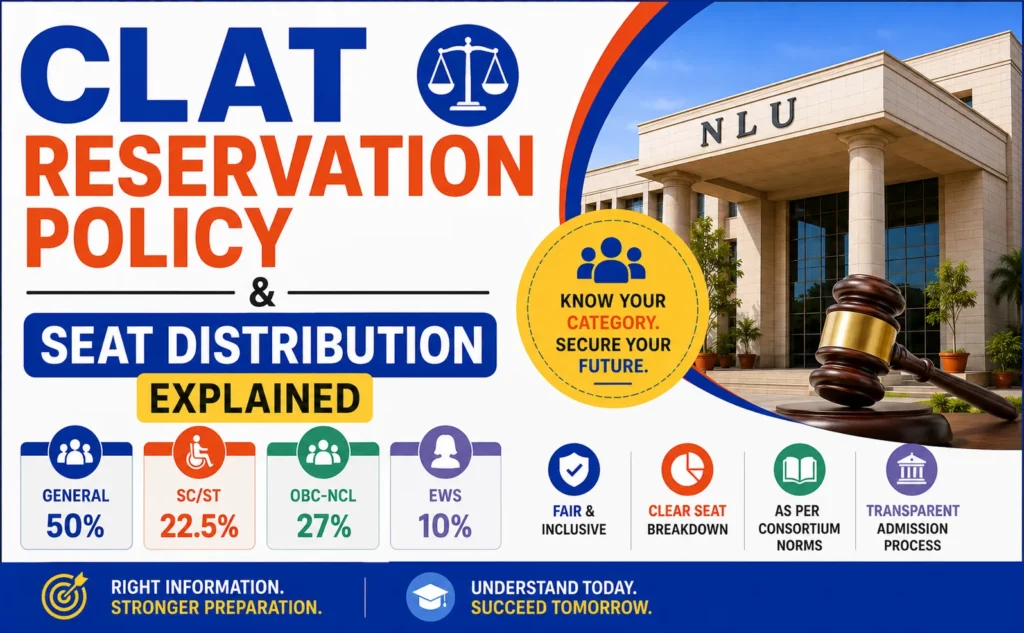
The CLAT 2028 reservation policy is primarily built on a strong vertical reservation structure, which divides seats among major social and economic categories. This system plays a crucial role in shaping the CLAT seat reservation system and directly impacts admission chances across NLUs.
Under the CLAT reservation criteria, vertical reservation is applied uniformly (with minor variations) across participating National Law Universities as part of the broader NLU reservation policy.
🔹 Vertical Reservation Breakdown
| Category | Reservation % | Description |
| SC | 15% | Scheduled Castes reservation |
| ST | 7.5% | Scheduled Tribes reservation |
| OBC (NCL) | Up to 27% | Non-Creamy Layer OBC candidates |
| EWS | 10% | Economically Weaker Sections |
This structure forms the backbone of sc st reservation CLAT, obc reservation CLAT, and ews reservation CLAT, ensuring balanced representation across categories.
Each category has its own merit list, meaning candidates compete only within their respective groups under the CLAT quota system. For example, an OBC candidate is evaluated only against other OBC candidates, not the General category.
This segmentation significantly influences the category wise seats in CLAT, cut-off trends, and final admission outcomes under the CLAT admission policy. Understanding this structure is essential for realistic college prediction and counselling strategy.
Horizontal Reservation in NLUs
The CLAT 2028 reservation policy also includes an important layer called horizontal reservation, which operates across all vertical categories such as SC, ST, OBC, EWS, and General. Unlike vertical reservations, these do not form separate categories but instead cut across the existing CLAT seat reservation system.
Horizontal reservation is a key part of the NLU reservation policy and ensures additional support for specific groups.
🔹 Major Horizontal Reservation Categories
- PwD (Persons with Disabilities): 3–5% seats across NLUs
- Female Candidates: 20–30% reservation in select NLUs
- Defence Quota: Wards of defence personnel
- Other Special Categories: As per individual NLU policies
As per official reservation guidelines, these categories are applied alongside vertical quotas, meaning a candidate may belong to both SC and PwD or OBC and female categories simultaneously .
This structure significantly impacts the CLAT quota system, as it reduces competition within specific groups and influences the final category wise seats in CLAT. Understanding horizontal reservation is essential for accurately analyzing admission chances under the CLAT admission policy.
State Quota & Domicile Reservations
The CLAT 2028 reservation policy includes an important component known as the state quota or domicile reservation. This system reserves a portion of seats in several National Law Universities (NLUs) for candidates belonging to the home state, making it a key factor in the CLAT seat reservation system.
State NLUs such as MNLU Mumbai and NLU Odisha reserve seats specifically for domiciled candidates, which significantly impacts the NLU category distribution and admission chances.
🔹 Key Points on Domicile Reservation
- Applicable mainly in state-funded NLUs
- Reserved seats for home-state candidates
- Lower cut-offs compared to All India seats
- Highly impactful in competitive NLUs
As part of the broader NLU reservation policy, domicile quotas are designed to ensure regional representation in legal education .
This system is a major advantage for local candidates and plays a critical role in shaping the CLAT quota system. It directly influences preference filling strategy under the CLAT admission policy, especially for students targeting top state NLUs.
Supernumerary Seats in CLAT
The CLAT 2028 reservation policy also includes supernumerary seats, which are additional seats created over and above the regular intake in National Law Universities (NLUs). These seats do not affect the standard CLAT seat reservation system and are allotted under special categories.
🔹 Types of Supernumerary Seats
- NRI / NRI-sponsored seats
- Foreign National seats
- Kashmiri Migrant quota
- Wards of Freedom Fighters (in select NLUs)
- Other special categories depending on individual NLU reservation policy
These seats are not part of the regular CLAT quota system, meaning they are created separately and do not reduce seats available for General, SC, ST, OBC, or EWS candidates.
Understanding supernumerary seats helps students get a clearer picture of the overall NLU category distribution and the complete CLAT admission policy framework.
Document Requirements & Counselling Process
The CLAT 2028 reservation policy requires candidates to submit valid and verifiable documents during counselling to claim their category-based benefits under the CLAT seat reservation system. Without proper documentation, candidates may lose eligibility for reserved seats.
🔹 Key Requirements
- Caste certificate (SC/ST/OBC)
- EWS certificate (valid income proof)
- PwD certificate (authorized medical board)
- Domicile certificate (for state quota seats)
As per the official NLU reservation policy, all documents must be verified during counselling rounds .
Incorrect or missing documents can directly affect allotment under the CLAT quota system, making verification a crucial step in the CLAT admission policy process.
How Tarkashastra Helps CLAT Aspirants
Understanding the CLAT 2028 reservation policy and the complex CLAT seat reservation system can be confusing for many students. This is where structured guidance becomes extremely important.
Tarkashastra Academy helps CLAT aspirants simplify the entire CLAT admission policy by providing expert mentorship, updated exam strategies, and personalized counselling support.
🔹 How Tarkashastra Supports Students
- Clear explanation of CLAT reservation criteria and NLU-wise seat distribution
- Guidance on category wise seats in CLAT for better preference filling
- Strategy sessions for maximizing chances in top NLUs
- Mock counselling simulations based on real NLU reservation policy
- Updated insights on CLAT quota system and changing admission trends
With expert faculty and data-driven preparation methods, Tarkashastra ensures students do not just prepare for CLAT but also understand how to convert rank into a top NLU seat effectively.
This makes it easier for aspirants to navigate the CLAT 2028 reservation policy strategically rather than just theoretically.
Related Blogs
- CLAT 2028 Syllabus: Topics, Weightage & Preparation Strategy
- Is CLAT 2028 Tough? Difficulty Level, Competition & Expert Analysis
- CLAT 2028 Complete Guide: Exam Pattern, Syllabus, Dates & Preparation Tips
Conclusion
The CLAT 2028 reservation policy plays a crucial role in shaping admissions across National Law Universities. From CLAT reservation criteria to NLU reservation policy, every layer of the system impacts final seat allocation and cut-off ranks.
A clear understanding of the CLAT seat reservation system, category wise seats in CLAT, and the CLAT quota system helps aspirants make smarter counselling decisions. Instead of confusion, informed planning can significantly improve NLU admission outcomes under the CLAT admission policy.
Ultimately, strategy matters as much as preparation.
FAQs
1. What is the CLAT 2028 reservation policy?
The CLAT 2028 reservation policy is the system through which seats in participating National Law Universities (NLUs) are allocated based on categories such as SC, ST, OBC (NCL), EWS, PwD, domicile, and other special quotas. It ensures fair representation while maintaining merit-based admissions.
2. What are the different types of reservations available in CLAT 2028?
CLAT 2028 includes four major reservation categories:
- Vertical Reservation (SC, ST, OBC, EWS)
- Horizontal Reservation (PwD, Female, Defence, etc.)
- State/Domicile Reservation
- Supernumerary Seats (NRI, Foreign Nationals, Kashmiri Migrants, etc.)
3. Does every NLU follow the same reservation policy?
No. While all NLUs follow the overall CLAT reservation framework, each university may have its own domicile quota, horizontal reservations, and special category policies. Candidates should check the reservation rules of their preferred NLU before counselling.
4. What is the difference between vertical and horizontal reservation in CLAT?
Vertical reservation is based on social and economic categories like SC, ST, OBC, and EWS. Horizontal reservation applies across all categories and includes reservations for PwD candidates, female candidates, defence wards, and other eligible groups.
5. How does domicile reservation affect CLAT admissions?
Several state-funded NLUs reserve seats for candidates who belong to their home state. These domicile reservations often result in lower cut-offs for eligible candidates, increasing their chances of admission.
6. What are supernumerary seats in CLAT?
Supernumerary seats are additional seats created over and above the regular intake. These are generally reserved for categories such as NRI/NRI-sponsored candidates, foreign nationals, Kashmiri migrants, and other special categories, depending on the NLU.
7. Which documents are required to claim reservation benefits during CLAT counselling?
Candidates must submit valid supporting documents such as caste certificates, EWS certificates, PwD certificates, domicile certificates, or any other category-specific documents during counselling. Failure to provide valid documents may result in the loss of reservation benefits.
8. Does reservation affect CLAT cut-offs?
Yes. Since each reservation category has its own merit list and seat allocation, cut-off ranks vary across categories. Reservation policies significantly influence admission chances and counselling outcomes.
9. Can a candidate claim both vertical and horizontal reservation?
Yes. A candidate can belong to a vertical category (such as OBC or SC) and simultaneously qualify for a horizontal reservation (such as PwD or Female), provided they meet the eligibility criteria.
10. Why is understanding the CLAT reservation policy important before counselling?
Understanding the CLAT reservation policy helps candidates make informed preference choices, estimate realistic admission chances, and develop an effective counselling strategy based on category-wise seat availability and NLU-specific reservation rules.