Introduction
The competition for CLAT 2028 general category seats is expected to be tougher than ever, as thousands of aspirants compete for admission into India’s top National Law Universities (NLUs). These limited general category seats in NLUs play a decisive role in shaping admission outcomes, making it essential for students to understand the complete CLAT seat matrix general category before counselling begins.
CLAT is not just about scoring a good rank—it is equally about understanding how CLAT seat distribution, reservation policies, and NLU-wise intake affect your final admission chances. Since each NLU follows its own seat structure, the availability of NLU general seats varies significantly across institutions.
A clear understanding of NLU admission general category trends helps aspirants make smarter choices during counselling. In this blog, we break down CLAT 2028 general category seats with a detailed NLU-wise analysis and practical strategy insights.
What Are General Category Seats in CLAT?
The CLAT 2028 general category seats refer to Unreserved (UR) or Open category seats across National Law Universities, which are filled purely on merit through CLAT rankings. These seats are not reserved under any quota such as SC, ST, OBC, or EWS, making them the most competitive segment in the entire admission process.
Unlike reserved categories, CLAT open category seats are available to all candidates, which significantly increases competition during counselling. However, the actual number of general category seats in NLUs is influenced by factors like domicile reservations and institutional policies, which often reduce All India availability.
This is why understanding category wise seats CLAT and their distribution is critical. A proper grasp of how NLU general seats are allocated helps students plan preferences strategically and improve their chances of securing admission in top law universities.
CLAT Seat Matrix General Category Overview
The CLAT seat matrix general category forms the backbone of understanding admission chances in National Law Universities. Across all participating NLUs, there are approximately 4000+ undergraduate law seats, out of which nearly 1700–1800 seats fall under the CLAT 2028 general category seats pool.
However, this number is not evenly distributed, and varies significantly from one NLU to another.
The structure of CLAT seat distribution is influenced by multiple factors such as domicile reservations, institutional capacity, and state-wise policies. As a result, the actual number of NLU general seats available for All India candidates is often lower than expected in several top universities.
📊 Overview of CLAT General Category Seats
| Parameter | Approximate Count |
| Total UG Seats (All NLUs) | 4000+ |
| General Category Seats | 1700–1800 |
| Reserved Categories | Remaining seats |
Understanding the CLAT seat allocation system is essential for building a realistic admission strategy during counselling.
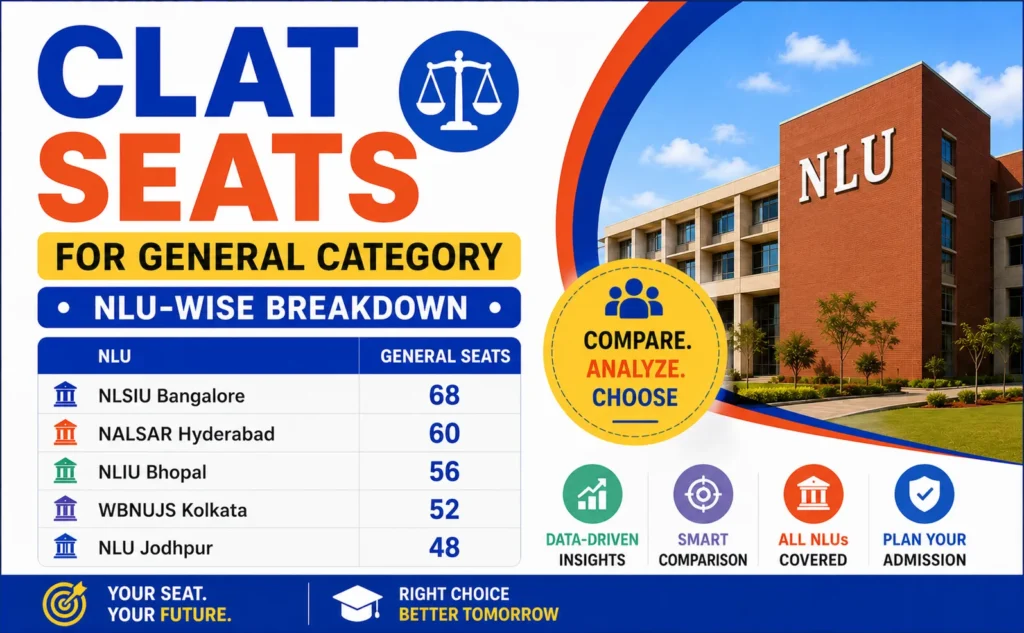
NLU-Wise Breakdown of General Category Seats
The distribution of CLAT 2028 general category seats varies widely across National Law Universities, making the NLU-wise breakup one of the most critical aspects of admission planning. While some NLUs offer relatively higher intake, top-ranked institutions have limited general category seats in NLUs, which significantly increases competition.
🔴 Top NLUs (Extremely High Competition)
Top NLUs account for the most sought-after NLU general seats, but the availability is very limited compared to demand.
| NLU | General Seats (Approx.) |
| NLSIU Bangalore | 120–130 |
| NALSAR Hyderabad | 60–70 |
| WBNUJS Kolkata | 90–100 |
| NLU Jodhpur | 80–90 |
| GNLU Gandhinagar | 75–85 |
| NLIU Bhopal | 75–85 |
These institutions attract the highest scorers in CLAT. Due to limited CLAT open category seats, cut-offs for these NLUs remain extremely high every year, often requiring top ranks.
🟡 Mid-Tier NLUs (Balanced Competition)
Mid-tier NLUs offer a relatively better balance between seat availability and competition in the CLAT seat matrix general category.
| NLU | General Seats (Approx.) |
| RMLNLU Lucknow | 75–85 |
| HNLU Raipur | 85–95 |
| MNLU Mumbai | 25–35 |
| MNLU Nagpur | 45–55 |
| CNLU Patna | 50–60 |
| NUSRL Ranchi | 80–90 |
These universities form the core of CLAT admission seats where candidates with moderate ranks (1500–6000 range) often secure admission depending on counselling rounds and seat movement.
🟢 Lower / Emerging NLUs (Better Accessibility)
Lower-tier NLUs provide comparatively more accessible opportunities within the CLAT seat distribution framework.
| NLU | General Seats (Approx.) |
| NLUJA Assam | 55–65 |
| DSNLU Visakhapatnam | 50–60 |
| TNNLU Trichy | 30–40 |
| HPNLU Shimla | 120–140 |
| DNLU Jabalpur | 50–60 |
These institutions play an important role for students aiming for NLU admission general category seats beyond top-tier options, especially in later counselling rounds.
Factors Affecting CLAT General Category Seats
- Domicile Reservation Impact
- Many NLUs reserve 25%–50% seats for state domicile candidates
- This directly reduces NLU general seats available for All India students
- Total Intake Variations
- Seat numbers differ across NLUs based on institutional capacity
- Expansion or reduction of seats changes CLAT 2028 general category seats annually
- New NLUs & Seat Expansion
- Introduction of new NLUs increases total seats but may not proportionally increase general category seats in NLUs
- Supernumerary Seats
- NRI, foreign nationals, and special quotas add extra seats
- These usually do not improve CLAT open category seats availability significantly
- Policy Changes by Consortium
- CLAT conducting body updates reservation rules and seat structures
- This affects CLAT seat matrix general category every academic cycle
- Year-to-Year Variation
- Cut-offs and seat distribution fluctuate based on applicant pool and difficulty level
- Impacts final CLAT seat allocation trends during counselling
About Tarkashastra – How It Helps CLAT Aspirants
Tarkashastra is a leading entrance exam coaching institute in Pune, specializing in CLAT, IPMAT, MBA CET, and other competitive exams. For students targeting CLAT 2028 general category seats, Tarkashastra provides a structured preparation system focused on legal reasoning, reading comprehension, and exam strategy building.
The institute helps aspirants understand complex topics while also guiding them through CLAT seat matrix general category, counselling strategy, and NLU admission general category planning. Regular mock tests, performance analysis, and personalized mentoring ensure students improve consistently.
What makes Tarkashastra valuable is its result-oriented approach that combines concept clarity with real exam strategy, helping students maximize their chances of securing general category seats in NLUs through smarter preparation and better decision-making.
Related Blogs
- CLAT 2028 Syllabus: Topics, Weightage & Preparation Strategy
- Is CLAT 2028 Tough? Difficulty Level, Competition & Expert Analysis
- CLAT 2028 Complete Guide: Exam Pattern, Syllabus, Dates & Preparation Tips
Conclusion
The CLAT 2028 general category seats remain the most competitive pathway for admission into India’s top National Law Universities. With limited general category seats in NLUs and rising competition each year, students must go beyond rank and understand the full CLAT seat matrix general category and counselling dynamics.
A clear understanding of CLAT seat distribution and NLU admission general category trends helps aspirants make smarter preference choices during counselling. Ultimately, success in CLAT depends on both preparation and strategic decision-making, especially in navigating CLAT seat allocation across different NLUs to secure the best possible outcome.
FAQs
1. How many General Category seats are available through CLAT 2028?
The exact number will be announced in the official CLAT 2028 seat matrix released by the Consortium of NLUs.
2. Which NLU offers the highest number of General Category seats?
The number of General Category seats varies by NLU and is specified in the official seat matrix each year.
3. How are General Category seats allocated?
General Category seats are allotted based on CLAT rank, candidate preferences, reservation rules, and seat availability during counselling.
4. Do domicile reservations reduce General Category seats?
Yes, domicile reservations may reduce the number of open General Category seats available at some NLUs.
5. What rank is required for General Category admission?
The required rank depends on the NLU, category, seat availability, and the year’s cutoff trends.
6. Are EWS seats separate from General Category seats?
Yes, EWS seats are reserved separately for eligible Economically Weaker Section candidates.
7. How competitive are General Category seats?
General Category seats are highly competitive due to a large number of applicants and limited seat availability.
8. Which NLUs are easiest to get for General Category candidates?
The easier NLUs vary each year based on cutoffs, seat intake, and counselling trends.
9. How does seat availability affect cutoff ranks?
Higher seat availability generally leads to comparatively lower cutoff ranks, while fewer seats increase competition.
10. Can General Category candidates apply under multiple quotas?
Yes, eligible candidates can claim applicable quotas such as domicile or EWS, subject to the NLU’s admission rules.