Introduction
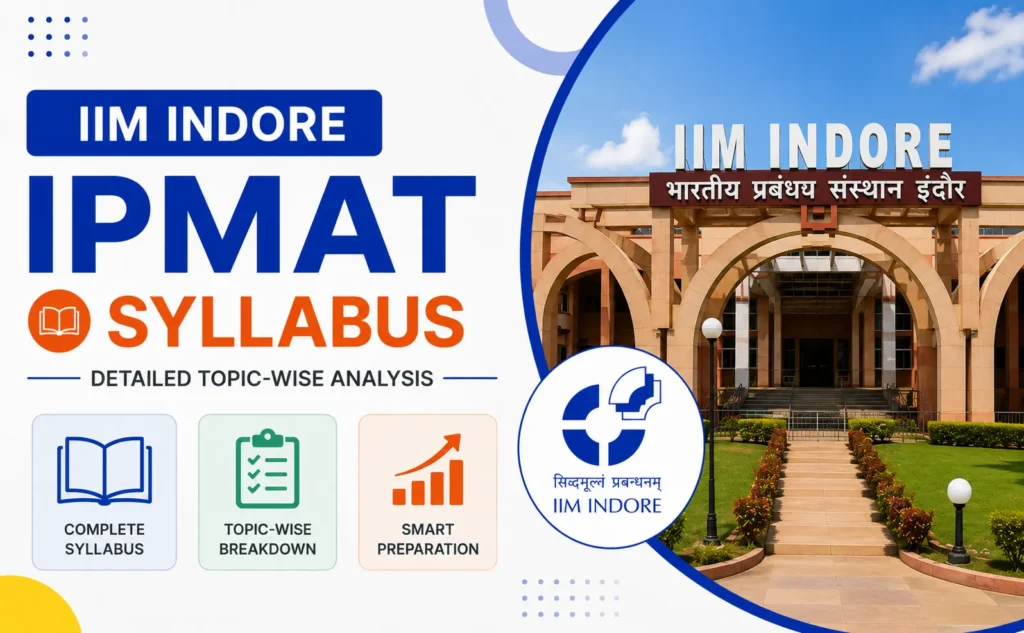
The Integrated Program in Management Aptitude Test (IPMAT) conducted by IIM Indore is one of the most sought-after entrance examinations for students aspiring to begin their management education immediately after Class 12. Every year, thousands of students compete for a limited number of seats, making the examination highly competitive.
A clear understanding of the IIM Indore IPMAT Syllabus 2028 is essential for success. Unlike board examinations that focus primarily on academic knowledge, IPMAT tests aptitude, reasoning ability, problem-solving skills, language proficiency, and time management.
Many students begin preparation without fully understanding the syllabus, often spending excessive time on low-priority topics while neglecting high-weightage areas. This comprehensive guide will help you understand the complete IPMAT Indore syllabus, identify important topics, and build an effective preparation roadmap.
Overview of IIM Indore IPMAT 2028
The Integrated Programme in Management (IPM) at IIM Indore is a five-year management program designed for students who wish to pursue management education immediately after higher secondary education.
Admission is primarily based on performance in IPMAT, followed by the selection process conducted by IIM Indore.
Before starting preparation, candidates should understand both the IPMAT syllabus and the examination pattern.
IIM Indore IPMAT Exam Pattern 2028
Understanding the IPMAT exam pattern helps students align their preparation with the actual examination structure.
Expected Exam Pattern
| Section | Question Type | Expected Questions |
| Quantitative Aptitude (Short Answer) | Non-MCQ | 15 |
| Quantitative Aptitude (MCQ) | MCQ | 30 |
| Verbal Ability | MCQ | 45 |
Key Highlights
- Computer-Based Test (CBT)
- Duration: Approximately 120 minutes
- Multiple sections with sectional timing
- Negative marking applicable for MCQs
- No negative marking for short-answer questions
Candidates should note that IIM Indore may make minor modifications to the pattern. Therefore, students should regularly monitor official notifications while preparing.
Complete IIM Indore IPMAT Syllabus 2028
The IPMAT syllabus broadly consists of two major sections:
- Quantitative Aptitude
- Verbal Ability
Unlike many competitive examinations, there is no officially published syllabus document. However, based on previous years’ examinations, a detailed IPMAT topic-wise syllabus can be identified.
Quantitative Aptitude Syllabus
The Quantitative Aptitude syllabus forms the most challenging section for many aspirants.
This section evaluates mathematical understanding, analytical thinking, and problem-solving ability.
Arithmetic
Arithmetic consistently contributes a significant portion of the examination.
Important topics include:
- Percentage
- Profit and Loss
- Simple Interest
- Compound Interest
- Ratio and Proportion
- Partnership
- Average
- Mixtures and Alligation
- Time and Work
- Pipes and Cisterns
- Time, Speed, and Distance
- Boats and Streams
Why Arithmetic Matters
Arithmetic is considered one of the highest-scoring areas because
- Concepts are straightforward.
- Questions are frequently repeated in different formats.
- Calculation speed can be improved with practice
Algebra
Algebra is one of the highest-weightage areas in the IIM Indore IPMAT Syllabus 2028.
Important topics include:
- Linear Equations
- Quadratic Equations
- Inequalities
- Functions
- Logarithms
- Progressions
- Polynomials
- Modulus
- Exponents
- Surds and Indices
Expected Weightage
Algebra often contributes a substantial percentage of quantitative questions.
Students targeting high scores should prioritize this area.
Number System
The number system serves as the foundation for several advanced mathematical topics.
Important topics include:
- Divisibility Rules
- Factors and Multiples
- Prime Numbers
- HCF and LCM
- Remainders
- Cyclicity
- Unit Digits
- Base Systems
- Integers
Preparation Tip
Mastering number system concepts improves performance across multiple quantitative topics.
Geometry
Geometry requires conceptual clarity and visualization skills.
Important topics include:
- Lines and Angles
- Triangles
- Circles
- Quadrilaterals
- Polygons
- Coordinate Geometry
- Mensuration
- Area Calculations
- Volume Calculations
Common Challenge
Many students avoid geometry because of its theoretical nature. However, it frequently appears in the examination and should not be ignored.
Modern Mathematics
Modern mathematics has gained importance in recent IPMAT examinations.
Important topics include:
- Permutations and Combinations
- Probability
- Set Theory
- Venn Diagrams
- Binomial Theorem
These topics often produce direct and formula-based questions.
Data Interpretation
Although not always a dominant area, data interpretation remains important.
Topics include:
- Tables
- Bar Graphs
- Pie Charts
- Line Graphs
- Caselets
Students should focus on calculation speed and data analysis techniques.
Quantitative Aptitude Topic-Wise Syllabus Summary
| Topic | Importance Level |
| Arithmetic | Very High |
| Algebra | Very High |
| Number System | High |
| Geometry | High |
| Modern Mathematics | Medium to High |
| Data Interpretation | Medium |
Verbal Ability Syllabus
The Verbal Ability section evaluates reading skills, vocabulary, grammar, and language comprehension.
Many students underestimate this section despite its significant contribution to overall scores.
Reading Comprehension
Reading comprehension is one of the most important components of the verbal ability syllabus.
Students may encounter passages related to:
- Business
- Economics
- Technology
- Science
- Social Issues
- Literature
Skills Required
- Inference making
- Main idea identification
- Tone recognition
- Critical reasoning
Vocabulary
Vocabulary-based questions test word knowledge and contextual understanding.
Important areas include:
- Synonyms
- Antonyms
- Word Usage
- One-Word Substitution
- Foreign Words
- Idioms and Phrases
Preparation Strategy
Reading newspapers, magazines, and quality articles daily significantly improves vocabulary.
Grammar
Grammar remains a consistent component of the examination.
Important topics include:
- Parts of Speech
- Subject-Verb Agreement
- Tenses
- Prepositions
- Conjunctions
- Articles
- Sentence Correction
- Error Detection
Strong grammar fundamentals directly improve verbal scores.
Para Jumbles
Candidates are required to arrange jumbled sentences into a logical sequence.
Skills tested include:
- Logical flow
- Paragraph structure
- Transition recognition
Sentence Completion
Questions may involve:
- Filling blanks
- Contextual word usage
- Sentence logic
This area combines grammar and vocabulary skills.
Critical Reasoning
Critical reasoning has become increasingly important in aptitude examinations.
Topics include:
- Assumptions
- Conclusions
- Arguments
- Strengthening Statements
- Weakening Statements
Verbal Ability Topic-Wise Syllabus Summary
| Topic | Importance Level |
| Reading Comprehension | Very High |
| Vocabulary | High |
| Grammar | High |
| Para Jumbles | Medium |
| Sentence Completion | Medium |
| Critical Reasoning | Medium to High |
IPMAT Important Topics Based on Previous Trends
Certain important topics consistently appear across examinations.
Quantitative Aptitude
High-priority topics include:
- Arithmetic
- Algebra
- Number System
- Geometry
- Probability
- Permutation and Combination
Verbal Ability
High-priority topics include:
- Reading Comprehension
- Vocabulary
- Grammar
- Critical Reasoning
Students should ensure mastery of these areas before moving to lower-priority topics.
Topic-Wise Preparation Strategy for IPMAT 2028
A structured IPMAT preparation strategy helps maximize efficiency.
Phase 1: Concept Building
Duration: First 4-5 Months
Focus on:
- Basic concepts
- Formula learning
- Grammar fundamentals
- Vocabulary development
Phase 2: Practice and Application
Duration: Next 4 Months
Focus on:
- Topic-wise practice
- Timed exercises
- Sectional tests
- Accuracy improvement
Phase 3: Mock Test Preparation
Duration: Final 4-5 Months
Focus on:
- Full-length mocks
- Time management
- Performance analysis
- Strategy optimization
Suggested IPMAT Study Plan for 2028 Aspirants
An effective IPMAT study plan should balance quantitative aptitude and verbal ability.
Daily Study Schedule
| Activity | Time |
| Quantitative Aptitude | 2 Hours |
| Verbal Ability | 1.5 Hours |
| Reading Practice | 30 Minutes |
| Vocabulary Building | 20 Minutes |
| Mock/Test Analysis | 30 Minutes |
Consistency is more important than studying long hours occasionally.
Importance of Mock Tests Alongside the Syllabus
Completing the syllabus alone does not guarantee success.
Students should regularly attempt the following:
- Sectional tests
- Topic tests
- Full-length mocks
Platforms such as Tarkashastra provide structured mock tests, topic-wise assessments, and performance tracking that help students convert preparation into actual exam performance.
IPMAT Syllabus vs. IPMAT Rohtak Syllabus
Many students wonder whether both examinations follow the same syllabus.
Similarities
Both exams cover:
- Quantitative Aptitude
- Verbal Ability
- Logical Thinking Concepts
Differences
| Feature | IPMAT Indore | IPMAT Rohtak |
| Quant Difficulty | Higher | Moderate |
| Short Answer Questions | Present | Usually Absent |
| Verbal Level | Moderate to High | Moderate |
| Overall Pattern | Unique | Different Structure |
Students preparing for both examinations should understand these distinctions.
Common Mistakes While Covering the IPMAT Syllabus
Ignoring Verbal Ability
Many students focus only on mathematics.
Delaying Mock Tests
Mocks should begin early in preparation.
Avoiding Difficult Topics
Topics such as algebra and geometry often carry substantial weightage.
Lack of Revision
Without revision, retention declines significantly.
No Error Tracking
Maintaining an error log helps prevent repeated mistakes.
Best Books for Covering the Complete IPMAT Syllabus
Students can use a combination of books and practice materials.
Quantitative Aptitude
Focus on resources covering:
- Arithmetic
- Algebra
- Geometry
- Number System
- Modern Mathematics
Verbal Ability
Resources should include:
- Vocabulary
- Reading Comprehension
- Grammar
- Critical Reasoning
Additionally, regular mock tests and previous-year papers remain essential components of preparation.
Conclusion
The IIM Indore IPMAT Syllabus 2028 is comprehensive but manageable when approached systematically. The examination primarily assesses quantitative aptitude and verbal ability, requiring a balance of conceptual understanding, consistent practice, and strategic preparation.
Students who start early, focus on high-weightage topics, follow a disciplined IPMAT study plan, and regularly attempt mock tests gain a significant advantage over their competition.
Success in IPMAT is not determined by how many hours you study but by how effectively you cover the syllabus, analyze your mistakes, and continuously improve your performance. With proper planning, quality study resources, and structured guidance from platforms like Tarkashastra, aspirants can confidently prepare for one of India’s most prestigious undergraduate management entrance examinations.
Frequently Asked Questions (FAQs)
1. What is the syllabus for IIM Indore IPMAT 2028?
The IIM Indore IPMAT syllabus primarily includes quantitative aptitude and verbal ability. Key quantitative topics include arithmetic, algebra, number systems, geometry, and modern mathematics, while verbal ability covers reading comprehension, vocabulary, grammar, parajumbles, and critical reasoning.
2. Has the IPMAT syllabus changed in recent years?
The core syllabus has remained largely consistent, although question patterns and difficulty levels may vary slightly from year to year.
3. What topics are covered in quantitative aptitude?
Quantitative aptitude includes arithmetic, algebra, geometry, number systems, data interpretation, probability, permutation and combination, and other mathematical concepts.
4. What topics are covered in Verbal Ability?
Verbal ability includes reading comprehension, grammar, vocabulary, sentence correction, parajumbles, critical reasoning, and sentence completion.
5. Is there any General Knowledge section in IPMAT?
No. The IIM Indore IPMAT examination does not currently include a General Knowledge section.
6. Which topics have the highest weightage in IPMAT?
Arithmetic, algebra, number systems, geometry, reading comprehension, vocabulary, and grammar generally carry the highest weightage.
7. How can I complete the IPMAT syllabus on time?
Create a structured study plan, prioritize high-weightage topics, take regular mock tests, and revise consistently throughout your preparation.
8. Is the IPMAT syllabus the same as IPMAT Rohtak?
The core areas are similar, but the exam patterns and difficulty levels differ. IPMAT Indore generally has a more challenging quantitative section.
9. Where can I download the IPMAT syllabus PDF?
Since IIM Indore does not officially release a detailed syllabus PDF, students can refer to structured syllabus guides, coaching materials, and preparation resources that compile topics based on previous-year exams.
10. Which books cover the complete IPMAT syllabus?
A combination of quantitative aptitude books, verbal ability resources, previous-year papers, and mock test series can comprehensively cover the entire IPMAT syllabus.