Introduction
If you are preparing for the Integrated Programme in Management (IPM) entrance examinations conducted by IIMs, the first step should be to understand the IPMAT Syllabus PDF. Every year, thousands of students compete for a limited number of seats at premier institutes such as IIM Indore and IIM Rohtak. A clear understanding of the syllabus helps candidates build an effective preparation strategy and avoid wasting time on irrelevant topics.
The IPMAT syllabus 2028 is expected to remain largely similar to previous years, covering Quantitative Aptitude, Verbal Ability, and Logical Reasoning (for Rohtak). While there is no exhaustive official syllabus document released by the institutes, the syllabus can be accurately reconstructed from previous exam patterns and question trends.
This guide provides a complete topic-wise syllabus, important topics, preparation tips, recommended books, and answers to the most frequently asked questions.
IPMAT 2028 Exam Overview
The Integrated Programme in Management Aptitude Test (IPMAT) is conducted primarily by IIM Indore and IIM Rohtak for admission to their five-year integrated management programmes.
IPMAT Indore Pattern
| Section | Questions |
| Quantitative Ability (MCQ) | 30 |
| Quantitative Ability (Short Answer) | 15 |
| Verbal Ability | 45 |
IPMAT Rohtak Pattern
| Section | Questions |
| Quantitative Aptitude | 40 |
| Logical Reasoning | 40 |
| Verbal Ability | 40 |
The major difference is that IIM Rohtak includes logical reasoning, whereas IIM Indore has a separate short answer quant section.
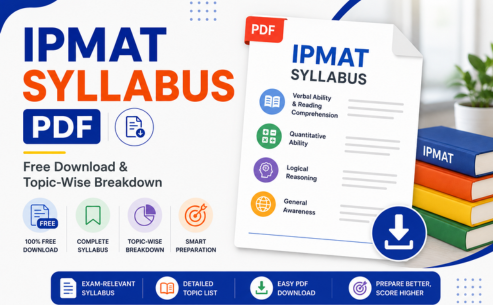
IPMAT Syllabus PDF 2028
Students searching for an IPMAT syllabus download should note that the exam authorities generally provide broad subject areas rather than a detailed chapter-wise syllabus. Therefore, coaching institutes and exam experts compile syllabus PDFs based on previous papers and official exam patterns.
A complete IPMAT syllabus PDF typically includes:
- Quantitative Aptitude
- Verbal Ability
- Reading Comprehension
- Logical Reasoning (Rohtak)
- Topic-wise weightage
- Previous year trends
- Preparation roadmap
IPMAT Quantitative Aptitude Syllabus 2028
Quantitative Aptitude is considered the most challenging section for many aspirants. Questions generally range from Class 10 to Class 12 difficulty levels.
1. Number System
Topics include:
- HCF and LCM
- Divisibility rules
- Remainders
- Factors and Multiples
- Cyclicity
- Base systems
Importance
Number system questions frequently appear in both Indore and Rohtak examinations.
2. Arithmetic
Arithmetic carries one of the highest weightages in the exam.
Important Topics
- Percentages
- Profit and Loss
- Discount
- Ratio and Proportion
- Partnership
- Average
- Mixture and Allegation
- Simple Interest
- Compound Interest
- Time and Work
- Pipes and Cisterns
- Time, Speed and Distance
- Boats and Streams
3. Algebra
Algebra forms a major portion of the paper.
Important Topics
- Linear Equations
- Quadratic Equations
- Inequalities
- Functions
- Logarithms
- Progressions (AP, GP)
- Polynomials
- Surds and Indices
Algebra-based questions are frequently asked in IPMAT Indore.
4. Geometry
Geometry tests conceptual understanding and visualisation skills.
Important Topics
- Lines and Angles
- Triangles
- Circles
- Polygons
- Coordinate Geometry
- Mensuration
- Area and Volume
5. Modern Mathematics
Important Topics
- Permutation and Combination
- Probability
- Set Theory
- Venn Diagrams
- Binomial Theorem
These topics often appear in higher-difficulty questions.
6. Data Interpretation
Important Topics
- Tables
- Pie Charts
- Bar Graphs
- Line Graphs
- Caselets
Data interpretation questions test analytical abilities and calculation speed.
Topic-Wise Quantitative Aptitude Summary
| Area | Difficulty |
| Arithmetic | Moderate |
| Algebra | Moderate to High |
| Number System | Moderate |
| Geometry | Moderate |
| Modern Math | High |
| Data Interpretation | Moderate |
IPMAT Verbal Ability Syllabus 2028
Verbal ability evaluates reading skills, grammar, vocabulary, and language comprehension.
Reading Comprehension
Reading comprehension is among the highest-weightage topics.
Questions are based on:
- Main Idea
- Inference
- Tone of Passage
- Vocabulary in Context
- Author’s Viewpoint
Students should develop a daily reading habit.
Vocabulary
Important Topics
- Synonyms
- Antonyms
- One Word Substitution
- Foreign Words
- Idioms and Phrases
- Word Usage
Vocabulary-based questions are regularly asked in IPMAT.
Grammar
Important Topics
- Nouns
- Pronouns
- Verbs
- Tenses
- Articles
- Prepositions
- Subject-Verb Agreement
- Active and Passive Voice
- Direct and Indirect Speech
Verbal Reasoning
Important Topics
- Para Jumbles
- Sentence Completion
- Odd One Out
- Critical Reasoning
- Logical Consistency
IPMAT Rohtak Logical Reasoning Syllabus
Logical Reasoning is exclusive to IPMAT Rohtak.
Important Topics
Analytical Reasoning
- Arrangements
- Seating Arrangements
- Puzzles
- Ranking
Logical Reasoning
- Coding-Decoding
- Blood Relations
- Direction Sense
- Syllogisms
- Input-Output
- Number Series
Data-Based Reasoning
- Data Sufficiency
- Venn Diagrams
- Charts and Graphs
Miscellaneous
- Clocks and Calendars
- Cubes and Dice
- Mirror Images
- Water Image
These topics frequently appear in Rohtak papers.
Most Important Topics for IPMAT 2028
Based on previous years’ trends, candidates should prioritise:
Quantitative Aptitude
- Arithmetic
- Algebra
- Number System
- Geometry
Verbal Ability
- Reading Comprehension
- Grammar
- Vocabulary
Logical Reasoning (Rohtak)
- Seating Arrangement
- Coding-Decoding
- Blood Relations
- Data Sufficiency
Arithmetic and algebra typically contribute a significant portion of quant questions.
Best Books for IPMAT Preparation
Quantitative Aptitude
- Arun Sharma – Quantitative Aptitude for CAT
- R.S. Aggarwal – Quantitative Aptitude
- Sarvesh Verma – Quantum CAT
Verbal Ability
- Word Power Made Easy by Norman Lewis
- High School English Grammar by Wren & Martin
- Arun Sharma & Meenakshi Upadhyay VARC
Logical Reasoning
- R.S. Aggarwal Logical Reasoning
- Arun Sharma Logical Reasoning
How to Complete the IPMAT Syllabus 2028
Phase 1: Foundation (Months 1–3)
- Learn concepts
- Build vocabulary
- Practise basic questions
Phase 2: Strengthening (Months 4–6)
- Topic-wise tests
- Previous year questions
- Sectional mocks
Phase 3: Exam Readiness (Months 7–9)
- Full-length mock tests
- Performance analysis
- Revision
Best Revision Strategy
Daily Revision
- Formula notebook
- Vocabulary notebook
- Error log
Weekly Revision
- One Quant revision day
- One verbal revision day
- One mock analysis session
Last 30 Days
- Focus only on:
- High-weightage topics
- Mock tests
- Mistake correction
Avoid starting completely new topics during the final weeks.
Common Mistakes to Avoid
Quant
- Ignoring Algebra
- Not practising Short Answer questions
Verbal
- Memorising vocabulary without usage
- Skipping reading comprehension practice
Logical Reasoning
- Solving puzzles without timing constraints
Overall
- Taking mocks without analysis
- Ignoring weak areas
Conclusion
The IPMAT syllabus 2028 remains the foundation of successful preparation. Before solving mocks or purchasing study material, students should thoroughly understand the topic-wise syllabus and create a structured study plan. The examination primarily evaluates quantitative aptitude and verbal ability, while IPMAT Rohtak additionally includes logical reasoning. By focusing on high-weightage areas such as arithmetic, algebra, reading comprehension, and logical reasoning, candidates can significantly improve their scores and increase their chances of securing admission to top IIMs. Consistent practice, regular revision, and mock test analysis remain the keys to cracking IPMAT.
FAQs
1. Where can I download the IPMAT syllabus PDF?
You can download an IPMAT syllabus PDF from coaching institutes, preparation portals, and educational websites that compile the syllabus based on previous-year exams. Official institutes generally provide broad subject areas rather than a detailed chapter-wise PDF.
2. What topics are included in quantitative aptitude?
Quantitative aptitude includes arithmetic, algebra, geometry, number systems, modern mathematics, and data interpretation.
3. What topics are included in Verbal Ability?
Verbal ability includes reading comprehension, vocabulary, grammar, para jumbles, sentence completion, and critical reasoning.
4. Is the syllabus the same for Indore and Rohtak?
No. Both exams include Quantitative Aptitude and Verbal Ability, but IPMAT Rohtak also contains a separate Logical Reasoning section.
5. Which topics are most important?
Arithmetic, algebra, reading comprehension, vocabulary, and logical reasoning are considered the most important topics.
6. Has the syllabus changed recently?
There have been no major syllabus changes in recent years. The core areas remain quantitative aptitude, verbal ability, and logical reasoning (for Rohtak).
7. Which books cover the syllabus effectively?
Books by Arun Sharma, R.S. Aggarwal, Norman Lewis, and Wren & Martin comprehensively cover the IPMAT syllabus.
8. How long does it take to complete the syllabus?
Most students require 6–9 months of consistent preparation to complete the syllabus and practice sufficient mock tests.
9. What is the best revision strategy?
Maintain formula notes, revise vocabulary daily, take weekly mocks, and analyse mistakes regularly.
10. Are official syllabus PDFs available?
Official institutes generally provide exam patterns and subject areas rather than a detailed chapter-wise syllabus PDF. Students usually rely on expert-curated syllabus documents.