Introduction
Every year, thousands of students compete for admission to the Integrated Programme in Management (IPM) offered by IIM Jammu. Since admission is based on JIPMAT performance along with other parameters prescribed by the institute, understanding the expected cutoff becomes an essential part of preparation.
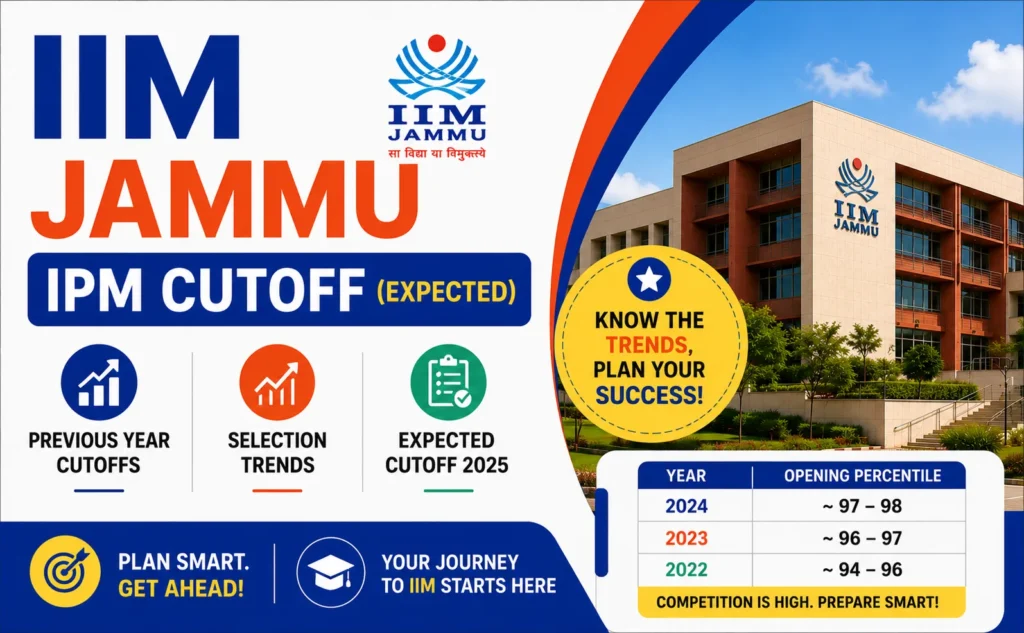
The IIM Jammu IPM Cutoff 2027 will ultimately depend on several factors, including the difficulty level of JIPMAT 2027, the number of applicants, seat availability, candidate performance, and the institute’s admission policy. While the official cutoff will only be announced after the admission process, analyzing previous years’ trends provides a realistic idea of the score range required for admission.
This guide explains the IIM Jammu IPM Cutoff 2027, expected cutoffs, previous year trends, category-wise qualifying requirements, safe score estimates, merit list preparation, and factors that influence admission.
What is the IIM Jammu IPM Cutoff?
The cutoff refers to the minimum performance required for a candidate to remain eligible for consideration during the admission process.
However, it is important to understand that meeting the cutoff does not guarantee admission. Candidates are ranked based on the institute’s admission policy and composite merit criteria.
How is the IIM Jammu IPM cutoff determined?
The cutoff changes every year depending on several variables.
Major factors include:
- Number of candidates appearing for JIPMAT
- Difficulty level of the examination
- Overall candidate performance
- Number of available seats
- Reservation policy
- Category-wise competition
- Merit list preparation criteria
- Institute’s admission policy
Even a small change in any of these factors can influence the final cutoff.
IIM Jammu IPM Admission Process
To understand the cutoff properly, students must first understand the admission process.
The selection generally involves:
- JIPMAT examination
- Minimum sectional eligibility
- Composite score preparation
- Merit list generation
- Seat allocation
Unlike many management admission processes, the IPM admission process at IIM Jammu has recently relied on JIPMAT performance and academic profile without a personal interview. The institute’s admission policy currently gives weightage to the JIPMAT percentile as well as Class 10 and Class 12 performance while requiring candidates to satisfy category-wise sectional eligibility percentiles.
IIM Jammu IPM Expected Cutoff 2027
Since the official cutoff will only be declared after JIPMAT 2027, the following ranges are expected estimates based on historical admission patterns and the institute’s current admission methodology.
| Category | Expected Competitive Range* |
| General | High percentile with strong academic profile |
| EWS | Moderately high percentile |
| OBC (NCL) | Moderately high percentile |
| SC | Competitive within category |
| ST | Competitive within category |
| PwD | As per category norms |
*These are indicative expectations only and not official cutoffs.
Category-wise Sectional Eligibility
IIM Jammu prescribes minimum sectional percentile requirements before a candidate becomes eligible for merit list consideration.
The admission policy has prescribed the following sectional percentile thresholds:
| Category | QA | DI | VA |
| General | 50 | 50 | 50 |
| EWS | 35 | 35 | 35 |
| OBC (NCL) | 35 | 35 | 35 |
| SC | 30 | 30 | 30 |
| ST | 25 | 25 | 25 |
| PwD | 25 | 25 | 25 |
Meeting these sectional thresholds only makes a candidate eligible for consideration. Final admission depends on the composite merit score.
IIM Jammu IPM Previous Year Cutoff Trends
The institute does not publish a fixed admission score every year because admissions depend upon the overall merit list and candidate pool.
However, historical trends indicate the following:
- Competition has increased steadily.
- Higher-performing candidates continue to apply each year.
- Overall admission standards have become more competitive.
- Academic consistency has become increasingly important under the current admission policy.
Understanding IPM Score Trends
Analyzing IPM score trends helps students estimate the level of competition.
Recent trends show:
- Growing popularity of IPM programs
- Increased number of JIPMAT applicants
- Higher competition for limited seats
- Better-prepared aspirants each year
- Rising importance of overall composite performance
This trend means candidates should aim well above the minimum qualifying level rather than targeting only the cutoff.
IIM Jammu Merit List Preparation
Many students confuse the cutoff with the final merit list.
These are different.
Cutoff
Minimum qualifying benchmark.
Merit List
Final ranking prepared after applying the institute’s admission policy.
For the current admission policy, the composite score is prepared using:
- JIPMAT Percentile – 70% weightage
- Class 10 Marks – 15% weightage
- Class 12 Marks – 15% weightage
This grading system means two students with similar JIPMAT performance may receive different ranks because of differences in academic performance.
How Academic Performance Affects Admission
Unlike institutes that rely solely on entrance scores, IIM Jammu also considers school academics.
Students with:
- Consistent Class 10 performance
- Strong Class 12 marks
- High JIPMAT percentile
generally enjoy a stronger composite score.
Therefore, the admission process rewards both entrance examination performance and academic consistency.
What is a Safe Score for IIM Jammu IPM?
One of the most common questions among aspirants is the following:
What is a safe score?
A “safe score” is not an official number.
Instead, it refers to a performance level that provides a relatively stronger chance of admission than simply meeting the minimum qualifying criteria.
Students should aim for:
- Excellent sectional performance
- High overall JIPMAT percentile
- Strong academic profile
- No weak section
Rather than targeting the expected cutoff, aspirants should focus on maximizing their overall score.
Percentile vs. Score
Students often confuse marks with percentile.
Raw Score
Actual marks obtained in JIPMAT.
Percentile
Relative performance compared with all candidates.
The same raw score may correspond to different percentiles each year because it depends on the following:
- Number of candidates
- Difficulty level
- Overall performance distribution
Therefore, admission decisions rely on percentile and composite evaluation rather than raw marks alone.
Why Cutoffs Change Every Year
No two admission cycles are identical.
Cutoffs may increase or decrease because of:
Difficulty Level
A difficult paper may lower the score required for a competitive percentile.
Number of Applicants
More applicants generally increase competition.
Seat Availability
Limited seats lead to higher competition.
Academic Profiles
Since academic performance contributes to the composite score, the overall quality of applicants also affects the merit list.
IIM Jammu Selection Trends
Recent IPM selection trends indicate:
- Increased competition every year
- Stronger academic profiles among applicants
- Greater awareness about IPM programs
- More candidates preparing specifically for JIPMAT
- Increasing importance of composite merit
Candidates should therefore prepare with the expectation of a competitive admission cycle rather than relying on historical estimates alone.
Category-wise Competition
Cutoffs vary across categories due to reservation policies.
Each category has:
- Separate competition
- Separate merit list
- Separate qualifying requirements
- Independent admission consideration
Candidates compete primarily within their respective reservation category after satisfying the prescribed eligibility conditions.
Merit List Cutoff vs. Eligibility Cutoff
These two concepts are often misunderstood.
Eligibility Cutoff
Minimum sectional requirement for consideration.
Merit List Cutoff
Composite score required to receive an admission offer.
The merit list cutoff is always more competitive because only the highest-ranked candidates receive seats.
How Many Students Cross the Cutoff?
Thousands of candidates appear for JIPMAT each year, and many satisfy the minimum qualifying criteria.
However:
- Only a limited number receive admission offers.
- A larger pool may be placed on waiting lists.
- Final admissions depend on seat acceptance and movement in subsequent merit lists.
The number of candidates who ultimately receive offers depends on intake capacity and acceptance behavior.
Can Previous Year Cutoffs Predict 2027 Admission?
Previous year trends are useful but cannot predict the official 2027 cutoff with certainty.
Reasons include:
- Different exam difficulty
- Different applicant pool
- Changes in admission policy
- Variation in composite scores
- Changes in seat intake
Historical trends should, therefore, be used only as guidance rather than guaranteed prediction.
Admission Chances Based on Performance
Although no institute guarantees admission based on a particular score, students can broadly assess their position.
Strong Admission Chances
- Excellent JIPMAT percentile
- Strong Class 10 marks
- Strong Class 12 marks
- Balanced sectional performance
Moderate Admission Chances
- Competitive percentile
- Good academics
- Sectional scores above qualifying thresholds
Lower Admission Chances
- Borderline qualifying performance
- Weak academics affecting composite score
- Sectional performance close to minimum eligibility
These are general indicators and not official admission categories.
Common Mistakes While Analyzing Cutoffs
Many students make incorrect assumptions.
Avoid:
- Assuming previous year scores will repeat
- Ignoring academic profile
- Focusing only on overall score
- Ignoring sectional eligibility
- Comparing raw marks across different years
- Believing unofficial social media predictions
A balanced analysis always considers the complete admission policy.
Preparation Strategy to Stay Above the Cutoff
The best approach is not to prepare for the cutoff but to prepare well above it.
Strengthen Quantitative Aptitude
Develop conceptual clarity and practice regularly.
Improve Verbal Ability
Read newspapers, editorials, and business articles daily.
Practice Data Interpretation
Solve sets under timed conditions.
Attempt Mock Tests
Regular mock tests improve speed, accuracy, and confidence.
Analyze Every Mock
Understanding mistakes is more valuable than simply taking tests.
Maintain Strong Academics
Since academic performance contributes to the composite score, students should take school examinations seriously as well.
Why Choose Tarkashastra for JIPMAT Preparation?
Cracking JIPMAT requires more than solving aptitude questions. Students need a structured preparation strategy, expert mentoring, regular mock tests, and continuous performance analysis.
At Tarkashastra, IPM aspirants receive comprehensive preparation covering quantitative aptitude, data interpretation, logical reasoning, verbal ability, reading comprehension, and current examination trends. The program includes classroom sessions, sectional tests, full-length mocks, previous-year paper practice, doubt-solving, and personalized mentoring to help students improve both scores and confidence.
In addition to entrance preparation, students receive guidance on admission strategy, expected cutoffs, application planning, and overall preparation for top IPM institutes such as IIM Jammu.
Final Thoughts
The IIM Jammu IPM Cutoff 2027 is expected to remain competitive because of increasing awareness of IPM programs and rising participation in JIPMAT. While previous years provide useful benchmarks, the official cutoff will depend on the difficulty level of JIPMAT 2027, the quality of applicants, seat availability, and the institute’s admission policy.
Rather than targeting the minimum qualifying cutoff, aspirants should aim for the highest possible JIPMAT percentile while maintaining strong academic performance in Class 10 and Class 12. This approach significantly improves the composite score and overall admission prospects.
Frequently Asked Questions (FAQs)
1. What is the expected cutoff for IIM Jammu IPM 2027?
The official cutoff has not yet been announced. It will depend on JIPMAT 2027 difficulty, applicant performance, seat availability, and the institute’s admission policy. The expected ranges discussed in this article are indicative estimates only.
2. How does the cutoff vary by category?
Different reservation categories have different qualifying criteria and compete within their respective category-wise merit lists. Sectional percentile eligibility also differs across categories.
3. What was the previous year cutoff?
IIM Jammu does not publish a fixed overall admission cutoff every year. Instead, it prescribes minimum sectional eligibility and prepares the final merit list using a composite score.
4. What is the safe score for admission?
There is no officially declared safe score. Candidates should target a high JIPMAT percentile along with strong Class 10 and Class 12 marks to maximize admission chances.
5. How is percentile related to cutoff?
A percentile reflects a candidate’s relative performance compared with all test-takers. The institute uses percentile-based evaluation in its admission process rather than relying solely on raw marks.
6. Are cutoffs different for IPM vs. other programs?
Yes. The IPM admission process uses JIPMAT and its own admission policy, while MBA programs follow different entrance examinations and selection criteria.
7. How many candidates meet the cutoff?
Many candidates satisfy the minimum qualifying requirements, but only a limited number receive admission offers because seats are restricted and admissions are based on composite merit.
8. Can cutoff trends predict admission?
Previous year trends provide useful guidance but cannot accurately predict future cutoffs because competition, paper difficulty, and admission policies change each year.
9. What is the merit list cutoff?
The merit list cutoff refers to the composite score required to receive an admission offer after applying the institute’s admission policy. It is generally more competitive than the minimum qualifying cutoff.
10. How does score affect selection chances?
A stronger JIPMAT percentile improves the composite score. When combined with strong Class 10 and Class 12 performance, it significantly enhances the likelihood of receiving an admission offer under the current admission policy.