Introduction
The Integrated Programme in Management (IPM) at IIM Jammu has become one of the most preferred management programmes for students aspiring to begin their management education immediately after Class 12. Admission to this prestigious programme is conducted through the Joint Integrated Programme in Management Admission Test (JIPMAT), a national-level entrance examination conducted by the National Testing Agency (NTA). IIM Jammu accepts only JIPMAT scores for IPM admissions; SAT scores are not considered.
Understanding the complete IIM Jammu IPM Entrance Exam 2027 is essential for every aspirant. From the exam pattern and syllabus to the marking scheme, selection process, registration, and preparation strategy, every aspect plays an important role in securing admission.
This detailed guide explains everything you need to know about the IIM Jammu IPM Entrance Exam 2027.
Overview of IIM Jammu IPM Entrance Exam 2027
The admission process for IIM Jammu IPM is based on the JIPMAT examination, conducted by NTA.
Exam Highlights
| Particular | Details |
| Entrance Examination | Joint Integrated Programme in Management Admission Test (JIPMAT) |
| Conducting Body | National Testing Agency (NTA) |
| Accepted By | IIM Jammu and IIM Bodh Gaya |
| Mode of Examination | Computer-Based Test (CBT) |
| Duration | 150 Minutes |
| Question Type | Multiple Choice Questions (MCQs) |
| Admission Basis | JIPMAT Score + Institute Admission Policy |
What is JIPMAT?
The Joint Integrated Programme in Management Admission Test (JIPMAT) is the entrance examination for admission to the five-year IPM programmes offered by IIM Jammu and IIM Bodh Gaya.
The examination evaluates candidates on:
- Quantitative Aptitude
- Data Interpretation
- Logical Reasoning
- Verbal Ability
- Reading Comprehension
The exam is conducted once every year in online mode by the National Testing Agency.
IIM Jammu IPM JIPMAT 2027
The IIM Jammu IPM JIPMAT serves as the gateway for admission.
Candidates must:
- Register for JIPMAT
- Appear for the examination
- Meet the institute’s eligibility criteria
- Satisfy the category-wise qualifying requirements
- Participate in the admission process
Under the current admission policy, there is no personal interview or written ability test for IIM Jammu IPM admissions. Final selection is based on JIPMAT performance and academic profile.
IIM Jammu IPM Exam Eligibility
Before applying, candidates should ensure they satisfy the prescribed eligibility requirements.
Generally, applicants should:
- Have passed Class 12 (or equivalent) from a recognised board.
- Meet the age criteria announced in the admission policy.
- Fulfil the minimum academic requirements.
- Complete online registration before the deadline.
Students appearing in the Class 12 examination may also apply, subject to fulfilling the institute’s conditions.
IIM Jammu IPM Registration Process
The registration process generally includes the following steps:
Step 1: Online Registration
Create an account using:
- Email ID
- Mobile Number
Step 2: Fill in the Application Form
Enter:
- Personal Details
- Academic Information
- Communication Details
Step 3: Upload Documents
Upload:
- Photograph
- Signature
- Required certificates
Step 4: Pay Application Fee
Payment is completed through online modes.
Step 5: Final Submission
Review the application carefully before submitting.
JIPMAT Exam Pattern 2027
Understanding the IPM exam pattern is the first step towards effective preparation.
Mode of Examination
- Computer-Based Test (CBT)
Question Type
- Multiple Choice Questions (MCQs)
Duration
- 150 Minutes (2 Hours 30 Minutes)
Number of Questions
- 100 Questions
Total Marks
- 400 Marks
The examination is objective in nature.
JIPMAT Test Sections
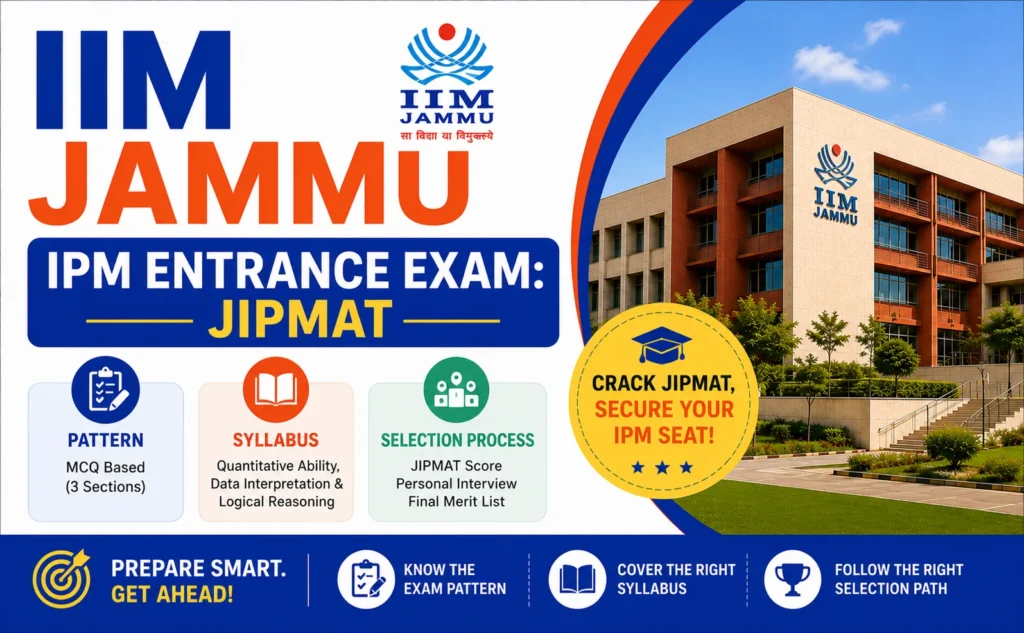
The examination consists of three sections.
1. Quantitative Aptitude
This section evaluates mathematical aptitude and numerical ability.
Important topics include:
- Number System
- Percentages
- Profit & Loss
- Ratio & Proportion
- Time & Work
- Time, Speed & Distance
- Simple & Compound Interest
- Algebra
- Geometry
- Mensuration
- Permutation & Combination
- Probability
- Statistics
2. Data Interpretation & Logical Reasoning
This section assesses analytical thinking and reasoning skills.
Important topics include:
- Tables
- Charts
- Graphs
- Logical Arrangements
- Blood Relations
- Coding-Decoding
- Seating Arrangement
- Series
- Direction Sense
- Syllogisms
- Puzzles
- Critical Reasoning
3. Verbal Ability & Reading Comprehension
This section evaluates English language proficiency.
Topics include:
- Reading Comprehension
- Vocabulary
- Grammar
- Sentence Correction
- Para Jumbles
- Synonyms
- Antonyms
- Fill in the Blanks
- Idioms
- Error Detection
JIPMAT Syllabus 2027
Although NTA does not prescribe a chapter-wise official syllabus, candidates generally prepare the following areas.
Quantitative Aptitude
- Arithmetic
- Algebra
- Geometry
- Trigonometry (basic concepts)
- Modern Mathematics
- Data Sufficiency
Logical Reasoning
- Analytical Reasoning
- Verbal Reasoning
- Puzzle Solving
- Pattern Recognition
Data Interpretation
- Pie Charts
- Line Graphs
- Bar Graphs
- Tables
- Mixed Graphs
- Caselets
English Language
- Reading Comprehension
- Grammar
- Vocabulary
- Sentence Formation
- Paragraph Completion
JIPMAT Marking Scheme
The IPM marking scheme is straightforward.
| Response | Marks |
| Correct Answer | +4 |
| Incorrect Answer | -1 |
| Unattempted | 0 |
Because of negative marking, candidates should avoid random guessing.
Exam Duration
One of the most common questions among students is about the exam duration.
The JIPMAT examination is conducted for:
- 150 Minutes
- No separate sectional time limits
Candidates are free to allocate time among sections according to their strategy.
Types of Questions Asked
The examination includes objective-type multiple-choice questions.
Students can expect questions based on:
- Conceptual understanding
- Mathematical calculations
- Logical analysis
- Reading comprehension
- Grammar
- Data interpretation
There are no descriptive questions.
Difficulty Level
The examination is generally considered to have a moderate level of difficulty.
Students with strong conceptual clarity and consistent practice can perform well.
The competition, however, remains high because of limited seats.
Selection Process After JIPMAT
The IPM selection process at IIM Jammu follows the institute’s admission policy.
The current selection methodology broadly includes the following:
Step 1
Appear for JIPMAT.
Step 2
Meet the prescribed sectional qualifying percentile for your category.
Step 3
The institute calculates a composite score.
Step 4
A merit list is prepared.
Step 5
Admission offers are made based on merit and seat availability.
At present, IIM Jammu does not conduct a personal interview for IPM admissions.
Weightage in Selection
Under the current admission policy, the composite score is prepared using:
| Component | Weightage |
| JIPMAT Percentile | 70% |
| Class 10 Marks | 15% |
| Class 12 Marks | 15% |
This means strong academic performance can significantly improve admission chances even among candidates with similar JIPMAT scores.
Category-wise Qualifying Requirements
Candidates are required to meet the prescribed category-wise sectional qualifying percentile before being considered for admission.
The qualifying thresholds differ for:
- General
- EWS
- OBC-NCL
- SC
- ST
- PwD
Meeting the minimum qualifying percentile does not guarantee admission, as the final merit list is prepared using the composite score.
Preparation Strategy
A structured preparation plan improves the chances of success.
Understand the Exam Pattern
Become familiar with:
- Sections
- Marking Scheme
- Time Allocation
Build Strong Concepts
Focus on:
- Arithmetic
- Grammar
- Logical Reasoning
- Reading Skills
Solve previous years’ papers.
Previous papers help students understand:
- Question pattern
- Difficulty level
- Frequently tested topics
Take Mock Tests
Regular mock tests improve:
- Speed
- Accuracy
- Time Management
- Confidence
Analyse Performance
After every mock:
- Identify mistakes.
- Revise weak topics.
- Improve accuracy.
Read Daily
Reading newspapers and editorials enhances the following:
- Vocabulary
- Comprehension
- General awareness
- Reading speed
Common Mistakes to Avoid
Many students lose marks because of avoidable errors.
Avoid:
- Ignoring negative marking
- Spending too much time on one question
- Skipping mock tests
- Memorising formulas without understanding concepts
- Neglecting Reading Comprehension
- Ignoring weaker sections
Time Management Strategy
A practical exam strategy includes:
- Begin with your strongest section.
- Avoid lengthy calculations.
- Skip difficult questions initially.
- Return to unanswered questions later.
- Reserve the last few minutes for review.
Recommended Resources
Students should prepare using:
- NCERT Mathematics
- Standard quantitative aptitude books
- English grammar reference books
- Logical reasoning practice material
- Data interpretation practice sets
- Previous JIPMAT papers
- Full-length mock tests
Consistency is more important than studying from multiple resources.
Why Choose Tarkashastra for JIPMAT Preparation?
Cracking the IIM Jammu IPM Entrance Exam 2027 requires a combination of conceptual clarity, regular practice, and strategic guidance. At Tarkashastra, students receive a structured preparation programme designed specifically for JIPMAT aspirants.
The programme includes expert-led classroom sessions, comprehensive study material, topic-wise practice questions, sectional tests, full-length mock exams, previous-year paper discussions, personalised doubt-solving, and performance analysis. Students are also guided on application strategy, cutoff expectations, and the overall admission process for IIM Jammu and other leading IPM institutes.
With experienced mentors and a focused preparation approach, Tarkashastra helps students build the confidence and skills required to perform well in JIPMAT.
Final Thoughts
The IIM Jammu IPM Entrance Exam 2027 is the first and most important milestone for students aspiring to join one of India’s leading Integrated Programme in Management courses. Since admission is based on JIPMAT and the institute’s composite selection criteria, candidates should focus on achieving a high percentile while maintaining strong academic performance in Class 10 and Class 12.
A disciplined preparation plan, regular mock tests, thorough revision, and consistent practice across quantitative aptitude, data interpretation, logical reasoning, and verbal ability can significantly improve the chances of securing admission. Rather than aiming only for the qualifying cutoff, aspirants should strive for the highest possible score to strengthen their position in the final merit list.
Frequently Asked Questions (FAQs)
1. What is the pattern of the JIPMAT exam?
JIPMAT is a computer-based test consisting of 100 multiple-choice questions to be completed in 150 minutes. The paper covers Quantitative Aptitude, Data Interpretation & Logical Reasoning, and Verbal Ability & Reading Comprehension.
2. What is the syllabus for IIM Jammu IPM?
The syllabus broadly includes quantitative aptitude, data interpretation, logical reasoning, verbal ability, reading comprehension, vocabulary, grammar, arithmetic, algebra, geometry, and analytical reasoning.
3. How long is the exam?
The examination duration is 150 minutes (2 hours 30 minutes).
4. How many sections are there?
The examination consists of three sections: Quantitative Aptitude, Data Interpretation & Logical Reasoning, and Verbal Ability & Reading Comprehension.
5. Is there negative marking?
Yes. Candidates receive +4 marks for every correct answer and -1 mark for every incorrect answer. Unattempted questions carry no marks.
6. What types of questions are asked?
The examination contains objective-type multiple-choice questions assessing aptitude, reasoning, English language skills, and data interpretation.
7. How should I prepare for the exam?
Build strong conceptual fundamentals, solve previous-year papers, take regular mock tests, revise consistently, and analyse your mistakes after every mock.
8. Is there a cutoff for the exam?
Yes. Candidates must satisfy the category-wise sectional qualifying percentile prescribed by IIM Jammu. Final admission is based on the composite merit score, not merely the qualifying cutoff.
9. How is the selection process linked to exam scores?
Under the current admission policy, the final composite score is based on 70% JIPMAT percentile, 15% Class 10 marks, and 15% Class 12 marks. There is currently no personal interview for IIM Jammu IPM admissions.
10. When is the exam conducted?
JIPMAT is generally conducted once every year, typically during the admission cycle announced by the National Testing Agency (NTA). Candidates should regularly check the official notification for the exact examination schedule.