Introduction
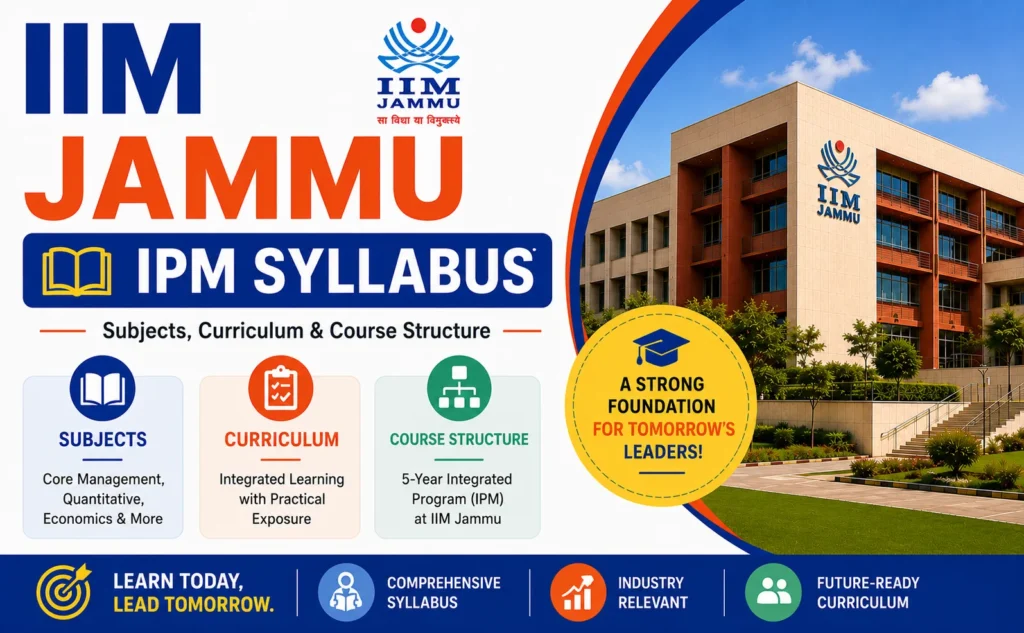
The Integrated Programme in Management (IPM) at IIM Jammu is one of India’s most comprehensive undergraduate management programmes. It combines multidisciplinary undergraduate education with advanced management studies, allowing students to build strong analytical, managerial, and leadership skills over five years.
When students search for the IIM Jammu IPM Syllabus 2027, they are usually referring to two different syllabi:
- JIPMAT Entrance Exam Syllabus (for admission)
- Five-Year IPM Curriculum (after admission)
Understanding both is important because clearing the entrance examination is only the first step. Once admitted, students undergo a rigorous academic programme that integrates business education with economics, technology, humanities, data analytics, entrepreneurship, and leadership development. The programme follows a semester system during the first three years and transitions to the MBA trimester structure in the final two years.
This comprehensive guide explains every aspect of the IIM Jammu IPM Syllabus 2027, including section-wise entrance exam topics, semester-wise curriculum, course structure, electives, internships, and preparation strategies.
Overview of IIM Jammu IPM Syllabus 2027
The IPM programme consists of two stages:
Stage 1: Entrance Examination
Admission is based on the Joint Integrated Programme in Management Admission Test (JIPMAT), which evaluates candidates in:
- Quantitative Aptitude
- Data Interpretation
- Logical Reasoning
- Verbal Ability
- Reading Comprehension
Stage 2: Five-Year Academic Programme
After admission, students study:
- Foundation Courses
- Business Core Courses
- Liberal Arts
- Technology
- Data Analytics
- Management
- Electives
- MBA Courses
The programme is designed around a holistic and multidisciplinary curriculum.
IIM Jammu IPM Course Structure
The programme lasts five years.
First Three Years
Students pursue the undergraduate (BBA) component through a semester system.
Final Two Years
Students merge into the flagship MBA programme and follow the trimester system after meeting the academic requirements set by the institute.
Programme Highlights
| Particular | Details |
| Programme Duration | 5 Years |
| Undergraduate Component | 3 Years (Semester System) |
| MBA Component | 2 Years (Trimester System) |
| Degree Awarded | BBA + MBA (subject to programme requirements) |
| Entrance Exam | JIPMAT |
| Teaching Method | Classroom, Projects, Internships, Electives |
Part A: JIPMAT Entrance Examination Syllabus
The JIPMAT examination evaluates aptitude rather than business knowledge.
The paper consists of three major sections.
Section 1: Quantitative Aptitude
The IPM quantitative syllabus focuses on concepts generally covered up to Class 10 Mathematics.
Important topics include:
Number System
- Factors
- Multiples
- LCM & HCF
- Divisibility Rules
Arithmetic
- Percentages
- Profit & Loss
- Ratio & Proportion
- Partnership
- Average
- Mixture & Allegation
Time-Based Topics
- Time & Work
- Pipes & Cisterns
- Time, Speed & Distance
Algebra
- Linear Equations
- Quadratic Equations
- Basic Algebraic Identities
Geometry
- Triangles
- Circles
- Quadrilaterals
- Polygons
Mensuration
- Area
- Volume
- Surface Area
Modern Mathematics
- Permutation & Combination
- Probability
- Sets
Statistics
- Mean
- Median
- Mode
Section 2: Data Interpretation & Logical Reasoning
The logical reasoning syllabus measures analytical thinking and decision-making.
Data Interpretation
Students should practise:
- Tables
- Bar Graphs
- Pie Charts
- Line Graphs
- Mixed Graphs
- Caselets
Logical Reasoning
Important topics include:
- Coding-Decoding
- Blood Relations
- Seating Arrangement
- Direction Sense
- Ranking
- Series
- Statement & Conclusion
- Syllogism
- Puzzles
- Critical Reasoning
- Calendar
- Clock Problems
Section 3: Verbal Ability & Reading Comprehension
The IPM verbal syllabus evaluates English language proficiency.
Important topics include:
Reading Comprehension
- Passage-based Questions
- Inference
- Vocabulary in Context
Grammar
- Sentence Correction
- Error Detection
- Tenses
- Articles
- Prepositions
Vocabulary
- Synonyms
- Antonyms
- One-Word Substitutions
- Idioms
- Phrases
Verbal Reasoning
- Para Jumbles
- Sentence Arrangement
- Fill in the Blanks
- Cloze Test
The official FAQs also indicate that quantitative aptitude is based broadly on Class 10 mathematics, while the other sections assess data interpretation, logical reasoning, verbal ability, and reading comprehension.
JIPMAT Exam Pattern
| Section | Major Areas |
| Quantitative Aptitude | Mathematics |
| Data Interpretation | Charts & Tables |
| Logical Reasoning | Analytical Reasoning |
| Verbal Ability | English Language |
| Reading Comprehension | Passages |
Part B: IIM Jammu IPM Curriculum
After admission, students begin a multidisciplinary academic journey.
The curriculum combines:
- Business Education
- Liberal Arts
- Technology
- Management
- Data Analytics
- Leadership
- Entrepreneurship
The institute describes the programme as a combination of foundation courses, business core courses, electives, and advanced MBA courses.
First Year Curriculum
The first year builds strong academic foundations.
Representative courses include:
- Business Communication I & II
- Business Economics
- Financial Accounting
- Principles of Management
- Business Mathematics I & II
- Introduction to Excel
- Marketing Management I
- Critical Thinking & Problem Solving
- Introduction to Psychology
- Principles of Computational Thinking
- Introduction to Data Structures
- Indian History & Culture
- Sociology
- Indian Knowledge System
- Performing Arts
The first year concludes with a boot camp, designed to provide experiential learning.
Second Year Curriculum
The second year expands students’ understanding of business functions and analytical tools.
Major subjects include:
- Professional Writing
- Indian & Global Economy
- Marketing Management II
- Financial Management
- Introduction to Human Resource Management
- Creativity & Innovation
- Data Analytics using R & Python
- Introduction to Statistics
- Operations Management
- AI & Machine Learning
- Strategic Management
- Money, Banking & Finance
- Sampling & Survey Design
- Environmental Science
- Foreign Language
Students also complete a social internship as part of the curriculum.
Third Year Curriculum
The third year prepares students for advanced management education.
Core courses include:
- New Venture Planning
- Materials & Logistics Management
- Branding & Advertising
- Industrial Relations & Labour Laws
- Business Laws
- Talent & Leadership Development
- Introduction to Econometrics
- Social Entrepreneurship
Students also undertake a corporate internship and choose multiple electives based on their interests.
MBA Curriculum (Years 4 & 5)
After completing the undergraduate component and meeting progression requirements, students join the flagship MBA programme.
The MBA curriculum typically includes advanced management subjects such as:
- Marketing
- Finance
- Human Resource Management
- Operations
- Business Analytics
- Strategy
- Economics
- Entrepreneurship
- International Business
- Supply Chain Management
- Information Systems
Students also choose electives aligned with their career aspirations.
Elective Courses
One of the strengths of the programme is flexibility.
Students can choose electives in areas such as:
- Marketing
- Finance
- Business Analytics
- Operations
- Human Resources
- Entrepreneurship
- Strategy
- Economics
- Technology Management
Elective availability depends on institute regulations and course registration norms.
Experiential Learning Components
The curriculum goes beyond classroom teaching.
Students participate in:
Boot Camp
Held after the first year to promote experiential learning.
Social Internship
Students work with NGOs or CSR organisations.
Corporate Internship
Students gain industry exposure through corporate projects.
International Exchange
Eligible students may participate in an international exchange programme based on merit and institute norms.
Sector-Specific Specialisation
Students can opt for sector-focused specialisations during the programme.
Skills Developed Through the Programme
The curriculum focuses on developing:
- Analytical Thinking
- Communication Skills
- Leadership
- Business Decision-Making
- Critical Thinking
- Data Analysis
- Teamwork
- Entrepreneurship
- Problem Solving
- Ethical Decision-Making
How to Prepare for the JIPMAT Syllabus
A systematic preparation strategy improves performance.
Strengthen Mathematics
Master:
- Arithmetic
- Algebra
- Geometry
- Statistics
Improve English
Develop:
- Reading Habit
- Vocabulary
- Grammar
- Comprehension
Practise Logical Reasoning
Solve puzzles regularly.
Take Mock Tests
Mocks improve:
- Accuracy
- Speed
- Time Management
Analyse Every Test
Review mistakes after every practice session.
Previous Year Papers
Yes.
Previous-year JIPMAT papers are among the most valuable preparation resources because they help students understand:
- Question Pattern
- Difficulty Level
- Frequently Tested Topics
- Time Management
Students should solve multiple previous papers under exam conditions.
Is the Syllabus Updated Regularly?
The JIPMAT entrance syllabus remains broadly stable, focusing on aptitude-based skills.
However:
- Question patterns may evolve.
- Difficulty level may vary.
- Weightage of topics can change.
Similarly, the institute may periodically revise the academic curriculum by introducing new courses, electives, and interdisciplinary learning opportunities to align with industry needs.
Common Mistakes to Avoid
Students often:
- Ignore Reading Comprehension.
- Neglect Data Interpretation.
- Memorise formulas without conceptual understanding.
- Avoid mock tests.
- Ignore time management.
Avoiding these mistakes significantly improves exam performance.
Why Choose Tarkashastra for JIPMAT Preparation?
Understanding the syllabus is the first step towards cracking the JIPMAT examination. At Tarkashastra, students receive a structured preparation programme that comprehensively covers the complete JIPMAT syllabus through concept-based learning, classroom coaching, sectional practice, full-length mock tests, previous-year paper discussions, and personalised mentoring.
The programme is designed to strengthen quantitative aptitude, data interpretation, logical reasoning, verbal ability, and reading comprehension while helping students improve speed, accuracy, and exam strategy. Students also receive guidance on the admission process, application planning, and preparation for leading IPM institutes such as IIM Jammu.
Final Thoughts
The IIM Jammu IPM Syllabus 2027 is much more than an entrance examination syllabus. It represents a complete academic journey that begins with clearing the JIPMAT examination and progresses into one of India’s most multidisciplinary management programmes.
Aspirants should first master the JIPMAT syllabus by building strong fundamentals in quantitative aptitude, data interpretation, logical reasoning, and verbal ability. Once admitted, they can expect a rigorous curriculum that combines management, economics, technology, humanities, analytics, internships, leadership development, and advanced MBA education.
With consistent preparation, disciplined practice, and the right guidance, students can successfully clear the entrance examination and make the most of the comprehensive learning opportunities offered by the IIM Jammu IPM programme.
Frequently Asked Questions (FAQs)
1. What subjects are included in the IIM Jammu IPM Syllabus 2027?
The entrance syllabus includes quantitative aptitude, data interpretation, logical reasoning, verbal ability, and reading comprehension. After admission, students study management, economics, accounting, marketing, finance, technology, analytics, psychology, humanities, and MBA-level subjects.
2. How is the course structured?
The programme is five years long. The first three years follow a semester system for the BBA component, while the final two years merge with the flagship MBA programme and follow the trimester system.
3. Are there section-wise topics?
Yes. The JIPMAT examination is divided into Quantitative Aptitude, Data Interpretation & Logical Reasoning, and Verbal Ability & Reading Comprehension.
4. What is the syllabus for Quantitative Aptitude?
It includes arithmetic, algebra, geometry, mensuration, number system, probability, permutation & combination, statistics, and related Class 10 Mathematics concepts.
5. What is the syllabus for verbal ability?
The Verbal Ability section covers reading comprehension, grammar, vocabulary, sentence correction, para jumbles, synonyms, antonyms, idioms, and fill-in-the-blanks.
6. What is included in logical reasoning?
Logical reasoning includes coding-decoding, blood relations, seating arrangement, direction sense, puzzles, syllogisms, statement-based reasoning, series, and analytical reasoning.
7. How can students prepare effectively?
Build strong conceptual clarity, practise section-wise questions, solve previous-year papers, take regular mock tests, analyse mistakes, and revise consistently.
8. Are previous year papers available?
Yes. Previous-year JIPMAT papers and mock tests are valuable resources for understanding the exam pattern, question types, and difficulty level.
9. Is the syllabus updated regularly?
The overall aptitude syllabus remains largely stable, but the institute may periodically update the academic curriculum and elective offerings to align with evolving industry requirements.
10. How long is the IPM programme?
The IIM Jammu IPM is a five-year integrated programme, consisting of three years of undergraduate (BBA) studies followed by two years integrated with the MBA programme, subject to academic progression requirements.