Introduction
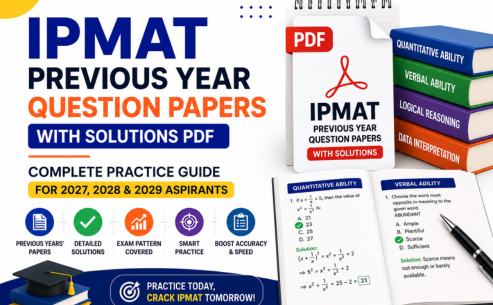
Preparing for the Integrated Program in Management Aptitude Test (IPMAT) requires more than just completing the syllabus. One of the most effective ways to improve your performance is by solving IPMAT previous year question paper sets regularly. These papers help students understand the exam pattern, identify important topics, improve speed, and develop effective test-taking strategies.
Whether you are preparing for IPMAT Indore, IPMAT Rohtak, or other integrated management entrance exams, practicing IPMAT solved papers, downloading IPMAT PYQ PDF files, and analyzing IPMAT papers with solutions can significantly boost your score.
In this guide, we will discuss why previous year papers are important, how to use them effectively, where to find them, and the best strategy to maximize your preparation.
Why Are IPMAT Previous-Year Question Papers Important?
Many students spend months studying concepts but fail to achieve a good score because they lack exam-level practice.
A well-planned preparation strategy should always include solving an IPMAT previous-year question paper regularly.
Key Benefits
| Benefit | How It Helps |
| Understand Exam Pattern | Familiarity with question types and structure |
| Improve Speed | Learn to solve questions quickly |
| Identify Weak Areas | Discover topics needing improvement |
| Build Exam Temperament | Reduce anxiety and improve confidence |
| Learn Time Management | Allocate time effectively across sections |
| Analyze Difficulty Level | Understand actual competition standards |
Previous year papers provide a realistic picture of what you can expect on exam day.
Understanding the IPMAT Exam Pattern
Before solving papers, it is important to understand the exam structure.
IPMAT Indore Pattern
| Section | Question Type |
| Quantitative Ability (MCQ) | Multiple Choice |
| Quantitative Ability (Short Answer) | Type-in-the-answer |
| Verbal Ability | Multiple Choice |
IPMAT Rohtak Pattern
| Section | Question Type |
| Quantitative Ability | MCQ |
| Logical Reasoning | MCQ |
| Verbal Ability | MCQ |
Since the patterns differ, students should solve papers specific to the exam they are targeting.
Why You Should Solve IPMAT Solved Papers
Many aspirants simply attempt questions and move on.
However, the real learning happens when you solve IPMAT-solved papers and carefully review the explanations.
Advantages of Solved Papers
1. Learn Correct Approaches
Solutions explain the most efficient methods.
You may discover shortcuts that save valuable exam time.
2. Understand Common Mistakes
Many solutions highlight traps and common errors made by students.
3. Improve Accuracy
Seeing step-by-step solutions helps strengthen conceptual clarity.
4. Learn Alternate Methods
Often there are multiple ways to solve the same question.
The best solutions introduce faster techniques.
What topics frequently appear in IPMAT previous year papers?
Analyzing an IPMAT previous year question paper reveals recurring themes.
Quantitative Ability
| Topic | Frequency |
| Arithmetic | Very High |
| Algebra | High |
| Number System | High |
| Geometry | Moderate |
| Modern Mathematics | Moderate |
| Data Interpretation | Moderate |
Verbal Ability
| Topic | Frequency |
| Reading Comprehension | Very High |
| Grammar | High |
| Vocabulary | High |
| Para Jumbles | Moderate |
| Sentence Correction | Moderate |
Logical Reasoning (Rohtak)
| Topic | Frequency |
| Seating Arrangement | High |
| Blood Relations | Moderate |
| Coding-Decoding | Moderate |
| Puzzles | High |
| Series & Patterns | High |
Understanding these trends allows students to prioritize important topics.
How to Use IPMAT PYQ PDF Effectively
Simply downloading an IPMAT PYQ PDF is not enough.
You must use it strategically.
Step 1: Complete Basic Concepts First
Before attempting full papers, ensure you understand fundamental concepts.
Focus on:
- Arithmetic
- Algebra
- Number System
- Grammar
- Vocabulary
- Reading Comprehension
Step 2: Solve Section-Wise
Start by solving individual sections.
For example:
- Quant only
- Verbal only
- Logical reasoning only
This builds confidence.
Step 3: Attempt Full-Length Papers
Once comfortable, move to complete papers under exam conditions.
Step 4: Maintain an Error Log
Record:
- Wrong questions
- Guesswork questions
- Time-consuming questions
Review this log weekly.
Step 5: Reattempt After Analysis
Many students never revisit old mistakes.
Reattempting previously incorrect questions ensures genuine improvement.
Ideal Timeline for Solving Previous Year Papers
Students often ask when they should begin practicing.
Here is a suggested timeline.
6–8 Months Before Exam
- Focus on concepts
- Solve topic-wise questions
- Attempt selected PYQs
4–6 Months Before Exam
- Start solving complete sections
- Analyze mistakes thoroughly
2–4 Months Before Exam
- Attempt one full paper every week.
Last 2 Months
- Solve 2–3 papers per week.
- Focus on speed and accuracy
Last 30 Days
- Take mock tests regularly
- Revise error logs
- Reattempt difficult PYQs
How Many Previous Year Papers Should You Solve?
Quality matters more than quantity.
A practical target is
| Level | Recommended Papers |
| Beginner | 5–7 Papers |
| Intermediate | 10–15 Papers |
| Advanced | 15–25 Papers |
Students targeting top ranks should ideally solve every available IPMAT previous year question paper along with additional mock tests.
Common Mistakes Students Make While Solving PYQs
1. Solving Without a Timer
This creates a false sense of confidence.
Always simulate actual exam conditions.
2. Ignoring Analysis
Many students spend hours solving papers but very little time reviewing mistakes.
Analysis is often more important than the attempt itself.
3. Looking at Solutions Too Early
Try every question seriously before checking answers.
4. Not Tracking Progress
Maintain a spreadsheet or notebook to record scores.
5. Solving Randomly
Follow a structured schedule.
Consistency beats occasional practice.
How Previous Year’s Papers Improve Time Management
Time management is one of the biggest challenges in IPMAT.
Regular practice with IPMAT papers with solutions helps students:
- Identify easy questions quickly.
- Skip lengthy problems intelligently
- Improve section switching
- Develop pacing strategies
- Increase overall attempts
Example
A beginner may take:
- 3 minutes per quant question
After solving multiple papers:
- Time may be reduced to 1–1.5 minutes.
This improvement can dramatically increase scores.
How to Analyze an IPMAT Previous Year Question Paper
Many aspirants underestimate analysis.
Use the following framework.
Category A: Easy Mistakes
Questions you knew but answered incorrectly.
Reason:
- Carelessness
- Calculation error
- Misreading
Category B: Conceptual Errors
Questions you could not solve because concepts were weak.
Action:
- Revise theory
Category C: Time Management Issues
Questions you knew but could not attempt.
Action:
- Practice speed drills
Category: D: Difficult Questions
Questions beyond your current level.
Action:
- Learn advanced methods
This structured review produces continuous improvement.
Difference Between Mock Tests and Previous Year’s Papers
Students should use both.
| Feature | Previous Year Papers | Mock Tests |
| Actual Exam Pattern | Yes | Approximate |
| Real Difficulty Level | Yes | Varies |
| Predictive Value | High | Moderate |
| Practice Variety | Limited | High |
| Exam Simulation | Good | Excellent |
The best strategy is combining both resources.
How Top Scorers Use IPMAT Papers with Solutions
High-performing candidates follow a systematic process.
Their Approach
- Solve one paper under strict timing.
- Analyze every question.
- Learn alternate solutions.
- Record mistakes.
- Reattempt after one week.
- Compare improvement.
This cycle gradually increases accuracy and confidence.
Best Strategy for Last 60 Days
The final two months are crucial.
Weekly Plan
| Day | Activity |
| Monday | Quant Practice |
| Tuesday | Verbal Practice |
| Wednesday | Logical Reasoning Practice |
| Thursday | Previous Year Paper |
| Friday | Error Analysis |
| Saturday | Mock Test |
| Sunday | Revision |
This balanced schedule ensures complete coverage.
How Previous Years’ Papers Build Confidence
Confidence comes from familiarity.
When students repeatedly solve an IPMAT previous year question paper, they begin to
- Recognize recurring patterns
- Predict question styles
- Reduce exam anxiety
- Improve decision-making
As a result, exam-day performance becomes significantly better.
Final Thoughts
If you are serious about securing admission into a top Integrated Program in Management, solving an IPMAT previous year question paper should be a non-negotiable part of your preparation strategy.
Regular practice with IPMAT solved papers, systematic analysis of IPMAT papers with solutions, and consistent use of IPMAT PYQ PDF resources can help you improve speed, accuracy, and confidence.
Remember that previous year papers are not just practice material—they are one of the most reliable indicators of exam expectations. Combine them with concept building, revision, and mock tests to maximize your chances of success.
FAQs
1. Where can I download previous year papers with solutions?
You can find IPMAT previous year question paper PDFs with solutions on coaching institute websites, educational portals, and preparation platforms that provide exam resources.
2. Are official solved papers available?
Official answer keys may be available for some exams, but detailed IPMAT solved papers are usually prepared by coaching institutes and subject experts.
3. How many papers should I solve before the exam?
A good target is 10–15 papers, while serious aspirants aiming for top ranks should solve 15–25 papers along with mock tests.
4. What are the benefits of solving papers with solutions?
IPMAT papers with solutions help improve conceptual understanding, accuracy, speed, and error analysis while teaching efficient solving methods.
5. Which year’s paper is most relevant?
The most recent papers are generally the most relevant because they closely reflect the current exam pattern and difficulty level.
6. How should I analyze my mistakes?
Categorize mistakes into careless errors, conceptual gaps, time-management issues, and difficult questions. Maintain an error log and review it regularly.
7. Are PDFs available for free?
Yes, many websites and educational platforms offer IPMAT PYQ PDF files free of cost. However, premium resources may provide more detailed solutions.
8. Can previous papers improve time management?
Absolutely. Regular practice under timed conditions helps students learn pacing, question selection, and efficient section management.
9. How often should I practice them?
Ideally, solve one previous year’s paper every week initially and increase the frequency to two or three papers per week closer to the exam.
10. What score should I target while solving them?
Aim for at least 75–85% accuracy during practice. Your target score should steadily improve as your preparation progresses and concepts become stronger.