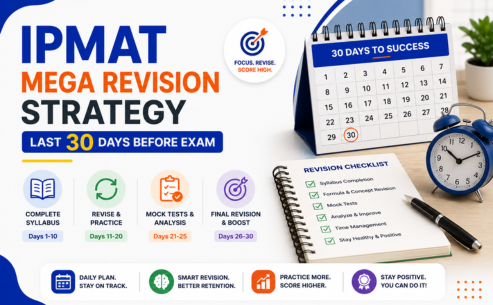
Introduction
Preparing for IPMAT is a long journey, but the final 30 days often determine whether a student secures admission to a top integrated program in management or falls short of the cutoff. Many aspirants spend months building concepts, solving questions, and taking mock tests. However, without a structured IPMAT revision strategy for 2028, even well-prepared students may struggle to perform at their best on exam day.
The last month before the examination is not the time to learn everything from scratch. Instead, it is the period to consolidate concepts, strengthen weak areas, improve speed and accuracy, and develop a confident test-taking approach.
This comprehensive guide presents an effective IPMAT last 30 days strategy, including a week-wise revision roadmap, mock test plan, daily study schedule, section-wise preparation methods, and common mistakes to avoid.
Why the Last 30 Days Matter for IPMAT
The final month before IPMAT is crucial because
- Most concepts have already been studied.
- Revision improves retention significantly.
- Regular mock tests reveal performance gaps.
- Time management skills can be perfected.
- Accuracy can be improved through targeted practice.
- Confidence grows through repeated exam simulation.
Students who utilize the last month effectively often improve their scores substantially compared to those who continue studying randomly.
Understanding the Goal of the Final 30 Days
Before creating an IPMAT preparation strategy, it is important to understand what should be achieved during this phase.
Primary Objectives
| Objective | Purpose |
| Concept Revision | Strengthen previously learned topics |
| Mock Tests | Improve exam temperament |
| Error Analysis | Eliminate recurring mistakes |
| Speed Building | Increase attempts without sacrificing accuracy |
| Time Management | Optimize section-wise performance |
| Confidence Enhancement | Reduce exam anxiety |
The focus should shift from learning to refining.
IPMAT Revision Strategy 2028: Week-Wise Plan
A structured revision schedule helps students cover the entire syllabus efficiently.
Week 1: Complete Syllabus Revision
Goals
- Revise all major concepts.
- Create short notes.
- Identify weak topics.
- Solve sectional questions.
Quantitative Aptitude Focus
Revise:
- Percentages
- Profit and Loss
- Ratio and Proportion
- Time and Work
- Time, Speed, and Distance
- Number System
- Algebra
- Geometry
- Arithmetic Applications
Verbal Ability Focus
Revise:
- Reading Comprehension
- Vocabulary
- Grammar Rules
- Sentence Correction
- Para Jumbles
- Critical Reasoning
Weekly Target
| Activity | Quantity |
| Sectional Tests | 6–8 |
| Practice Questions | 500+ |
| Mock Tests | 2 |
Week 2: Strengthening Weak Areas
After the first week, students generally know which topics require additional attention.
Identify Weaknesses
Create three categories:
| Category | Topics |
| Strong | High accuracy topics |
| Moderate | Average performance topics |
| Weak | Low accuracy topics |
Spend maximum effort on moderate and weak areas.
Recommended Approach
For Quantitative Aptitude
- Revisit formulas.
- Solve medium-level questions.
- Practice timer-based exercises.
For Verbal Ability
- Read editorials daily.
- Solve RC passages.
- Improve vocabulary retention.
Weekly Target
| Activity | Quantity |
| Mock Tests | 3 |
| RC Practice Sets | 15+ |
| Quant Questions | 400+ |
Week 3: Intensive Mock Test Phase
This is the most important stage of the IPMAT revision plan.
Mock Test Strategy
Attempt full-length mocks under actual exam conditions.
Rules
- No interruptions.
- Follow official time limits.
- Analyze immediately after completion.
Mock Analysis Framework
| Area | Questions to Ask |
| Accuracy | Which questions were incorrect? |
| Time Management | Which section consumed excess time? |
| Conceptual Errors | Why was the mistake made? |
| Guessing Errors | Was the attempt justified? |
| Question Selection | Did I choose the right questions? |
Weekly Target
| Activity | Quantity |
| Full-Length Mocks | 4–5 |
| Analysis Sessions | After Every Mock |
| Revision Hours | 2–3 Daily |
Week 4: Final Revision and Exam Readiness
The last week should focus entirely on reinforcement.
Priorities
- Formula revision
- Vocabulary revision
- Error notebook review
- Previous mock analysis
- Confidence building
Avoid extensive new learning.
Final Week Schedule
| Activity | Time |
| Formula Revision | Daily |
| Reading Practice | Daily |
| One Mock Every Alternate Day | Yes |
| Sleep Management | Essential |
| Stress Reduction | Essential |
Section-Wise IPMAT Preparation Strategy
Quantitative Aptitude Strategy
Quantitative aptitude often determines the final rank because many students struggle with sectional cutoffs.
High-Priority Topics
| Topic | Importance |
| Arithmetic | Very High |
| Algebra | Very High |
| Number System | High |
| Geometry | High |
| Modern Mathematics | Moderate |
| Data Interpretation | Moderate |
Revision Technique
For each chapter:
- Revise formulas.
- Solve easy questions.
- Solve medium questions.
- Attempt timed practice.
- Review mistakes.
Formula Revision Method
Maintain a separate formula notebook containing:
- Algebra formulas
- Geometry formulas
- Percentage shortcuts
- Probability formulas
- Permutation and combination concepts
Review this notebook daily.
Verbal Ability Strategy
Verbal Ability is often the score booster for well-prepared candidates.
Daily Verbal Routine
| Activity | Duration |
| Reading Comprehension | 45 Minutes |
| Vocabulary | 20 Minutes |
| Grammar Practice | 30 Minutes |
| Editorial Reading | 30 Minutes |
Reading Sources
Focus on:
- Business articles
- Current affairs
- Opinion pieces
- Educational content
This improves both reading speed and comprehension.
Reading Comprehension Revision Strategy
Reading comprehension contributes significantly to the verbal section.
Best Approach
Before reading:
- Identify passage type.
- Understand tone.
While reading:
- Focus on main idea.
- Mark keywords mentally.
After reading:
- Answer factual questions first.
- Attempt inference questions later.
Mock Test Strategy for the Last 30 Days
Mocks are the backbone of every successful IPMAT last 30 days strategy.
Recommended Number of Mock Tests
| Remaining Days | Number of Mocks |
| Days 30–21 | 2 |
| Days 20–14 | 3 |
| Days 13–7 | 4 |
| Days 6–1 | 2 |
Total Recommended Mocks
11–12 Full-Length Mock Tests
Quality matters more than quantity.
How to Analyze Mock Tests Properly
Many students take mocks but never analyze them effectively.
Three-Step Analysis
Step 1: Identify Wrong Answers
Categorize mistakes:
| Error Type | Meaning |
| Concept Error | Lack of understanding |
| Calculation Error | Careless mistake |
| Time Pressure Error | Rushed attempt |
| Guessing Error | Unnecessary risk |
Step 2: Maintain an Error Log
Create a notebook with:
Date, Topic, Error, Solution
Review this notebook every week.
Step 3: Reattempt Incorrect Questions
Solve all wrong questions without seeing solutions first.
This ensures genuine learning.
Time Management Strategy for IPMAT
Many students lose marks because of poor time allocation.
Ideal Exam Approach
Quantitative Aptitude
- Attempt easy questions first.
- Skip lengthy calculations initially.
- Return later if time permits.
Verbal Ability
- Focus on accuracy.
- Avoid spending excessive time on a single RC question.
Daily Study Schedule During the Last 30 Days
A balanced schedule prevents burnout.
Sample Daily Timetable
| Time | Activity |
| 6:30 AM – 7:00 AM | Wake Up & Planning |
| 7:00 AM – 8:30 AM | Quant Revision |
| 8:30 AM – 9:00 AM | Break |
| 9:00 AM – 10:30 AM | Verbal Practice |
| 10:30 AM – 11:00 AM | Vocabulary |
| 11:00 AM – 1:00 PM | Topic Revision |
| 1:00 PM – 2:00 PM | Lunch Break |
| 2:00 PM – 4:00 PM | Mock Test/Sectional Test |
| 4:00 PM – 5:00 PM | Mock Analysis |
| 5:00 PM – 6:00 PM | Break |
| 6:00 PM – 8:00 PM | Weak Area Practice |
| 8:00 PM onwards | Light Revision |
How to Improve Speed and Accuracy
Speed without accuracy is dangerous.
Accuracy without speed limits attempts to be perfect.
Both must improve together.
Techniques
Use timed practice.
Solve:
- 10 questions in 15 minutes
- 20 questions in 25 minutes
Avoid random guessing.
Guess only when
- At least two options are eliminated.
- Probability of success is reasonable.
Review Every Mistake
Mistakes repeated twice become habits.
Common Mistakes to Avoid During the Last Month
Learning Completely New Topics
Many students panic and start studying untouched chapters.
This often creates confusion and wastes valuable revision time.
Ignoring Mock Analysis
Taking mocks without analysis has limited value.
Analysis is where actual improvement happens.
Studying Excessive Hours
Quality matters more than quantity.
Ten focused hours are better than sixteen distracted hours.
Neglecting Sleep
Memory retention decreases significantly when sleep is compromised.
Aim for:
- 7–8 hours daily
Comparing Scores with Others
Every student progresses differently.
Focus on:
- Personal improvement
- Accuracy growth
- Sectional performance
Exam Week Preparation Tips
Three Days Before Exam
- Revise formulas.
- Revise vocabulary.
- Review error notebook.
- Avoid difficult practice sets.
One Day Before Exam
Do not attempt a full-length mock.
Instead:
- Read short notes.
- Stay relaxed.
- Prepare documents.
- Sleep early.
Exam Day Strategy
Before the Exam
- Reach early.
- Stay calm.
- Avoid discussing difficult topics.
During the Exam
- Focus on easy questions first.
- Maintain composure.
- Follow planned time allocation.
After the Exam
Avoid overthinking individual questions.
Final 30-Day Success Checklist
| Task | Status |
| Complete Syllabus Revision | ✓ |
| Formula Notebook Ready | ✓ |
| Vocabulary Notes Prepared | ✓ |
| Error Log Maintained | ✓ |
| 10–12 Mock Tests Attempted | ✓ |
| Weak Areas Revised | ✓ |
| Daily Reading Habit Maintained | ✓ |
| Sleep Schedule Fixed | ✓ |
Following this checklist ensures that students enter the examination hall fully prepared.
Conclusion
A well-structured IPMAT revision strategy for 2028 can significantly improve performance during the final month before the examination. The key is to prioritize revision over new learning, maintain a disciplined mock test schedule, analyze mistakes carefully, and focus on improving speed and accuracy. An effective IPMAT 30-day strategy combines concept reinforcement, regular testing, error correction, and mental preparation. Students who follow a systematic IPMAT revision plan during these crucial weeks are far more likely to maximize their score and secure admission to their preferred management program.
FAQs
1. What should students focus on during the last 30 days?
Students should focus on revision, mock tests, formula review, error analysis, and strengthening weak areas rather than learning entirely new topics.
2. How many mock tests should be attempted?
Most students should aim for approximately 10–12 full-length mock tests during the final 30 days, along with detailed analysis of each test.
3. Which topics should be prioritized for revision?
Arithmetic, Algebra, Number System, Geometry, Reading Comprehension, Grammar, Vocabulary, and Logical Reasoning should receive maximum attention.
4. How much time should be spent on Quantitative Aptitude?
Students can dedicate around 40–50% of their daily study time to quantitative aptitude, depending on their strengths and weaknesses.
5. How should Verbal Ability be revised?
Verbal ability revision should include daily reading comprehension practice, vocabulary revision, grammar exercises, and editorial reading to improve comprehension speed.
6. Is it advisable to learn new topics during the final month?
Generally, no. The final month should focus on revising familiar topics and strengthening existing knowledge rather than learning entirely new concepts.
7. How can students improve speed and accuracy?
Timed practice sessions, regular mock tests, mistake analysis, and smart question selection can significantly improve both speed and accuracy.
8. What mistakes should be avoided in the last month?
Students should avoid excessive experimentation, neglecting mock analysis, comparing scores with others, sacrificing sleep, and studying new difficult topics.
9. How should students balance revision and mock tests?
A balanced approach includes regular topic revision during weekdays and periodic full-length mock tests with detailed analysis sessions.
10. What is the ideal daily study schedule before IPMAT?
An ideal schedule includes quantitative aptitude practice, verbal ability revision, topic-wise review, mock tests, error analysis, and adequate breaks with 7–8 hours of sleep.