Introduction
The IPMAT Question Paper 2029 is expected to follow a pattern similar to recent examinations, making it crucial for aspirants to understand the expected structure, topic-wise weightage, and overall IPMAT difficulty level before starting their preparation.
A detailed IPMAT paper analysis helps students identify high-scoring areas, anticipate challenging sections, and develop an effective exam strategy. By studying previous trends, candidates can gain valuable insights into the likely question distribution and prepare more confidently for the IPMAT 2029 examination.
IPMAT Question Paper 2029 Overview
The IPMAT Question Paper 2029 is expected to assess candidates on two critical areas: Quantitative Ability and Verbal Ability. Based on recent trends, the examination is likely to consist of three sections with separate sectional time limits and cut-offs.
The exam evaluates mathematical aptitude, logical thinking, language proficiency, and problem-solving skills. Understanding the exam structure is the first step toward effective preparation and accurate IPMAT paper analysis.
Candidates should familiarize themselves with the expected pattern to improve time management and maximize their performance in the actual examination.
Expected IPMAT 2029 Exam Pattern
| Section | Expected Questions | Time Limit | Marks |
| Quantitative Ability (SA) | 15 | 40 Minutes | 60 |
| Quantitative Ability (MCQ) | 30 | 40 Minutes | 120 |
| Verbal Ability | 45 | 40 Minutes | 180 |
| Total | 90 | 120 Minutes | 360 |
Marking Scheme
| Response Type | Marks |
| Correct Answer | +4 |
| Incorrect MCQ Answer | -1 |
| Incorrect SA Answer | No Negative Marking |
The overall structure indicates that Verbal Ability carries the highest weightage, while Quantitative Ability contributes significantly to determining the final score and sectional qualification.
IPMAT Difficulty Level 2029 – Expected Analysis
The overall IPMAT difficulty level for 2029 is expected to remain Moderate to Difficult, following the trend observed in recent years. While the examination is designed to test aptitude rather than advanced academic knowledge, the level of competition and sectional cut-offs make it a challenging entrance test for management aspirants.
According to previous IPMAT paper analysis, Quantitative Ability—especially the MCQ section—has consistently been the most demanding part of the exam, with nearly 40–50% of questions requiring strong conceptual clarity and problem-solving skills. On the other hand, Verbal Ability has traditionally been the most scoring section, with a majority of questions falling in the easy-to-moderate range.
Expected Difficulty Level of IPMAT Question Paper 2029
| Section | Expected Difficulty Level |
| Quantitative Ability (MCQ) | Moderate to High |
| Quantitative Ability (SA) | Moderate |
| Verbal Ability | Easy to Moderate |
| Overall Paper | Moderate to Difficult |
Aspirants should note that the IPMAT Question Paper 2029 is likely to reward students who maintain a balance between speed, accuracy, and sectional performance. Strong preparation in Algebra, Arithmetic, Reading Comprehension, and contextual vocabulary can significantly improve overall scores and help clear sectional cut-offs.
Section-Wise Question Distribution in IPMAT Question Paper 2029
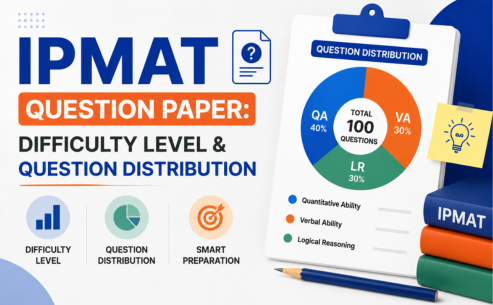
A detailed understanding of the IPMAT Question Paper 2029 can help aspirants prioritize topics and allocate preparation time more effectively. Based on recent exam trends and previous IPMAT paper analysis, the examination is expected to maintain a balanced distribution between Quantitative Ability and Verbal Ability.
While Verbal Ability contributes the highest number of questions and marks, Quantitative Ability remains the deciding factor for many candidates due to its higher IPMAT difficulty level.
Expected Section-Wise Question Distribution in IPMAT 2029
| Section | Expected Questions | Weightage | Expected Difficulty |
| Quantitative Ability (MCQ) | 30 | 33.3% | Moderate to High |
| Quantitative Ability (SA) | 15 | 16.7% | Moderate |
| Verbal Ability | 45 | 50.0% | Easy to Moderate |
| Total | 90 | 100% | Moderate to Difficult |
Section-Wise Contribution to the Exam
| Section | Key Focus Areas |
| Quantitative Ability (MCQ) | Algebra, Arithmetic, Number Systems, Geometry, DI |
| Quantitative Ability (SA) | Logarithms, Sequences & Series, Probability, Statistics |
| Verbal Ability | Reading Comprehension, Fill in the Blanks, Para Jumbles, Sentence Completion |
The table clearly shows that Verbal Ability accounts for nearly half of the paper, making it the most scoring section. However, students cannot ignore Quantitative Ability, as both QA sections collectively contribute 50% of the examination and typically determine overall percentile and sectional cut-off performance. A smart preparation strategy should therefore balance accuracy in Verbal Ability with conceptual mastery in Quantitative Aptitude.
Quantitative Ability MCQ Analysis
The Quantitative Ability MCQ section is expected to be the most challenging part of the IPMAT Question Paper 2029. According to previous IPMAT paper analysis, nearly 40–50% of the questions in this section are moderate to difficult and require strong conceptual understanding along with effective time management.
Since candidates have limited time to solve these questions, accuracy becomes just as important as speed. Historically, Algebra, Arithmetic, and Data Interpretation have dominated this section, collectively contributing more than half of the questions asked.
Expected Topic-Wise Distribution in Quantitative Ability (MCQ)
| Topic | Expected Questions |
| Arithmetic | 7-8 |
| Algebra | 7-8 |
| Data Interpretation | 2-3 |
| Number Systems | 3-4 |
| Geometry & Mensuration | 3-4 |
| Permutation & Combination | 2-3 |
| Sets & Venn Diagrams | 1-2 |
| Matrices & Miscellaneous | 1-2 |
Key Insights from IPMAT Paper Analysis
| Observation | Expected Trend |
| Most Important Topics | Algebra, Arithmetic, DI |
| Difficulty Level | Moderate to High |
| Good Attempt | 65-70% Questions |
| Accuracy Target | 85%+ |
Students preparing for the IPMAT Question Paper 2029 should prioritize Algebra and Arithmetic during the initial stages of preparation, as these topics consistently form the backbone of the Quantitative Ability section. Regular mock tests and sectional practice can significantly improve performance in this high-impact area.
Quantitative Ability Short Answer (SA) Analysis
The Quantitative Ability Short Answer (SA) section plays a crucial role in the IPMAT Question Paper 2029. Unlike the MCQ section, candidates must enter the exact answer without the support of answer choices. One major advantage, however, is the absence of negative marking, allowing students to attempt more questions confidently.
Based on previous IPMAT paper analysis, this section is generally moderate in difficulty, although nearly 20–30% of the questions can be conceptually tricky and calculation-intensive.
Expected Topic-Wise Distribution in Quantitative Ability (SA)
| Topic | Expected Questions |
| Logarithms | 3-4 |
| Sequences & Series | 2-3 |
| Arithmetic Progression | 2-3 |
| Geometry & Mensuration | 2-3 |
| Probability | 2-3 |
| Statistics | 1-2 |
Key Insights from IPMAT Paper Analysis
| Observation | Expected Trend |
| Difficulty Level | Moderate |
| Tricky Questions | 20-30% |
| Good Attempt | 70-80% Questions |
| Accuracy Target | 80%+ |
Historical trends indicate that Logarithms, Sequences & Series, Probability, and Geometry frequently appear in this section, making them essential topics for IPMAT aspirants. Students aiming for a high score in the IPMAT Question Paper 2029 should focus on strengthening conceptual understanding and improving calculation speed through regular practice.
Verbal Ability Analysis
The Verbal Ability section is expected to be the most scoring component of the IPMAT Question Paper 2029. Unlike traditional English examinations that focus heavily on direct vocabulary-based questions, IPMAT typically evaluates a candidate’s comprehension, contextual understanding, grammar application, and logical interpretation of language.
According to previous IPMAT paper analysis, nearly 80% of the questions in this section are easy to moderate in difficulty, making it an excellent opportunity for students to maximize their scores. Strong reading habits and consistent practice can significantly improve performance in this section.
Expected Topic-Wise Distribution in Verbal Ability
| Topic | Expected Questions |
| Reading Comprehension | 12-15 |
| Fill in the Blanks | 8-10 |
| Sentence Completion | 6-8 |
| Para Jumbles | 4-6 |
| Contextual Vocabulary | 4-5 |
| Grammar & Usage | 4-5 |
Key Insights from IPMAT Paper Analysis
| Observation | Expected Trend |
| Difficulty Level | Easy to Moderate |
| Most Important Areas | RC & Fill in the Blanks |
| Weightage of RC + FIB | 50-55% |
| Accuracy Target | 90%+ |
| Good Attempt | 85-90% Questions |
Previous trends suggest that Reading Comprehension and Fill in the Blanks together account for nearly 50–55% of the section. Therefore, students preparing for the IPMAT Question Paper 2029 should focus on improving reading speed, comprehension accuracy, and contextual vocabulary to gain a competitive advantage.
Good Attempts & Score Expectations for IPMAT 2029
While the actual cut-offs for the IPMAT Question Paper 2029 will depend on the overall IPMAT difficulty level, candidates should focus on maximizing accuracy rather than attempting every question. Based on previous IPMAT paper analysis, a balanced attempt strategy across all three sections can significantly improve the chances of clearing sectional as well as overall cut-offs.
Expected Good Attempts for IPMAT 2029
| Section | Total Questions | Good Attempts | Target Accuracy |
| Quantitative Ability (MCQ) | 30 | 20-22 | 85%+ |
| Quantitative Ability (SA) | 15 | 10-12 | 80%+ |
| Verbal Ability | 45 | 38-40 | 90%+ |
Expected Performance Benchmarks
| Performance Level | Attempt Strategy |
| Excellent | High attempts with strong accuracy across all sections |
| Good | Focus on strengths while clearing sectional cut-offs |
| Safe | Prioritize accuracy over aggressive attempts |
Students preparing for the IPMAT Question Paper 2029 should remember that a high score is often achieved through smart question selection, effective time management, and maintaining accuracy throughout the examination rather than simply attempting the maximum number of questions.
How to Prepare Based on the IPMAT Paper Analysis
A thorough understanding of the IPMAT Question Paper 2029 can help students create a focused and result-oriented preparation strategy. Since previous IPMAT paper analysis indicates that Quantitative Ability is generally the most challenging section while Verbal Ability offers the highest scoring potential, aspirants should adopt a balanced preparation approach.
Consistent practice, regular revision, and mock test analysis are essential for improving both speed and accuracy. Rather than studying every topic equally, students should prioritize IPMAT Previous year question .
Preparation Strategy for IPMAT 2029
| Preparation Area | Recommended Approach |
| Algebra & Arithmetic | Build strong fundamentals and practice daily |
| Reading Comprehension | Read editorials, articles, and business newspapers |
| Mock Tests | Attempt full-length mocks regularly |
| Previous Year Papers | Analyze question patterns and recurring topics |
| Sectional Tests | Improve sectional speed and accuracy |
| Revision | Maintain short notes and formula sheets |
Key Preparation Tips
- Prioritize Algebra, Arithmetic, and Reading Comprehension.
- Focus on clearing sectional cut-offs alongside maximizing overall scores.
- Analyze every mock test to identify weak areas.
- Improve calculation speed for Quantitative Ability.
- Develop a daily reading habit to strengthen Verbal Ability.
By aligning preparation with the expected IPMAT difficulty level and question distribution, aspirants can improve their performance and approach the IPMAT Question Paper 2029 with greater confidence and accuracy.
Prepare for IPMAT 2029 with Tarkashastra
Cracking the IPMAT Question Paper 2029 requires more than just completing the syllabus. Students need a structured preparation plan, expert mentorship, regular mock tests, and continuous performance evaluation to stay ahead of the competition. Since the IPMAT difficulty level is expected to remain moderate to difficult, guided preparation can significantly improve both accuracy and confidence.
At Tarkashastra, students receive comprehensive support through concept-focused learning, sectional practice tests, full-length mock examinations, and detailed IPMAT paper analysis sessions with Important questions. The program is designed to help aspirants strengthen their Quantitative Ability, Verbal Ability, and test-taking strategy while tracking their progress through personalized performance reviews.
Why Choose Tarkashastra for IPMAT Preparation?
| Feature | Benefit |
| Live Interactive Classes | Learn concepts from experienced mentors |
| Comprehensive Study Material | Cover the complete IPMAT syllabus systematically |
| Full-Length Mock Tests | Simulate actual exam conditions |
| Sectional Tests & Analysis | Improve speed and accuracy topic-wise |
| Previous Year Paper Discussions | Understand recurring patterns and trends |
| Personalized Mentorship | Get guidance tailored to your strengths and weaknesses |
Whether you are just beginning your preparation or looking to improve your score, Tarkashastra’s dedicated IPMAT coaching programs can help you approach the IPMAT Question Paper 2029 with a clear strategy and greater confidence.
Conclusion
The IPMAT Question Paper 2029 is expected to maintain a moderate to difficult IPMAT difficulty level, with Quantitative Ability remaining the most challenging section and Verbal Ability continuing to be the most scoring. A careful IPMAT paper analysis reveals that topics such as Algebra, Arithmetic, Reading Comprehension, and Fill in the Blanks are likely to play a crucial role in determining performance. By focusing on high-weightage topics, practicing mock tests regularly, and following a structured preparation plan, aspirants can significantly improve their chances of securing admission to their dream IPM program.
FAQs
1. What is the expected difficulty level of IPMAT 2029?
The IPMAT 2029 exam is expected to have a moderate to difficult difficulty level, with Quantitative Ability being more challenging than Verbal Ability.
2. How many questions are expected in IPMAT 2029?
IPMAT 2029 is expected to have around 90 questions distributed across Quantitative Ability (MCQ), Quantitative Ability (SA), and Verbal Ability sections.
3. Which section is usually the toughest?
The Quantitative Ability MCQ section is generally considered the toughest due to its conceptual and calculation-intensive questions.
4. What is the question distribution by section?
The expected distribution is 30 Quantitative Ability MCQs, 15 Quantitative Ability Short Answer questions, and 45 Verbal Ability questions.
5. Has the pattern changed recently?
No major changes have been observed in recent years. The exam pattern has remained largely consistent with three sections and sectional time limits.
6. What are the high-weightage topics?
Algebra, Arithmetic, Data Interpretation, Reading Comprehension, Fill in the Blanks, and Logarithms are among the most important topics.
7. How should students attempt the paper?
Students should focus on accuracy first, attempt easier questions early, and manage time effectively across all sections.
8. What is a good number of attempts?
A good attempt is generally 20–22 questions in QA MCQ, 10–12 in QA SA, and 38–40 in Verbal Ability with high accuracy.
9. How does IPMAT 2029 compare with previous years?
IPMAT 2029 is expected to follow a similar pattern and difficulty level as recent years, with only minor variations in topic weightage.
10. What surprises can students expect?
Students may encounter a few unconventional questions, especially in Quantitative Ability and Reading Comprehension, requiring strong conceptual understanding and adaptability.